

On this page
- Key Takeaways
- How Does Staff Churn Increase the Hidden Total Cost of Ownership in BPO Contracts?
- What Operational Metrics Suffer Most When Turnover Spikes in Offshore Operations?
- Why Do Certain BPO Providers in the Philippines Experience Significantly Lower Attrition?
- What Does Stabilizing Retention to Protect Margin Look Like in Practice?
- How Does PITON-Global Mitigate Attrition Risk for Enterprise Buyers?
- Frequently Asked Questions
High employee attrition in Philippine BPO operations inflates Total Cost of Ownership well above baseline contract rates through recurring recruitment, continuous onboarding, quality degradation, and lost domain expertise. Nominal hourly rates in Manila and Cebu remain far below onshore alternatives, but unmanaged turnover erodes net savings, which puts agent retention and workforce stability in the Philippines at the center of the business case. Partnering with providers that execute tier-one retention strategies preserves planned margins.
Key Takeaways
- Hidden financial leakage: Staff churn shifts costs from predictable invoice rates to variable operational overhead, including candidate sourcing, statutory night-differential pay adjustments during training, and heavy supervisory intervention.
- Service quality erosion: High turnover triggers a marked drop in First Contact Resolution and inflates Average Handle Time as junior agents repeatedly replace experienced staff.
- The low-rate trap and retention benchmarks: Selecting a vendor solely on bottom-tier hourly rates often produces the highest net unit cost, while elite Philippine providers hold annual turnover to a fraction of the rate seen at unmanaged commodity call centers.
- Contractual risk mitigation: Structuring Master Services Agreements with retention-linked Service Level Agreements directly protects financial yield and account stability.
How Does Staff Churn Increase the Hidden Total Cost of Ownership in BPO Contracts?
Entry-level Philippine rates look cost-effective against onshore wages, but turnover acts as an operational tax: every departure triggers recruiting, background checks, hardware provisioning, and multi-week DOLE-governed training, followed by a 60–90 day ramp-to-proficiency dip. Low-attrition providers run only slightly above contract rate; high-attrition providers run far above it.
While entry-level hourly contract rates in the Philippines appear cost-effective—a fraction of onshore wage levels—headline pricing masks the true financial baseline. High turnover acts as an operational tax on offshore delivery models: every time a trained agent leaves an account, the business absorbs direct costs for recruiting, background checks, hardware provisioning, and intensive multi-week training modules governed by Department of Labor and Employment (DOLE) standards. The chart below shows how the invoice rate and the attrition-adjusted cost diverge as turnover rises.
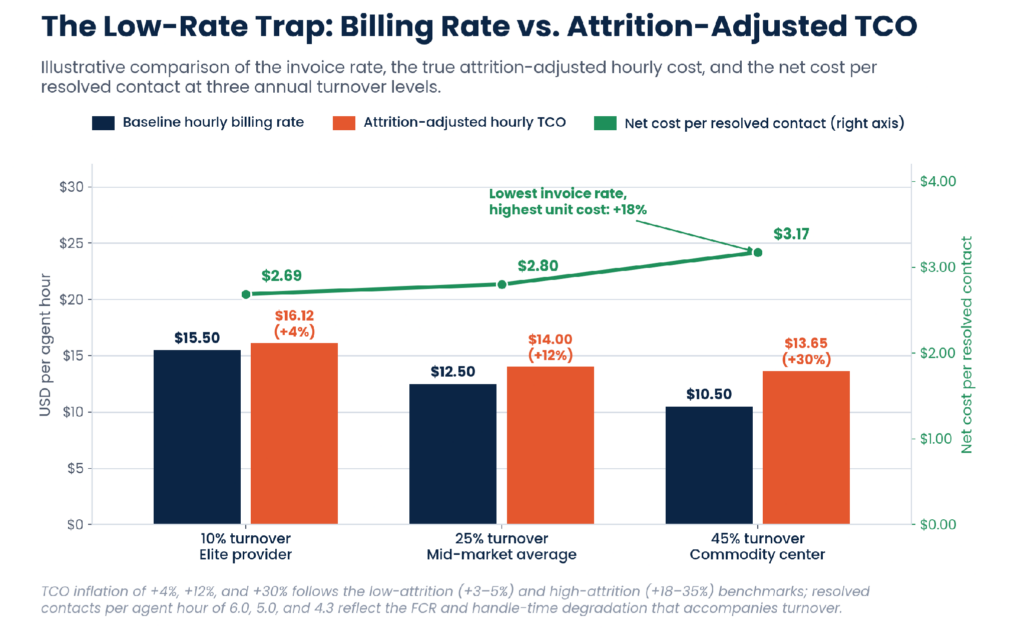
Figure 1. Baseline hourly billing rate versus attrition-adjusted TCO and net cost per resolved contact at low, moderate, and high annual turnover (illustrative).
During an agent’s initial 60 to 90 days on the floor—the ramp-to-proficiency phase—productivity dips while transactional error rates rise. This adjustment window requires higher supervisor-to-agent ratios and constant quality assurance monitoring, driving up indirect management costs. The table below contrasts the cost vectors of a low-attrition provider with those of a high-attrition provider.
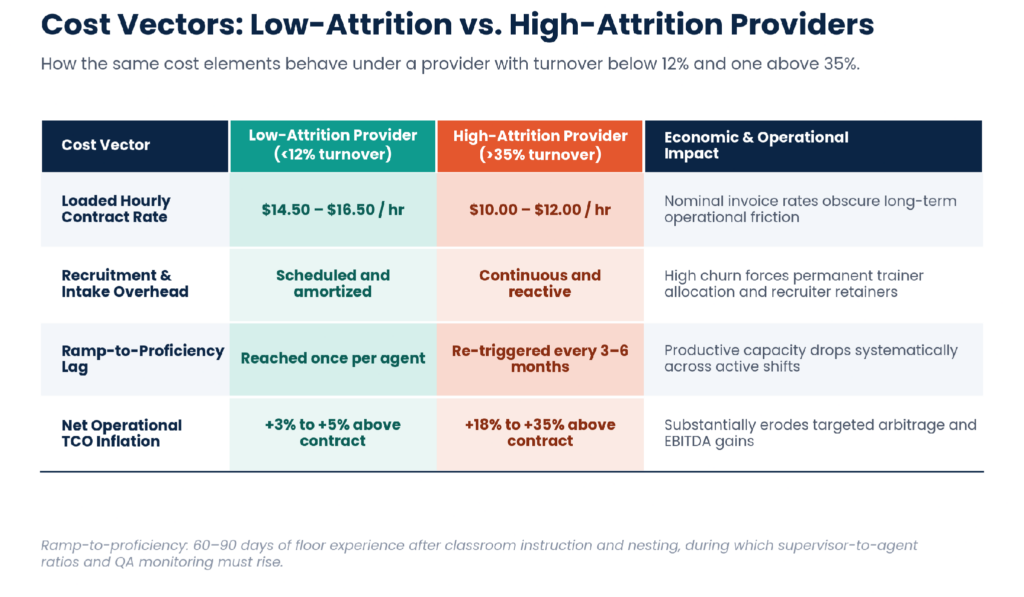
Figure 2. Financial and operational cost vectors: low-attrition provider versus high-attrition provider, with economic and operational impact.
What Operational Metrics Suffer Most When Turnover Spikes in Offshore Operations?
Workforce volatility damages key performance indicators before losses reach the accounts: replacement staff push repeat contacts up sharply as First Contact Resolution falls, Average Handle Time rises with unfamiliar toolstacks, Customer Effort Score and CSAT decline as escalations increase, and turnover raises compliance and data security exposure across access governance, PCI DSS, and SOC 2 Type II protocols.
Tenured agents possess contextual domain knowledge, customer empathy, and system navigation speed that static knowledge bases cannot quickly replicate. Replacements are rarely hard to find, given the depth of the country’s agent pipeline; what cannot be hired is tenure. When they leave, the damage propagates through the operation in a predictable sequence, shown below, and it feeds back on itself: the supervisors who absorb the load are the next people to burn out.
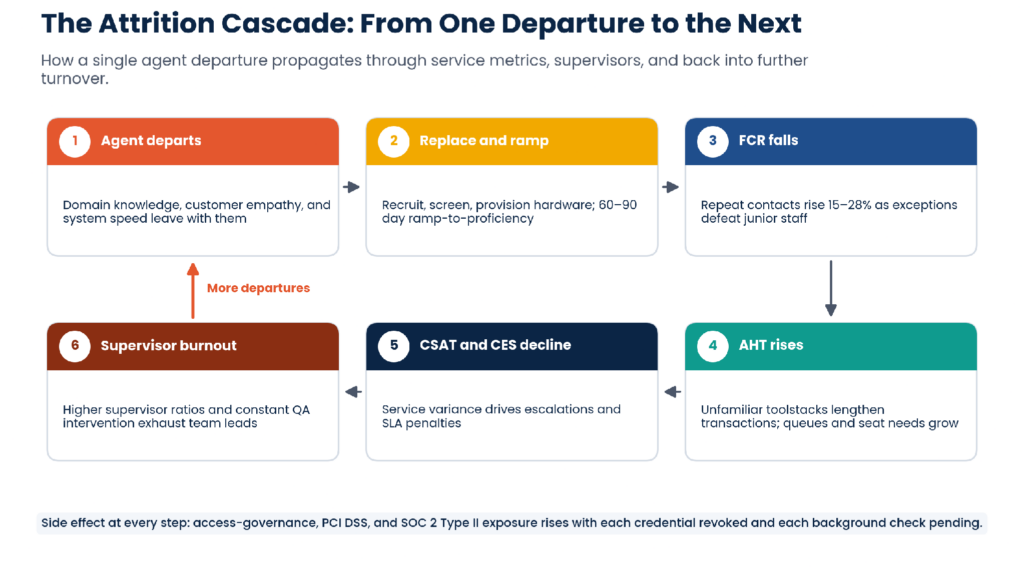
Figure 3. How a single agent departure cascades into lower FCR, elevated handle times, CSAT decline, and manager burnout—and back into further attrition.
First Contact Resolution (FCR)
Inexperienced replacement staff struggle with complex workflow exceptions, causing customer repeat contacts to rise. Each repeat contact is a second cost for the same problem, which is why FCR is the earliest and most reliable financial signal of attrition.
Average Handle Time (AHT)
Unfamiliarity with software toolstacks and complex CRM workflows increases transaction times, escalating queuing delays and staffing requirements. A team that needs more handle time needs proportionally more seats to hold the same service level.
Customer Effort Score (CES) and CSAT
High agent turnover generates service variance, causing customer satisfaction scores to decline as escalations become frequent. Variance, not just average performance, is what customers notice—and what triggers SLA penalties.
Compliance and Data Security Risk
Rapid workforce turnover increases risk exposure around access governance, PCI DSS compliance, and adherence to SOC 2 Type II operational protocols. Every departure is a credential to revoke and every hire a background check to complete; at commodity-tier turnover, access hygiene becomes a full-time job.
Why Do Certain BPO Providers in the Philippines Experience Significantly Lower Attrition?
The Philippine outsourcing ecosystem splits into operational tiers. Legacy commodity providers trade volume for thin margins and high attrition; premier mid-market and enterprise partners hold turnover far lower through four practices: competitive total compensation with day-one HMO coverage and above-statutory night differentials, defined career pathways, modern work infrastructure, and cultural alignment built on servant leadership and recognition.
While legacy commodity providers trade volume for low margins, premier mid-market and enterprise BPO partners invest heavily in workforce retention. High-retention providers maintain operational stability through four primary practices, and the quadrant below shows why buyers should look for them in the upper right rather than the lower left of the market.
Competitive Total Compensation
Performance-linked bonuses, comprehensive HMO health coverage including dependents from day one, and night-shift differential pay that exceeds the statutory minimum. Compensation that clears the local market removes the single most common reason an agent takes a call from a recruiter.
Defined Career Pathways
Internal mobility programs, backed by structured upskilling on the contact center floor, that transition top-performing agents into QA, workforce management, team leadership, and process optimization roles. A visible path out of the frontline keeps the best people on the account long enough to become its institutional memory.
Modern Work Infrastructure
Enterprise-grade ergonomic workstations, high-speed redundant connectivity, transport shuttle support, and hybrid work allowances supported by disciplined remote workforce management. Infrastructure signals how a provider values its people, and night-shift agents notice it every day.
Cultural Alignment and Engagement
Servant leadership models and employee recognition programs that resonate with local workplace values. Frontline leadership quality is the variable most buyers never audit and the one most closely correlated with retention.
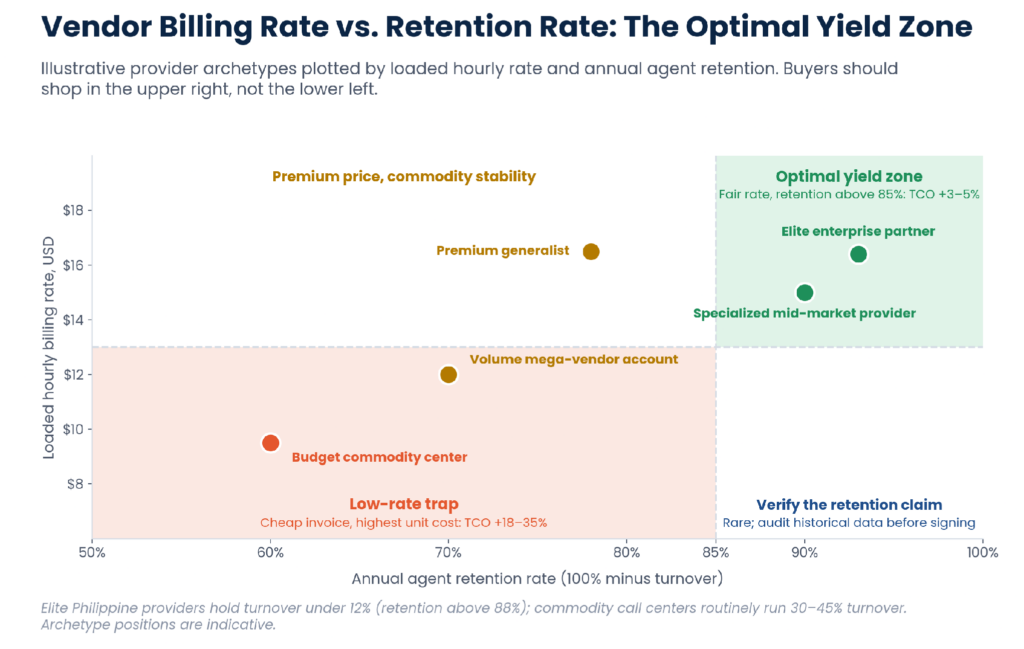
Figure 4. Strategic quadrant matrix: vendor billing rate against annual retention rate, with the optimal yield zone for enterprise buyers (illustrative provider archetypes).
Focusing solely on low hourly billing rates when selecting a Philippine BPO partner creates a false sense of economy. Unmanaged agent turnover introduces hidden operational friction that degrades customer experience and drives up total cost. Long-term outsourcing success requires partnering with providers that invest in their talent to deliver stable, high-performing teams.
— John Maczynski, CEO, PITON-Global
What Does Stabilizing Retention to Protect Margin Look Like in Practice?
Stabilizing retention protects margin even when the hourly rate rises. A North American fintech migrated its 120-FTE operation from a budget Manila call center with chronic turnover to a specialized mid-tier provider with retention-linked SLAs, cutting annualized attrition sharply, lifting First Contact Resolution, and reducing total cost of ownership despite a higher baseline rate.
Client Challenge
A rapidly scaling North American fintech platform experienced severe annual agent turnover with a budget call center in Manila. The resulting drop in First Contact Resolution triggered contractual SLA penalties and inflated onboarding expense, so the low invoice rate was producing the highest net unit cost in the company’s support operation.
Vendor Selection
PITON-Global audited the account dynamics, identified root-cause compensation and leadership mismatches, and conducted a targeted vendor selection across its network of more than 100 vetted Philippine providers, scoring candidates on verified historical retention rather than headline rate.
Solution Implemented
The client migrated its 120-FTE operation to a specialized mid-tier BPO provider offering retention-linked SLAs, dedicated career progression tracks, and modern agent management tools, accepting a baseline hourly rate noticeably higher than the incumbent’s.

Figure 5. Quantifiable outcomes of the fintech platform’s migration to a retention-focused provider.
Outcomes and Lessons
Annualized attrition fell to a fraction of its former level, First Contact Resolution increased materially, and total cost of ownership dropped overall—despite a higher baseline hourly rate. The lesson: baseline contract pricing is a poor predictor of total cost; operational stability and agent retention are the true drivers of outsourcing yield.
How Does PITON-Global Mitigate Attrition Risk for Enterprise Buyers?
PITON-Global is a specialized BPO advisory and vendor-matching firm dedicated to Philippine outsourcing. Unlike traditional brokers, it conducts rigorous operational audits across a curated network of more than 100 vetted providers, evaluating proven performance, verified historical retention rates, leadership quality, infrastructure, and ISO 27001, SOC 2, and PCI DSS compliance, then matches clients on culture, scale, and operational focus.
Who Is PITON-Global?
PITON-Global is a specialized, vendor-neutral BPO advisory and vendor-matching firm headquartered in Manila, dedicated to Philippine outsourcing initiatives and led by senior operators with more than 65 combined years of global outsourcing governance. Its particular expertise is the human-capital variable—retention, leadership, and culture—that determines whether a contract’s headline savings survive contact with the floor.
How Does PITON-Global Differ from Traditional Outsourcing Brokers?
Traditional brokers rely on self-reported vendor claims and earn commissions on placement. PITON-Global conducts rigorous operational audits, evaluates candidate providers on proven operational performance, verified historical retention rates, leadership quality, physical and technical infrastructure, and international compliance standards, and recommends on the buyer’s outcomes rather than provider promotion—staying engaged through contracting and ongoing oversight.
How Does PITON-Global’s Network of 100+ Vetted Philippine BPO Providers Benefit Organizations?
A curated network of more than 100 vetted contact center and back-office providers across the Philippines lets buyers compare operators on the metric that predicts total cost: verified retention. Because each provider’s attrition history, leadership stability, and compliance posture have already been audited, buyers avoid the commodity tier where high turnover is the norm.
How Does PITON-Global’s Advisory-Led Vendor Matching Process Work?
PITON-Global’s advisory model runs in four stages: an operational audit of the buyer’s current account dynamics and root causes; talent and culture matching against the vetted network on retention, leadership, scale, and operational focus; risk-mitigated contracting with retention-linked SLAs, capped training hours for replacements, and key-person clauses; and ongoing oversight of retention and performance metrics after go-live.
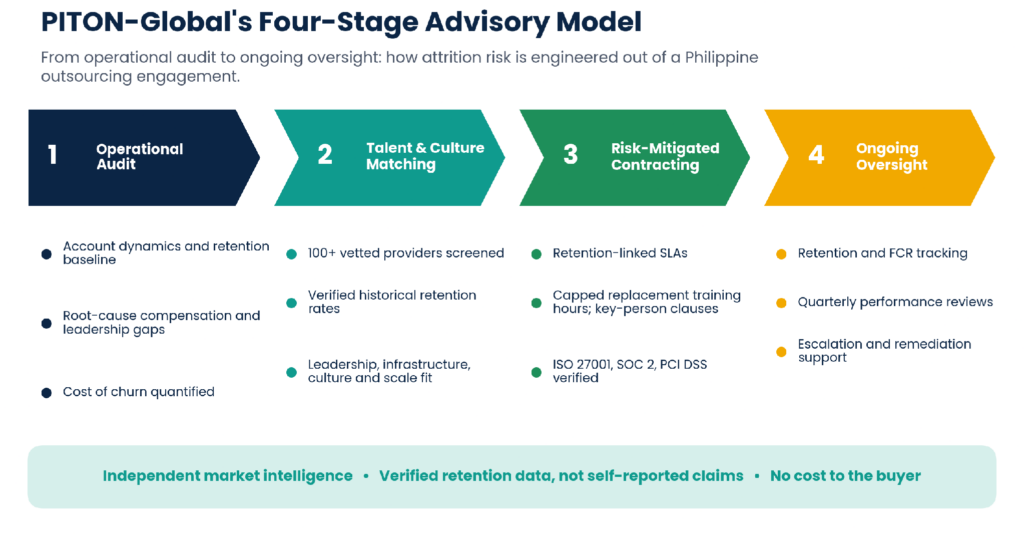
Figure 6. PITON-Global’s four-stage advisory model: operational audit, talent and culture matching, risk-mitigated contracting, and ongoing oversight.
Why Do Organizations Use PITON-Global?
Organizations use PITON-Global to eliminate vendor selection risk, prevent costly execution mistakes, and secure long-term outsourcing performance. Because it provides independent market intelligence at no cost to the buyer, it replaces self-reported RFP claims with verified retention data at the point where the low-rate trap is most tempting.
Frequently Asked Questions
What is considered a healthy annual attrition rate for BPO providers in the Philippines?
Top-tier workforce retention in the Philippine BPO market means annual turnover well below the broader industry average, which runs several times higher in the commodity tier. That gap makes provider evaluation essential to cost control.
How can enterprise buyers contractually protect themselves against vendor turnover?
Buyers can structure Master Services Agreements with retention-linked financial SLAs, cap billable training hours for replacement personnel, and mandate key-person retention clauses for management and specialized roles.
Does paying higher contract rates guarantee lower agent attrition?
Not automatically. While competitive compensation is foundational, retention is equally driven by frontline leadership quality, internal career paths, modern equipment, and workplace culture.
Are back-office and non-voice operations impacted by attrition as much as voice support?
Yes. Although non-voice roles often show slightly lower baseline turnover than high-volume voice channels, the complex domain knowledge required for back-office processing makes turnover equally costly in error rates and retraining.
How long does it take for a newly hired offshore agent to reach full productivity?
For complex customer support or financial back-office workflows, full proficiency typically requires 60 to 90 days of floor experience following formal classroom instruction and nesting.
Why should buyers work with an advisory firm like PITON-Global instead of issuing a direct RFP?
Direct RFPs rely on self-reported vendor claims. PITON-Global provides independent market intelligence, evaluating historical retention data, operational health, and workplace culture across more than 100 vetted providers to match buyers with the right partner.