

On this page
- Key Takeaways
- Why Does Nominal Hourly Billing Rate Fail as a Benchmark for Offshore Efficiency?
- What Mathematical Framework Converts Raw BPO Billing Rates into Productivity-Adjusted Unit Costs?
- How Do Regional Wage Arbitrage and BPO Tiers Influence Productive Yield Across the Philippines?
- What Does Optimizing Unit Cost Economics Look Like in Practice?
- How Does PITON-Global Help Enterprise Buyers Select on Yield Rather Than Rate?
- Frequently Asked Questions
Companies should evaluate Philippine BPO services on Productivity-Adjusted Labor Cost: fully loaded hourly expense divided by a productivity yield combining First Contact Resolution, Average Handle Time, and rework rates. Judging quotes on nominal billing rates alone creates a false economy; factoring in ramp curves and net yield shows high-performing providers deliver a markedly lower cost per productive transaction. Modeling coverage hours and headcount against a fully loaded rate is the right first step; adjusting that rate for yield is the second.
Key Takeaways
- Nominal vs. real arbitrage: Fully loaded hourly billing rates mask baseline efficiency variances; true economic yield is measured at the output unit level, not the billable hour.
- The ramp-to-proficiency tax: Inexperienced or poorly retained offshore teams incur continuous training lag, effectively inflating real operational costs well beyond the quoted rate.
- The PACT framework: Evaluating vendors requires weighting throughput velocity (AHT, speed to resolve) against qualitative outputs (FCR, accuracy, rework rates) through the Productivity-Adjusted Cost per Transaction formula.
- Geographic tiers and advisory-led selection: Capabilities and labor costs vary across Metro Manila, Metro Cebu, and Next-Wave Digital Cities such as Iloilo, Clark, and Davao, and vendor-neutral oversight mitigates the risk of low-cost providers that erode margins through hidden transactional friction.
Why Does Nominal Hourly Billing Rate Fail as a Benchmark for Offshore Efficiency?
Nominal offshore billing rates set against onshore rates assume equal output velocity and quality, which rarely holds. When a team takes twice as long to process a claim or fails to resolve on first contact, savings evaporate as supervisor ratios, client oversight, and license redundancies escalate; a high-yield provider’s real cost per resolved case runs materially lower.
Relying on raw invoice billing rates as a primary procurement metric creates structural financial misalignments. In the Philippine BPO sector, baseline entry rates for customer experience, back-office data operations, and specialized technical functions vary with technical requirements, compliance level, and location, while onshore alternatives in North America or Western Europe routinely cost several times as much. Comparing these figures directly assumes equal output velocity and quality — the same trap our analysis of how offshoring changes cost per contact warns against. The chart below shows what happens to the comparison once productivity is priced in.
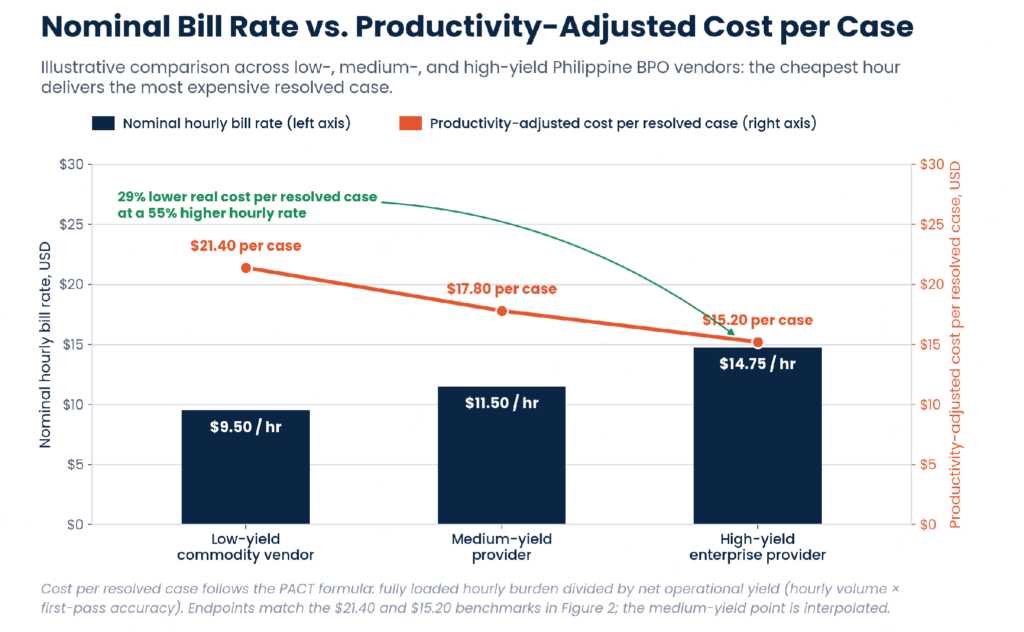
Figure 1. Nominal hourly bill rate versus productivity-adjusted cost per resolved case across low-, medium-, and high-yield vendors (illustrative).
When an offshore team requires twice as long to process a back-office claim or fails to resolve a customer inquiry on first contact, nominal cost savings evaporate. Operational overhead—supervisor-to-agent ratios, client-side oversight management, quality monitoring, and software license redundancies—escalates rapidly. The table below sets a commodity low-cost vendor against an enterprise high-yield provider on the dimensions that determine real cost.
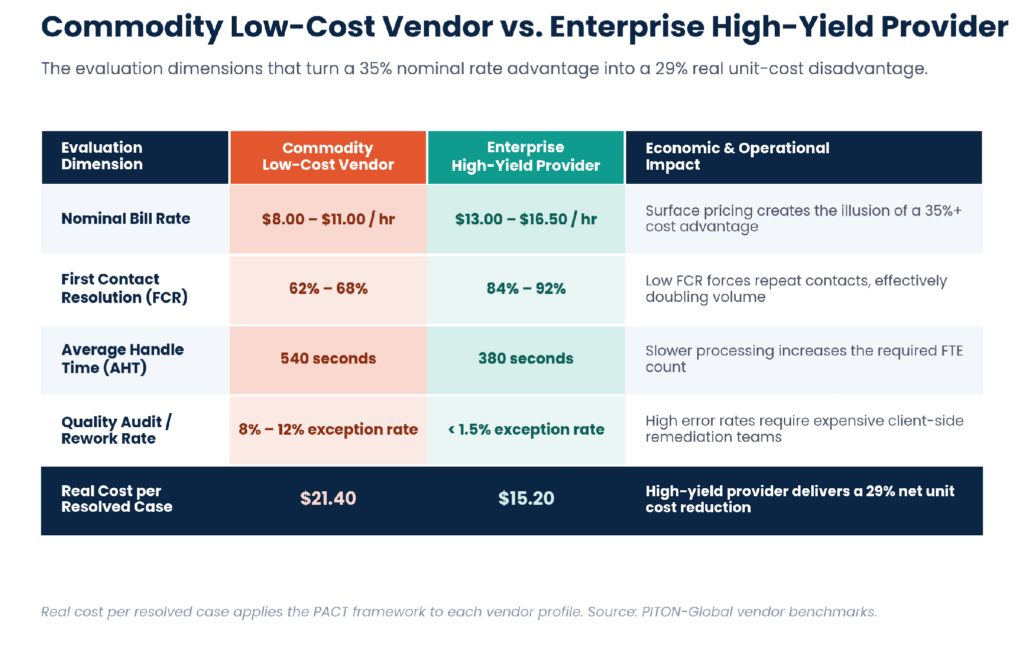
Figure 2. Evaluation dimensions for a commodity low-cost vendor versus an enterprise high-yield provider, with economic and operational impact.
What Mathematical Framework Converts Raw BPO Billing Rates into Productivity-Adjusted Unit Costs?
The Productivity-Adjusted Cost per Transaction (PACT) framework divides the fully loaded hourly burden—billing rate plus prorated licenses, statutory night differential where applicable, and client-side oversight—by net operational yield, the hourly output volume multiplied by the first-pass accuracy rate. PACT = Bh ÷ (Vh × (1 − Er)), adjusted for a 60-to-90-day ramp-to-proficiency curve.
To establish a transparent financial comparison, procurement executives must move beyond simple headcount pricing models and implement a standardized Productivity-Adjusted Cost per Transaction framework. The structural breakdown below shows the formula and a worked example for the two vendors in Figure 2; the evaluation process relies on three sequential calculations.
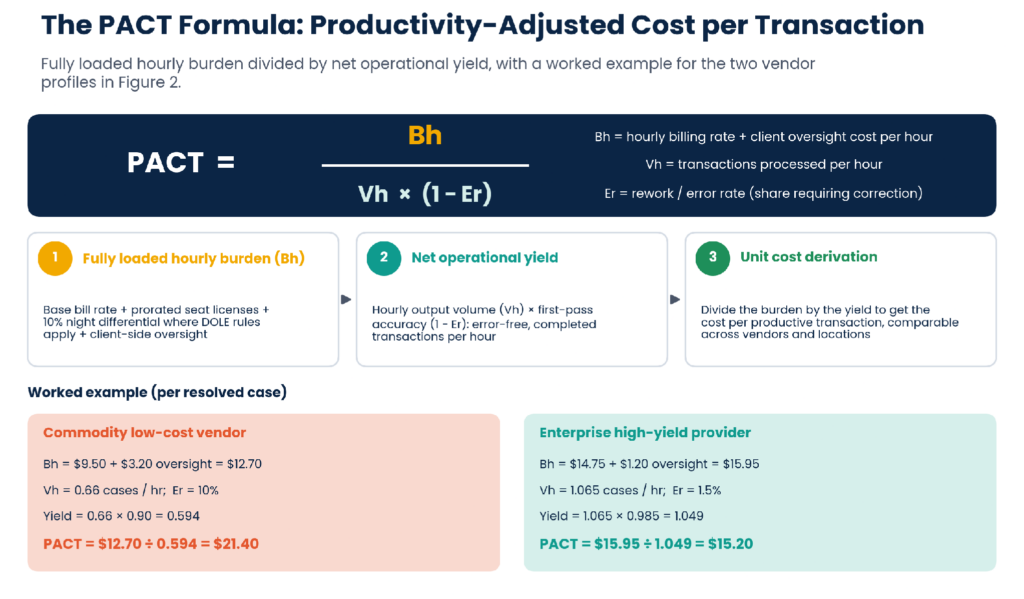
Figure 3. The PACT formula: fully loaded hourly burden divided by net operational yield, with a worked example for a commodity vendor and a high-yield provider.
Fully Loaded Hourly Burden
Sum the vendor’s base hourly billing rate, prorated technology seat licenses, the statutory night differential where applicable under Philippine Department of Labor and Employment (DOLE) rules, and internal client-side management overhead. The burden is what the hour actually costs the buyer, not what appears on the invoice.
Net Operational Yield
Determine the volume of error-free, completed transactions generated per hour. Multiply total hourly output volume by the first-pass accuracy rate—one minus the rework exception rate. A team that processes more transactions but returns a tenth of them for correction has less yield than the raw count suggests.
Unit Cost Derivation
Divide the fully loaded hourly burden by the net operational yield: PACT equals hourly burden divided by hourly volume times (1 − error rate). The result is the only figure that can be compared across vendors, locations, and pricing models on a like-for-like basis.
The Impact of Learning and Ramp Curves
Incorporate a 60-to-90-day ramp-to-proficiency adjustment. A newly onboarded team operating at half its baseline capacity during Month 1 effectively doubles the unit cost during that period, and high vendor attrition continuously resets the ramp curve, maintaining a permanent cost penalty on the account.
How Do Regional Wage Arbitrage and BPO Tiers Influence Productive Yield Across the Philippines?
Tier 1 hubs in Metro Manila and Cebu concentrate specialized talent for complex financial, healthcare, and IT work at premium rates with faster ramp-up and greater autonomy. Next-Wave Cities Iloilo, Clark, and Davao deliver back-office and standard CX at lower rates with turnover meaningfully below Manila’s, while vendor capability tiers—supervisor ratios, QA automation, security governance—set yield within each location.
The Philippine BPO landscape consists of distinct geographic tiers and provider capabilities, and regional dynamics directly influence baseline wage expectations, talent availability, and long-term productive output. Location sets the rate; the provider’s operating discipline sets the yield.
Tier 1 Hubs (Metro Manila and Metro Cebu)
High concentrations of specialized talent for complex financial service processes, healthcare management including US-registered nurses, and complex IT support. Higher real estate and talent retention costs result in higher bill rates, but teams achieve faster ramp-up speeds and greater autonomous problem-solving—which lowers PACT even at the higher rate.
Next-Wave Digital Cities (Iloilo, Clark, Davao, Cagayan de Oro)
Emerging outsourcing hubs offer lower facilities overhead and highly stable talent pools, yielding lower billing rates for back-office processing and standard CX. Annual employee turnover is often meaningfully lower than in Manila’s prime business districts, preserving institutional knowledge and keeping the ramp curve from resetting.
Vendor Capability Tiers
Enterprise-grade and specialized boutique BPOs invest in optimized supervisor ratios of 1:8 rather than 1:15, continuous skill advancement programs, automated QA tools, and strict ISO 27001 or SOC 2 Type II security governance, directly reducing operational risk. The map below summarizes regional specialization, rate bands, turnover benchmarks, and PEZA-registered zones.

Figure 4. Philippine BPO hubs by tier, with regional specialization, indicative billing rates, turnover benchmarks, and PEZA-registered economic zones.
Focusing strictly on hourly billing rates when outsourcing to the Philippines is an expensive mistake. A bargain-rate team that processes half the volume with a high error rate costs significantly more than a higher-rate team operating with precision. True economic value comes from measuring productivity-adjusted unit cost, not headcount.
— John Maczynski, CEO, PITON-Global
What Does Optimizing Unit Cost Economics Look Like in Practice?
Optimizing unit cost means paying more per hour to pay less per document. A North American freight management platform moved 80 back-office documentation seats from a low-cost provider with double-digit error rates to a specialized mid-tier Manila provider at a higher hourly rate, lifting processing velocity sharply, cutting exceptions to a fraction of a percent, and reducing cost per processed document by roughly a quarter.
Client Challenge
A North American freight management platform outsourced 80 back-office documentation seats to a low-cost Philippine provider on a bargain hourly rate. Despite low invoice rates, transaction backlogs grew, error rates climbed into double digits, and internal audit remediation costs erased the projected budget savings.
Vendor Selection
PITON-Global audited the operating model, applied the PACT benchmark to quantify the true cost per processed document, and conducted a competitive vendor matching process across its network of more than 100 vetted Philippine BPO providers—the structured approach set out in our framework for selecting a BPO vendor.
Solution Implemented
The client transitioned operations to a specialized mid-tier provider in Manila at a higher billing rate. The new vendor implemented workflow automation, improved team lead ratios to 1:8, and established strict SLA performance tiers tied to velocity and accuracy.
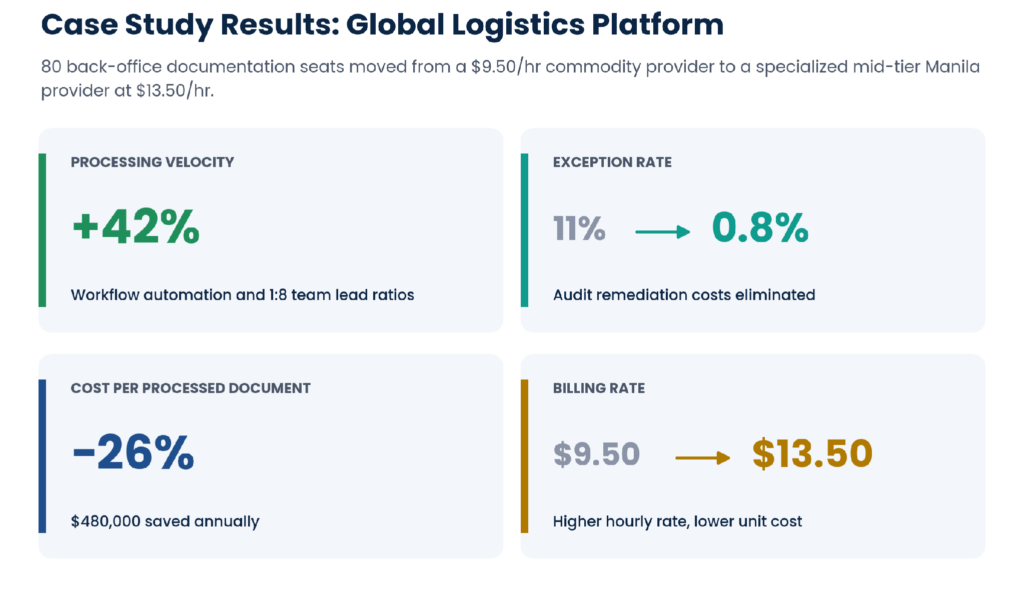
Figure 5. Quantifiable outcomes of the freight platform’s move to a high-yield provider.
Outcomes and Lessons
Processing velocity increased sharply, exception rates fell from double digits to a fraction of a percent, and the client achieved a net reduction of roughly a quarter in total cost per processed document. The lesson: higher nominal hourly rates combined with disciplined process execution yield lower overall operating expenses.
How Does PITON-Global Help Enterprise Buyers Select on Yield Rather Than Rate?
PITON-Global is an independent, vendor-neutral BPO sourcing advisory and consultancy headquartered in Manila that works exclusively on behalf of enterprise buyers. It conducts rigorous operational assessments across a pre-vetted network of more than 100 providers, evaluating real productive yield, historical retention, technical infrastructure, and ISO 27001, SOC 2, and PCI DSS compliance, then structures performance-aligned agreements at zero advisory cost.
Who Is PITON-Global?
PITON-Global is an independent, vendor-neutral BPO sourcing advisory and consultancy firm headquartered in Manila, operating on the ground in the Philippines and led by senior operators with more than 65 combined years of global outsourcing governance. It works exclusively on behalf of enterprise buyers to eliminate vendor selection risk and accelerate operational deployment.
How Does PITON-Global Differ from Traditional Outsourcing Brokers?
Traditional BPO brokers match on nominal rate and earn commissions on placement. PITON-Global conducts rigorous operational assessments, evaluates vendors on real productive yield, historical retention rates, technical infrastructure, and compliance adherence, recommends on the buyer’s productivity-adjusted cost rather than provider promotion, and stays engaged through contract structuring and deployment.
How Does PITON-Global’s Network of 100+ Vetted Philippine BPO Providers Benefit Organizations?
A pre-vetted network of more than 100 top-performing call center and back-office providers across Metro Manila, Metro Cebu, and Next-Wave Digital Cities lets buyers compare operators on PACT rather than invoice rate, extending the selection logic in our definitive guide to setting up a call center in the country. Because each provider’s yield, retention, supervisor ratios, and certifications have already been assessed, buyers avoid the commodity tier where low rates hide high unit costs.
How Does PITON-Global’s Advisory-Led Vendor Matching Process Work?
PITON-Global’s advisory model runs in four stages: an operational audit of the buyer’s current cost per transaction and its root causes; productivity modeling that applies the PACT benchmark to candidate providers; network matching on yield, retention, infrastructure, and location; and contractual SLA structuring that ties compensation to FCR, accuracy, and volume targets.
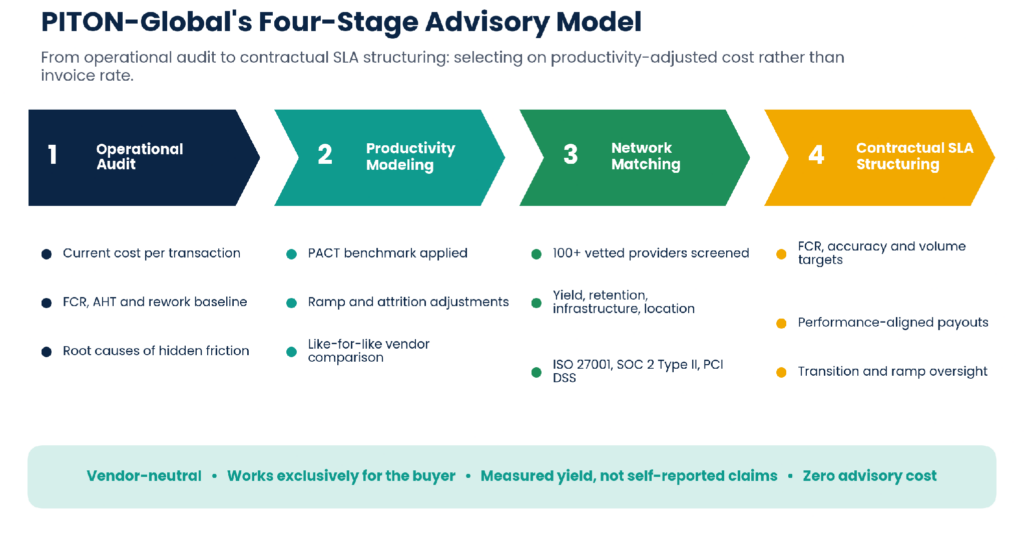
Figure 6. PITON-Global’s four-stage advisory model: operational audit, productivity modeling, network matching, and contractual SLA structuring.
Why Do Organizations Use PITON-Global?
Enterprise buyers use PITON-Global to achieve optimal productivity-adjusted cost savings rather than the lowest invoice rate. Because it provides deep market intelligence at zero advisory cost, it replaces self-reported RFP capabilities with measured yield at the point where a nominal-rate decision is most tempting.
Frequently Asked Questions
What operational metrics are required to calculate productivity-adjusted labor costs?
Calculating productivity-adjusted labor costs requires tracking base hourly bill rates, Average Handle Time or transaction processing speed, First Contact Resolution or first-pass accuracy rates, client management overhead, and training ramp duration.
How much lower are BPO labor costs in the Philippines compared to US onshore rates?
Nominal billing rates in the Philippines typically run at roughly half of US onshore rates or less. On a productivity-adjusted basis, net savings narrow but remain substantial, depending on team proficiency and process complexity.
How does employee attrition affect the productivity-adjusted cost equation?
High turnover continuously resets the proficiency curve, keeping a higher percentage of agents in the low-productivity onboarding phase. This operational lag adds a significant indirect cost premium above the base contract rate.
Are Next-Wave Cities in the Philippines better for cost efficiency than Metro Manila?
Next-Wave Cities such as Iloilo, Clark, and Davao offer lower facilities overhead and high workforce stability, making them highly cost-efficient for standard CX and back-office processing. Metro Manila remains optimal for highly specialized technical, financial, or complex enterprise operations.
How do performance-based SLAs protect productivity-adjusted margins in BPO contracts?
Performance-based SLAs tie financial payouts directly to output metrics such as FCR, accuracy thresholds, and unit volume targets rather than just logged billable hours, ensuring vendor compensation aligns with client productivity goals.
Why should enterprise buyers use an advisory firm like PITON-Global instead of issuing a direct RFP?
Direct RFPs often rely on self-reported vendor capabilities. PITON-Global brings deep market intelligence to evaluate actual productivity yield, historical retention, and culture across more than 100 vetted providers, matching buyers with optimal partners at zero advisory cost.