

On this page
- Key Takeaways
- What Are the Core Structural Differences Between FTE, Transaction, and Outcome Pricing Models in Philippine Outsourcing?
- How Do Philippine Market Realities Impact the Financial Viability of Each Model?
- When Should an Enterprise Graduate from Seat-Based Contracts to Performance-Based Commercial Structures?
- What Are the Hidden Financial Risks and Tradeoffs of Paying per Result?
- How Did PITON-Global Match a Global Insurance Firm with the Ideal Philippine Provider?
- Why Do Leading Enterprises Partner with PITON-Global for Outsourcing Advisory?
- Frequently Asked Questions
CFOs should compare outsourcing pricing models by mapping cost predictability against operational risk, evaluating whether labor efficiency (FTE-based), volume scalability (transaction-based), or business impact (outcome-based) best aligns with enterprise margin targets and risk tolerance across multi-channel offshore environments. FTE models fix cost and keep risk with the buyer; transaction models share it; outcome models transfer it to the provider. Whichever structure wins, the rate itself should be legible: the pricing model behind the quote shows what a fully loaded per-agent rate contains before any risk premium is layered on.
Key Takeaways
- FTE-based pricing: Secures dedicated talent at fixed monthly costs, ideal for stable, predictable operational workflows.
- Transaction-based models: Tie spend directly to volume metrics, protecting margins during demand volatility.
- Outcome-based pricing: Transfers operational performance risk to the provider, aligning financial incentives with revenue or cost-reduction milestones.
- Scalability and partner selection: Manila, Cebu, and provincial delivery hubs offer unique scalability from a massive English-proficient graduate talent pool and robust infrastructure, and strategic partner selection must balance cost structures with robust change management and quality oversight frameworks.
What Are the Core Structural Differences Between FTE, Transaction, and Outcome Pricing Models in Philippine Outsourcing?
FTE pricing bills a fixed monthly rate per agent covering compensation, PhilHealth, SSS, and Pag-IBIG benefits, infrastructure, and facilities, giving control and predictable budgets while leaving productivity and utilization risk with the buyer. Transaction pricing pays per completed unit, eliminating idle-time cost but transferring capacity planning risk to the vendor. Outcome pricing ties compensation to NPS, cost-per-acquisition, or recovery targets.
Evaluating offshore financial structures requires dissecting how risk and reward are distributed between the enterprise buyer and the Philippine service provider. Full-Time Equivalent pricing remains the traditional benchmark across major hubs such as Manila and Cebu: buyers pay a fixed monthly rate per agent covering base compensation, mandatory Philippine statutory benefits (PhilHealth, SSS, Pag-IBIG), workstation infrastructure, and standard facility overhead. The model offers maximum operational control and predictable budgeting, though productivity variance and utilization risk rest entirely on the enterprise.
Transaction-based pricing shifts the focus from time to output volume. Organizations pay a fixed fee per completed unit of work—an inbound customer service ticket resolved, a claims form processed, an outbound sales conversion verified. The structure eliminates idle-time costs during low-volume cycles, making it optimal for seasonal workloads—cyclical publishing operations, as our look at cost optimization in publishing outsourcing shows, are a typical fit—yet it transfers capacity planning risk to the vendor.
Outcome-based pricing takes risk-sharing a step further by tethering compensation to macro-level business metrics such as net promoter score retention thresholds, cost-per-acquisition targets, or bad-debt recovery percentages. Providers operating under this model absorb severe margin compression if performance targets fail, and command a premium price when KPIs are exceeded. The table below summarizes the three structures.

Figure 1. Cost predictability, operational risk bearer, and best-fit workloads for FTE-based, transaction-based, and outcome-based pricing.
Mapped against cost predictability and the party that bears operational risk, the three models occupy distinct positions—and the hybrid structures discussed later sit between them, a spectrum our framework for value-based commercial models explores in more depth.

Figure 2. Comparative matrix mapping cost predictability against risk allocation across FTE, transactional, and outcome pricing structures, with the hybrid framework from the case study.
How Do Philippine Market Realities Impact the Financial Viability of Each Model?
The Philippine ecosystem combines labor availability, CREATE Act incentives, and infrastructure costs. FTE models in Metro Manila or Tier-2 hubs deliver deep savings over onshore, but wage inflation in specialized sectors demands re-pricing clauses; transaction models need WFM tools and telemetry to avoid billing disputes; and outcome models price in risk at a clear premium over FTE rates unless baselines are bulletproof.
The Philippine outsourcing ecosystem operates within a distinct macroeconomic framework characterized by high labor availability, government fiscal incentives through the Corporate Recovery and Tax Incentives for Enterprises (CREATE) Act, and specific infrastructure cost realities. When deploying an FTE model in Metro Manila or provincial Tier-2 locations such as Iloilo and Davao, labor cost arbitrage delivers average savings of 60 to 70 percent compared with onshore operations. Wage inflation in specialized sectors—healthcare revenue cycle management, complex technical support—nevertheless places pressure on fixed FTE rates, requiring meticulous contract re-pricing clauses. The macro picture behind those variables is set out in our 2026 strategic intelligence index for the sector.
Transaction-based models require sophisticated workforce management tools and real-time data integration between the client enterprise and the offshore facility; without granular telemetry, disputes arise over what constitutes a billable transaction versus an incomplete interaction. Outcome-based structures require immense trust and mature historical data baselines: because providers must price in the inherent risk of missing targets, baseline pricing can run well above standard FTE rates unless historical defect rates and agent handling times are statistically bulletproof. The breakdown below shows the variables at work.
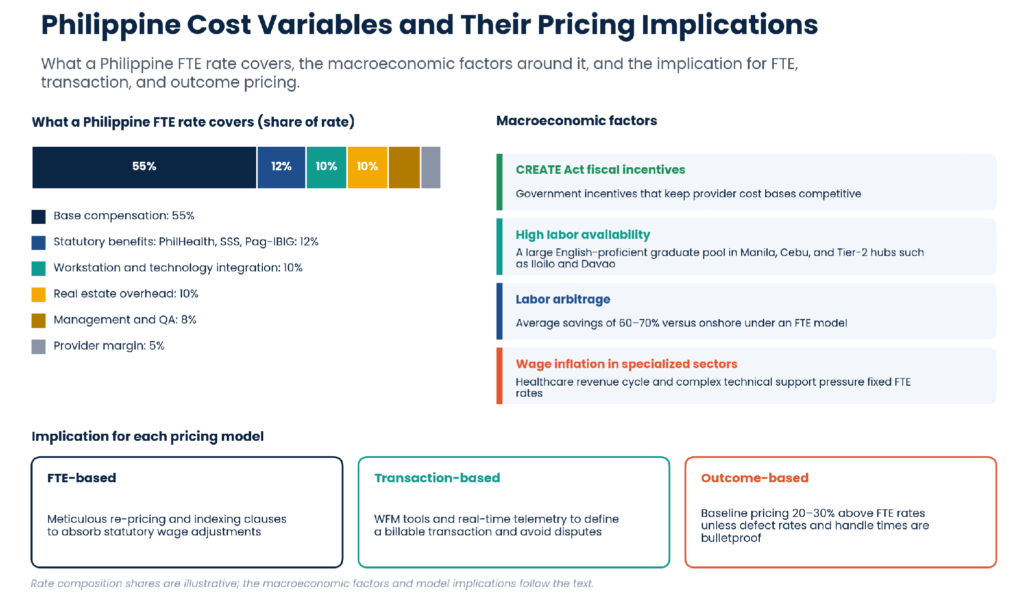
Figure 3. Philippine BPO cost structure variables—statutory benefits, real estate overhead, technology integration, and macroeconomic factors—and their implications for each pricing model (rate composition illustrative).
When Should an Enterprise Graduate from Seat-Based Contracts to Performance-Based Commercial Structures?
Migrating from FTE to transaction or outcome agreements is an evolution, not a first step. Evaluate a transition when process standardization reaches Six Sigma maturity, data spans at least twelve quarters, and the supplier shows cultural alignment and technical competence. One fintech moving tier-one collections to an outcome model cut costs materially and lifted recovery yields on transparent baselines.
Migrating from a fixed FTE model to transaction or outcome agreements is rarely an initial step; it is a strategic evolution that occurs once operational maturity is established. Organizations should evaluate a transition when process standardization reaches a Six Sigma maturity level, historical performance data spans at least twelve consecutive quarters, and the supplier has demonstrated cultural alignment and technical competence.
A global fintech enterprise migrating tier-one collections from a Manila-based FTE model to an outcome-based structure realized a significant reduction in operational costs while increasing recovery yields. The transition succeeded because historical default curves, regulatory compliance parameters, and dialer efficiencies were completely transparent. Conversely, transitioning an ambiguous, rapidly evolving back-office workflow to transaction pricing often leads to vendor friction, margin disputes, and eventual service degradation as agents rush through complex tasks to hit arbitrary volume quotas. The decision tree below sets out the gates.
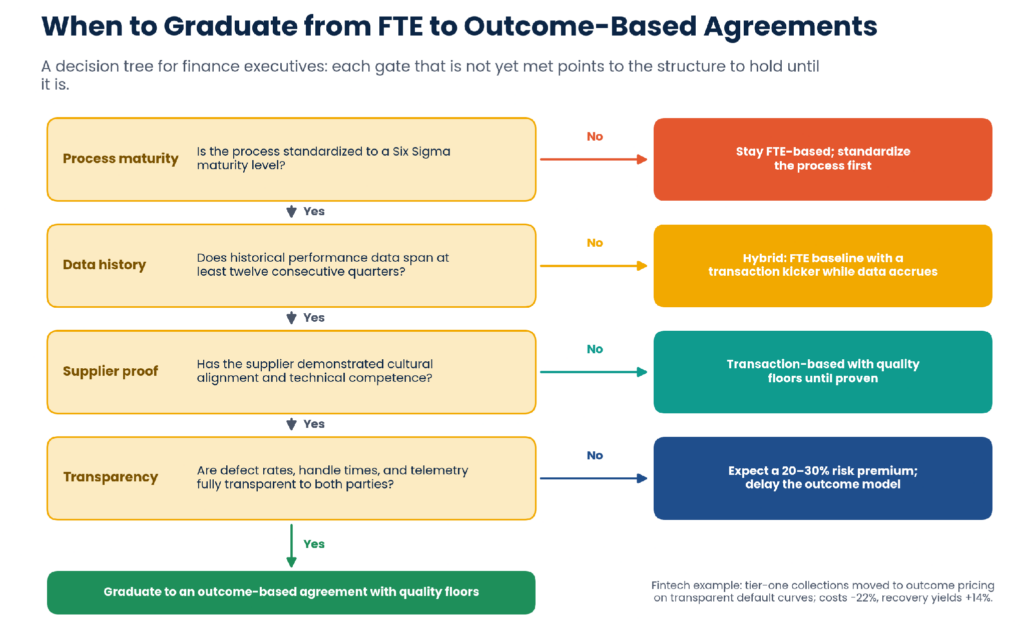
Figure 4. Decision tree for graduating from FTE contracts to outcome-based agreements, with the structure to hold at each unmet gate.
What Are the Hidden Financial Risks and Tradeoffs of Paying per Result?
Outcome models carry systemic hazards: when a provider’s margin depends entirely on metrics, vendors may close tickets prematurely to boost throughput or cherry-pick high-probability leads while neglecting complex escalations. Compliance with the Data Privacy Act of 2012 while running outcome-tracking software demands API integrations and auditing, and governance, compliance oversight, and vendor management office staff can neutralize the administrative savings.
Pursuing zero-risk outcome models introduces subtle systemic hazards that can destabilize enterprise operations if mismanaged. When a provider’s margin is entirely dependent on performance metrics, vendors may engage in aggressive behavior, such as prematurely closing customer tickets to boost throughput metrics or cherry-picking high-probability leads while neglecting complex client escalations.
Data security compliance adds substantial overhead. Maintaining rigorous adherence to the Data Privacy Act of 2012 (Republic Act No. 10173) while utilizing complex outcome-tracking software requires robust API integrations and continuous auditing, and enterprises must budget for governance, compliance oversight, and vendor management office personnel to audit performance claims independently—neutralizing the administrative savings initially anticipated from outcome contracts. The panel below sets each risk beside its safeguard.
The pursuit of outcome-based pricing can easily backfire if the underlying process is fundamentally broken. Shifting risk to a Philippine partner does not eliminate operational friction; it merely converts inefficiency into a financial premium that the vendor will inevitably bake into their baseline margins.
— John Maczynski, CEO, PITON-Global
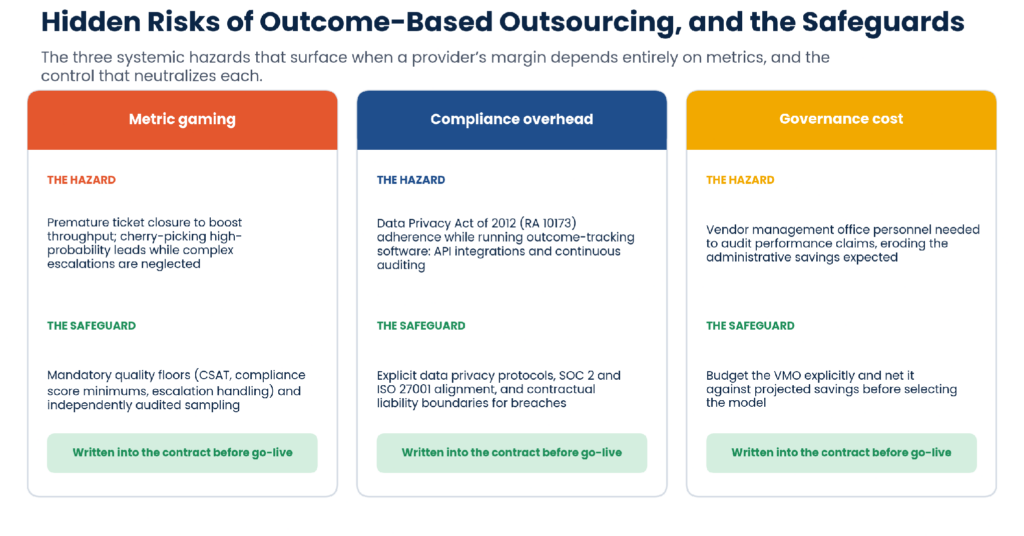
Figure 5. The hidden risks of outcome-based outsourcing—metric gaming, compliance overhead, governance cost—and the contractual safeguard for each.
How Did PITON-Global Match a Global Insurance Firm with the Ideal Philippine Provider?
PITON-Global matched an international insurer hesitant to commit to a 300-seat FTE contract without guarantees by curating three providers from more than 100 vetted operators and structuring a hybrid framework: an FTE baseline for data entry with a transaction-based kicker tied to a demanding straight-through processing accuracy threshold. Claims expenditure fell by roughly a third and turnaround dropped from days to hours.
Client Challenge
An international insurance provider struggled with escalating claims processing costs and high error rates in its onshore operations. The enterprise required a scalable solution but was hesitant to commit to a traditional 300-seat FTE contract without performance guarantees.
Vendor Selection
PITON-Global initiated a comprehensive audit of the client’s historical workflows, data security requirements, and volume volatility patterns. Rather than deploying a generic sourcing strategy, it leveraged its advisory network of more than 100 vetted Philippine BPO providers to curate a shortlist of three specialized operations with proven healthcare and insurance domain expertise.
Solution Implemented
PITON-Global structured a hybrid commercial framework: a baseline FTE arrangement for core data entry, paired with a transaction-based kicker tied to straight-through processing accuracy rates above 98.5 percent—fixed infrastructure stability for the predictable work, volume-tied incentives for the quality that mattered.
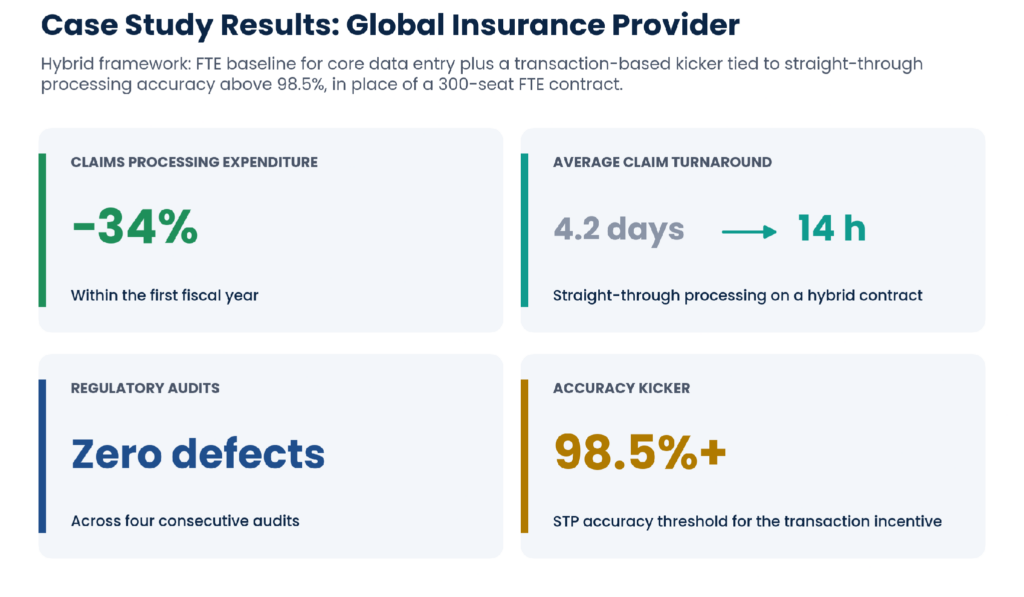
Figure 6. Quantifiable outcomes of the insurance provider’s hybrid FTE-plus-transaction framework.
Outcomes and Lessons
Total claims processing expenditure fell substantially within the first fiscal year; average claim turnaround accelerated from 4.2 days to 14 hours; and the operation achieved a zero-defect compliance rating across four consecutive regulatory audits. The strategic lessons: hybrid models combining fixed infrastructure stability with volume-tied incentives yield superior operational alignment compared with pure single-model strategies, and rigorous pre-qualification of niche Philippine providers eliminates lengthy onboarding friction.
Why Do Leading Enterprises Partner with PITON-Global for Outsourcing Advisory?
Navigating the Philippine BPO landscape means evaluating hundreds of competing providers, varying infrastructure standards, and regulatory requirements. PITON-Global is an independent, advisory-led consultancy rather than a broker, maintaining market intelligence across more than 100 vetted contact centers and back-office operations to eliminate procurement guesswork, mitigate contracting risk, optimize pricing model selection, and accelerate deployment without advisory fee markups from suppliers.
Who Is PITON-Global?
PITON-Global is an independent, advisory-led BPO consultancy headquartered in Manila, led by senior operators with more than 65 combined years of global outsourcing governance. It maintains deep market intelligence across more than 100 carefully vetted Philippine contact centers and back-office operations, bridging the gap between enterprise buyers and elite service providers.
How Does PITON-Global Differ from Traditional Outsourcing Brokers?
Traditional brokers earn commissions on placement and have no reason to challenge a pricing structure the provider prefers. PITON-Global provides conflict-free advisory backed by operational expertise, models the commercial scenarios before the provider is chosen, recommends on the buyer’s margin targets and risk tolerance rather than provider promotion, and stays engaged through contract structuring and deployment.
How Does PITON-Global’s Network of 100+ Vetted Philippine BPO Providers Benefit Organizations?
A network of more than 100 vetted providers, each assessed on infrastructure standards, regulatory posture, WFM telemetry, and domain expertise, lets enterprises identify which operators can actually run a transaction or outcome model rather than merely quote one. The insurance case study’s shortlist of three healthcare and insurance specialists came from that pre-qualification.
How Does PITON-Global’s Advisory-Led Vendor Matching Process Work?
The process runs from audit to go-live: auditing historical workflows, data security requirements, and volume volatility; modeling FTE, transaction, outcome, and hybrid scenarios against margin targets; curating a shortlist of specialized providers from the vetted network; verifying infrastructure and compliance on site; then structuring the commercial framework and supporting recruitment, facility provisioning, and go-live within the standard 60-to-90-day window.
Why Do Organizations Use PITON-Global?
Organizations use PITON-Global to eliminate procurement guesswork, mitigate structural contracting risk, optimize pricing model selection, and accelerate successful vendor deployment—without incurring advisory fee markups from suppliers.
Frequently Asked Questions
What is the average cost savings of outsourcing to the Philippines compared to the US?
Organizations typically achieve substantial operational cost reductions when factoring in labor arbitrage, real estate overhead, and statutory compliance management.
How does Philippine labor law impact FTE pricing stability?
Mandatory government benefits, holiday pay premiums, and annual minimum wage adjustments in regions such as Metro Manila require enterprises to include transparent indexing clauses within long-term FTE contracts.
Which pricing model is best for unpredictable seasonal volumes?
Transaction-based pricing is superior for seasonal peaks and valleys, because it insulates the buyer from paying for idle agent hours during low-demand cycles.
How do outcome-based models handle data security and compliance?
Contracts must explicitly outline data privacy protocols compliant with the Philippine Data Privacy Act and international standards such as SOC 2 and ISO 27001, assigning liability boundaries for data breaches.
What distinguishes PITON-Global from traditional outsourcing brokers?
PITON-Global provides conflict-free advisory services backed by deep operational expertise, matching enterprises with the ideal provider from an independent network of more than 100 vetted Philippine BPOs.
How long does it take to implement a new Philippine BPO contract?
Standard end-to-end deployment—from initial scoping and vendor matching to recruitment, facility provisioning, and go-live—typically ranges from 60 to 90 days.