

BPO services in the Philippines provide a strategic $12–$18/hour fully loaded solution; check what offshore support really costs per agent against your own headcount before reading on. By 2026, the sector has transitioned to Intelligence Arbitrage, where Filipino “AI Pilots” manage Agentic AI workflows. This hybrid model ensures 90%+ resolution rates and bank-grade security (HIPAA 2.0) while delivering a 70% TCO reduction compared to US onshore operations for Fintech, Ecommerce, and Healthcare.
Executive Summary: The Intelligence Arbitrage
In March 2026, the global Business Process Outsourcing (BPO) sector has reached a definitive inflection point. The legacy narrative of “labor arbitrage”—the simple exchange of low-cost man-hours for back-office tasks—has been rendered obsolete by the arrival of Agentic AI.
Today, the Philippines has successfully pivoted from the “World’s Call Center” to the world’s first Intelligence Arbitrage Hub. With one of the largest outsourcing-sector valuations in the world and a workforce of 2.1 million specialists, the archipelago has secured its position as the critical Human-in-the-Loop (HITL) layer for the world’s most regulated industries. For Fortune 500 leaders, the strategic mandate has shifted: BPO Services in the Philippines are no longer primarily a lever on SG&A expenses; they are a Strategic Command Center where high-EQ human talent orchestrates autonomous systems to protect brand reputation, manage risk, and accelerate revenue.
The 2026 Paradigm Shift: The “Loyalty” Reckoning
The traditional BPO model was built on volume; the 2026 model is built on Velocity and Veracity. As AI agents now handle 80% of routine, rules-based interactions, the remaining 20%—the “Exception Path”—has become the primary driver of enterprise value.
Customer service is the ultimate driver of loyalty. Data from the 2026 Brand Keys Customer Loyalty Engagement Index shows a 32% year-over-year surge in consumer expectations. Satisfaction is no longer the goal; it is merely “table stakes.” Research indicates that 93% of consumers are more likely to make repeat purchases from companies with excellent service, yet brand loyalty has plummeted to roughly 49% recently as consumers become more selective.
Exhibit A: The BPO Maturity Model (2020 vs. 2026)
| Capability | Legacy BPO (2020) | Intelligence Hub (2026) |
| Primary Value | Labor Arbitrage (Cost) | Intelligence Arbitrage (Judgment) |
| Tech Stack | CRM + Knowledge Base | Agentic AI + Real-time Co-pilots |
| Workforce | Task-Oriented Generalists | Domain-Specific “AI Pilots” |
| Billing Model | Per Full-Time Equivalent (FTE) | Per Outcome / Resolution |
| Data Security | VPN & Firewalls | Zero-Possession Architecture |
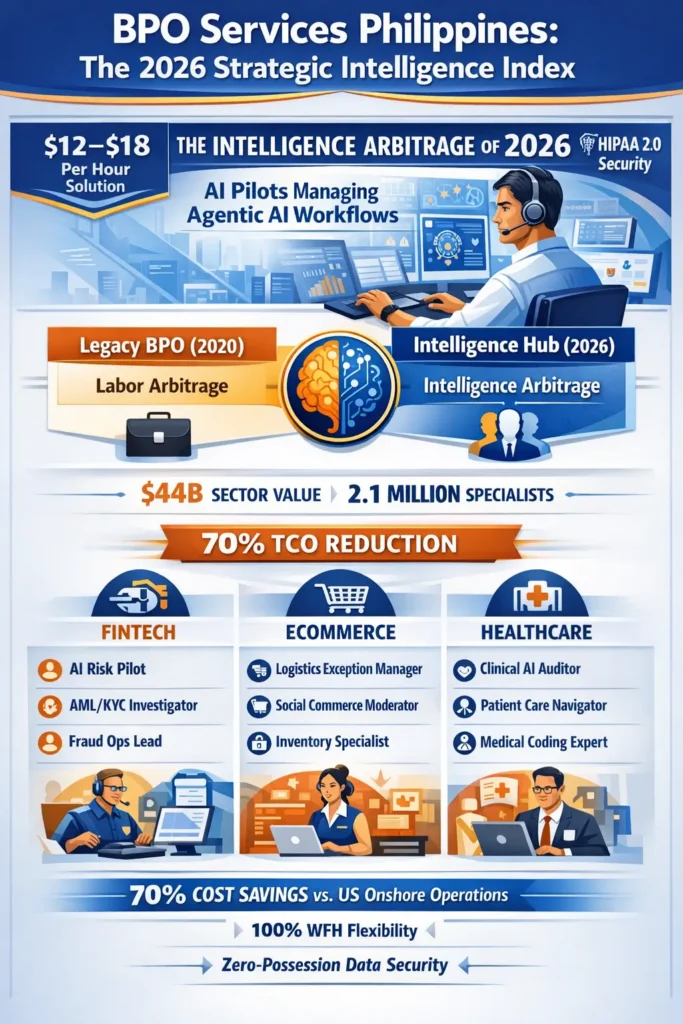
Vertical Hyper-Specialization: Top 10 Positions per Industry
To stay ahead of the competition in other countries, the local workforce has moved into high-complexity domains—from the CAD and engineering work covered in our 2026 guide to the regulated-industry roles below. At fully loaded rates that remain a fraction of onshore equivalents, these are the 40 most frequently outsourced roles.
I. Fintech (The Risk & Resilience Pillar)
- AI Risk Pilot: Audits autonomous transaction flags to prevent false positives.
- AML/KYC Investigator: Performs entity resolution for complex alerts.
- Tokenized Asset Coordinator: Audits Stablecoin reserves and RWAs.
- Fraud Operations Lead: Real-time detection and autonomous SAR filing.
- Cross-Border Settlement Clerk: Reconciles 24/7 payment exceptions.
- Dispute Arbitrator: Expert representation in merchant arbitration.
- Digital Wallet Trust Lead: Manages “Locked Account” emotional crises.
- Loan Underwriting Analyst: Secondary verification of AI-generated credit scores.
- Cybersecurity GRC Analyst: Ensures 36-hour incident disclosure compliance.
- Fintech API Support (Tier 3): Troubleshoots bank-neobank integration failures.
II. Ecommerce (The Zero-Latency Engine)
- Logistics Exception Manager: Proactively intervenes in “Middle Mile” delays.
- Revenue Recovery Specialist: Converts a meaningful share of return requests into exchanges.
- Social Commerce Moderator: Real-time conversion on TikTok Shop and WhatsApp.
- Inventory/SKU Orchestrator: Syncs stock across Amazon, Shopify, and 3PL hubs.
- Marketplace Integrity Officer: Ensures listings meet “Truth in Advertising” AI standards.
- Subscription Retention Lead: Manages churn-risk accounts via behavioral triggers.
- UGC Content Coordinator: Curates rights for AI-augmented ad campaigns.
- Ecommerce Data Scientist: Transforms raw data into “Predictive Buying” personas.
- Catalog Hygiene Manager: Manages “Digital Twin” inventory for AR shopping.
- Fraud Prevention Desk: Stops “friendly fraud” and PNR abuse.
III. Healthcare (The Clinical Integrity Layer)
- Clinical AI Auditor (US-RN): Audits AI Scribes for near-perfect coding accuracy.
- Predictive RCM Specialist: Prevents insurance denials before submission.
- Patient Care Navigator: Coordinates telehealth intake and RPM monitoring.
- Utilization Reviewer: Determines treatment necessity for global insurers.
- Medical Coding (Forensic): Certified coders for litigation-grade documentation.
- Pharmacovigilance Officer: Monitors adverse drug reactions for pharma trials.
- Prior Authorization Expert: Navigates provider-payer friction.
- Health-Tech Integration Lead: Manages secure PII data flows between EHRs.
- Clinical Data Abstractionist: Migrates sensitive history with HIPAA 2.0 rigor.
- Patient Access Lead: Manages high-stakes telehealth triage.
IV. Insurance (The Empathy Moat)
- Predictive Underwriter: Reviews applications outside AI’s confidence threshold.
- Claims Triage Specialist: Directs “Empathy Path” claims to human adjusters.
- Subrogation Specialist: Recovers funds from third-party insurers.
- Policy Remediation Expert: Updates language driven by 2026 climate legislation.
- Bilingual Policy Advocate: Support in English/Spanish for North America.
- Insurance Fraud Investigator: Detects “Inconsistency Patterns” via NLP.
- Broker Support Liaison: Primary contact for high-value portfolio agencies.
- Life Insurance Case Manager: Handles sensitive beneficiary payouts.
- Annuity Administrator: Manages data integrity for retirement products.
- Catastrophic Event Lead: Rapid-response support for natural disasters.
Policy & Infrastructure: The $12–$18 “Success Zone”
Success in the Philippines is shielded by Republic Act 12066 (CREATE MORE Act). This law has institutionalized full WFH flexibility, allowing BPOs to hire from the “Provincial Alpha” where attrition runs materially lower. Security is now managed via Zero-Possession Architecture, ensuring no PII ever resides on local devices.
Expert FAQs: The Strategic Perspective
Q: Why has the “Fully Loaded” rate held steady despite global inflation? A: This is a direct result of the CREATE MORE Act. By allowing fully remote work, vendors have stripped away massive Metro Manila real estate overhead. Furthermore, the full tax deductibility of power and AI-upskilling costs allows vendors to pay higher “AI Pilot” wages while keeping the client’s TCO stable and competitive.
Q: How does the Philippines handle “AI Hallucinations” in regulated sectors like Fintech and Healthcare? A: Leading hubs utilize Human-in-the-Loop (HITL) governance. For every AI decision with a confidence score below a strict threshold, the system automatically “shuttles” the task to a Filipino specialist. In Healthcare, US-licensed nurses audit AI transcripts in real-time, ensuring that clinical accuracy stays at audit-grade levels, satisfying HIPAA 2.0 requirements.
Q: What is the “Provincial Alpha,” and how does it affect my ROI? A: The “Provincial Alpha” refers to the talent density in “Next-Wave Cities” like Iloilo, Davao, and Bacolod. Because the cost of living is markedly lower than Manila, the same fully loaded rate provides these agents with a “high-status” lifestyle. This results in attrition rates a fraction of those in saturated urban hubs, significantly lowering your long-term training and recruitment costs—one of the financial risks a CFO should model before signing.
Q: Is “Zero-Possession Architecture” compatible with US and EU data privacy laws? A: Yes. In 2026, top-tier Philippine BPOs use Pixel-Streaming. The agent sees a visual “broadcast” of the data, but the actual data never leaves the client’s US/EU-based cloud. This setup satisfies GDPR and SEC requirements because the offshore specialist never actually “possesses” or “stores” the data.Q: How do I transition from “Per-FTE” billing to “Outcome-Based” billing?A: Start with a hybrid “Shadow Period.” Measure your baseline Cost-Per-Resolution using a traditional hourly rate. Once the AI-human synergy is optimized (usually 90 days), transition to a flat fee per successful resolution.