

On this page
- Key Takeaways
- How Does Philippine Outsourcing Directly Reduce SG&A Ratios?
- What Operational Metrics Improve Alongside Expense Reductions?
- What Common Pitfalls Cause Organizations to Miss SG&A Targets?
- What Does Reclaiming Operating Margins Look Like in Practice?
- Why Do Executives Partner with PITON-Global for Strategic Sourcing?
- Frequently Asked Questions
Partnering with BPO providers in the Philippines reduces Selling, General, and Administrative overhead materially across back-office, customer experience, and specialized finance operations. By replacing high onshore fixed costs with scalable, unit-based delivery—see what fully loaded per-agent rates actually run offshore—enterprise organizations systematically compress operating ratios while maintaining strict service-level quality and data compliance.
Key Takeaways
- Direct cost arbitrage: Onshore full-time employee fully loaded costs fall to a fraction of their level when the work moves offshore, yielding immediate structural line-item reductions.
- Shift from fixed to variable capital: Transitioning core operational overhead into scalable consumption models reduces capital expenditure commitments and stabilizes operating cash flow.
- Margin expansion beyond labor, with turnover risk absorbed: Process efficiency and AI-assisted workflows drive ongoing productivity gains that prevent administrative scope creep during growth, while offshore partner infrastructure absorbs attrition, training, facilities, and technology refresh expenses.
- Advisory-led provider precision: Selecting specialized, right-sized Philippine operators prevents the common missteps associated with generic brokers or massive tier-one BPOs.
How Does Philippine Outsourcing Directly Reduce SG&A Ratios?
Onshore SG&A is weighted toward direct compensation, employment taxes, health benefits, real estate, and software licensing. Offshore fully loaded rates cover compensation, benefits, management oversight, facilities, redundant connectivity, and technology, so voice CX, back-office, finance and accounting, and Tier-1 technical support each land at a fraction of the onshore hourly cost.
Selling, General, and Administrative expenses represent one of the heaviest ongoing drag factors on enterprise operating margins. Onshore SG&A overhead is heavily weighted by direct compensation, employment taxes, health benefits, physical real estate, and enterprise software licensing. The financial impact on operating margins is measured as SG&A ratio compression: baseline onshore SG&A minus offshore operational cost, divided by gross enterprise revenue, multiplied by 100. The line-item breakdown below shows why the offshore cost is so much smaller.

Figure 1. Structural line-item breakdown of a US onshore FTE cost versus a Philippine fully loaded operational cost (illustrative midpoints).
In the Philippines, fully loaded rates cover agent compensation, benefits, management oversight, facility access, redundant connectivity, and baseline technology infrastructure. The table below sets onshore fully loaded cost against the Philippine equivalent by functional area, and reallocating repetitive transactional and analytical workflows to those teams generates immediate savings that reach EBITDA margins directly.
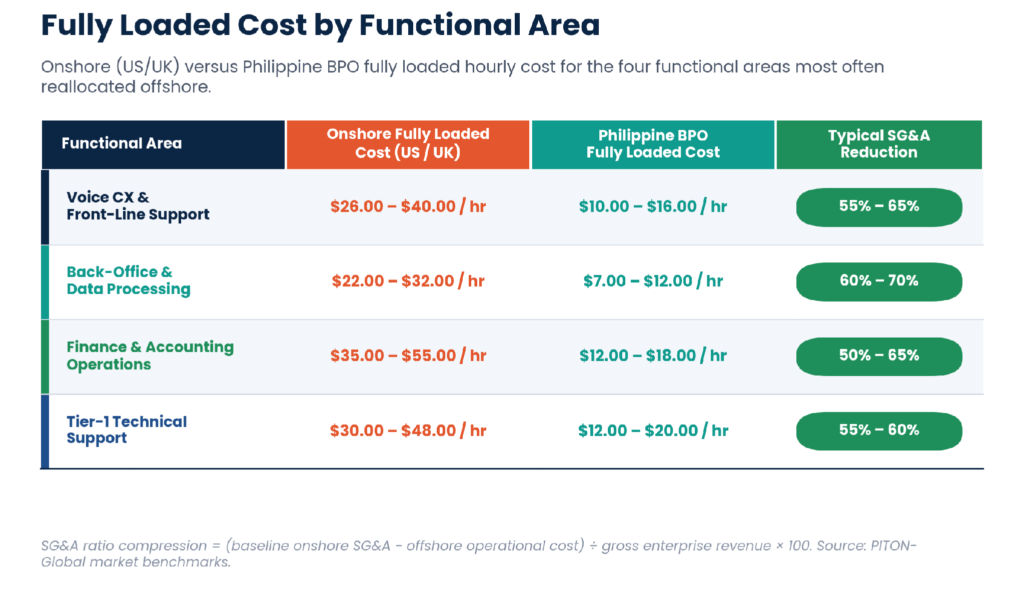
Figure 2. Onshore versus Philippine BPO fully loaded hourly cost by functional area, with the typical SG&A reduction.
What Operational Metrics Improve Alongside Expense Reductions?
Lowering administrative cost does not damage quality: the Philippine talent ecosystem—highly educated, fluent in English, culturally aligned—delivers domain expertise. Net efficiency yield equals transaction volume divided by offshore unit cost, multiplied by SLA compliance rate, and it rises through 24/7/365 processing velocity, human-in-the-loop quality assurance that keeps SLA compliance consistently high, and retention stability that cuts recruiting and retraining cycles.
A common corporate misconception is that lowering administrative cost metrics damages quality. The Philippine talent ecosystem—built around a highly educated, fluent English-speaking workforce with strong cultural affinity—delivers high domain specialization, and net efficiency yield (transaction volume processed divided by offshore unit cost, multiplied by SLA compliance rate) captures the combined effect of three improvements.
Process Throughput and Velocity
24/7/365 coverage cycles accelerate processing speed across accounts payable, claims management, underwriting support, and customer ticket resolution, because queues are worked during the hours an onshore office is closed.
Quality Assurance and Accuracy
Specialized Philippine operators integrate human-in-the-loop oversight with modern workflows, holding SLA compliance at contractually high levels. Accuracy is contractual, not aspirational.
Employee Retention Stability
High operational retention within established BPO hubs lowers recruiting and retraining cycles compared with high onshore turnover, protecting the domain knowledge that keeps unit cost low.
At a fully loaded offshore baseline, you aren’t just buying minutes; you are buying intelligence cycles that protect your brand’s reputation and lower administrative waste.
— John Maczynski, CEO, PITON-Global

Figure 3. Operational metrics that improve alongside expense reductions—throughput, accuracy, and retention—with the net efficiency yield formula.
What Common Pitfalls Cause Organizations to Miss SG&A Targets?
Organizations miss SG&A targets through three sourcing pitfalls: selecting mega-BPOs for mid-market programs, where junior account teams create operational friction; underestimating change management, where misaligned process documentation extends onboarding ramps and doubles spending during transition; and ignoring vendor vetting rigor, where providers lacking SOC 2, PCI DSS, or GDPR compliance introduce regulatory exposure.
Without rigorous sourcing discipline, organizations encounter hidden execution costs that erode expected cost benefits. The two paths diverge early: an unvetted provider leads to scope creep, high attrition, and margin erosion, while advisory-led selection from a vetted network leads to precision matching, executive governance, and the cost reduction the business case promised. The decision tree below shows the criteria that separate them.
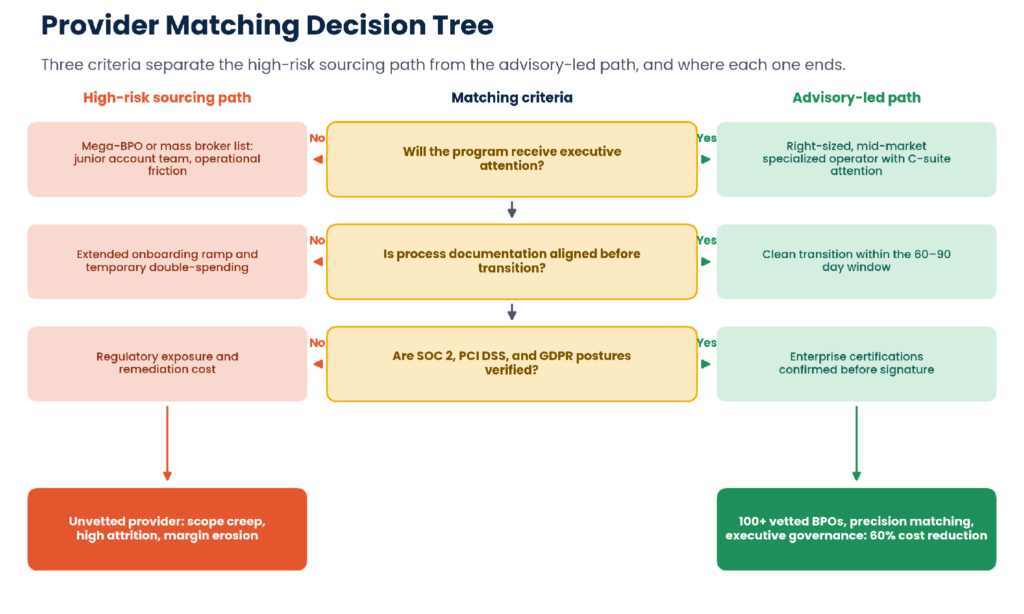
Figure 4. Provider matching decision tree: the criteria that separate mid-market specialized operators from generic mass brokers, and where each path ends.
Selecting Mega-BPOs for Mid-Market Programs
Global enterprise BPOs often assign mid-tier client accounts to junior account teams, leading to operational friction. A program that represents a rounding error to the provider rarely receives the executive attention its SG&A target depends on.
Underestimating Change Management
Misaligning process documentation before transition creates extended onboarding ramps and temporary double-spending. Documenting and standardizing workflows before migration is what keeps the 60-to-90-day transition window intact.
Ignoring Vendor Vetting Rigor
Partnering with unverified providers lacking SOC 2, PCI DSS, or GDPR compliance introduces regulatory exposure, and the remediation cost lands on the buyer after signature rather than the provider before it.
What Does Reclaiming Operating Margins Look Like in Practice?
Reclaiming operating margins starts with a right-sized provider. A rapidly scaling U.S. payments processor whose SG&A ratio had climbed to an unsustainable share of revenue established a dedicated 50-FTE Manila team for fraud verification, dispute processing, and multi-channel engagement, and within 12 months cut operational overhead and transaction processing costs materially and brought its SG&A ratio back within target.
Client Challenge
A rapidly scaling U.S. payments processor saw its SG&A ratio climb to an unsustainable share of total revenue as domestic support and fraud operations costs rose with volume.
Vendor Selection
Partnering with PITON-Global, the executive team evaluated mid-sized Philippine BPOs with proven compliance histories and specialized financial services expertise—deliberately avoiding both generic brokers and mega-BPOs where a mid-market program would receive junior account attention.
Solution Implemented
PITON-Global matched the client with an award-winning operator in Manila, establishing a dedicated 50-FTE team for back-office fraud verification, dispute processing, and multi-channel customer engagement, ramped from a pilot to full scale over the first 180 days as the timeline below shows.

Figure 5. The 180-day transition cycle from pilot seats to a dedicated 50-FTE team, and the 12-month SG&A ratio trajectory (illustrative ramp).
Outcomes and Lessons
Within 12 months, the client materially reduced operational overhead and transaction processing costs and brought overall SG&A back down to a sustainable share of revenue. The lesson: partnering with a right-sized provider ensures dedicated executive governance, enabling seamless scaling without compromising operational control. The same outcomes—unit cost, working capital, and CapEx—are the ones that justify expanding an offshore footprint once the first program stabilizes.
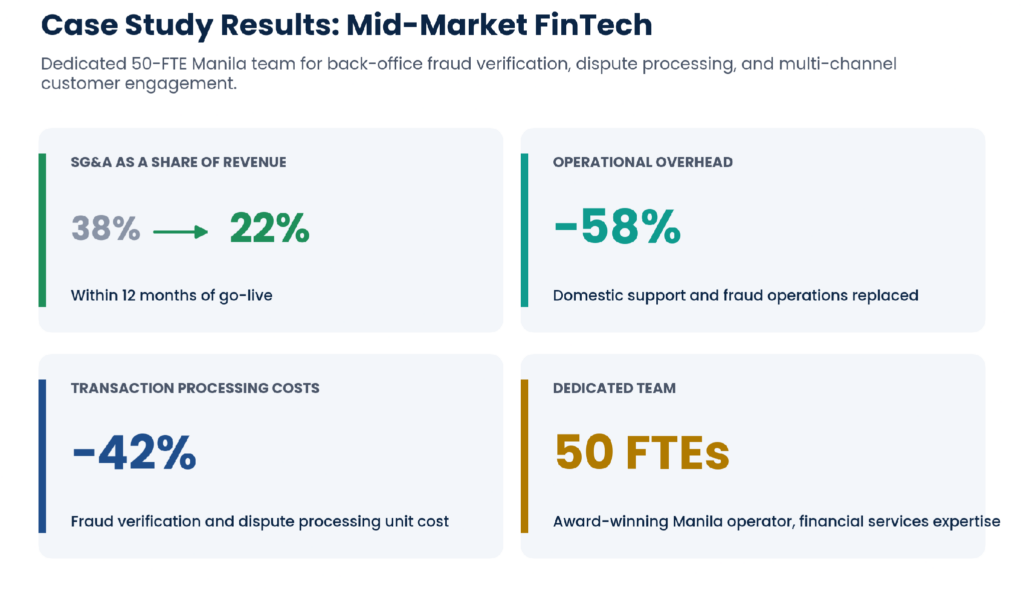
Figure 6. Quantifiable outcomes of the payments processor’s SG&A restructuring.
Why Do Executives Partner with PITON-Global for Strategic Sourcing?
PITON-Global is an independent BPO advisory firm headquartered in Manila with over 25 years of hands-on market leadership. Unlike brokers pushing volume-based sales lists, it acts as a vendor-neutral advisor, evaluating client specifications against real-world production performance, security postures, and cultural alignment across a network of more than 100 vetted Philippine providers, reducing RFP review cycles from months to days.
Who Is PITON-Global?
PITON-Global is an independent, vendor-neutral BPO advisory firm headquartered in Manila with over 25 years of hands-on market leadership, led by senior BPO executives. It works on the buyer’s side of the table, from SG&A baseline through provider matching to governance alignment.
How Does PITON-Global Differ from Traditional Outsourcing Brokers?
Traditional brokers act as sales intermediaries driven by commission models and push volume-based sales lists. PITON-Global operates as an independent advisory firm led by senior BPO executives, focusing strictly on vendor-neutral performance matching and governance alignment, and recommending on the buyer’s SG&A outcome rather than provider promotion.
How Does PITON-Global’s Network of 100+ Vetted Philippine BPO Providers Benefit Organizations?
A network of more than 100 vetted Philippine BPO service providers, evaluated on real-world production performance, security postures, and cultural alignment, lets executives skip both generic mass brokers and mega-BPO account queues. Programs are paired with right-sized operators where they receive C-suite attention—the condition the case study shows matters most.
How Does PITON-Global’s Advisory-Led Vendor Matching Process Work?
The operator-led matching process runs from specification to governance: establishing the SG&A baseline and target ratio; evaluating client specifications against the vetted network’s production data, compliance certifications, and cultural fit; delivering a right-sized shortlist within days rather than months; verifying security postures and executive attention; then aligning contract governance and scaling terms.
Why Do Organizations Use PITON-Global?
Executives partner with PITON-Global because the matching process eliminates guesswork, reduces RFP review cycles from months to days, and pairs organizations with providers where their program receives C-suite attention—at no cost to the buyer.
Frequently Asked Questions
How quickly can an organization realize SG&A reductions through offshore outsourcing?
Initial savings begin as soon as the transition period concludes, typically within 60 to 90 days. Most clients achieve full steady-state cost savings within the first two quarters of live operations.
Does outsourcing back-office tasks compromise regulatory or data compliance?
No, provided you select vetted partners. Tier-1 and specialized mid-market Philippine BPO providers maintain enterprise certifications including SOC 2 Type II, ISO 27001, PCI DSS, and GDPR compliance.
What size program is required to benefit from Philippine BPO operations?
Organizations scaling teams from as few as 5 to 15 FTEs up to 500 or more seats can capture substantial unit-cost advantages without sacrificing operational leverage—and the same SG&A logic extends beyond support to engineering and IT operations teams.
What is the difference between an outsourcing broker and an advisory firm like PITON-Global?
Traditional brokers act as sales intermediaries driven by commission models. PITON-Global operates as an independent advisory firm led by senior BPO executives, focusing strictly on vendor-neutral performance matching and governance alignment.
How do modern Philippine BPO providers integrate artificial intelligence into operations?
Leading providers combine autonomous AI agents for routine transactional automation with human specialists supervising exceptions, maximizing efficiency without losing quality—an approach covered in our guide to BPO technology strategy.