

On this page
- Key Takeaways
- How Does Currency Fluctuation Impact Long-Term BPO Contract Pricing?
- How Do Statutory Wage Orders Affect Long-Term Program Costs?
- What Hidden Capital Costs Erode Initial BPO Cost Reduction Projections?
- How Does Agent Attrition Translate Into Financial Drag?
- What Does a Risk-Mitigated Financial Structure Deliver in Practice?
- How Does PITON-Global Reduce Financial Risk in Philippine Outsourcing?
- Frequently Asked Questions
CFOs evaluating Philippine outsourcing must analyze foreign exchange volatility, hidden operational friction from unmanaged turnover, statutory wage escalation under regional labor orders, and transition budget drag. None of these appear on a rate card, which is why the whole-picture cost of an offshore program has to be modeled before any price is compared. Mitigating these risks requires symmetrical currency corridors, performance-indexed rate caps, and auditing vendor balance sheets to confirm sustained financial health.
Key Takeaways
- Unmanaged attrition creates financial drag. Low baseline bill rates often trigger turnover far above healthy levels, inflating re-recruitment cost and eroding productivity.
- Foreign exchange volatility cuts both ways. USD/PHP movement can compress vendor margins or force mid-term renegotiation the buyer did not budget for.
- Statutory wage compression compounds. Regional wage orders and Article 124 wage-distortion obligations lift pay scales well above the minimum band.
- Transition capital is real capital. Knowledge transfer, dual-run redundancy, and IT integration consume a material share of first-year contract value before the run-rate saving begins.
- Vendor solvency is a financial risk. A provider without balance sheet reserves cannot absorb a currency swing or a wage order without cutting delivery.
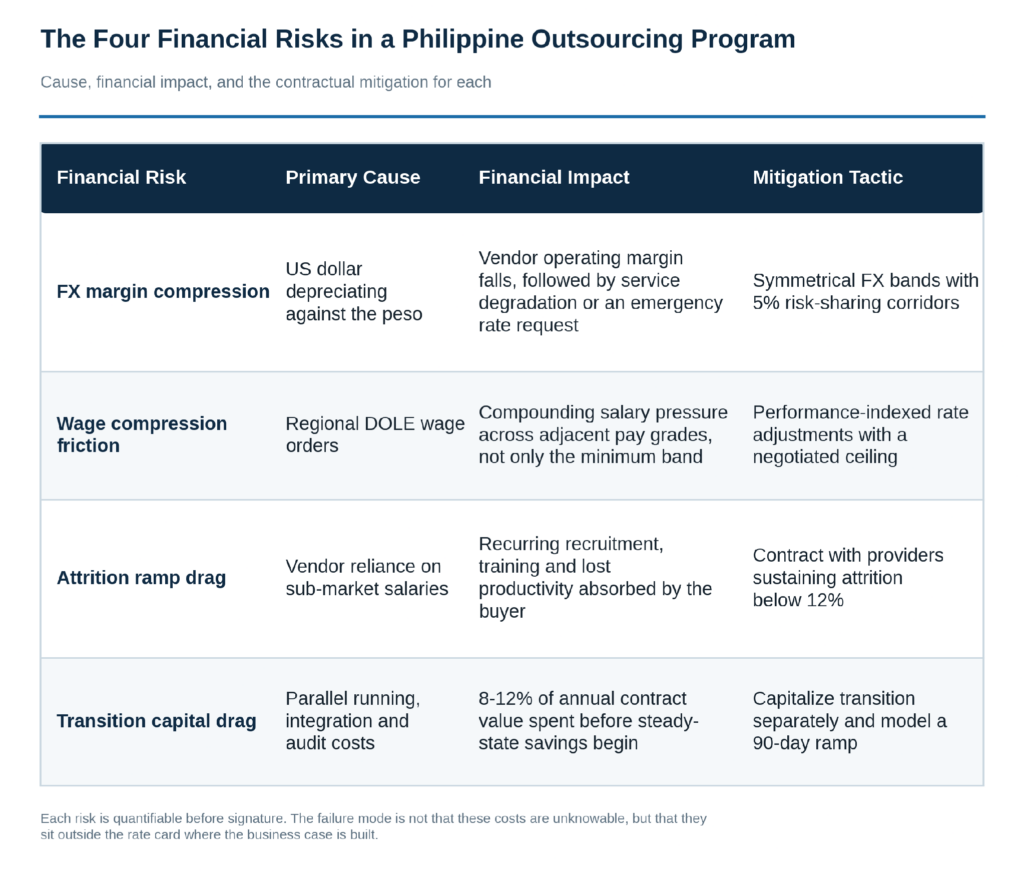
Figure 1. The four financial risks in a Philippine outsourcing program, with cause, impact, and mitigation for each.
How Does Currency Fluctuation Impact Long-Term BPO Contract Pricing?
Most Philippine contracts bill in US dollars while the provider pays salaries, leases, and statutory benefits in pesos. When the dollar depreciates, provider margin compresses and the buyer eventually absorbs the consequence through service degradation or an emergency rate request. A symmetrical corridor prices that risk in advance.
The exposure is structural rather than exceptional. A provider carrying peso-denominated costs against dollar revenue has no hedge unless the contract creates one, and unhedged margin compression does not stay a vendor problem for long. It surfaces first as reduced hiring quality, then as thinner supervision, then as a request to reopen the rate. Each of those costs the buyer more than the currency movement would have.
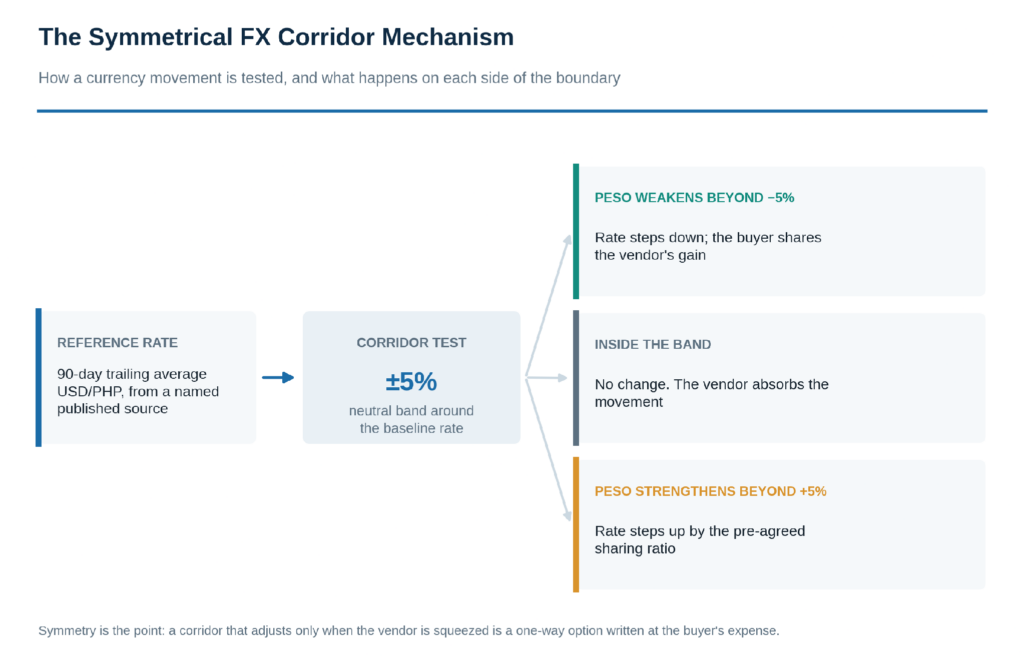
Figure 2. The symmetrical FX corridor mechanism: how a movement is tested and what happens on each side of the boundary.
Why Symmetry Is the Word That Matters
A corridor that adjusts pricing only when the peso strengthens is a one-way option written at the buyer’s expense. Genuine risk sharing moves in both directions: if the buyer funds an increase when the currency runs against the provider, the buyer receives a reduction when it runs in the provider’s favor. Providers rarely propose the downside leg voluntarily, and its absence is a reliable indicator of how the rest of the agreement has been drafted.
Specify the Mechanism, Not Just the Band
Three details determine whether a corridor works in practice: the reference rate source, the averaging window, and the sharing ratio outside the band. A 90-day trailing average from a named published source prevents either party from timing an adjustment request around a single volatile day. The sharing ratio should be explicit — an equal split is common and defensible — and the adjustment should apply only to the peso-denominated cost base, not to the total invoice.
How Do Statutory Wage Orders Affect Long-Term Program Costs?
Regional wage boards adjust minimum wages on independent cycles, and Article 124 of the Labor Code requires correcting the wage distortion those increases create across adjacent pay grades. The cost impact therefore extends well beyond agents paid at the floor, and it compounds across a multi-year term.
Philippine wages are set regionally. In Metro Manila, Wage Order NCR-27 raised the non-agricultural daily minimum to ₱755 on 25 July 2026, with a second tranche taking it to ₱780 in January 2027. Most enterprise BPO talent sits well above the floor, which is precisely why CFOs underestimate the exposure: the direct effect on minimum-wage earners is small, but the distortion effect is not. When the floor rises, the differential between entry agents, tenured agents, and team leaders narrows, and Article 124 obligates the employer to restore a rational structure. The result is compounding pressure across the whole pay scale.
Absorb Wage Orders Through an Indexed Cap
The right instrument is a performance-indexed rate adjustment: annual movement tied to published benchmarks, capped at a negotiated ceiling, applied to the labor component only, and released only where performance thresholds were met. This converts an unpredictable renegotiation into a mechanical, budgetable adjustment. Critically, it also prevents the provider from applying a wage-order justification to facilities, technology, and margin — costs that do not move with Philippine wage inflation.
What Hidden Capital Costs Erode Initial BPO Cost Reduction Projections?
Transition capital is a material share of annual contract value: parallel running, knowledge transfer, network provisioning, licensing, and third-party security audits. Add a 90-day ramp before full proficiency. Modeling these inside the run-rate saving overstates year-one benefit and understates year-one cash requirement; a three-year total cost of ownership view keeps them where the board can see them.
The most common error in outsourcing financial models is treating the offshore rate as though it applies from day one. It does not. During transition the buyer funds two teams simultaneously, provisions redundant network capacity, licenses the software stack — the digital foundations the program will run on — for a workforce that is still being hired, and commissions the security audits — SOC 2 Type II, HIPAA assessments where relevant — that the new environment requires. None of that is optional, and none of it appears in a rate comparison, which is why what it costs to run a Philippine call center is a different question from what a provider charges per hour.
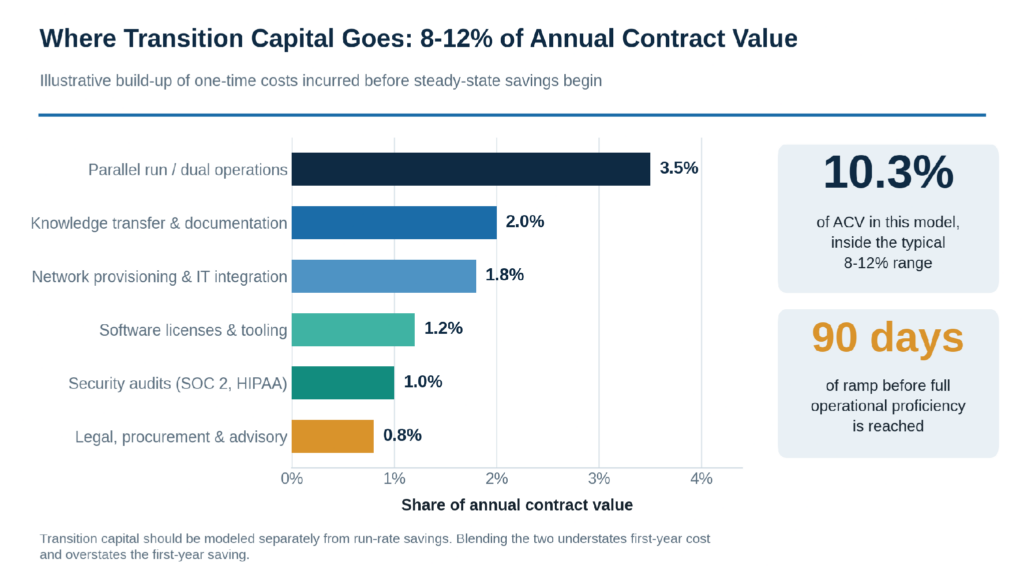
Figure 3. Where transition capital goes, as a share of annual contract value, alongside the ramp period before full proficiency.
Model the Ramp, Not Just the Rate
A 90-day learning curve means the buyer pays for output it does not fully receive during the first quarter. Build this into the model explicitly: assume partial productivity in month one, a steep climb through month two, and full proficiency by the end of month three, and treat the shortfall as a transition cost rather than a service failure. Programs that skip the parallel run to protect the first-year number generally pay for it in quality incidents during the second quarter, which is a more expensive way to buy the same weeks.
How Does Agent Attrition Translate Into Financial Drag?
Each departure carries recruitment, classroom and nesting time, and a productivity ramp during which the buyer is billed for partial output. On a 100-FTE program, the difference between a stable floor and a high-churn one adds up to a substantial annual sum in direct replacement cost alone — before any service-quality effect.
Attrition is where a low bill rate quietly repays itself to the provider. A rate built on sub-market salaries produces turnover well above the industry’s healthy range, and a floor at that level never holds a majority of fully productive agents, because most of the team is inside the ramp curve at any given time. The buyer pays the agreed rate for a permanently junior operation.
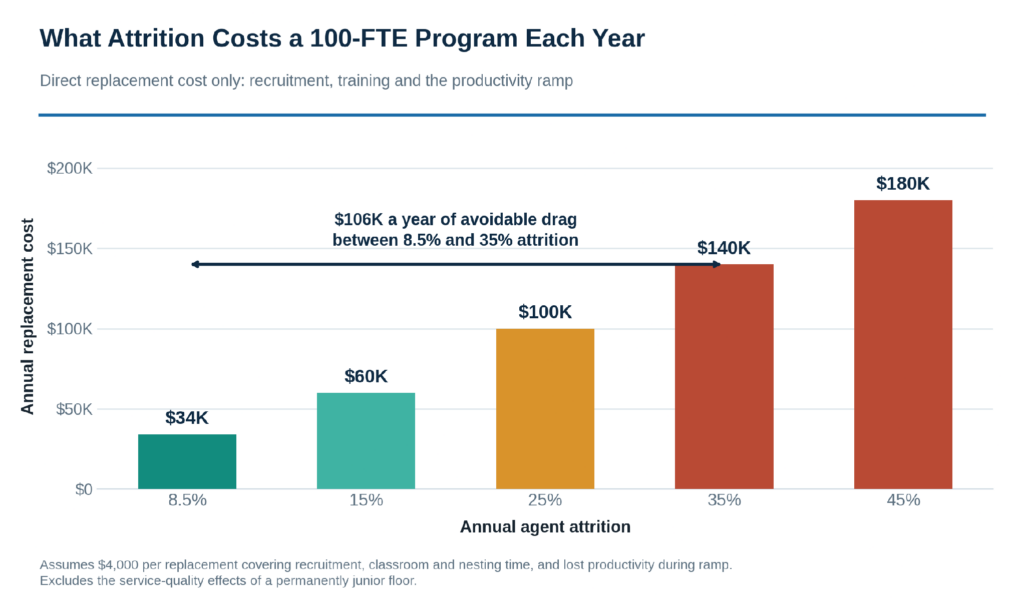
Figure 4. Annual direct replacement cost for a 100-FTE program across attrition levels.
The chart understates the true position, deliberately. It counts only direct replacement cost, not the longer handle times, higher error rates, increased escalation volume, and additional client-side management that a high-churn floor generates. Those effects are harder to quantify precisely, but they run in the same direction and are usually larger.
A low billable rate looks attractive on a procurement spreadsheet, but if it relies on suppressed wages, it triggers a cycle of churn, retraining, and operational drag that eliminates your margin savings. True financial leadership in BPO means modeling the total cost of delivery from day one.
— John Maczynski, CEO, PITON-Global
What Does a Risk-Mitigated Financial Structure Deliver in Practice?
A North American financial services firm running 100 back-office FTEs was materially over budget from currency swings and runaway attrition. Restructuring around a symmetrical FX corridor, a wage-indexed rate cap, and tenure-linked bonuses stabilized costs at a deep net run-rate saving, brought turnover down to a fraction of its former level, and recouped transition capital in five months.
Client Challenge
The firm was carrying a significant budget overrun on a 100-FTE program with a low-cost Philippine provider. Two causes compounded: currency movement had pushed the provider into margin pressure it responded to by suppressing wages, and the resulting attrition generated continuous replacement cost the original business case had never modeled. Neither risk was visible in the rate card the program had been approved against.
Audit and Vendor Selection
PITON-Global conducted a financial audit of the program and matched the client with a vetted mid-market Philippine provider holding genuine balance sheet reserves and specialized fintech delivery experience. Financial solvency was treated as a selection criterion in its own right — a provider without reserves cannot absorb a currency swing or a wage order without cutting somewhere the buyer will eventually feel.
Solution Implemented
The resulting three-year master services agreement combined a symmetrical FX corridor, a capped wage-indexed rate adjustment, and performance bonuses tied explicitly to agent tenure rather than to short-term throughput. Each instrument addressed one of the three failure modes that had produced the overrun.
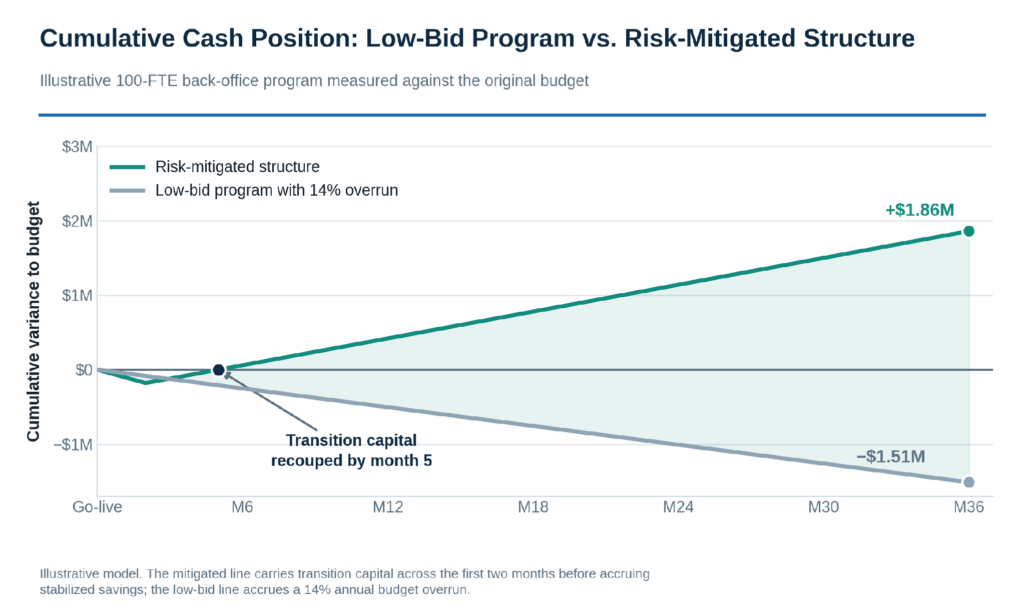
Figure 5. Cumulative cash position against the original budget: low-bid program versus risk-mitigated structure.
Outcomes and Lessons
Operating costs stabilized at a deep net run-rate saving across the 36-month term, annual turnover fell to a fraction of its prior level, and all transition capital was recouped within five months of go-live. The lesson generalizes beyond this program: currency risk-sharing and workforce compensation are the same problem viewed from two angles. A provider squeezed by either one protects margin through the wage line, and the wage line is what determines whether the buyer’s service holds.
How Does PITON-Global Reduce Financial Risk in Philippine Outsourcing?
PITON-Global is a BPO advisory and sourcing consultancy specializing in enterprise placements across the Philippines. Operating as an independent advisor rather than a transaction broker, it protects client capital through financial and operational diligence on every provider it recommends.
Who Is PITON-Global?
PITON-Global advises enterprise buyers on Philippine outsourcing across provider selection, financial modeling, and commercial structuring. Its relevance to a CFO evaluation is specific: assessing whether a provider can survive a wage order or a currency swing requires reading its financial position, not its capability deck. In a market of more than 1,000 contact centers and back-office operations, solvency, client concentration, and reserve depth vary enormously and none of it is disclosed in a proposal.
How Does PITON-Global Differ from Traditional Outsourcing Brokers?
A transaction broker earns when a placement happens, which narrows the recommendation set to whichever providers pay best and ends the relationship at introduction. An advisory-led model is organized around the client’s outcome: independent evaluation, recommendations that may include providers with no commercial relationship to the advisor, and continued engagement through modeling, negotiation, and governance. On financial risk work the distinction is concrete, because an intermediary paid on placement has no reason to report that a shortlisted provider is thinly capitalized.
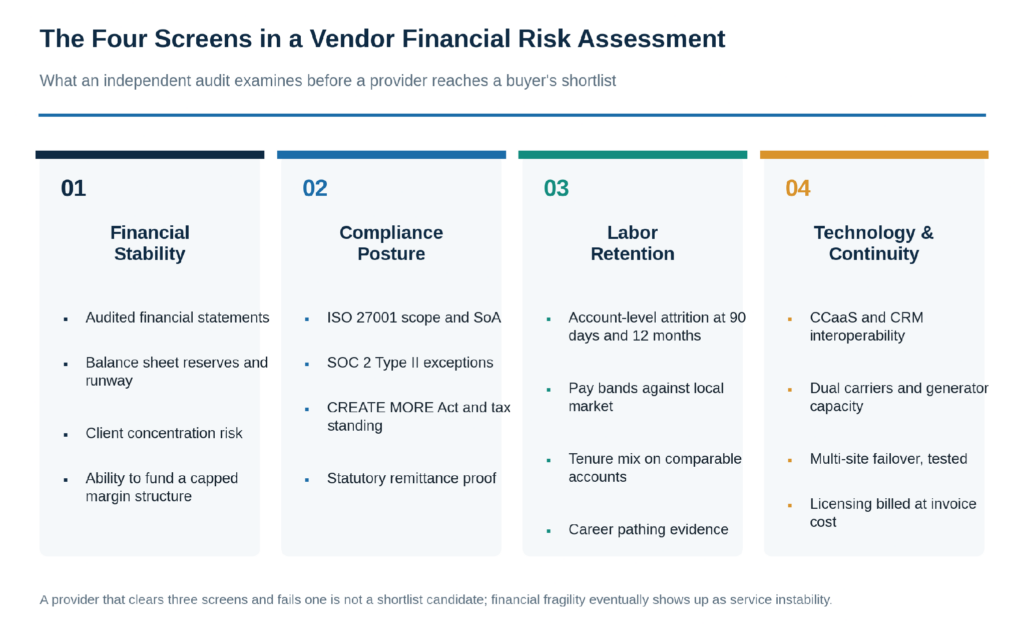
Figure 6. The four screens applied in a vendor financial risk assessment before a provider reaches a shortlist.
How Does PITON-Global’s Network of 100+ Vetted Philippine BPO Providers Benefit Organizations?
The network spans audited providers across voice and CX, back office and finance, healthcare and claims, IT and technical support, and specialist verticals in Manila, Cebu, Clark, and Davao — each evaluated for financial solvency and operational history before entering it. Because the screening has already happened, buyers start from a field where every candidate could realistically deliver and survive the term, and qualification compresses from months to weeks.
How Does PITON-Global’s Advisory-Led Vendor Matching Process Work?
Matching runs from requirement definition through to executed terms. Scope, volumes, coverage hours, and financial constraints are documented; the vetted network is filtered on domain expertise, financial health, and cultural alignment; competing proposals are restated onto one fully loaded basis so friction and transition costs can be modeled rather than assumed; shortlisted providers are validated on balance sheet position, compliance standing, attrition history, and continuity capability; and the buyer is supported through negotiation of the FX corridor, indexed cap, and total cost of ownership model that will govern the term.
Why Do Organizations Use PITON-Global?
- Reduced financial risk. Diligence on solvency, compliance standing, and attrition history surfaces exposure before it reaches the contract.
- Financial model architecture. Guidance on structuring symmetrical FX bands, performance-indexed caps, and total cost of ownership models.
- Objective matching. Vendor-agnostic placement based on financial health, domain expertise, and cultural alignment rather than on referral economics.
- Accelerated selection. A pre-audited shortlist compresses a discovery cycle that typically runs for months into weeks.
- Protected capital. Transition budgets, ramp assumptions, and contingency are modeled explicitly rather than discovered in the first quarter.
Frequently Asked Questions
How do statutory wage orders in the Philippines affect outsourcing contracts?
Regional wage boards adjust statutory minimums on their own cycles, and Article 124 obligations extend the effect across adjacent pay grades. Contracts should include performance-indexed rate adjustments so increases flow through smoothly at documented cost rather than arriving as a sudden rate request mid-term.
What is a symmetrical FX corridor in BPO contracts?
A contractual mechanism where client and vendor share currency risk within pre-agreed boundaries — commonly a narrow band around a baseline rate — with billing adjusting only when movement exceeds the band. Symmetry means adjustment applies in both directions, not only when the provider is squeezed.
What percentage of ACV should be budgeted for BPO transition costs?
Budget a material share of annual contract value — a figure the provider should state explicitly in its proposal — to cover parallel running, knowledge transfer, network provisioning, licensing, security audits, and legal and compliance fees. Capitalize it separately from run-rate savings, and add the productivity shortfall across the 90-day ramp.
How does agent turnover directly impact a BPO program’s financial return?
Turnover repeatedly triggers recruitment fees, extends average handle times, raises error rates, and increases management oversight, each of which offsets the labor saving that justified the program. On a 100-FTE operation, the direct replacement cost gap between a stable team and a high-churn one is a substantial annual sum.
What financial compliance standards must Philippine BPO vendors meet?
Require audited financial statements, ISO 27001 and SOC 2 Type II certification with the scope covering your site and service, and evidence of compliance with local tax obligations including the CREATE MORE Act and statutory benefit laws. Verify statutory remittances through government receipt schedules rather than attestation.