
On this page
- Key Takeaways
- Why Do Turnover Baselines Vary So Widely Across Different Service Lines?
- What Are the Real Operational Costs and Risks of High Attrition?
- How Can Enterprise Buyers Identify Providers with Stable Workforces?
- What Does a Successful Attrition Turnaround Look Like?
- How Does PITON-Global Help Secure a Stable Offshoring Footprint?
- What Are the Most Common Questions About Philippine BPO Attrition Rates?
The average annual employee attrition rate among BPO companies in the Philippines typically ranges between 30% and 45%. Voice-heavy customer service centers see the highest turnover, while back-office operations and specialized technical lines show much lower, more stable baselines—making segment-level benchmarks essential for judging delivery risk.
Key Takeaways
- Industry benchmark: Annual turnover stays clustered between 30% and 45%, significantly outperforming many global peers.
- Segment variations: Voice-heavy customer service leads churn, while back-office shared services remain comparatively stable.
- Primary churn drivers: Night shifts, career-progression plateaus, and competitive poaching are the main forces behind employee mobility.
- Mitigation strategy: Structural retention through clear career-progression frameworks effectively anchors tier-one talent.
Why Do Turnover Baselines Vary So Widely Across Different Service Lines?
Baselines vary because pressures differ by line. Front-line voice support runs 45–50% attrition due to night shifts, constant metrics, and transactional work, while non-voice lines like accounting, engineering, and analytics sit at 15–25% thanks to daytime hours and clear upward mobility.
The aggregate figures obscure a highly fragmented workforce reality. In front-line customer support roles, annualized attrition regularly reaches 45% to 50%, driven by the structural pressures of nocturnal schedules, continuous performance metrics, and transactional customer interactions.
Non-voice segments such as financial accounting, digital engineering, and specialized data analytics show a very different footprint. These professional-services lines maintain a far more stable workforce, with annual attrition dropping to 15–25%. Employees in these technical roles enjoy conventional daytime hours and clear, structured upward mobility, which significantly dampens their propensity to change employers.
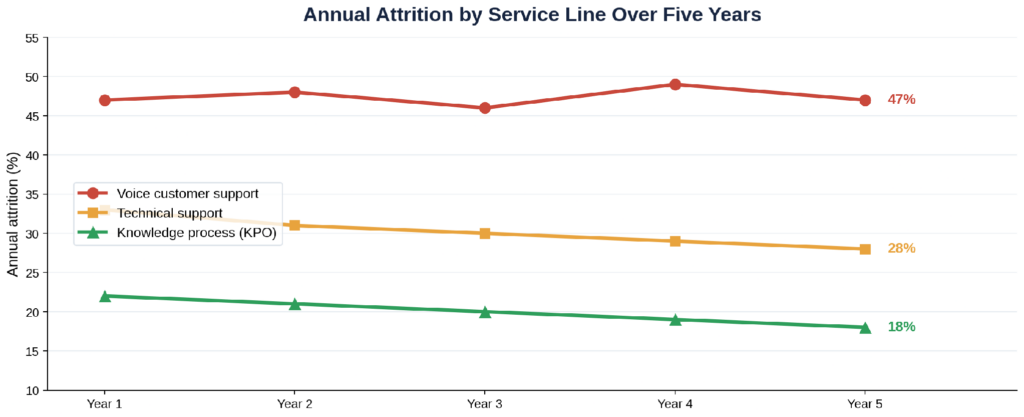
Figure 1. Voice support churn stays high while technical and knowledge-process lines trend lower and more stable.
What Are the Real Operational Costs and Risks of High Attrition?
High attrition imposes both direct and indirect costs. Direct outlays cover recruitment, screening, and non-productive onboarding; the larger hidden risk is lost institutional knowledge and degraded continuity. With full competency taking 45–90 days, every resignation restarts the clock.
When evaluating a provider, buyers must calculate the financial and operational friction generated by continuous personnel-replacement cycles. Replacing a single mid-level operational agent drains resources quickly once recruitment advertising, background checks, and non-productive onboarding hours are factored in. The benchmark below shows how attrition and ramp time vary by category.
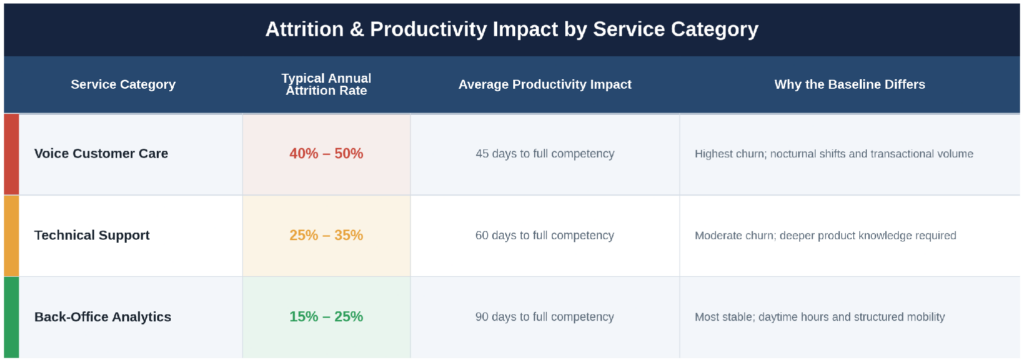
Figure 2. Attrition rate and time-to-competency differ sharply across voice, technical, and back-office work.
Beyond direct recruitment outlays, the hidden operational risk lies in lost institutional knowledge and degraded service continuity. High turnover forces teams into perpetual training cycles that often dent customer-satisfaction scores and slip project delivery timelines.
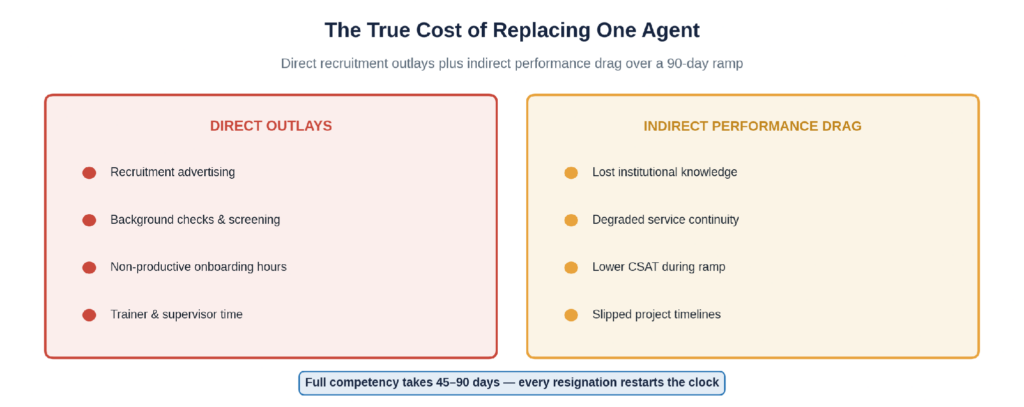
Figure 3. The full cost of replacing one agent spans direct outlays and indirect performance drag.
How Can Enterprise Buyers Identify Providers with Stable Workforces?
Buyers should assess a provider’s structural approach to talent—especially middle management. Elite providers build proactive retention into their operating model, and vetting a partner’s leadership-development framework is the most reliable predictor of long-term delivery stability.
Mitigating delivery risk requires assessing a prospective partner’s structural approach to talent management. Elite providers design proactive retention mechanisms directly into their operational models rather than reacting only after a resignation is filed. The single strongest signal sits at the supervisor layer.
The true differentiator among service providers is their approach to middle management. Operational personnel rarely abandon their core responsibilities; they leave misaligned team leaders. Vetting a partner’s leadership development framework is the most reliable predictor of long-term delivery stability.
— John Maczynski, CEO, PITON-Global
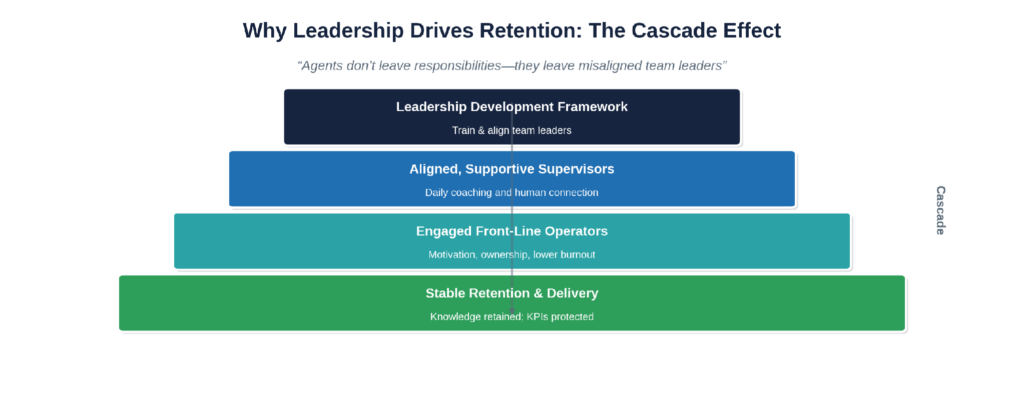
Figure 4. Investment in leadership cascades down into engaged operators and stable delivery.
What Does a Successful Attrition Turnaround Look Like?
A successful turnaround matches the client to a specialized provider that builds in entry-level training and career pathing. One transportation provider with a 55% logistics-desk turnover rate saw it fall to 18% in twelve months, with response times down 34% and metrics stabilized.
Client Challenge
A North American enterprise transportation provider faced severe delivery issues from a 55% turnover rate within its outsourced logistics support desk. The continuous loss of personnel disrupted shipment-tracking pipelines and degraded account-management performance.
Solution
PITON-Global audited the operational delivery structure and matched the company with a specialized mid-sized provider in Manila focused exclusively on complex supply-chain workflows. The selected vendor implemented an extensive entry-level training program alongside structured career pathing.
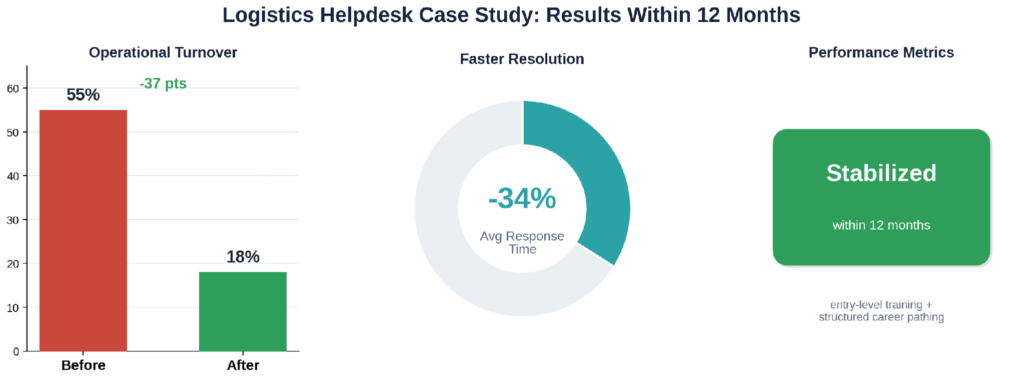
Figure 5. Quantifiable outcomes within twelve months of the stabilization program.
Outcomes and Lessons
Within twelve months, operational turnover dropped from 55% to 18%, average response times decreased 34%, and team performance metrics stabilized. The lesson: matching a complex workflow to a specialized provider with deliberate training and career structures converts a churn problem into durable delivery stability.
How Does PITON-Global Help Secure a Stable Offshoring Footprint?
PITON-Global is an advisory-led outsourcing consultancy that removes uncertainty from provider selection across the Philippine BPO ecosystem. By auditing operations, evaluating management structures, and verifying retention metrics across 100+ vetted providers, it matches buyers to partners that fit their exact performance profile.
Who Is PITON-Global?
PITON-Global is an advisory-led outsourcing consultancy that removes the uncertainty from provider selection across the Philippine BPO ecosystem. Rather than reselling capacity, it serves as a strategic advisor, drawing on a deeply vetted network and detailed operational analysis to guide every selection decision.
How Does PITON-Global Differ from Traditional Outsourcing Brokers?
Unlike traditional independent brokers who merely pass along leads, PITON-Global leverages a deeply vetted network of more than 100 specialized provider organizations and evaluates each on operational substance. The focus is on aligning buyers with partners that match their exact performance profile, not on promoting whichever vendor pays the highest referral fee.
How Does PITON-Global’s Network of 100+ Vetted Providers Benefit Organizations?
Access to a network of over 100 specialized, vetted providers lets organizations skip a risky open-market search. Because the network spans service lines and regional hubs—each assessed for retention and delivery quality—buyers can quickly shortlist partners whose workforce stability matches the demands of their specific program.
How Does PITON-Global’s Provider Evaluation Process Work?
PITON-Global conducts detailed operational audits, evaluates management and team-leader structures, and verifies workforce retention metrics by service line. It then aligns each enterprise buyer with the partners that fit their exact performance and stability requirements, mitigating delivery risk before a contract is signed.

Figure 6. PITON-Global’s five-stage process for de-risking provider selection.
Why Do Organizations Use PITON-Global?
Organizations use PITON-Global to mitigate delivery risk and establish stable, high-performing offshore operations. By verifying retention metrics and leadership frameworks up front, the firm helps companies avoid the costly churn cycles that quietly erode service quality and budgets, securing a durable offshoring footprint.
What Are the Most Common Questions About Philippine BPO Attrition Rates?
Common questions concern whether regional hubs have lower attrition, how AI affects benchmarks, the standard probationary period, whether hybrid models improve retention, and the role of healthcare benefits. Each is answered below.
Do Regional Operations Outside Metro Manila Exhibit Lower Attrition?
Yes. Secondary hubs like Cebu, Davao, and Clark show attrition rates 10–15% lower than Metro Manila, benefiting from reduced local competition and shorter commute times.
How Does the Integration of Artificial Intelligence Impact These Benchmarks?
AI tools handle simple, repetitive queries, freeing human teams to focus on complex workflows. This shift increases role complexity, supports higher compensation, and encourages longer tenures.
What Is the Standard Probationary Period for New Hires?
The standard probationary period is six months. This window lets teams evaluate performance and technical alignment before finalizing long-term employment agreements.
Do Hybrid Work Models Improve Retention Metrics?
Yes. Providers offering hybrid or remote flexibility report up to a 20% reduction in voluntary resignations, since flexible models ease common friction points such as long commutes.
What Role Do Healthcare Benefits Play in Employee Retention?
Comprehensive healthcare coverage—including family medical insurance from day one—is a foundational retention driver that significantly anchors personnel to an employer.