

Hospitals outsourcing to the Philippines should hold every healthcare BPO partner — from coding desks to patient-access and RCM teams serving North American hospitals — to strict SLAs covering clinical documentation accuracy, first-pass clean-claim rates, and average speed of answer for patient support (under 30 seconds), each backed by enforceable data-security guarantees that protect patient health information.
Key Takeaways
- Clinical accuracy: demand near-perfect accuracy for transcription and coding to prevent downstream denials.
- Financial integrity: write a high first-pass clean-claim rate into the contract as a hard floor to optimize the revenue cycle and cash flow.
- Patient experience: mandate patient-support response under 30 seconds to protect CSAT and HCAHPS scores.
- Security compliance: enforce zero-tolerance clauses for data-privacy breaches under HIPAA and GDPR.
What Financial Metrics Directly Impact Revenue Cycle Performance?
The revenue cycle is a hospital’s financial lifeblood, so financial SLAs cannot be vague. Demand a high first-pass clean-claim floor, DSO under 35 days, denial resolution within 72 hours, and a tightly capped A/R-over-90-days bucket.
When partnering with a healthcare BPO provider, the financial benchmarks below should be written into the contract as non-negotiable, institutional-grade thresholds — each tied to a defined consequence if missed.

These thresholds are not abstract; each one attaches to a specific point in the revenue cycle, from eligibility — where real-time insurance verification secures revenue at the point of service — and coding through claim submission and collections. Mapping the SLA to the stage it governs makes accountability concrete.
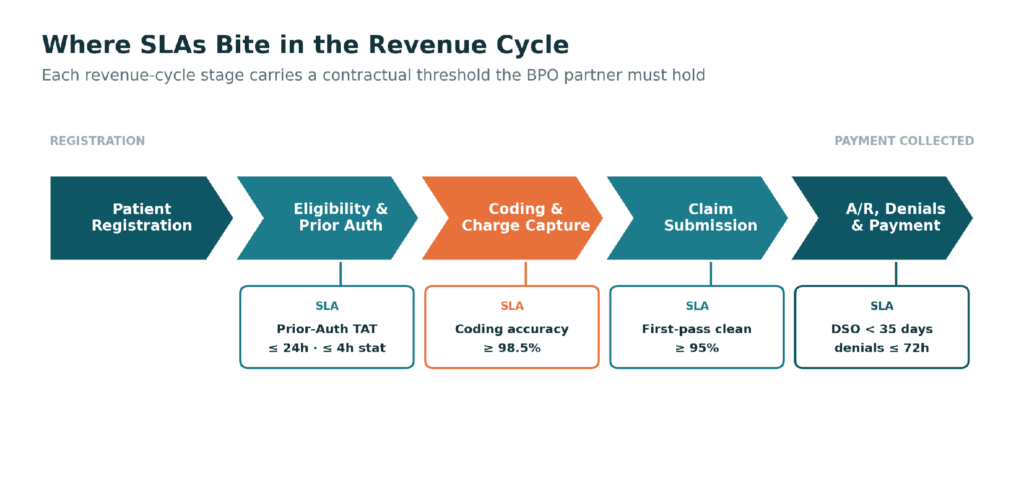
A critical tradeoff runs underneath all of this: speed versus quality. An offshore provider may promise rapid claim submission, but rushing pre-authorization or coding spikes back-end denials. Hospitals should incentivize accuracy over raw volume to maximize long-term collections and protect operating margins, the lever behind the EBITDA improvement health systems can expect.
How Do Operational and Quality Metrics Protect Patient Care?
Operational SLAs protect the patient experience directly. Require near-perfect medical coding accuracy, average speed of answer under 30 seconds, a low abandonment ceiling, and prior-authorization turnaround within 24 hours for routine and 4 hours for urgent cases.
Beyond finance, operational efficiency shapes clinical outcomes and patient trust. The Philippine BPO sector pairs an English-fluent workforce — frequently including licensed registered nurses — with complex clinical tasks, but that quality only materializes when the right thresholds are enforced.
- Medical coding accuracy: a near-perfect floor on current ICD-10/11 and CPT frameworks, audited monthly by independent certified coders.
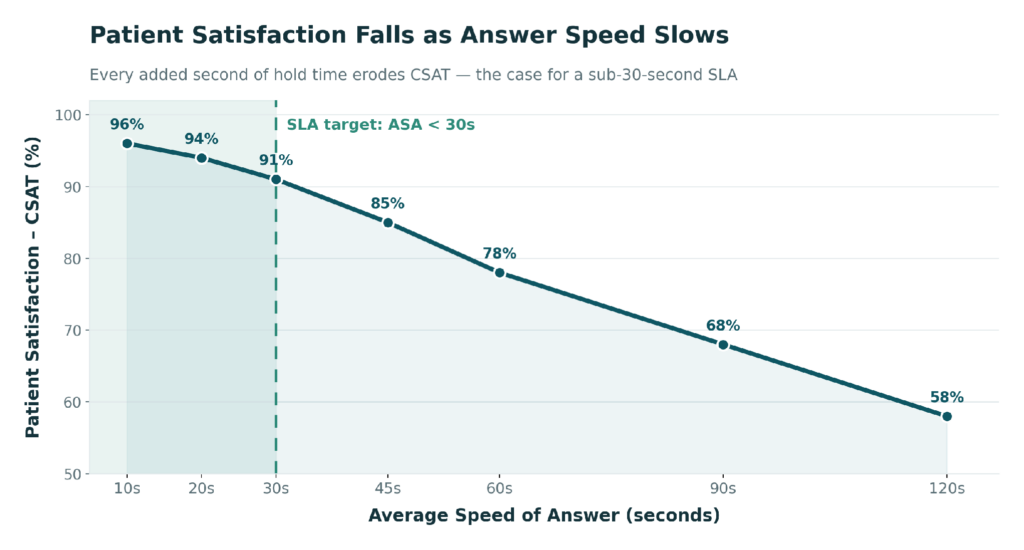
- Average Speed of Answer (ASA): under 30 seconds for scheduling, eligibility, and billing inquiries.
- Abandonment rate: a low, contractually capped rate so patients are not disconnected during peak inbound hours.
- Prior-authorization TAT: within 24 hours for routine requests and 4 hours for urgent or stat cases.
Response speed is not a soft metric — it tracks directly with satisfaction. As average speed of answer climbs past the 30-second mark, CSAT falls sharply, which is precisely why the threshold belongs in the contract.
Many hospital executives make the mistake of treating healthcare BPO as a generic customer-service function. In healthcare, a delayed response or an incorrectly coded chart isn’t just an inconvenience — it’s an immediate compliance risk and a direct threat to patient trust. Your SLAs must treat the offshore vendor as a seamless, high-fidelity extension of your clinical team.
— John Maczynski, CEO of PITON-Global
What Data Security and Compliance Mandates Are Non-Negotiable?
Data security is the most critical clause in any international healthcare agreement. Mandate a zero-tolerance breach clause, continuous independent SOC 2 Type II and HITRUST auditing, and end-to-end AES-256 encryption with secure VDI — reinforced by the Philippines’ Data Privacy Act of 2012.
The Philippine BPO sector is heavily regulated under Republic Act No. 10173, the Data Privacy Act of 2012, which closely mirrors GDPR and HIPAA. Even so, contract language must spell out accountability explicitly through the following clauses.
Zero-Tolerance Breach Clause
Any unauthorized access, exposure, or leakage of protected health information must trigger immediate, severe financial penalties, full indemnification of the hospital, and grounds for immediate contract termination.
Continuous Independent Auditing
The provider must maintain current SOC 2 Type II and HITRUST certifications and permit independent third-party security audits annually, at the vendor’s expense.
End-to-End Encryption & Technical Controls
All data moving between hospital systems and the Philippine delivery center must use AES-256 encryption or higher. The operational environment must enforce clean-desk policies, biometric access, disabled USB ports, and a secure VDI that prevents any local data storage.
How Did One Hospital Network Recover Its Annual Revenue Leakage?
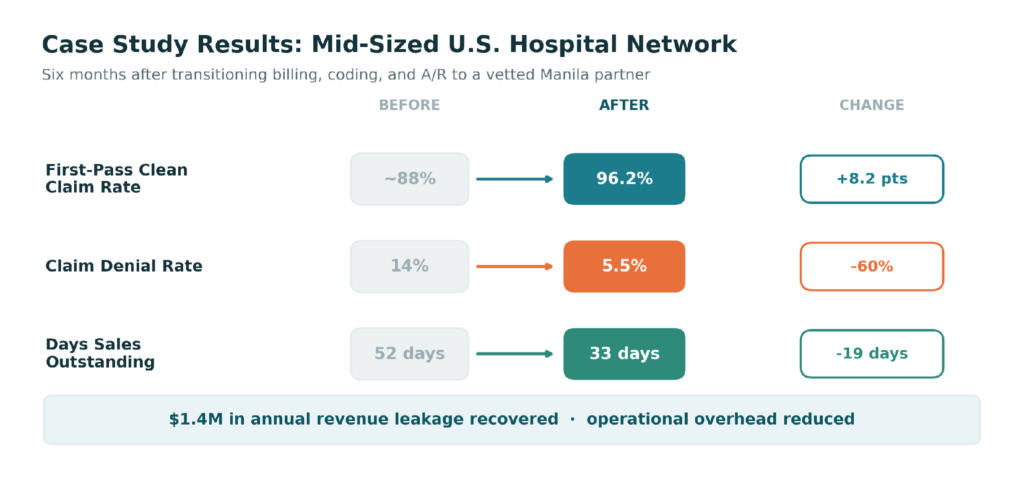
Facing a high denial rate and 52-day DSO, a mid-sized U.S. hospital network transitioned billing, coding, and A/R to a vetted Manila partner under strict SLA penalties. Within six months, the first-pass clean-claim rate climbed sharply, denials fell steeply, DSO dropped to 33 days, and the network recovered substantial annual revenue.
The Challenge
A mid-sized U.S. hospital network faced a high claim-denial rate, DSO ballooning to 52 days, and rising costs inside its internal billing department.
Selection and Solution
Partnering with PITON-Global, the hospital evaluated specialized Manila BPOs through a strict matrix focused on clinical coding certifications, HITRUST compliance, and healthcare-exclusive infrastructure. It then transitioned complex billing, coding, and A/R to the vetted provider, embedding SLA penalties for accuracy deviations and daily performance tracking.
The Outcomes
Within six months, the first-pass clean-claim rate climbed sharply, denials fell steeply, and DSO dropped to 33 days — recovering significant annual leakage while reducing operational overhead.
A clean transition required documenting legacy internal rules and establishing transparent communication protocols up front, preventing early friction between onshore clinical staff and offshore administrative teams.
How Does PITON-Global De-Risk the Outsourcing Process?
PITON-Global is an advisory-led BPO consultancy in Manila that guides enterprise buyers through vendor selection, contract negotiation, and SLA structuring. Drawing on a vetted network of 100+ specialized Philippine providers, it matches hospitals to partners with proven compliance, credentialing, and RCM track records.
Rather than acting as a broker that passes leads to the highest bidder, PITON-Global serves as a strategic, advisory-led partner across the full lifecycle of vendor selection, contract negotiation, and SLA structuring.
With a meticulously vetted network of more than 100 specialized Philippine call-center and back-office providers, PITON-Global matches hospitals to vendors with proven records in healthcare compliance, credentialing, and revenue cycle management. Healthcare organizations use that institutional knowledge to eliminate structural risk, avoid hidden deployment costs, and accelerate time-to-market with confidence.
What Do Hospitals Most Often Ask About Healthcare BPO SLAs?
Common questions cover SLA-miss penalties, nurse availability, time-zone coverage, review cadence, and direct EHR integration. Concise answers follow.
What happens if a provider misses an SLA?
Contracts should include tiered service-level credits. If a critical metric is missed — say coding accuracy falling below its contracted floor — the provider forfeits a pre-negotiated share of the monthly invoice for each violation until performance is remediated and sustained.
Are registered nurses available for healthcare BPO roles?
Yes. The Philippines has a large surplus of licensed registered nurses working in the BPO sector, deployed for high-complexity tasks like clinical documentation improvement, utilization review, coding, and complex triage support.
How are time-zone differences managed for live patient support?
Providers run dedicated 24/7/365 shifts aligned exactly to Eastern, Central, Mountain, or Pacific time, ensuring real-time support, eligibility verification, and instant responsiveness.
How often should SLA metrics be reviewed?
Monthly during the first 12 months to smooth out bottlenecks, quarterly thereafter — and whenever payer rules shift or the hospital adopts a new EHR platform, as part of a broader governance framework for the vendor relationship.
Do providers support direct EHR integration?
Yes. Specialized providers work inside major systems such as Epic, Cerner, or eClinicalWorks via secure, encrypted VDI, keeping all data on the hospital’s U.S. servers with no PHI stored locally in the Philippines.