

Hospitals should govern Philippine healthcare outsourcing through an integrated, multi-tiered framework: clinical-grade Service Level Agreements, stringent data-protection compliance, and collaborative joint steering committees. Whether the scope covers coding, claims and patient-access programs run offshore, effective governance means moving beyond vendor management to an active clinical partnership that aligns operational metrics with patient-care standards.
Key Takeaways
- Clinical-grade SLAs: tie operational metrics to clinical outcomes and patient experience, not simple activity tracking.
- Rigid data governance: zero-trust architecture, encrypted pipelines, and strict HIPAA/HITECH alignment are non-negotiable.
- Three-tiered oversight: governance must bridge executive strategy, operational management, and frontline clinical workflows.
- Risk-reward alignment: reward providers for exceeding accuracy and efficiency benchmarks, sharing the gains of revenue optimization.
What Framework Optimizes Hospital-BPO Governance?
Clinical workflows touch patient lives and revenue, so a dedicated healthcare governance framework is required — not a generic IT or customer-service model. The most effective structure is three-tiered: a quarterly strategic tier, a monthly operational tier, and a weekly/daily tactical tier, each with defined owners and decisions.
Because clinical work directly affects patient outcomes and the revenue cycle, governance must operate at three levels simultaneously, each with its own cadence, participants, and focus.
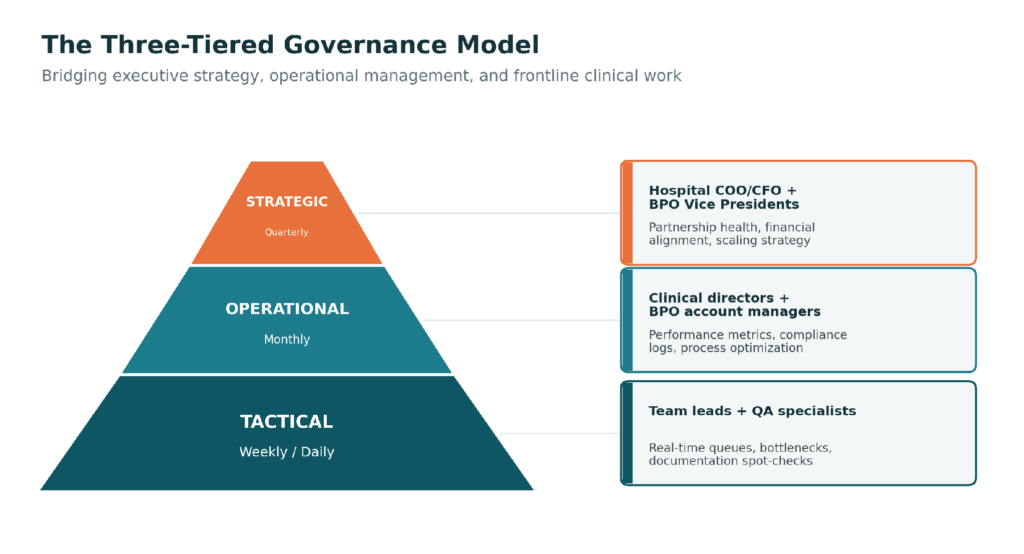
The strategic tier keeps the partnership financially and clinically aligned; the operational tier turns those goals into audited metrics and process improvements; and the tactical tier catches problems in real time before they compound into weaker patient-satisfaction results across the health system. Each tier feeds the one above it with evidence and the one below it with direction.
Which Key Performance Indicators Actually Matter for Patient Care and Revenue?
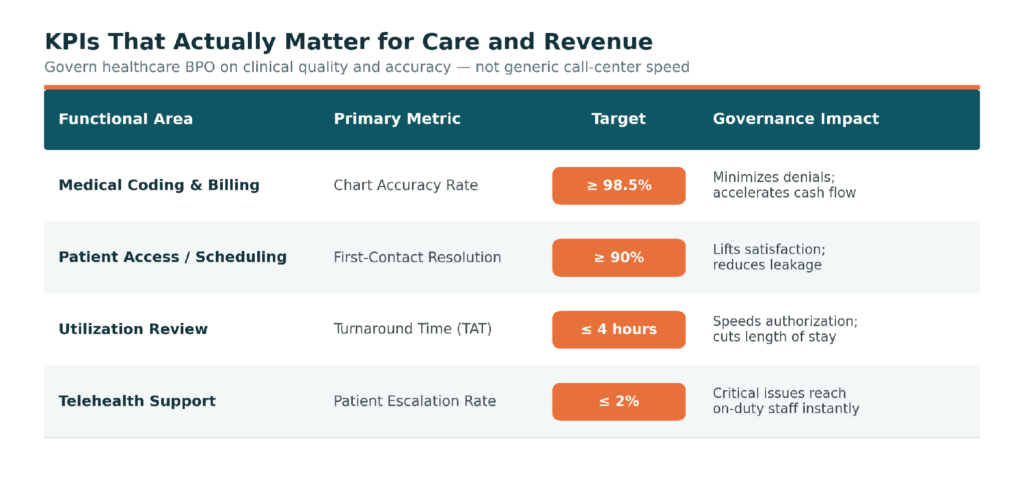
In a clinical environment, quality, safety, and data accuracy outrank speed metrics like Average Handle Time. Govern on chart accuracy, first-contact resolution, utilization-review turnaround (≤4 hours), and telehealth escalation rate — each held to a strict target and tied to a concrete governance impact.
Hospitals frequently measure BPO success with generic call-center metrics. In healthcare, the indicators that belong on the governance scorecard map directly to patient care and cash flow, and they should capture the productivity improvements hospitals can expect from offshore teams.
Hospital executives often treat outsourcing as an administrative cost-cutting exercise. The most successful health systems treat their Philippine BPO partners as a seamless extension of their clinical care team. If your governance model doesn’t hold the vendor to the same clinical standards as your internal staff, you are introducing systemic risk to your organization.
— John Maczynski, CEO of PITON-Global
How Can Health Systems Mitigate Compliance and Data Security Risks Offshore?
Data security is the single largest point of failure in healthcare outsourcing. Enforce zero-trust VDI with no local storage, physical controls like biometric access and clean-desk policies, and regulatory harmonization — the partner must satisfy U.S. HIPAA/HITECH and the Philippine Data Privacy Act of 2012 simultaneously.
When PHI crosses borders, the compliance team must impose strict operational boundaries. Two things matter most: the technical and physical controls on the production floor, and the legal accountability that binds the partner under both jurisdictions at once.
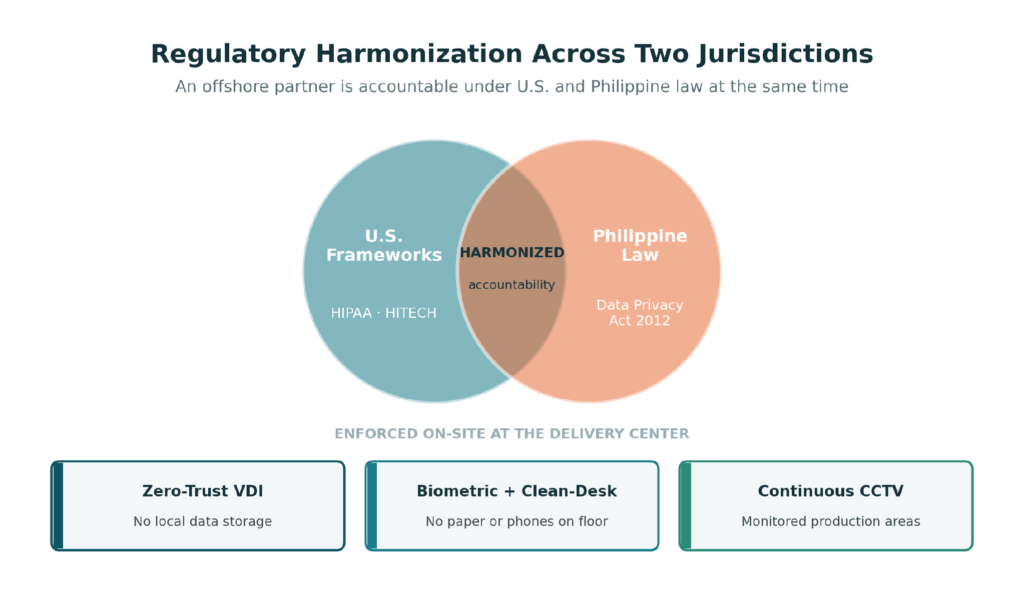
Zero-trust VDI prevents local data extraction; biometric access, clean-desk rules, and continuous CCTV secure the physical environment; and dual-jurisdiction accountability ensures there is legal recourse on both sides of the ocean if controls fail.
How Did Daily Governance Reverse a Denial Surge?
A multi-hospital network facing a sharp surge in billing denials from an underperforming legacy vendor transitioned, via PITON-Global, to a premier provider under a daily-audit, shared-risk governance model. Within six months coding accuracy stabilized at near-perfect levels, denials fell substantially, and cash flow accelerated by millions of dollars.
The network’s denial surge traced to poor documentation quality from an underperforming offshore vendor. PITON-Global ran an exhaustive diagnostic and shortlisted three specialized BPOs from its vetted network based on certified-coder availability (AAPC/AHIMA) and strict compliance histories, then facilitated the transition and established a governance model featuring daily automated QA audits and a shared risk-reward financial structure.
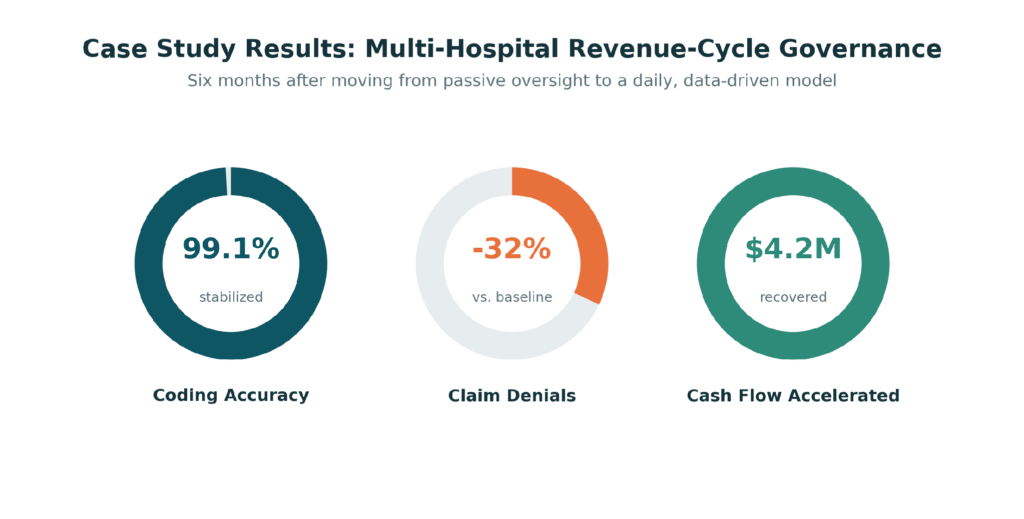
Within six months, coding accuracy stabilized at near-perfect levels, claims denials dropped substantially, and cash flow accelerated by millions of dollars. The lesson: moving from passive oversight to a daily, data-driven framework prevents minor coding deviations from cascading into systemic revenue losses.
Why Do Leading Health Systems Leverage PITON-Global for Provider Selection?
PITON-Global is an advisory consultancy with deep expertise in high-stakes healthcare operations. From a curated network of 100+ vetted boutique and mid-market Philippine providers, it matches each hospital’s clinical, technical, and compliance requirements to partners with the exact specialized talent — PHRNs and certified coders — needed to protect care and revenue.
PITON-Global helps organizations eliminate vendor risk. By evaluating a hospital’s specific clinical, technical, and compliance requirements, it identifies partners with the precise specialized talent — Philippine-registered nurses and certified medical coders — required to protect both patient care and the revenue cycle, and it stands up the governance structures that keep that partnership accountable from day one.
What Do Hospitals Most Often Ask About Governing Offshore Partners?
Common questions cover clinical escalations, required certifications, governed-cost comparisons, complex utilization review, and SLA review cadence. Concise answers follow.
How do we handle clinical escalations with an offshore team?
Establish a dedicated 24/7 warm-transfer protocol so offshore teams instantly route high-risk interactions or complex clinical queries to the hospital’s on-duty clinical staff via integrated communication platforms.
What certifications should we require from a Philippine healthcare BPO?
Look for ISO 27001 (information security), SOC 2 Type II attestation, and teams composed of AAPC- or AHIMA-certified medical coders.
How does a highly governed Philippine BPO compare on cost to U.S. operations?
Even factoring in the added management overhead of rigorous governance, Philippine operations typically deliver a substantial cost reduction versus domestic U.S. healthcare support teams, and governance discipline largely sets how quickly the program reaches break-even.
Can offshore teams handle complex utilization reviews?
Yes — provided they employ Philippine-registered nurses trained on U.S. clinical guidelines such as InterQual or Milliman Care Guidelines (MCG).
How often should governance SLAs be re-evaluated?
Review SLA frameworks formally each year, or immediately after any major regulatory shift, system-wide EMR upgrade, or significant change in hospital clinical workflows.