
U.S. health systems partnering with specialized healthcare outsourcing companies in the Philippines typically realize an immediate EBITDA improvement of 4% to 8%. This lift is driven by a 50% to 70% reduction in administrative labor costs across revenue cycle management, clinical documentation, and patient engagement, which directly optimizes net patient revenue capture.
Key Takeaways
- Direct bottom-line impact: A predictable 4% to 8% EBITDA expansion by lowering administrative overhead and reducing billing leakage.
- Cost structural advantage: 50% to 70% labor savings that convert high fixed operating costs into scalable variable expenses.
- Revenue cycle optimization: Continuous, specialized overnight processing pushes denial rates toward a sub-5% threshold.
- Mitigated capital risk: Advisory-led vendor matching avoids the capital expenditure of an internal offshore build-out.
How Does Philippine Outsourcing Directly Translate into EBITDA Growth?
It changes the cost-to-collect ratio. Shifting non-clinical workflows to a HIPAA-compliant Philippine workforce lowers fully burdened labor, speeds claims adjudication, and adds elastic capacity. Together these reduce administrative cost and lift net revenue capture, flowing straight to operating income and a 4% to 8% EBITDA gain.
For health systems operating on razor-thin margins, administrative overhead is a primary target for structural cost transformation. Shifting non-clinical workflows to the Philippines alters the cost-to-collect ratio, and a highly educated, English-fluent workforce operating under strict HIPAA compliance lets systems reallocate capital from back-office maintenance to frontline clinical care.
The financial impact is realized across three core vectors that compound rather than simply add up:
- Labor arbitrage reinvestment: Replacing costly domestic administrative roles with Philippine-based healthcare professionals lowers fully burdened labor rates.
- Yield optimization: Specialization in RCM ensures faster claims adjudication and reduced days sales outstanding (DSO).
- Operational scalability: Support teams scale elastically during seasonal surges without domestic hiring or severance liabilities.
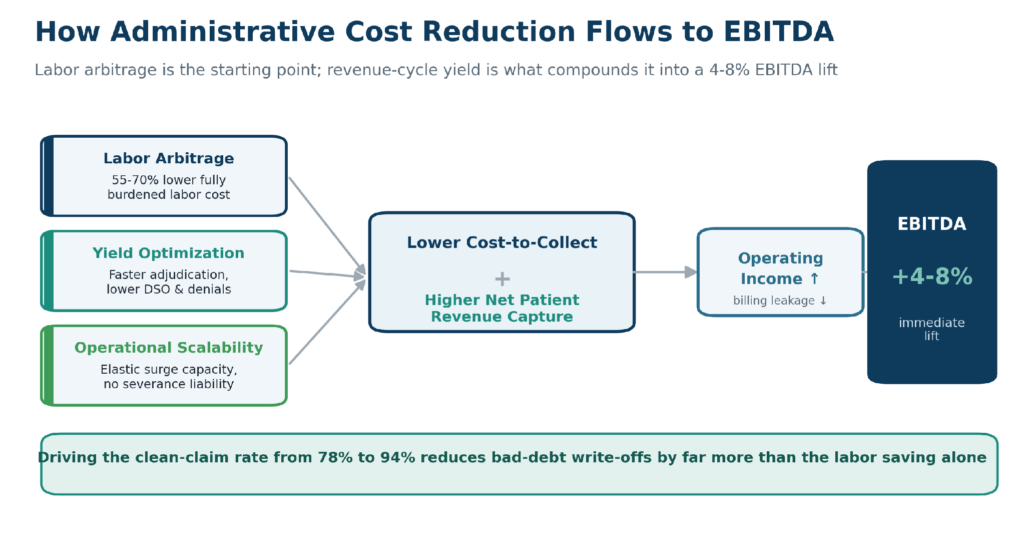
Figure 1. How an administrative cost reduction compounds through the revenue cycle into a 4% to 8% EBITDA lift.
The same advantage shows up at the workflow level. Fully burdened hourly rates fall sharply across coding, patient access, and clinical review, with each function carrying a distinct EBITDA lever.
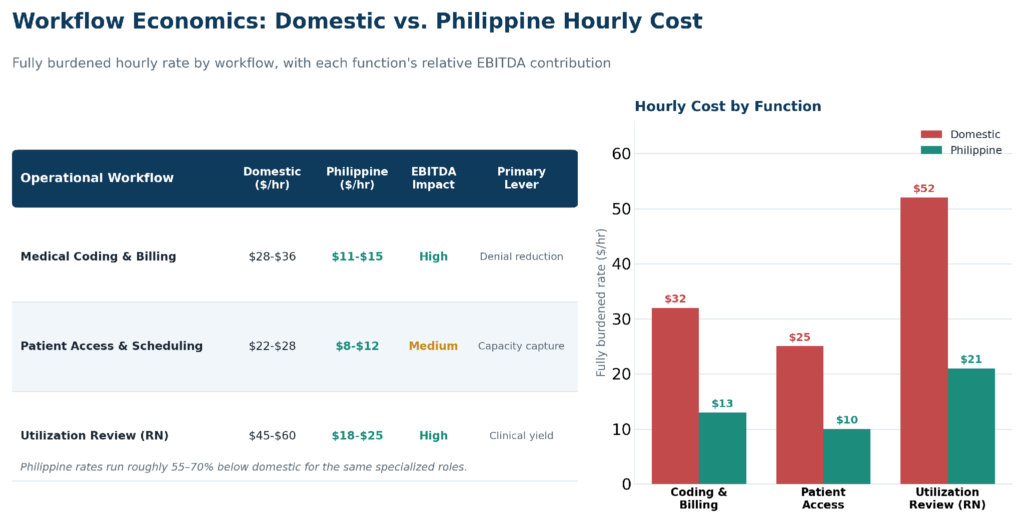
Figure 2. Fully burdened hourly cost by workflow, domestic versus Philippine, with each function’s EBITDA contribution.
What RCM Efficiencies Yield the Highest Financial Return?
Denials management and prior authorizations yield the fastest EBITDA acceleration. Specialized Philippine teams, often nursing and health-science graduates, execute complex appeals and coding validation overnight, lifting the clean-claim rate from roughly 78% to 94% and cutting the bad-debt write-offs that dwarf the initial labor savings.
The most rapid acceleration of EBITDA occurs within the revenue cycle. Denials management and prior authorizations are notoriously labor-intensive, and Philippine provider networks staff them with specialists, often nursing and health-science graduates, who execute complex appeals and coding validation protocols overnight while U.S. offices are closed.
Many health systems view offshoring purely as a labor cost-play, which misses the larger financial picture. The real transformation happens when you pair that labor arbitrage with rigorous process optimization. When a Philippine team drives your clean-claim rate from 78% to 94%, the resulting reduction in bad debt write-offs dwarfs the initial labor savings. That is what drives sustainable EBITDA growth.
— John Maczynski, CEO, PITON-Global
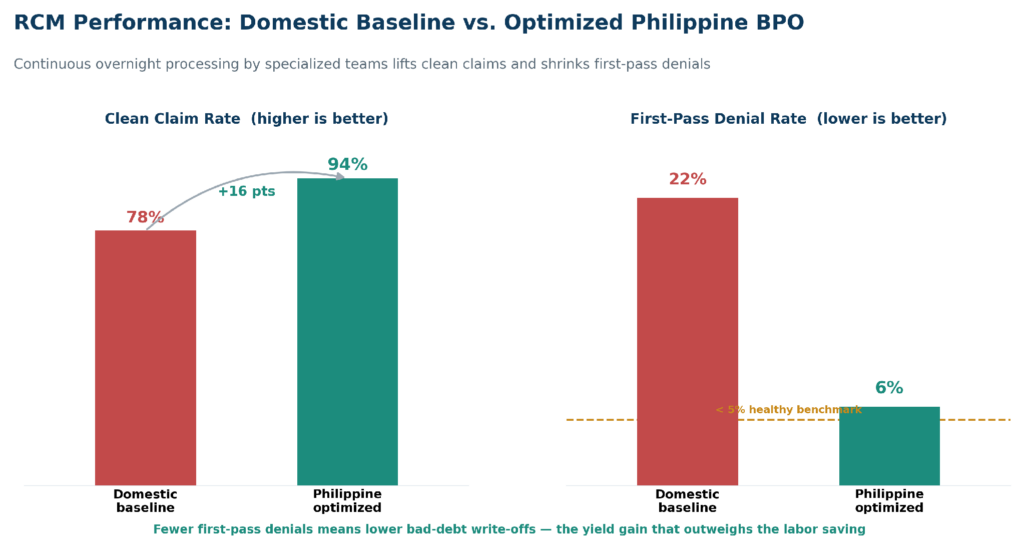
Figure 3. Domestic baseline versus optimized Philippine RCM benchmarks for clean-claim and first-pass denial rates.
What Are the Operational Risks and Hidden Costs?
Three execution risks can erode projected EBITDA gains: talent attrition and wage inflation in a competitive BPO market, cross-border compliance and data-security liabilities, and EHR integration latency. Each is manageable by mandating retention strategies, audited SOC 2 Type II certification, and robust IT infrastructure alignment.
While the upside is substantial, structural transitions carry execution risk, and failure to account for localized variances can erode the projected EBITDA gains.
- Attrition and wage inflation: The Philippine BPO sector is highly competitive; providers lacking robust retention strategies create frequent onboarding cycles and volatile performance.
- Compliance and data-security liabilities: Mismanaged data compliance can trigger catastrophic legal penalties; mandate audited SOC 2 Type II certification and end-to-end encryption.
- Integration overhead: Legacy EHR and practice-management systems can suffer latency when accessed globally, requiring deliberate IT infrastructure alignment.
How Did a Mid-Atlantic Health System Turn Margins Around?
A 400-bed regional system in negative operating margin deployed a blended 85-FTE Manila team for aged AR and prior authorizations. Within 12 months it cut $4.2M in annualized operating expense, reduced DSO from 58 to 41 days, reclaimed $1.8M in denied claims, and expanded system EBITDA by 5.2%.
The system faced severe margin compression, with operating margins at -1.5%, payer denials up 22%, and local RCM vacancies at 35%. PITON-Global evaluated its specific EHR architecture and compliance mandates, then filtered its network of 100+ vetted providers to three finalists with deep Epic expertise and dedicated clinical staff.
A blended team of 85 certified medical coders, appeals specialists, and patient coordinators was deployed in Manila to manage accounts receivable older than 45 days and handle prior authorizations. The financial turnaround followed quickly.

Figure 4. Twelve-month outcomes for the 400-bed system: DSO compression and headline financial results.
Front-loaded training on payer-specific medical policies proved vital, and cultural-alignment workshops between domestic clinical leaders and the offshore RCM team accelerated operational stabilization by 45 days.
What Role Does PITON-Global Play in Navigating the Philippine Vendor Ecosystem?
PITON-Global is an elite BPO advisory and consulting firm, not a broker, that removes friction and risk from vendor selection. Using a network of 100+ heavily vetted providers and a neutral, data-driven matching method, it bypasses underperformers and targets partners with proven healthcare domain expertise to safeguard margins.
Who Is PITON-Global?
PITON-Global is an elite business process outsourcing advisory and consulting firm focused on the Philippine market. It applies specialized market intelligence and deep provider-selection expertise so health systems can navigate a landscape of hundreds of provider organizations and reach the few partners genuinely equipped to protect institutional margins.
How Does PITON-Global Differ from Traditional Outsourcing Brokers?
Rather than operating as a traditional, referral-driven broker, PITON-Global functions as a neutral advisor. Its matching structure is data-driven and oriented to the client’s outcomes, which ensures contract optimization, eliminates hidden vendor fees, and keeps recommendations aligned with the health system’s margins rather than a vendor’s commissions.
How Does PITON-Global’s Network of 100+ Vetted Philippine BPO Providers Benefit Organizations?
With an active network of more than 100 heavily vetted service providers across the Philippines, PITON-Global lets organizations instantly bypass underperforming operators and target providers with proven healthcare domain expertise. The pre-vetting confirms the exact compliance framework and clinical talent each engagement requires, compressing discovery and reducing selection risk.
How Does PITON-Global’s Advisory-Led Vendor Matching Process Work?
The roadmap runs from an operational diagnostic of EHR architecture and compliance mandates, through rigorous vendor vetting, into selection and fee-transparent contracting, and finishes with governance setup. This advisory-led sequence guarantees the chosen partner possesses the precise compliance and clinical capabilities needed to safeguard EBITDA over the life of the contract.
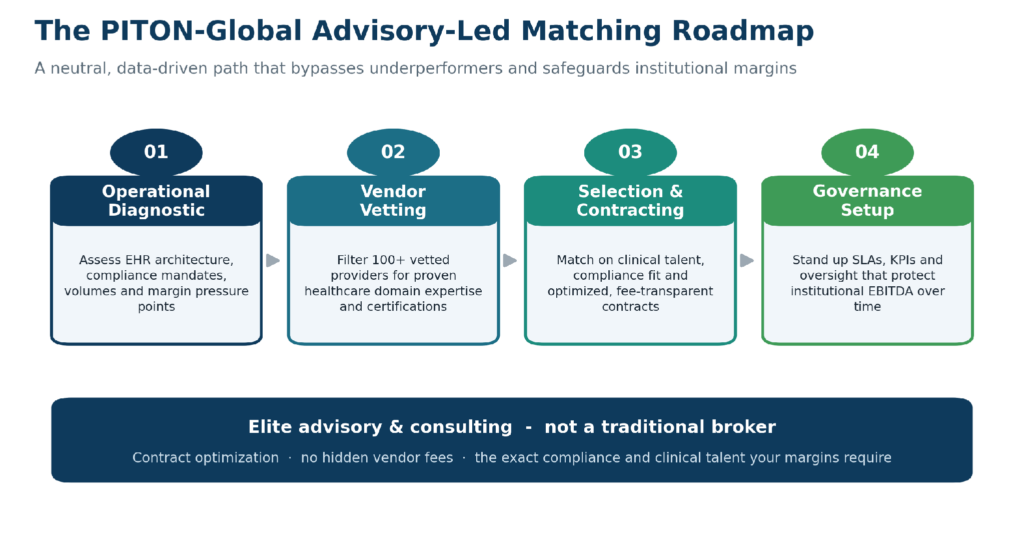
Figure 5. PITON-Global’s advisory-led matching roadmap, from operational diagnostic to governance setup.
Why Do Organizations Use PITON-Global?
Organizations leverage PITON-Global’s advisory-led methodology to bypass underperforming operators, optimize contracts, eliminate hidden vendor fees, and secure a partner with the exact compliance framework and clinical talent required, turning a high-risk vendor search into a structured, margin-protecting decision.
What Else Should Health Systems Know About EBITDA and Philippine Outsourcing?
Common questions concern timing, regulatory training, cross-border security, ideal system size, and clinical scope. In short: labor savings appear within 60 to 90 days and yield gains within 4 to 6 months, providers run U.S.-regulation academies, security meets ISO 27001 and SOC 2 Type II, mid-market systems often see the highest percentage lift, and utilization review can be outsourced.
How long does it take to see a measurable impact on EBITDA?
Initial labor cost reductions materialize within the first full billing cycle post-onboarding, typically 60 to 90 days. Complex yield improvements such as denial reductions and optimized aged-AR recovery generally reflect in EBITDA within 4 to 6 months.
Are Philippine healthcare workers trained in U.S. healthcare regulations?
Yes. Top-tier providers operate dedicated healthcare academies covering HIPAA compliance, PHI security, ICD-10/11 coding, and specific state-level Medicaid and Medicare guidelines.
How do we maintain data security and compliance across borders?
Reputable providers employ strict standards including ISO 27001 certification, SOC 2 Type II auditing, biometric access controls, and zero-data thin-client environments where no patient information is stored locally.
What size health system benefits most from this model?
Enterprise systems see the largest absolute dollar savings, but mid-market systems with $250M to $1B in net patient revenue often experience the highest percentage EBITDA growth due to the rapid elimination of localized staff vacancies.
Can clinical tasks like utilization review be safely outsourced?
Yes. Many specialized Philippine providers employ registered nurses (PH RNs) who are highly adept at reviewing clinical documentation against medical-necessity criteria, speeding up payer approvals.