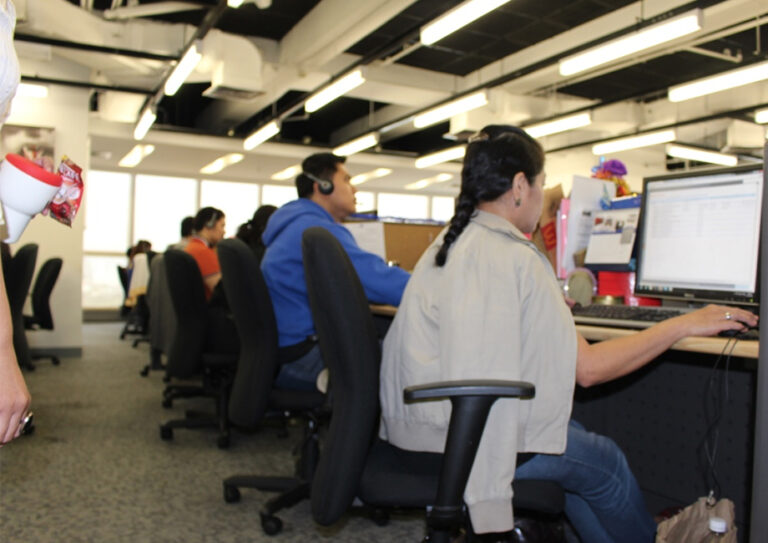

Hospitals partnering with specialized healthcare BPO teams in the Philippines typically see a substantial increase in administrative throughput, sharply lower billing error rates, and a shorter Days Sales Outstanding (DSO) cycle. Delivered through provider and payer support from Filipino clinical staff, these gains accelerate the revenue cycle while freeing onshore clinicians to focus on patient care.
Key Takeaways
- Accelerated cash flow: optimized RCM workflows compress collection cycles significantly, minimizing revenue leakage.
- Clinical talent for non-clinical roles: licensed Philippine nurses execute complex coding and utilization review with exceptional precision.
- Elimination of domestic volatility: shifting high-turnover administrative work to stable offshore teams insulates systems from staffing shortages.
- Drastic error reduction: specialized oversight drives clean-claim submission sharply higher within the first 90 days.
- Cost optimization: back-office savings can be reinvested into frontline patient care and facility upgrades.
What Key Operational Metrics Quantify These Productivity Gains?
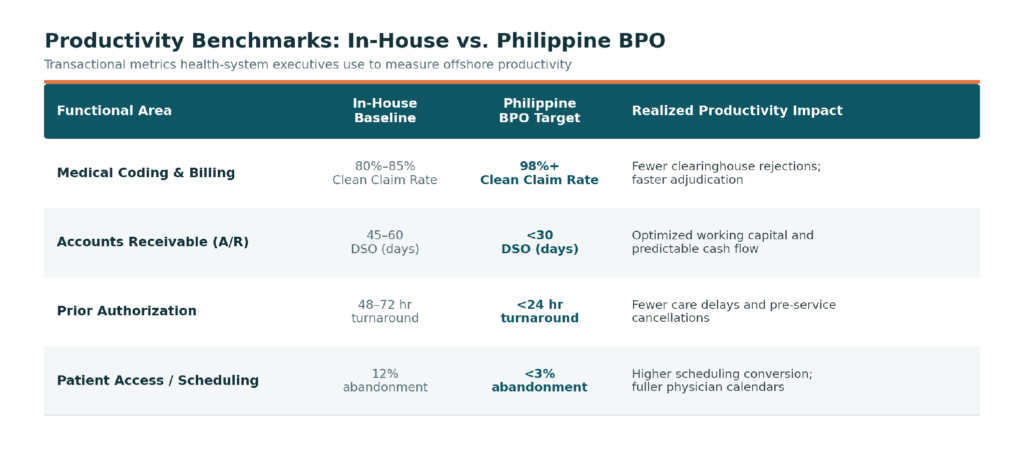
Productivity shows up in hard transactional benchmarks: clean-claim rates climbing toward near-perfect first-pass submission, DSO falling from 45–60 days to under 30, prior-authorization turnaround dropping below 24 hours, and patient-access abandonment falling sharply.
When U.S. hospital networks move administrative workloads offshore, the gains are measurable rather than abstract. The combination of highly educated professionals and rigorous operational governance produces predictable velocity increases across revenue-cycle and back-office pipelines. Executives track that velocity through clear transactional metrics.
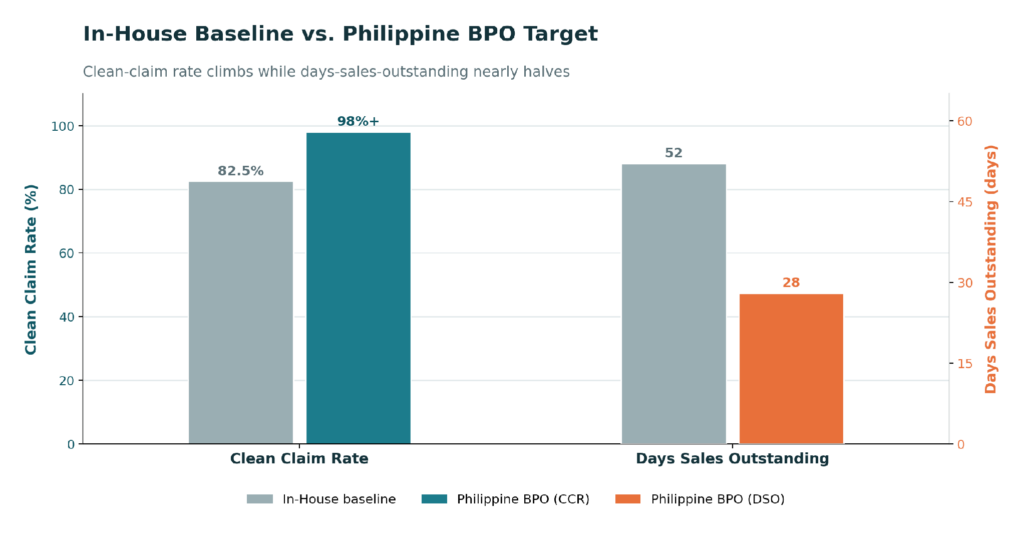
Plotted against in-house baselines, the two flagship financial metrics move in opposite, favorable directions at once — clean-claim rate up, days-sales-outstanding down.
Beyond raw transaction volume, these teams introduce structural resilience. In-house billing departments often battle high turnover that disrupts cash flow; offshore teams preserve institutional knowledge through structured, multi-tier management frameworks that keep performance stable.
How Do Philippine Teams Drive Efficiency in Complex Clinical Workflows?
Philippine teams go well beyond data entry. A deep pool of registered nurses and healthcare professionals applies clinical judgment to specialized, non-bedside work — utilization review against InterQual or Milliman criteria, Hierarchical Condition Category (HCC) coding, and root-cause complex denial management that recovers lost revenue.
A common misconception holds that offshore capability is limited to basic, repetitive tasks. In reality, the Filipino talent landscape features clinicians who apply medical knowledge to high-value administrative functions.
- Utilization review and case management: licensed nurses review documentation against InterQual or Milliman Care Guidelines, confirming medical necessity before payers audit.
- HCC coding: experienced coders capture comprehensive patient risk profiles from the EHR, optimizing reimbursement for value-based care.
- Complex denial management: specialized teams run root-cause analysis on clinical rejections and draft precise appeals that recover revenue rather than writing it off.
The value is no longer just about transactional speed; it is about clinical alignment. When a U.S. hospital utilizes a Philippine BPO team staffed by actual clinicians, they are not just outsourcing labor — they are embedding precise clinical judgment into their administrative architecture. This substantially reduces compliance risks and improves the bottom line.
— John Maczynski, CEO of PITON-Global
What Risks and Operational Tradeoffs Must Hospital Executives Evaluate?
Three risks demand active management: data security and HIPAA compliance, integration with legacy EHRs, and time-zone synchronization. Each maps to a concrete safeguard — Zero-Trust architecture and thin clients, low-latency VDI into Epic or Cerner, and deliberate routing of overnight versus real-time tasks.
The productivity case is strong, but moving operations offshore introduces specific dependencies that leadership must manage deliberately, which is why assessing whether your hospital is ready comes first. The framework below pairs each risk with the operational safeguard that neutralizes it.
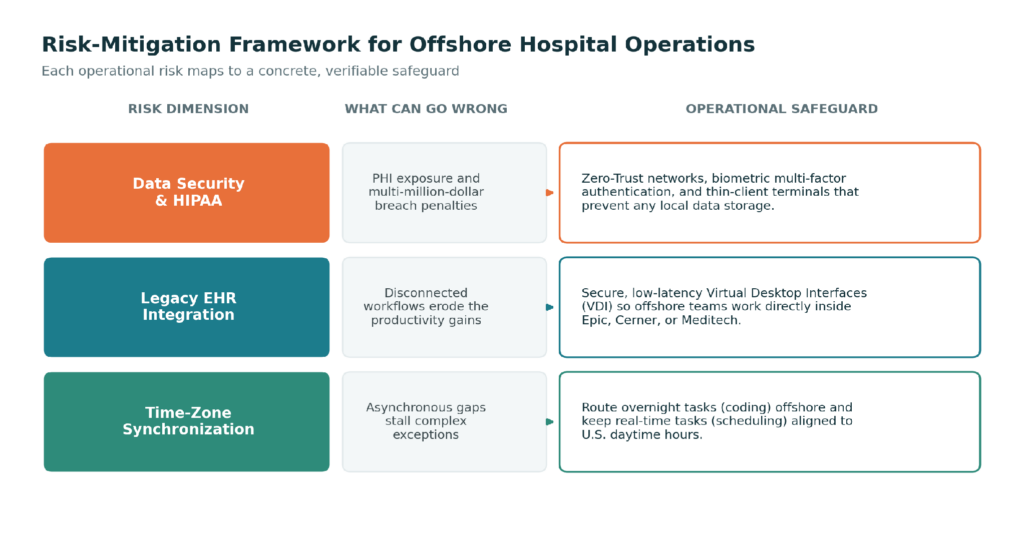
The throughline is control. High-performing partnerships do not accept these risks passively; they engineer them out through architecture, integration design, and shift planning agreed before any workflow moves offshore, then sustain them through a structured governance framework for the vendor.
How Did a Specialty Clinic Network Cut DSO Nearly in Half?
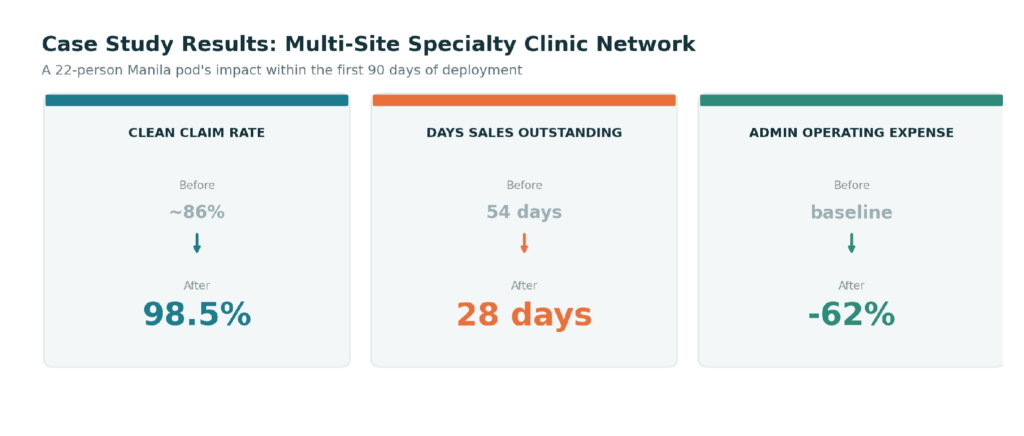
A multi-site U.S. specialty clinic network facing a high write-off rate and heavy billing-team turnover rebuilt its revenue cycle with a 22-person Manila pod. Within 90 days, the clean-claim rate climbed sharply, DSO fell from 54 to 28 days, and administrative operating expense dropped substantially.
The Challenge
A multi-site specialty network suffered a high claim write-off rate and a high volume of unbilled encounters, driven by chronic annual turnover in its domestic medical-billing team.
Selection and Solution
The network partnered with PITON-Global to navigate the crowded offshore market. PITON-Global audited the workflows and shortlisted three HIPAA-compliant healthcare BPOs with proven records in complex specialty billing. The selected provider deployed a dedicated pod of 22 certified coders and revenue-cycle specialists, migrating the workflow into a secure, biometric-monitored environment with a direct VDI link to the clinic’s EHR.
The Outcomes
Within 90 days, the clean-claim rate rose sharply, DSO dropped from 54 to 28 days, and administrative operating expense fell substantially — enough to open two new regional clinics without adding back-office headcount, a clear case of expanding without increasing administrative overhead.
Success hinged on deep process alignment. Investing in comprehensive workflow documentation during the initial 30-day implementation phase prevented operational bottlenecks after launch.
Why Do Healthcare Organizations Partner With PITON-Global?
PITON-Global is a specialized Philippine BPO advisory and outsourcing consultancy that acts as an objective strategic advisor rather than a lead broker. Drawing on two decades of operational experience and a vetted network of 100+ providers, it matches each hospital’s volume, complexity, and tech stack to the right partner.
PITON-Global helps healthcare organizations navigate a crowded offshore landscape. Unlike traditional brokers that simply pass along leads, it functions as an objective strategic advisor, using more than two decades of operational experience to eliminate outsourcing risk.
The firm maintains a thoroughly vetted network of more than 100 specialized, mid-sized Philippine BPO providers, each subject to regular audits of technical infrastructure, financial stability, HIPAA/SOC 2 compliance, and employee retention. By matching a hospital’s specific volume, clinical complexity, and technology stack to the right provider, PITON-Global accelerates vendor selection, secures competitive commercial terms, and establishes sustainable offshore partnerships.
What Do Hospital Leaders Most Often Ask Before Outsourcing to the Philippines?
The most frequent questions cover HIPAA compliance, transition timelines, communication quality, direct EHR access, and how providers keep pace with payer and regulatory changes. Concise answers follow.
How do Philippine BPO teams maintain strict HIPAA compliance?
Reputable providers operate under Business Associate Agreements and match U.S. data-protection standards: biometric access, clean-room environments without paper or recording devices, robust encryption, and regular external SOC 2 Type II audits.
What is the typical timeline to transition billing or coding workflows?
A standard migration spans 30 to 60 days, covering secure network integration, workflow discovery, SOP documentation, team training, and a phased parallel-run test to protect data integrity.
How are communication barriers handled for complex patient interactions?
The Philippines is a top customer-service destination thanks to strong English proficiency and cultural affinity with the U.S. Agents receive specialized training in medical terminology and empathetic communication for scheduling and self-pay calls.
Can a team work directly within our existing Epic or Cerner system?
Yes. Teams operate via secure Citrix or VMware VDI, ensuring all patient data stays within the hospital’s IT infrastructure with no PHI stored locally in the Philippines.
What happens when payer rules or regulatory guidelines change?
Specialized providers run dedicated clinical-compliance and QA teams that continuously update training to align with annual ICD-10/11 updates, CPT changes, and shifting CMS guidelines.