

On this page
- Key Takeaways
- How Does Customer Experience in the Philippines Drive Brand Loyalty?
- What Key Performance Indicators Correlate with Offshoring Success?
- What Are the Operational Risks and Mitigation Strategies?
- What Does a Successful Retention-Focused Deployment Look Like?
- How Does PITON-Global Help Enterprises Protect Customer Retention?
- What Are the Most Common Questions About Outsourcing Contact Centers to the Philippines?
Outsourcing contact center operations to the Philippines improves customer retention by raising First Contact Resolution and lowering Customer Effort Scores. An empathetic workforce and scalable infrastructure deliver stable, round-the-clock service that protects loyalty—converting routine support into measurable, long-term brand equity. That outcome rests on the talent side of an offshore program: who the vendor hires, how it trains them and how long they stay.
Key Takeaways
- FCR elevation: Moving to specialized providers typically lifts First Contact Resolution materially, directly mitigating churn caused by unresolved issues.
- Structural cost advantages: The offshore model yields substantial cost efficiencies versus domestic teams, letting buyers reinvest savings into agent training and CX technology.
- Mitigated attrition risk: Partnering with specialized mid-market providers in provincial hubs stabilizes delivery, achieving turnover well below the Metro Manila baseline.
- Cultural alignment: Deep linguistic affinity with Western markets produces high-empathy interactions that protect brand sentiment during escalated support scenarios.
How Does Customer Experience in the Philippines Drive Brand Loyalty?
It drives loyalty by reducing service friction. High Customer Effort Scores predict defection, and a Philippine workforce with native-level English, Western cultural affinity, and natural service orientation lowers that effort—producing shorter holds, higher empathy, and stronger emotional ties to the brand.
Retention in enterprise commerce depends heavily on the friction customers hit during resolution. High Customer Effort Scores (CES) are strong leading indicators of defection, so the primary operational benefit of transitioning care to specialized offshore providers is a sharp reduction in that friction.
The labor pool in primary hubs like Metro Manila and provincial university cities such as Iloilo, Bacolod, and Davao offers a distinctive blend of native-level English fluency, high cultural affinity with Western markets, and natural service orientation rooted in the Filipino work ethic. This shrinks the cognitive distance between consumer and representative. In high-stakes environments—fintech, insurance, premium e-commerce—that alignment translates into shorter hold times and higher empathy, and customers who experience clear communication and authentic problem-solving form stronger emotional ties to the brand, directly lowering churn.
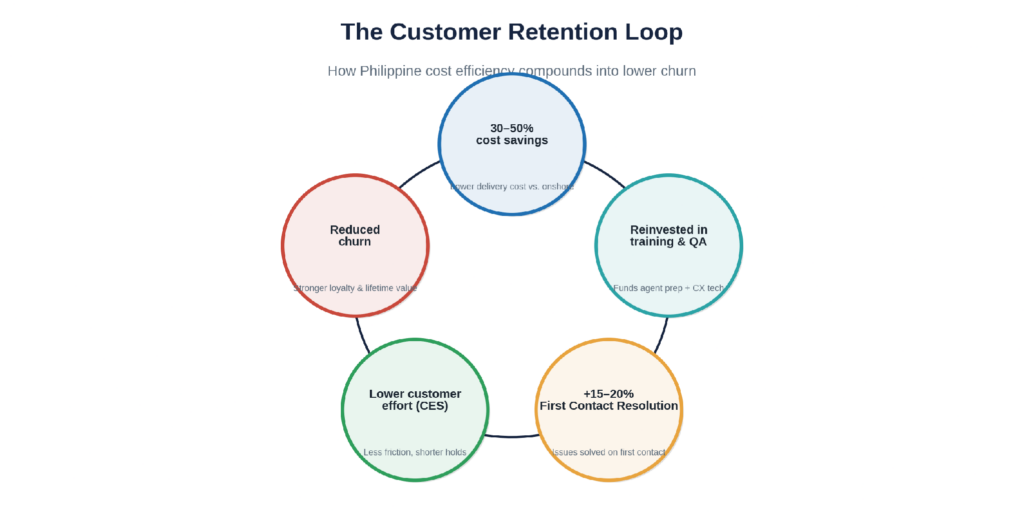
Figure 1. The retention loop: cost savings fund training and QA, lifting FCR and lowering churn.
What Key Performance Indicators Correlate with Offshoring Success?
Success correlates with First Contact Resolution, CSAT, Average Handle Time, and fully loaded cost. Well-structured programs use cost advantages to build high-touch quality rather than cut service—so costs fall while FCR and CSAT rise after migration.
To understand the retention impact, executives must analyze specific operational metrics. Labor savings should never translate into degraded service; instead, well-run programs reinvest their cost advantage into quality-focused, high-touch support. As the chart shows, fully loaded cost can fall sharply in the months after migration while FCR and CSAT climb.
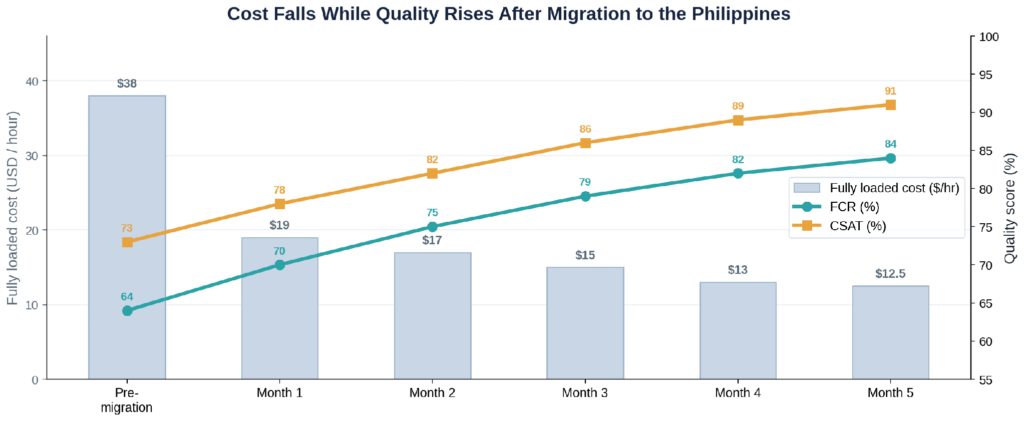
Figure 2. After migration, fully loaded cost declines while First Contact Resolution and CSAT rise.
The benchmarks below summarize the performance shift typically seen when enterprise customer care moves to a vetted Philippine provider:

Figure 3. Core operational benchmarks and their direct impact on customer retention.
The standout is the FCR gain combined with a lower fully loaded rate. Lifting First Contact Resolution well above the typical onshore range removes repeat contacts—one of the strongest churn drivers—while the lower hourly rate funds the 24/7 coverage that reduces queue abandonment.
What Are the Operational Risks and Mitigation Strategies?
The main risks are agent attrition, data security, and corporate alignment. Mitigation means choosing provincial hubs or engaged mid-market providers to stabilize retention, and enforcing HIPAA, PCI-DSS, and GDPR compliance with zero-possession virtual desktop infrastructure.
The upside is clear, but shifting customer-facing operations offshore introduces structural risks that can harm retention if unmanaged. Enterprise buyers should plan deliberately for talent competition, infrastructure security, and corporate alignment.
Managing Agent Attrition
Annual agent turnover in tier-one Metro Manila BPOs runs high. That churn harms consistency, because new agents need time to master product knowledge, which depresses FCR, and it carries a real cost in the economics of an offshore program. To mitigate this, buyers can favor provincial hubs where lower talent competition stabilizes retention, or partner with mid-market providers that offer clear career paths and stronger employee engagement.
Enforcing Data Security and Compliance
A single data breach can permanently damage customer trust and retention. Enterprise programs must ensure providers operate under strict frameworks—HIPAA, PCI-DSS, and GDPR—and use zero-possession virtual desktop infrastructure (VDI) so sensitive data is never stored on local offshore hardware.
Many executives view outsourcing purely through a cost-reduction lens, which can cause them to underinvest in operational setup. True customer retention is achieved when you treat the Philippine operation as a core center of excellence. The goal is to use the geographic cost differential to fund superior agent preparation, deep product specialized training, and robust operational leadership.
— John Maczynski, CEO, PITON-Global
What Does a Successful Retention-Focused Deployment Look Like?
A successful deployment uses a dedicated, smaller team measured on customer effort rather than raw volume. One digital marketplace more than halved monthly churn, lifted FCR substantially, drove average speed of answer below 45 seconds, and cut operating costs sharply in five months.
Client Challenge
A fast-growing North American digital marketplace was losing a significant share of active subscribers month over month due to long support delays, high call abandonment, and low first-contact resolution from an overburdened in-house team.
Vendor Selection
The company engaged PITON-Global to move away from generic, large-scale providers. PITON-Global audited the workflows and ran a selection across its network of 100+ vetted boutique and mid-market BPOs, filtering for proven digital-platform experience and flexible scaling.
Solution Implemented
The client chose a specialized mid-market provider in a provincial university hub and deployed a dedicated 45-seat omnichannel pod across voice, chat, and email, with a hybrid performance structure focused on customer effort rather than raw volume.
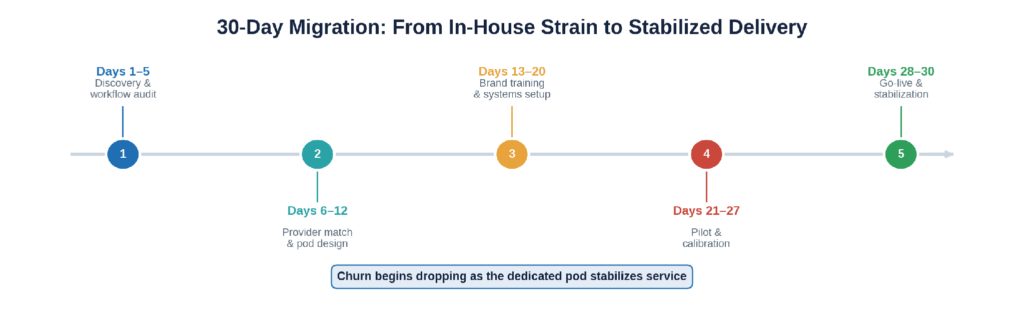
Figure 4. The 30-day migration path from in-house strain to stabilized Philippine delivery.
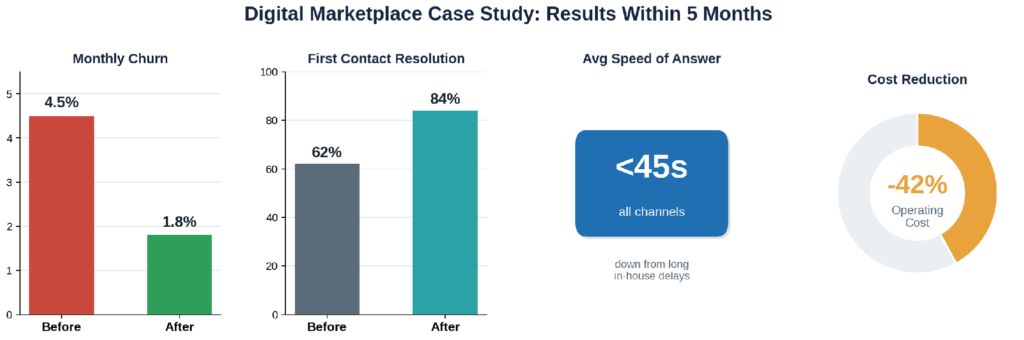
Figure 5. Measurable outcomes achieved within five months of deployment.
Outcomes and Lessons
Within five months, monthly subscriber churn fell by more than half, First Contact Resolution rose substantially, average speed of answer dropped below 45 seconds across all channels, and operating costs fell sharply. The lesson: a dedicated, smaller team inside a mid-market provider often delivers better attention to detail and lower attrition than large, volume-driven global BPOs—producing a more reliable customer experience.
How Does PITON-Global Help Enterprises Protect Customer Retention?
PITON-Global is a premium, advisory-led consultancy that matches enterprise buyers to top-tier Philippine providers. Using a consultative methodology across a network of 100+ vetted mid-market and boutique BPOs, it removes selection guesswork, minimizes risk, and builds support engines that protect long-term retention.
Who Is PITON-Global?
PITON-Global is a premium, advisory-led outsourcing consultancy specializing in matching enterprise buyers with top-tier customer care and back-office providers in the Philippines. Backed by decades of global leadership experience, it functions as a strategic advisor rather than a capacity reseller, bringing deep expertise in BPO advisory and provider selection to every engagement.
How Does PITON-Global Differ from Traditional Outsourcing Brokers?
Traditional brokers operate on simple volume incentives, steering clients toward whichever large provider pays the most. PITON-Global takes a consultative, provider-agnostic approach instead—reviewing vetted options objectively and recommending the exact match for each client’s culture, technology stack, and compliance needs, with the focus on client outcomes rather than provider promotion.
How Does PITON-Global’s Network of 100+ Vetted Philippine BPO Providers Benefit Organizations?
Access to a curated network of more than 100 vetted, compliant mid-market and boutique providers accelerates discovery in a fragmented market. Coverage spans industries, service tiers, and both Metro Manila and provincial hubs, so organizations can quickly qualify partners whose stability, specialization, and compliance posture fit their retention goals.
How Does PITON-Global’s Advisory-Led Vendor Matching Process Work?
The process runs from workflow audit to ongoing optimization: mapping CX goals and effort drivers, reviewing the vetted network, vetting compliance, matching on culture, technology, and hub location, then standing up the pod and tracking FCR, CES, and churn.

Figure 6. PITON-Global’s five-stage, consultative provider-matching process.
Why Do Organizations Use PITON-Global?
Organizations use PITON-Global to remove guesswork from vendor selection, minimize risk, and avoid common offshoring mistakes. By matching each buyer to a high-performance partner and focusing on customer-effort outcomes, the firm helps build support engines that lower operating costs while protecting long-term customer retention.
What Are the Most Common Questions About Outsourcing Contact Centers to the Philippines?
Common questions concern the effect on Customer Effort Scores, average cost savings, human–automation hybrid models, the case for provincial hubs over Metro Manila, and how to keep customer data secure offshore. Each is addressed below.
How does outsourcing to the Philippines impact Customer Effort Scores (CES)?
High language proficiency and strong cultural alignment — core talent advantages over domestic staffing models — let Filipino support professionals handle complex issues with fewer communication gaps. That reduces repeat contacts and supervisor escalations, which directly lowers Customer Effort Scores.
What is the average cost savings when transitioning a contact center to the Philippines?
Most companies see a substantial reduction in fully loaded operational costs versus onshore teams. The savings span human resources, local management, facilities, and technology infrastructure.
How do modern Philippine BPOs integrate human agents with automation?
Top-tier providers use a hybrid model: automated systems handle routine, repetitive questions while human agents take complex, high-value, or emotional issues. This speeds response times while preserving a personal touch at critical touchpoints.
Why should an enterprise consider provincial Philippine hubs over Metro Manila?
Metro Manila remains a major hub with advanced infrastructure, but provincial cities like Iloilo, Bacolod, and Davao offer lower operating costs and significantly lower agent attrition—stability that sustains consistent service quality for long-term programs.
How can buyers ensure customer data stays secure with an offshore provider?
Partner with vendors holding international certifications such as ISO 27001, PCI-DSS, and HIPAA. Clean-desk policies and secure virtual desktop infrastructure prevent local data storage and protect consumer privacy.