

Health systems should evaluate labor cost stability by auditing a provider’s attrition-mitigation frameworks, regional salary-dispersion models, and transparent pricing mechanisms. Sustainable forecasting for offshore medical coding and patient-support programs depends on selecting partners whose compensation strategies outpace regional market inflation while maintaining a well-managed employee value proposition.
Key Takeaways
- Audit attrition management: High turnover creates hidden operational cost; favor providers with consistently high, audited clinical retention rates.
- Geographic labor arbitrage: Moving operations from Metro Manila to secondary hubs leverages meaningful wage differentials.
- Pricing-model structure: Transparent, itemized pricing limits exposure to sudden cost adjustments versus fixed flat rates.
- Compliance & benefits verification: True budget stability requires compliance with mandatory 13th-month pay and recent social-security changes.
What Key Microeconomic Factors Influence Philippine Healthcare BPO Wage Inflation?
Wage inflation is driven by competing global demand for specialized clinical talent, domestic shifts in statutory benefits, and regional minimum-wage mandates. Annual escalation for specialized healthcare information management services is steady rather than negligible, requiring rigorous geographic and role-specific cost auditing.
Evaluating a provider requires looking beyond basic hourly rates to the local economic drivers that shape long-term cost. The Philippine healthcare information management services sector faces unique labor pressures from competing global corporate demand and the migration of clinical talent. Unpredictable overhead is often tied directly to local regulatory compliance—recent SSS contribution increases, updated PhilHealth brackets, and regional minimum-wage mandates create baseline cost pressures that affect less structured providers.
The benchmark below outlines current operational costs across primary and secondary Philippine hubs, with the attrition risk attached to each role.
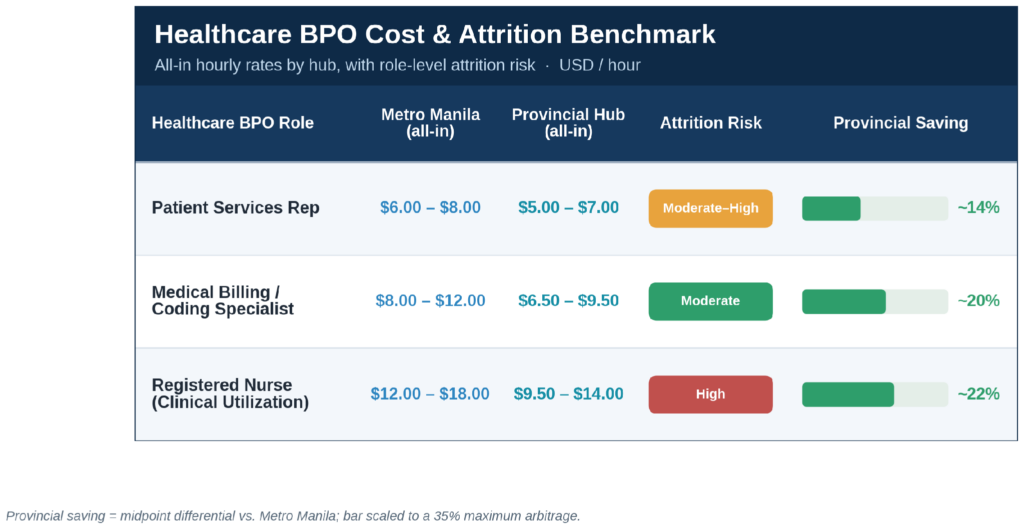
Figure 1 — All-in hourly rates by hub with role-level attrition risk and the provincial-hub saving versus Metro Manila.
Because inflation compounds differently by role, multi-year forecasts must be modeled per role rather than as a blended average. The outlook below shows how the gap widens over five years.

Figure 2 — Five-year cumulative wage inflation by specialized role; global demand pushes clinical roles to the top of the inflation band.
How Does a Provider’s Talent Retention Strategy Protect Buyers From Price Escalations?
A strong retention strategy absorbs recruitment, onboarding, and productivity-lag overhead. Providers maintaining a consistently high, audited retention rate mitigate the hidden expense of continuous back-filling and retraining in highly regulated clinical environments—shielding the client from those costs.
The true cost of high turnover is often hidden within procurement. When a provider loses an experienced medical coder or clinical reviewer, the client absorbs the impact through extended onboarding cycles, temporary drops in quality metrics, and unexpected recruitment outlays.
True budget predictability in offshore healthcare operations is not achieved by negotiating the lowest starting rate. It is achieved by partnering with a provider whose internal operating margins are deliberately designed to fund comprehensive healthcare benefits, clear career advancement paths, and performance-based incentives. If your partner underpays their frontline staff, your health system will ultimately pay the price through unpredictable operational friction and frequent back-filling costs.
— John Maczynski, CEO, PITON-Global
When assessing a partner’s labor-management strategy, ensure they have clear protocols for:
- Comprehensive healthcare (HMO) coverage: High-performing providers include health benefits for employees and dependents on day one to help stabilize attrition.
- Continuous clinical upskilling: Dedicated training frameworks for complex certifications (AAPC, AHIMA) keep staff engaged and reduce voluntary turnover, a talent model outlined in our strategic HPO blueprint.
- Workplace delivery alternatives: Well-managed hybrid operating models mitigate commuting challenges in major metros, expanding the accessible talent pool.
Which Fee Structures Offer the Highest Long-Term Cost Predictability?
Transparent, itemized cost-plus pricing offers the highest predictability. Unlike fixed-rate structures that hide margin compression, itemized models decouple direct clinical compensation from vendor margin—protecting health systems from sudden service degradation, quality drops, or mid-contract rate renegotiation.
The architecture of your outsourcing contract heavily influences long-term budget stability. Fixed flat-rate contracts appear simple but frequently introduce downstream financial risk: if local inflation or legislative shifts press on a provider’s margins, they may be forced to renegotiate mid-term or quietly reduce service quality. Transparent, itemized pricing instead separates direct employee compensation from the provider’s operational margin and management fees—showing exactly how much budget goes toward retaining talent versus vendor overhead, and ensuring compliance with mandates like the required 13th-month pay.
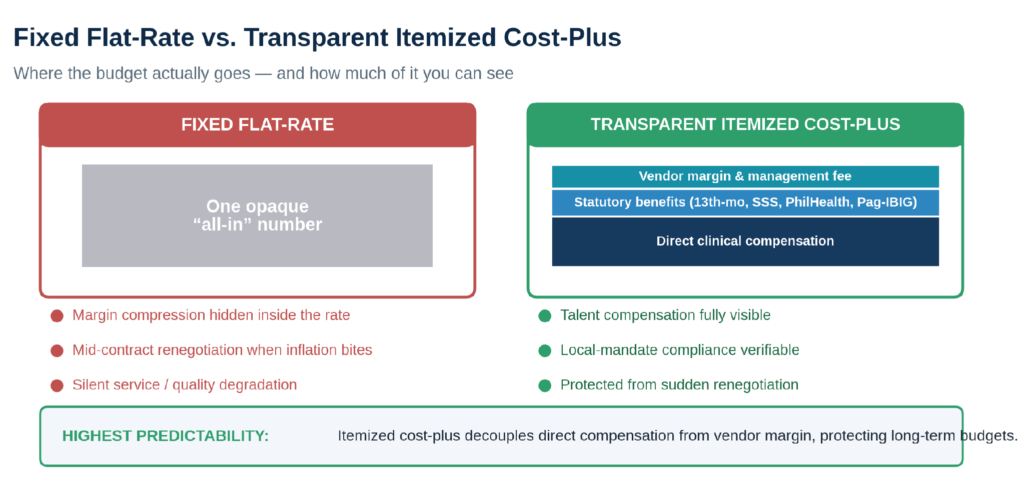
Figure 3 — Fixed flat-rate versus transparent itemized cost-plus: what each model lets a health system actually see.
What Does Strategic Partner Matching Deliver in Practice?
A multi-state US health system whose incumbent vendor ran severe attrition transitioned RCM to a transparent, secondary-hub provider with low audited clinical turnover. Within a year, program attrition fell to a fraction of its former level, A/R days dropped 14, and the system locked in long-term cost structures with no mid-contract adjustments.
Client Challenge
A major multi-state US health system faced severe backlogs in its revenue cycle management operations. Its incumbent offshore vendor suffered severe annualized attrition, leading to delayed claims submissions and an escalating outstanding accounts-receivable balance.
Vendor Selection Process
The health system engaged PITON-Global to identify an institutional partner capable of stabilizing delivery costs. PITON-Global filtered its network of more than 100 vetted Philippine providers, evaluating them on historical attrition metrics, specialized clinical experience, and transparent fee structures.
Solution Implemented
The system transitioned operations to a highly specialized, mid-sized healthcare BPO in a secondary growth hub that used a fully transparent pricing model and maintained a low, audited clinical turnover rate. The outcomes are summarized below.
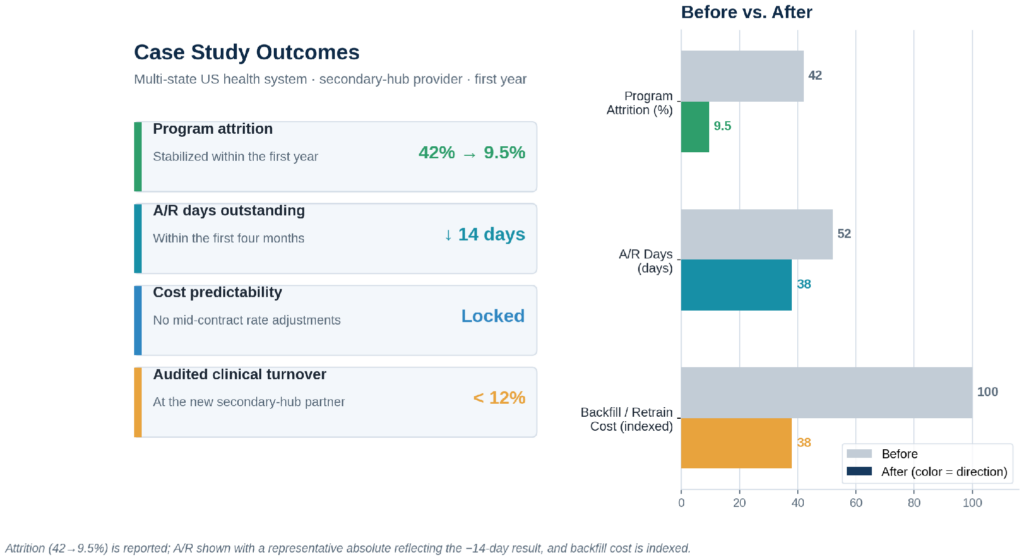
Figure 4 — Quantifiable outcomes after transitioning to a transparent, low-attrition secondary-hub partner.
Selecting an outsourcing partner on proven retention metrics and transparent cost structures provides better long-term financial stability than simply choosing the lowest initial bid, and it sets up the financial outcomes that justify expanding the program later.
How Does PITON-Global Mitigate Outsourcing Risk?
PITON-Global is an independent BPO advisory firm—not a volume-driven broker—that maps each health system’s institutional requirements to optimal provider capabilities across a vetted network of 100+ operators, eliminating structural mismatch risk and ensuring market-aligned pricing built for long-term cost stability.
PITON-Global guides enterprise health systems through the complexities of vendor selection in the Philippines, functioning as an independent strategic advisor rather than a volume-driven outsourcing broker. Leveraging an exclusive network of more than 100 thoroughly vetted call-center and back-office providers, the firm maps specific institutional requirements to optimal provider capabilities.
This advisory-led methodology eliminates structural mismatch risk, ensures market-aligned pricing, and matches health systems with partners capable of maintaining long-term cost stability.
Frequently Asked Questions
What is the standard annual wage-inflation rate for healthcare BPO roles in the Philippines?
Annual wage inflation for specialized healthcare roles is steady and predictable rather than spiky. Niche technical positions—such as certified clinical coders or utilization reviewers—can see higher adjustments based on regional demand.
How do secondary provincial hubs compare to Metro Manila on cost stability?
Provincial hubs offer meaningful savings on base labor and experience lower overall attrition. However, major metros retain an advantage for highly specialized clinical positions that require deep, concentrated talent pools.
What mandatory statutory benefits must be included in Philippine contract pricing?
All-in pricing must account for local labor mandates, including the 13th-month pay requirement, Social Security System (SSS) contributions, PhilHealth, and Home Development Mutual Fund (Pag-IBIG) allocations.
How does high provider turnover impact total cost of ownership?
High turnover drives up secondary costs through repetitive onboarding, lower initial accuracy, and operational delays, which can quickly erode any upfront savings from a low-cost contract—one reason a fully loaded TCO calculation should price attrition explicitly.
Why is transparent, itemized pricing preferred over flat fixed rates for long-term agreements?
Itemized pricing isolates direct labor cost from provider operational margins, giving health systems visibility into how talent is compensated and protection against sudden service disruptions or unexpected mid-contract renegotiation.