

Expanding healthcare outsourcing operations in the Philippines is justified by a steep reduction in total cost of ownership, a low claim denial rate, and higher patient throughput. These outcomes come from migrating high-overhead administrative, billing, and clinical-support workflows to a highly compliant, elite healthcare workforce, the same mix of revenue-cycle and back-office work for U.S. providers that most programs start with.
Key Takeaways
- Substantial capital preservation: Shifting administrative, billing, and clinical-documentation infrastructure yields immediate, substantial cost reductions versus onshore models.
- Optimized revenue cycle: Specialized medical-billing talent drives claim denial rates down sharply, accelerating cash flow and recapturing leaked revenue.
- Amplified clinical capacity: Virtual medical scribes free onshore physicians from admin work, reclaiming up to three hours of clinical time per provider daily.
- Institutionalized policy advantage: The 2024 CREATE MORE Act (RA 12066) provides fiscal certainty via a flat 5% Special Corporate Income Tax and 100% deductions for power and technology.
What Core Financial Metrics Drive the Business Case for Healthcare Offshoring?
Two metric families drive the case: total cost of ownership, which falls sharply once recruitment, benefits, real estate, and payroll taxes are included, and revenue cycle performance, where well-structured offshore teams cut denial rates and bring DSO below 40 days by closing systemic revenue-leakage points.
Evaluating the financial viability of expanding healthcare operations requires moving past basic hourly-rate arbitrage. Executive buyers must assess total cost of ownership (TCO) alongside direct improvements to revenue cycle metrics, because the two together determine the real return. Both feed directly into an organization’s administrative cost ratio.
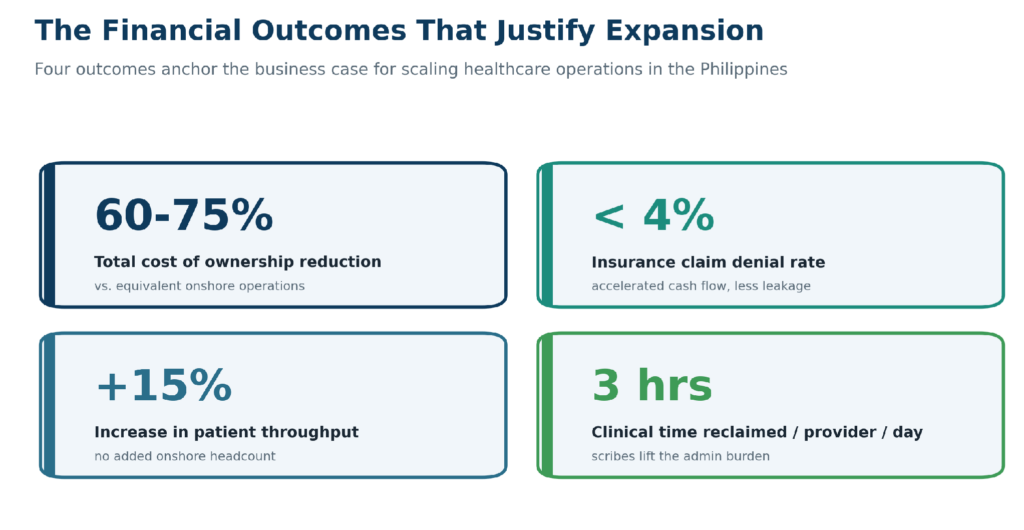
Figure 1. The four financial outcomes that anchor the business case for expanding Philippine operations.
By scaling operations in the Philippines, organizations structurally lower employee overhead, including recruitment, benefits, real estate, and payroll taxes, which regularly delivers a deep TCO reduction. Beyond direct cost, the justification is anchored in optimization across the entire revenue cycle, as offshore teams reduce leakage from coding inaccuracies, delayed prior authorizations, and unsubmitted claims.
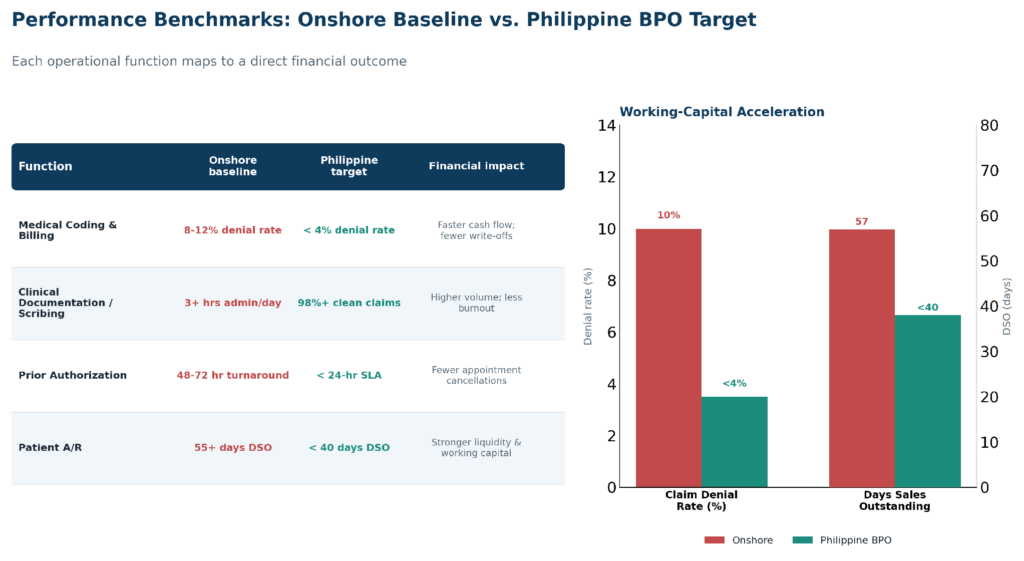
Figure 2. Onshore baseline versus Philippine BPO targets by function, with the working-capital acceleration in denial rate and DSO.
How Does the Regulatory and Legislative Landscape Protect Offshore Capital Investments?
The Philippines pairs fiscal certainty with data-sovereignty standards. The 2024 CREATE MORE Act (RA 12066) institutionalizes a flat 5% Special Corporate Income Tax, 100% deductions for power and technology, and work-from-home flexibility for up to half of the workforce, while elite centers operate under HIPAA, SOC 2 Type II, ISO 27001, and PCI-DSS 4.0 frameworks.
A primary concern for CFOs and compliance officers expanding global delivery models is mitigating regulatory, statutory, and macroeconomic risk. The Philippines has built an exceptionally stable regulatory environment engineered to protect enterprise capital and sensitive data assets.
The CREATE MORE Act (RA 12066), signed into law in 2024, provides significant fiscal stability, guaranteeing an institutionalized flat 5% Special Corporate Income Tax (SCIT) and allowing work-from-home arrangements for up to half of the workforce without risking corporate tax incentives, which enables reliable multi-year financial modeling. The country has also aligned its legal framework with international data mandates, so elite delivery centers operate under rigorous sovereign security protocols.
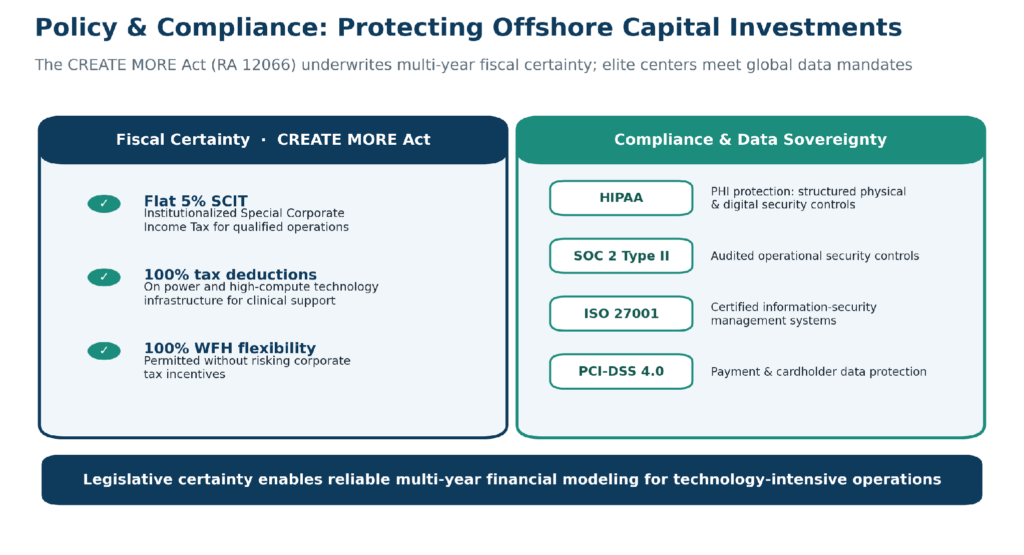
Figure 3. Fiscal certainty under the CREATE MORE Act alongside the compliance frameworks elite delivery centers maintain.
What Operational Trade-offs and Risks Must Executive Decision-Makers Manage?
The central trade-off is rate versus total cost: the lowest seat rate rarely equals the lowest TCO. In high-severity clinical and complex RCM work, squeezing vendor margins drives talent attrition that destroys yield. Managing retention through career pathways, clinical education, and competitive pay preserves the financial return.
While the returns are clear, scaling an offshore delivery model introduces operational challenges that require active management, and understanding these trade-offs is essential to long-term program stability.
Many healthcare organizations fail to realize that the lowest hourly seat rate rarely equates to the lowest total cost of ownership. In high-severity clinical support and complex revenue cycle operations, squeezing vendor margins leads directly to talent attrition, which destroys yield. True financial optimization is achieved by investing in premium tier-one environments that build duty-of-care, clinical oversight, and robust compliance directly into the operating model.
— John Maczynski, CEO, PITON-Global
Managing talent retention in competitive hubs like Metro Manila and Cebu requires strategic alignment. Selecting partners that provide clear career pathways, continuous clinical education, and competitive compensation mitigates the risk of operational volatility that would otherwise erode the projected yield. How vendors absorb that wage pressure is covered in how healthcare BPO firms manage rising labor costs.
What Did a Multi-State Physician Group Achieve by Expanding Offshore?
A multi-state physician group with a high denial rate, 58-day DSO, and severe physician burnout deployed licensed medical graduates as AI-assisted scribes and RCM analysts. Within 120 days, denials fell sharply, DSO dropped to 38 days, and reclaimed clinical time drove a measurable increase in patient throughput with no added onshore headcount.
The group faced mounting strain from a high insurance claim denial rate, a rising 58-day DSO baseline, and physician burnout from complex EHR data entry. It partnered with PITON-Global to audit its multi-channel billing and administrative workflows, then screened the network of 100+ vetted providers for mid-market operators with deep expertise in specialized billing, clean-claim execution, and NLP-assisted scribing.
PITON-Global deployed a dedicated team of licensed medical graduates in Manila as virtual AI-assisted scribes and specialized RCM analysts, integrated directly into the client’s EHR via secure, zero-trust infrastructure for real-time documentation and pre-submission claim scrubbing.
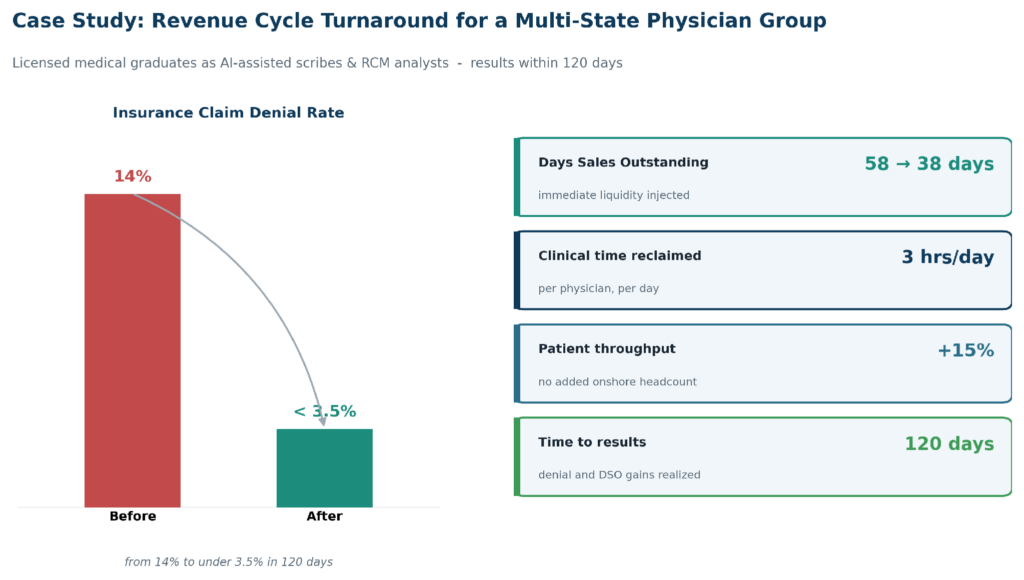
Figure 4. Outcomes within 120 days: denial-rate compression and the headline liquidity, capacity, and throughput gains.
Transitioning highly specialized workflows succeeds when providers use licensed clinical talent rather than general administrative staff. Factoring workflow-specific expertise into vendor selection eliminates costly downstream performance remediation. That discipline is what turns projections into the ROI health systems can actually expect.
Why Do Leading Health Systems Use PITON-Global for Strategic Sourcing?
Leading health systems use PITON-Global because it acts as an objective advocate rather than a commission-driven broker. Led by international operations executives, it provides independent, data-driven matching across 100+ vetted providers, evaluating each through objective lenses to remove procurement blind spots and establish high-performance foundations from day one.
Who Is PITON-Global?
PITON-Global is a specialized business process outsourcing advisory and consulting firm led by international executives with decades of hands-on contact-center and operational-governance experience. That operating background lets it evaluate Philippine providers the way a seasoned operator would, rather than the way a referral intermediary would.
How Does PITON-Global Differ from Traditional Outsourcing Brokers?
Unlike traditional broker models that run on standard referral commissions, PITON-Global acts as an objective advocate. Its recommendations come from independent, data-driven vendor matching rather than referral incentives, keeping guidance aligned with the health system’s financial and compliance goals instead of a vendor’s commercial interests.
How Does PITON-Global’s Network of 100+ Vetted Philippine BPO Providers Benefit Organizations?
PITON-Global maintains a rigorously vetted network of more than 100 premium Philippine BPO providers. Because each is pre-assessed on compliance certifications, technical capability, and cultural alignment, organizations reach qualified, high-performance operators quickly and avoid the procurement blind spots that come with navigating an unvetted market.
How Does PITON-Global’s Advisory-Led Vendor Matching Process Work?
The firm evaluates potential vendors through four objective lenses: volume and scale fit, domain expertise, compliance and security, and commercial optimization. This advisory-led approach removes procurement blind spots, eliminates sourcing risk, shortens the provider-selection timeline, and establishes a high-performance operational foundation from day one.
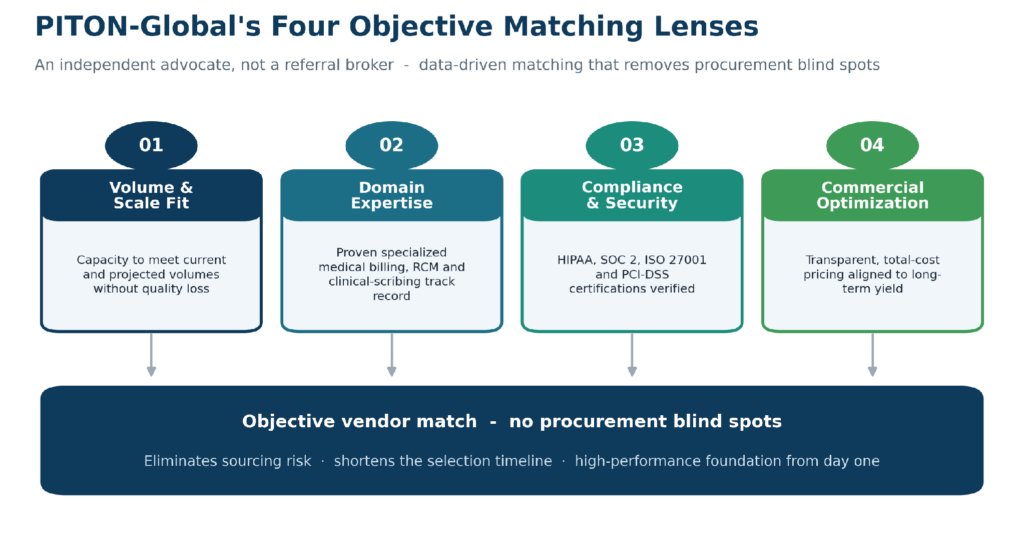
Figure 5. PITON-Global’s four objective matching lenses, converging on a high-performance vendor match.
Why Do Organizations Use PITON-Global?
Organizations use PITON-Global to remove procurement blind spots, eliminate sourcing risk, and shorten the selection timeline while establishing a high-performance foundation from day one, converting a complex, high-stakes vendor decision into a structured, evidence-based match between need and verified capability.
What Else Should Executives Know Before Expanding Offshore?
Common questions concern cost savings, HIPAA, clinical scope, timelines, and tax policy. In short: expect a steep TCO reduction, security via VDI and zero-trust access, remote medical scribing by licensed graduates, a 60-to-90-day implementation, and long-term fiscal certainty under the CREATE MORE Act.
What are the average cost savings when moving healthcare billing to the Philippines?
Most organizations see a steep reduction in total cost of ownership versus equivalent onshore administrative staff, driven by lower labor overhead and optimized facility costs.
How do Philippine BPO providers maintain HIPAA compliance for sensitive health data?
Elite delivery centers use secure virtual desktop infrastructure (VDI), zero-trust network access, continuous biometric surveillance, and clean-room environments where physical recording devices are prohibited.
Can specialized clinical workflows like medical scribing be handled remotely?
Yes. Licensed medical graduates who understand complex terminology execute real-time charting via secure telehealth integrations, minimizing documentation errors.
What is the typical implementation timeline for scaling an offshore healthcare team?
A standard migration spans 60 to 90 days, covering workflow scoping, secure IT provisioning, standard-operating-procedure calibration, and a phased pilot launch.
How does the CREATE MORE Act alter the financial profile of Philippine operations?
Enacted in 2024, it establishes long-term fiscal certainty by setting a flat 5% Special Corporate Income Tax and granting 100% deductions on power expenses, reducing the long-term cost of technology-intensive operations.