

On this page
- Key Takeaways
- What Structural Challenges Frequently Limit Captive Processing Centers?
- How Does a Hybrid Philippine Co-Sourcing Matrix Stabilize Global Operations?
- What Does a Successful Shared Services Co-Sourcing Transformation Look Like in Practice?
- What Is PITON-Global’s Role in the Outsourcing Ecosystem?
- What Are the Most Common Questions About Co-Sourcing Models?
Outsourcing companies in the Philippines support global shared services strategies by acting as flexible co-sourcing partners that supply scalable technical talent, geographic backup, and advanced automation frameworks. This integration lets internal shared services centers cut localized labor overhead substantially, improve SLA compliance, and convert rigid cost structures into elastic, variable operations. How large the saving is depends on the function, the team size and the hours covered, which is why modeling headcount and coverage costs live tells a CFO more than any generic benchmark.
Key Takeaways
- Hybrid integration: blending internal corporate centers with third-party offshore BPO providers removes capacity bottlenecks and limits systemic, single-site risk.
- Technological progression: elite Manila and Cebu operators inject robotic process automation (RPA), specialized analytics, and advanced platform management directly into shared enterprise workflows.
- Specialized talent arbitrage: the dense availability of accounting, IT, and legal professionals in Manila and Cebu resolves persistent domestic skill deficits.
- Operational adaptability: co-sourcing lets enterprise operations scale functional footprints rapidly without domestic headcount friction or long transition cycles.
- Cost model transformation: fixed internal overhead converts into transaction-based or consumption-driven pricing, improving budget predictability.
- Partner selection is decisive: advisory-led evaluation, such as PITON-Global’s, aligns providers to technical, cultural, and compliance requirements before contracts are signed.
What Structural Challenges Frequently Limit Captive Processing Centers?
As captive shared services centers mature, initial centralization savings level off under local wage inflation, climbing real estate expenses, and high turnover in core processing teams. Retention is a solved problem for the better offshore vendors, as our review of typical BPO attrition rates shows, but it rarely is for a captive. Fixed employment models then leave the center unable to absorb volume surges, macroeconomic shocks, or sudden shifts in corporate direction.
The pattern is remarkably consistent across regions. In the early years, consolidating dispersed administrative work into a captive SSC produces a steep drop in operating cost. But the curve flattens — and often reverses — as the hub’s labor market tightens, facilities expand, and experienced processors churn out of roles perceived as low-mobility. Meanwhile, technology modernization demands recurring capital that competes with core business investment, so process improvement stalls exactly when it is most needed.
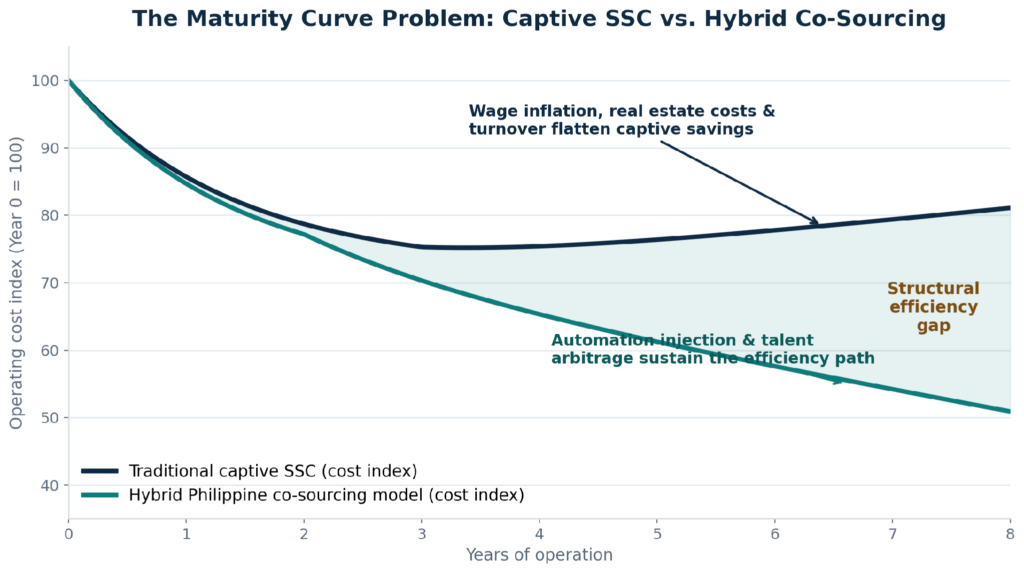
Figure 1. The maturity curve problem: captive savings flatten over time while a hybrid co-sourcing model sustains the efficiency path.
The operational exposure compounds the financial one. When a localized center experiences unexpected transaction surges or severe regional disruptions, standard operating procedures degrade quickly — backlogs form, error rates climb, and SLA commitments slip. For enterprise operations leaders, this combination of flattening economics and concentrated risk creates a compelling thesis for rethinking the sourcing architecture rather than simply expanding the captive footprint — the trade-off weighed in our captive-versus-managed-services cost comparison.
How Does a Hybrid Philippine Co-Sourcing Matrix Stabilize Global Operations?
In a hybrid co-sourcing matrix, the offshore provider functions as a responsive execution tier beneath the captive core — absorbing volume-sensitive administrative and specialized workflows while the internal center retains governance, process ownership, and data control. The model adds elastic pricing, provider-funded automation, geographic redundancy, and niche talent at scale.
Rather than replacing the existing captive center, the external partner extends it — which is what separates a strategic partnership from a transactional outsourcing deal. The Philippines’ professional ecosystem provides massive structural advantages for this role: a young, university-educated population of roughly 1.8 million BPO professionals operating in a Western-centric corporate culture, with more than 500,000 new graduates entering the workforce annually. Local teams align readily with complex international regulatory frameworks, including Sarbanes-Oxley (SOX), HIPAA, and GDPR, and delivery hubs across Metro Manila, Cebu, Clark, and Davao give multinationals genuine geographic redundancy.
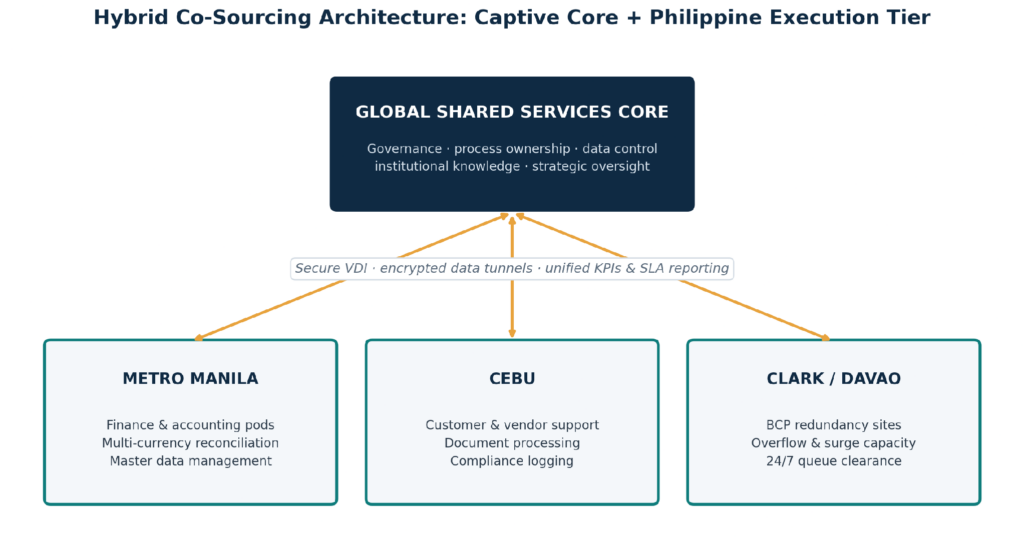
Figure 2. The hybrid co-sourcing architecture: the captive core retains governance while Philippine hubs provide the execution tier.
Each structural constraint of the standalone captive model maps to a specific co-sourcing remedy — and to measurable KPI movement. Fixed overhead converts to consumption-driven pricing; stagnant processes absorb provider-funded RPA, machine learning APIs, and modern ERP configurations; single-site exposure disperses across multiple high-tier hubs; and niche skill deficits are closed by onboarding certified accounting, legal, and software development talent at scale.
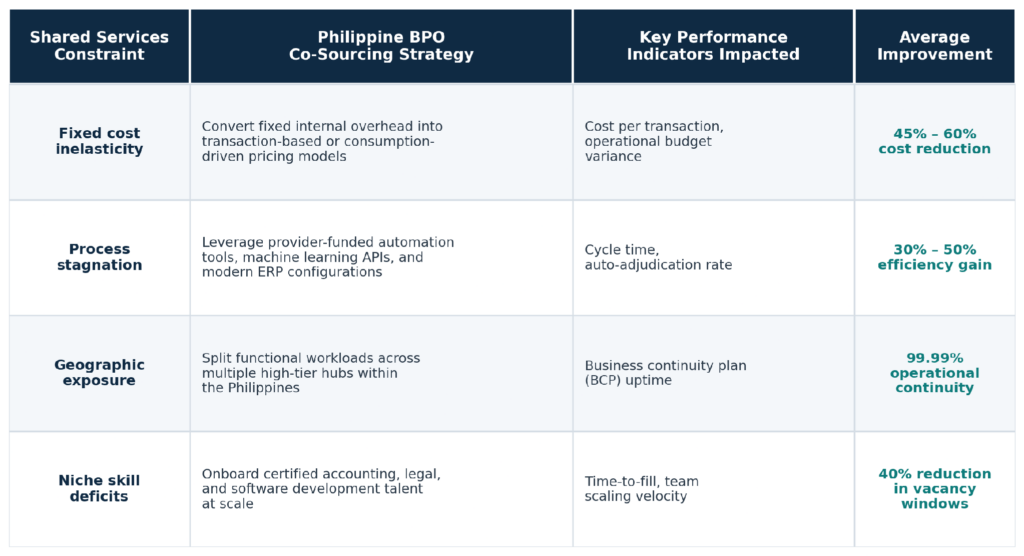
Figure 3. How Philippine co-sourcing strategies resolve the four dominant shared services constraints, with typical improvement ranges.
“The most forward-thinking global corporations no longer view outsourcing as a simple cost-saving exercise,” says John Maczynski, CEO of PITON-Global. “They view it as an essential strategy for agility. Partnering with elite Philippine BPO specialists allows enterprise leaders to augment their shared services operations with immediate technical capabilities, removing institutional gridlock and positioning the firm to capture rapid growth opportunities.”
What Does a Successful Shared Services Co-Sourcing Transformation Look Like in Practice?
In a representative engagement, a multinational fintech carved multi-currency bank reconciliations out of its overwhelmed Western European shared services unit and transferred them to a 25-analyst team in Metro Manila. Backlogs fell from 10 business days to under 12 hours within 60 days, and the total cost per processed ledger fell by well over half.
Client Challenge
The company’s internal shared services unit in Western Europe was overwhelmed by multi-currency bank reconciliations and complex vendor data validation. Backlogs extended past 10 business days, driving up transaction reconciliation errors and creating friction with strategic vendors.
Vendor Selection Process
The enterprise engaged PITON-Global to move past generic broker lists and uncover a resilient partner. PITON-Global audited the company’s enterprise application framework and compliance rules, completing a targeted matching process across its network of 100+ vetted BPO operators in the country to secure a partner with proven multi-currency ERP expertise.
Solution Implemented
- Transferred high-volume, repetitive reconciliation and master data management processes out of the European facility.
- Onboarded a dedicated team of 25 financial analysts in a secure facility in Metro Manila.
- Integrated automated workflow tools using the client’s live NetSuite environment via secure, encrypted data tunnels.
Quantifiable Business Outcomes

Figure 4. Measured results within the first 60 days of the co-sourced reconciliation operation.
Lessons Learned
Standardizing and cleansing the data ingestion paths before moving workflows offshore accelerates team nesting and ensures immediate performance stability. Clean inputs, not heroic effort, are what allow an offshore team to hit accuracy benchmarks from week one.
What Is PITON-Global’s Role in the Outsourcing Ecosystem?
PITON-Global is an advisory-led outsourcing consultancy that removes the uncertainty from Philippine vendor selection. Leveraging an actively audited network of more than 100 premium, vetted providers, it gives enterprise procurement teams a direct route to top-performing partners — without hidden advisory costs or broker markups.
Who Is PITON-Global?
PITON-Global is a Philippine-focused BPO advisory firm led by executives with decades of institutional outsourcing leadership. Within that market it acts as an independent guide for global procurement and operations teams: defining requirements, mapping the provider landscape, and steering the selection of co-sourcing partners for shared services, back-office, and contact center programs. Its expertise spans provider capabilities, pricing benchmarks, compliance frameworks, and the operational realities of delivering from Manila, Cebu and the provincial hubs.
How Does PITON-Global Differ from Traditional Outsourcing Brokers?
Conventional brokers are commission-driven: they promote the providers that pay them, biasing recommendations toward the broker’s economics. PITON-Global’s advisory-led methodology is built on independent provider evaluation — objectively assessing technical integration capabilities, cultural alignment, management depth, and compliance benchmarks. Recommendations are made solely on fit with the client’s requirements, keeping the focus on client outcomes rather than provider promotion.
How Does PITON-Global’s Network of 100+ Vetted Philippine BPO Providers Benefit Organizations?
The Philippine market is dense and highly fragmented, with hundreds of mid-market and enterprise operators offering widely varying technical capabilities; standard RFPs typically return generic sales proposals rather than evidence of operational alignment. PITON-Global maintains an actively audited ecosystem of more than 100 premium call centers and back-office providers spanning finance and accounting, legal process outsourcing, IT services, and customer operations. Because diligence on certifications, infrastructure, and track records has already been performed, organizations compress vendor discovery and qualification from months into weeks.
How Does PITON-Global’s Advisory-Led Vendor Matching Process Work?
Engagements follow a structured five-stage methodology. Technical discovery audits the enterprise application framework and compliance rules. PITON-Global then filters its network to a shortlist with demonstrated strength in the relevant domain, scores each provider against the client’s technical integration, culture, and scale criteria, and layers in risk-reduction measures — site diligence, security audits, and reference validation — before guiding evaluation, pricing benchmarking, and contract alignment.
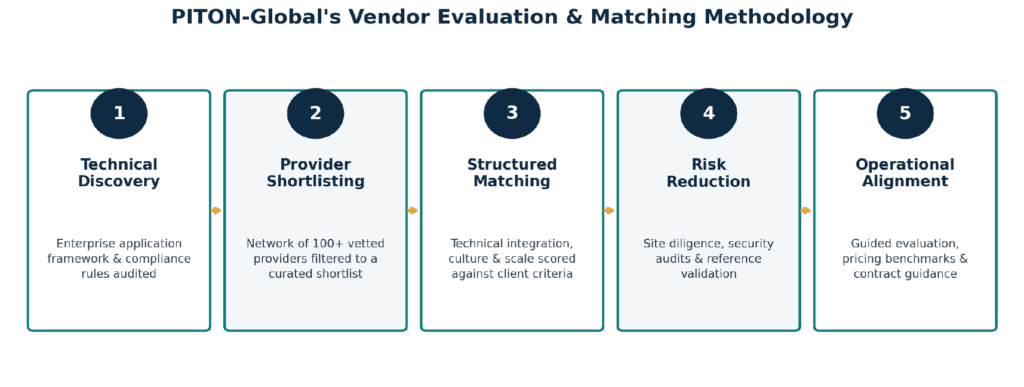
Figure 5. PITON-Global’s advisory-led evaluation and matching methodology, from technical discovery to operational alignment.
Why Do Organizations Use PITON-Global?
Global procurement teams engage PITON-Global to reduce selection and execution risk, improve provider fit, and accelerate vendor decisions. The advisory-led process replaces RFP guesswork with objective evaluation, prevents vendor lock-in, and provides strategic guidance from initial discovery through contract signature. The result is scalable, high-yield co-sourcing models that stabilize quickly and sustain SLA performance — achieved at zero advisory cost to the buyer.
What Are the Most Common Questions About Co-Sourcing Models?
Buyers most often ask about business continuity, legal and compliance capability, technical onboarding, digital transformation support, and commercial models. Mature providers in the country have established answers to all five, grounded in redundant infrastructure, deep professional talent pools, and flexible contract structures.
How do Philippine BPO providers handle business continuity planning for shared services?
Premium providers maintain advanced enterprise infrastructure: redundant fiber-optic internet feeds, on-site backup power generation, and secure secondary operating sites across distinct geographic hubs such as Cebu, Clark, and Davao — protecting operations from severe weather or localized network disruptions.
Can specialized legal and compliance tasks be integrated into a Philippine co-sourcing model?
Yes. The Philippines has a robust population of legal professionals and compliance analysts specializing in contract management, document review, and regulatory logging, making it an excellent hub for complex legal process outsourcing (LPO).
What technical onboarding procedures are standard when integrating an external provider?
A typical implementation spans four to eight weeks, covering secure virtual desktop infrastructure (VDI) configuration, multi-factor authentication (MFA) setup, deep workflow documentation, and a multi-week structured training and shadowing period.
How do modern Philippine providers support enterprise digital transformation goals?
Top-tier operators act as technology incubators, embedding specialized automation engineers, optical character recognition (OCR) systems, and data analytics tools directly into the workflows they manage to optimize transaction speeds and auto-adjudication rates.
What commercial models are standard for long-term shared services partnerships?
Agreements generally rely on predictable FTE-based monthly pricing, transaction-based pricing, or hybrid models that tie financial rewards directly to hitting clear operational SLA targets — often with elastic scaling clauses for seasonal demand.