

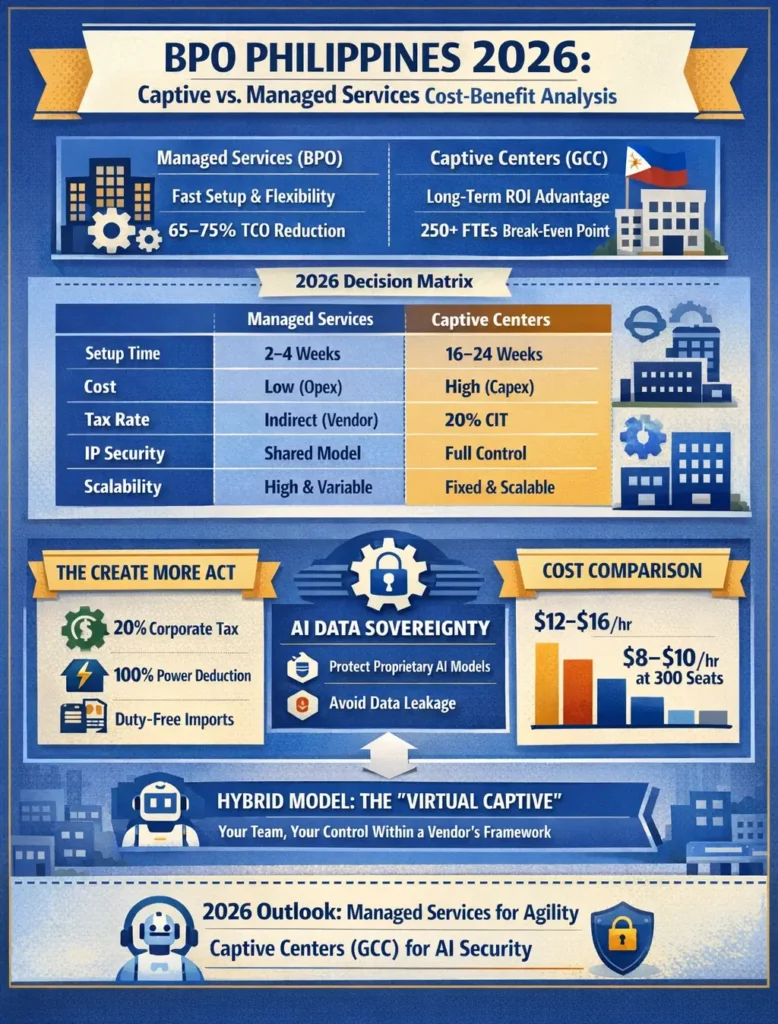
In 2026, the Managed Services model in the Philippines remains the primary choice for rapid market entry (under 30 days) and variable scaling, offering a 65%–75% TCO reduction with zero upfront capital expenditure; you can see how those managed-service numbers are built with per-agent rates modeled live for your headcount for your function and headcount. Conversely, the Captive (GCC) model has become the superior long-term ROI play for operations exceeding 250 FTEs, where the elimination of vendor margins (typically 15%–20%) and direct access to CREATE MORE Act tax incentives (20% CIT) result in a further 25% cost advantage over a 3-year horizon.
30-Second Executive Briefing
- Legislative Shift: The full implementation of the CREATE MORE Act (RA 12066) in 2026 has removed the “on-site” requirement for tax incentives, allowing Captive Centers to hire 100% remote talent while retaining a 20% Corporate Income Tax rate.
- The AI Factor: Enterprises are shifting toward Captives to maintain Data Sovereignty over proprietary Agentic AI training sets, avoiding the “shared model” risks common in multi-tenant Managed Service environments.
- Cost Efficiency: Managed Services provide immediate “Fully Loaded” predictability at a single hourly rate, while Captives require a substantial upfront setup investment but achieve lower unit costs through direct payroll management.
- Speed to Value: Managed Service providers now utilize “Plug-and-Play” AI stacks that materially shorten training time-to-proficiency, whereas Captives offer deeper cultural integration and “Malasakit” (ownership) alignment.
- Hybrid Maturity: The 2026 “Virtual Captive” has emerged as the middle ground—using a vendor’s legal entity and facilities but maintaining 100% control over staff selection and operational workflows.
The 2026 Landscape: Beyond “Either/Or”
For a decade, the choice was binary: rent a team or build a company. In 2026, the rise of Agentic AI and the CREATE MORE Act has blurred these lines. A “Managed Service” now often includes sophisticated AI orchestration, while “Captives” (now commonly called Global Capability Centers or GCCs) are leveraging third-party platform-as-a-service (PaaS) to launch in half the time it took in 2022.
Current search intent from COOs reveals a shift from “How do I save money?” to “How do I protect my AI intellectual property while maintaining Philippine cost structures?”
Table 1: 2026 Comparative Decision Matrix
| Feature | Managed Services (BPO) | Captive Center (GCC) |
| Setup Timeline | 2 – 4 Weeks | 16 – 24 Weeks |
| Capital Requirement | Low (Opex-based) | High (Capex-based) |
| Tax Incentives | Indirect (Vendor’s benefit) | Direct (20% CIT via CREATE MORE) |
| IP Security | Contractual Guardrails | Physical & Digital Sovereignty |
| Scalability | High (Immediate +/-) | Moderate (Fixed by infrastructure) |
The CREATE MORE Act: A Catalyst for the 2026 GCC
The CREATE MORE Act (RA 12066) is the single most significant driver for the “Captive Renaissance” in 2026. Previously, firms were tethered to Special Economic Zones (PEZA) to receive tax breaks. Today, the “work-from-anywhere” provision has revolutionized the GCC model.
- Reduced Corporate Income Tax: Registered Business Enterprises (RBEs) in the Philippines now pay a flat, reduced corporate income tax rate that undercuts the combined federal-plus-state burden carried by a US entity.
- Full Power-Cost Deduction: For GCCs running high-performance AI servers and GPU-heavy workstations, the full deductibility of power expenses under the “Enhanced Deductions” regime delivers a measurable boost to the bottom line.
- Duty-Free Imports: Captives can now import specialized AI hardware and high-spec servers free of import duty, even before their final Certificate of Registration is issued, provided a performance bond is posted.
- Local Tax Certainty: Local Government Unit (LGU) taxes are now capped at a low fixed rate for those under the ITH/EDR regimes, preventing the “hidden fees” that historically plagued foreign-owned entities.
- VAT Zero-Rating: 2026 rules have expanded VAT zero-rating to include “incidental and necessary” services such as security, HR, and consultancy, improving monthly cash flow by 12%.
Breaking Down the Total Cost of Ownership (TCO)
In 2026, the “Fully Loaded” cost in the Philippines is about more than just a desk and a computer. It includes the AI Stack Licensing, Zero-Trust Security Perimeters, and Retention Premiums.
The Managed Service Economics
When you pay a vendor a single blended hourly rate, you are paying for their recruitment engine, their legal entity, and their management expertise, with the vendor’s margin layered on top of direct labor. That is why benchmarking a vendor’s pricing proposal line by line matters before you sign.
- Best for: SMEs or departments with fewer than 150 FTEs, where the fixed overhead of a legal entity and a local management layer would outweigh the vendor’s margin—provided the vendor is chosen through a structured vendor-selection process rather than on rate alone.
The Captive (GCC) Economics
In a GCC, you pay the direct “Burdened Salary” (Base + 13th month + SSS/PhilHealth/Pag-IBIG) plus the facility and local management costs.
- The Breakeven Point: Historically 500 seats, the 2026 breakeven point has dropped to 250 seats due to the efficiency of cloud-based operations and the CREATE MORE Act.
- Savings Delta: At around 300 seats, a Captive typically delivers a substantial annual saving compared to a Managed Service provider, even after accounting for local HR and compliance costs; building the ROI business case around that delta is what turns the decision into a board-ready number.
The AI Sovereignty Requirement
A major “change ” point for 2026 buyers is Model Autonomy. Managed Service Providers (MSPs) often utilize “Shared AI Workers” to keep their costs low across multiple clients.
- Data Leakage Risk: In a Managed Service environment, your customer interactions might be used to fine-tune a model that also serves your competitors.
- Customization Depth: Captives allow for “Deep Fine-Tuning” of Agentic AI. You can train your bots on your specific “Brand Voice” and proprietary technical manuals without sharing that data with a third-party vendor.
- The “AI Pilot” Talent Pool: In 2026, the best Philippine talent wants to work for global brands directly. Captives have a 12% higher retention rate than third-party BPOs because agents feel a sense of “Malasakit” (ownership) toward the parent company.
Strategic Implementation: The 12-Week Velocity Framework
If you choose the Captive route in 2026, you no longer need a two-year roadmap. Leading consultancies now use the 12-Week Velocity Framework:
- Weeks 1-4 (Legal Architecture): Registering with the SEC and choosing the Enhanced Deductions (ED) vs. Special Corporate Income Tax (SCIT) path based on your 5-year capex forecast.
- Weeks 5-8 (Digital & Physical Hub): Utilizing “Flexible Managed Offices” in Manila or Cebu that provide the security of a GCC with the agility of a BPO.
- Weeks 9-12 (Human-AI Integration): Hiring the core leadership team—specifically the AI Operations Manager and Cultural Alignment Lead—to ensure the Manila hub is an extension of HQ, not a silo.
The Maturity Leap
The Philippines has officially transitioned from the “World’s Back Office” to the “World’s Primary Intelligence Engine.” For the 2026 enterprise, Managed Services remain the ultimate tool for Agility, while the Captive model is the ultimate tool for Equity.If your roadmap involves processing highly sensitive PII (Personally Identifiable Information) or building a proprietary AI workforce that serves as a competitive moat, the Captive (GCC) model under the CREATE MORE Act is the only logical 2026 choice.