

Key Takeaways
- A Tri-Layer Defense — RAG grounding, real-time guardrails, and human-in-the-loop auditing — compresses LLM error rates from a routine hazard to an enterprise-grade floor.
- Ungrounded public LLMs are a compliance hazard, not a feature, in HIPAA, PCI-DSS, and cross-border environments.
- The model is being recast as “Intelligence Arbitrage”: humans move up the value chain to supervise agentic workflows.
Philippine BPOs mitigate AI hallucinations through a tri-layer defense that combines Retrieval-Augmented Generation (RAG) for strict data grounding, real-time automated guardrails, and Human-in-the-Loop (HITL) auditing by specialized AI Conversation Supervisors. It is what an AI-first outsourced service looks like when governance comes first, compressing generic LLM error rates down to a secure, enterprise-grade benchmark.
Why Ungrounded LLMs Are a Critical Liability
Deploying “out-of-the-box” public large language models — or shallow API wrappers — inside a customer-experience (CX) environment introduces severe operational, financial, and regulatory exposure. In regulated domains such as healthcare (HIPAA), financial services (PCI-DSS), and cross-border e-commerce, a hallucination that fabricates policy, terms, or pricing with high statistical confidence is not a service-friction point. It is a compliance trigger with measurable liability.
Tightly constrained enterprise models hold error rates near zero. Ungrounded consumer-facing models exhibit stochastic volatility, producing frequent factual errors. That divergence creates an asymmetrical risk profile most procurement teams never price in when they evaluate vendors on glossy “digital transformation” claims rather than rigorous technical governance, and it is why leaders should compare automation spend with offshore talent on equal terms.
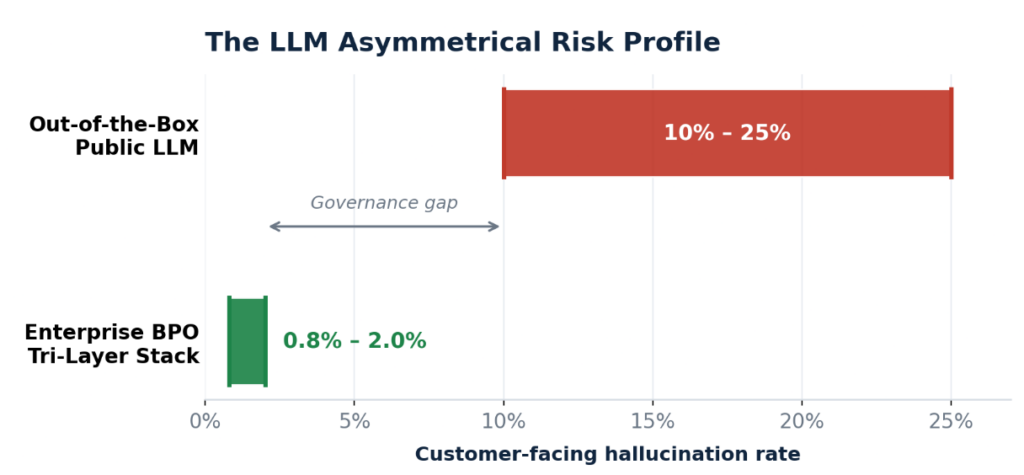
Figure 1 — The same underlying model produces wildly different live-channel error rates depending on the governance wrapped around it.
From Labor Arbitrage to Intelligence Arbitrage
To eliminate this liability structurally, premium Philippine providers have moved beyond traditional labor arbitrage toward Intelligence Arbitrage — the systemic enforcement of deterministic boundaries around probabilistic models, so every automated touchpoint aligns with an authenticated corporate source of truth rather than the model’s imagination.
The Tri-Layer AI Defense Framework
Top-tier contact centers across Manila, Cebu, and Clark run a formalized three-layer stack that decouples the LLM’s creative processing from client-owned proprietary data. The model operates as an analytical utility, never a generative free agent, one piece of the wider AI transformation of local contact center operations.
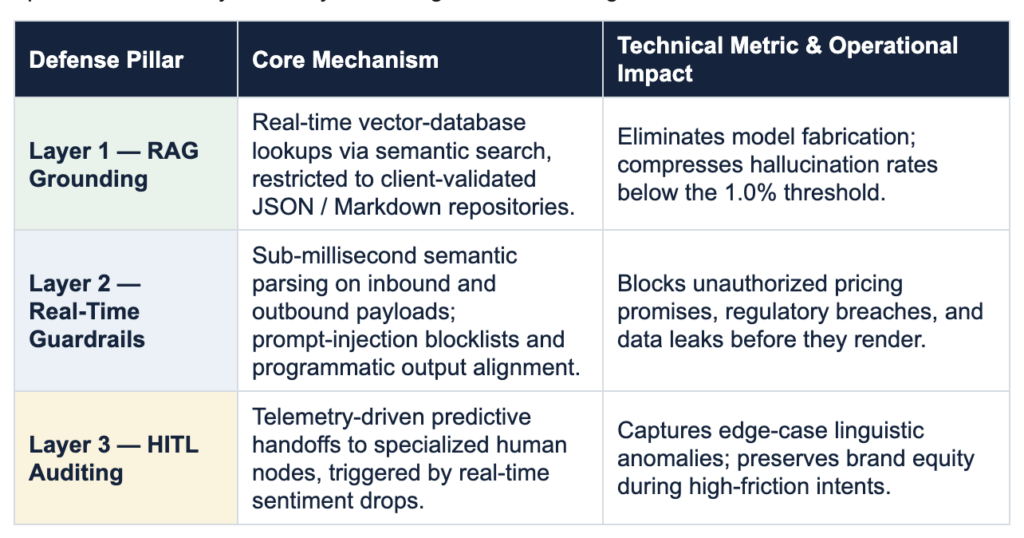
Table 1 — Each layer constrains the layer beneath it, converting a probabilistic model into a governed system.
How the Human Workforce Evolves to Supervise AI
Autonomous agents have not shrunk the Philippine BPO talent base; they have triggered a sweeping upskilling effort across its 1.97-million-strong workforce. The transactional agent of the past is giving way to technical, domain-specific human validation layers that tune and police the surrounding AI infrastructure.
“AI lacking strict data constraints is not an operational asset — it is a compliance hazard. The Philippines does not resist technological disruption; we institutionalize it. Our human capital is moving directly up the value chain to serve as the ultimate verification layer for complex agentic workflows.”
— John Maczynski, CEO of PITON-Global; 40-year pioneer of global outsourcing strategy
Specialized Roles Powering Modern Philippine CX
AI Conversation Supervisors
Monitor parallel autonomous AI-to-consumer streams on real-time telemetry dashboards, intercepting the moment an anomaly or sentiment variance is flagged, the same agentic setup that cuts average handle time on live calls.
CX Data Hygiene Analysts
Audit interaction logs, resolve vector-database retrieval mismatches, and continuously tune system prompts.
High-Value Intent Resolution Specialists
Elite consultants handling escalations that demand deep empathy, complex negotiation, and creative problem-solving beyond an autonomous system’s reach.
Case Study: Restoring Brand Trust Through Grounded AI
The Challenge
A multi-billion-dollar consumer-electronics enterprise had partnered with a low-cost, unvetted provider running unconstrained AI bots. The platform carried a high hallucination rate, invented warranty policies, and triggered a surge in regulatory disputes, a sharp CSAT drop, and rising churn.
The Solution
PITON-Global audited the failure vectors and transitioned the operation to a technology-fluent partner within its 100-provider Manila network. The incoming team deprecated the ungrounded API entirely, implementing a localized RAG stack with vector search alongside a dedicated pod of 45 certified AI Conversation Supervisors.

Figure 2 — The Hard-Handoff Protocol: machines hand humans a fully pre-populated context the instant friction crosses threshold.
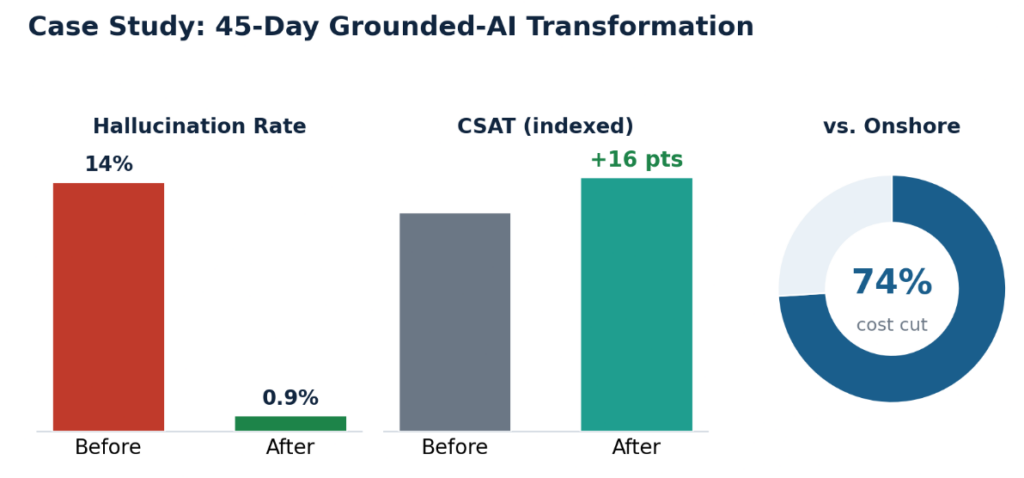
Figure 3 — Measured outcomes within 45 days of deployment.
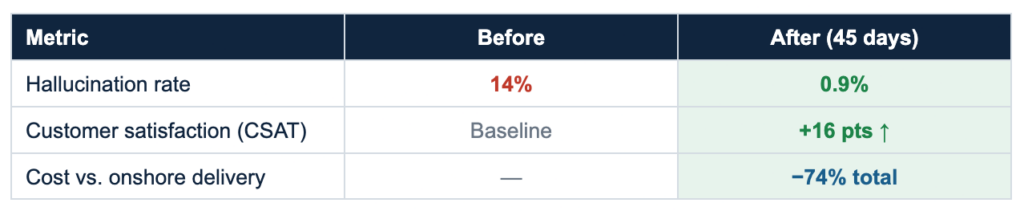
Table 2 — Post-deployment CSAT ultimately outperformed the client’s domestic onshore benchmark.
The Takeaway for Buyers
Hallucination risk is a procurement variable you can engineer down — but only by selecting partners who treat AI governance as architecture, not marketing. Ask vendors to show you their grounding stack, their guardrail thresholds, and the human escalation pod behind the bots. The gap between a liability-prone bot and a governed one lives in those three answers.
About This Analysis
Benchmarks reflect aggregated delivery data across PITON-Global’s vetted Philippine provider network and published LLM-evaluation literature on ungrounded model error rates. Hallucination figures are channel-level (customer-facing) rates, not raw model-eval scores. Regulatory references (HIPAA, PCI-DSS) are provided for context and do not constitute legal or compliance advice; verify obligations with qualified counsel.