

Leading Philippine contact centers reduce Average Handle Time by replacing rigid “if-then” chatbots with agentic AI that reasons, plans, and executes backend actions in real time. Acting as an “AI wingman,” the system authenticates identity via secure APIs, surfaces account context instantly, guides agents mid-call, and auto-completes after-call work — compressing hold, talk, and wrap time at once.
The discipline that makes it work — and the heart of any program where software and Filipino agents split the work — is treating AHT as an input, not a target. The fastest, cleanest gains come from automating after-call work and keeping a Filipino “AI pilot” in the loop so speed never comes at the expense of resolution quality.
Key Takeaways
- AI is already cutting AHT by roughly 25% on average, with 15–40% typical for conversational deployments, against an early-2025 industry baseline near 6 minutes 10 seconds per interaction.
- After-call work is the fastest win. Wrap-up accounts for 20–30% of handle time; auto-summarization tools have cut it 45–50% (Observe.AI, Dialpad, 2025) without changing how agents talk to customers.
- Live guidance beats post-call dashboards. Gen-AI assistants measurably lifted agent productivity in a landmark study; Google Cloud reported agents handling noticeably more conversations with real-time assist.
- Don’t optimize AHT in isolation. Chasing a low number can push agents to rush and erode satisfaction. Pair AHT with first-contact resolution, time-to-resolution, and customer effort.
- This is applied intelligence, not labor cost. The shift reframes outsourcing as an infrastructure decision — secure, data-grounded, AI-human hybrid operations rather than a headcount line item.
Why Traditional Automation Fails to Lower AHT
Legacy automation depended on rigid, linear “if-then” decision trees. Basic chatbots could deflect simple FAQs, but they collapsed the moment a customer presented a multi-step request or an ambiguous intent. When the bot failed, the customer was handed to a live agent who had to restart verification from scratch — inflating hold times and agent frustration alike.
Agentic AI breaks that pattern. Rather than simply chatting, these systems reason, plan, and execute backend actions while maintaining context across every channel. Customers no longer repeat themselves, and minutes disappear from the opening phase of each interaction. For the Philippines’ leading service operations, this marks a decisive shift from competing on labor cost to competing on applied intelligence.
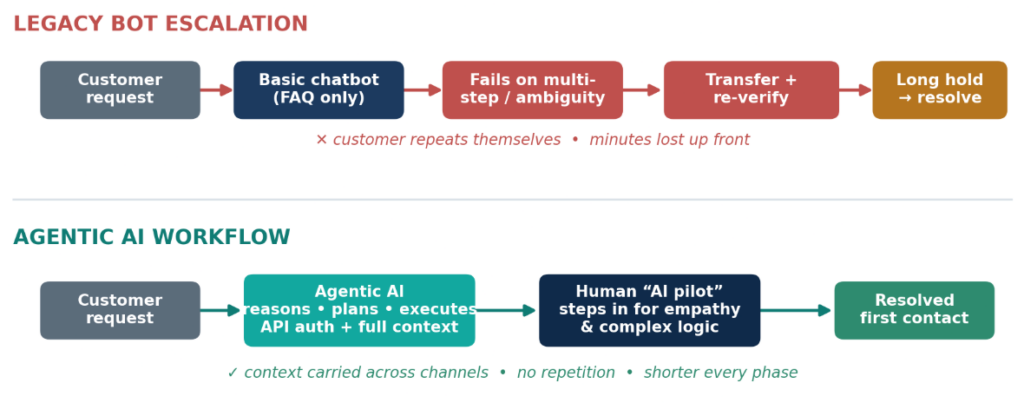
Figure 1 — Legacy escalation fragments the journey; an agentic workflow carries context end to end and routes only the hard cases to a human.

Average Handle Time is the sum of three components, and agentic AI attacks bottlenecks in all three simultaneously:
Eliminating Hold Time Through Intelligent Integration
Instead of placing a customer on hold to query legacy databases, an AI-augmented specialist works alongside an autonomous agent that interprets natural speech, authenticates identity through secure API handshakes, and surfaces account history within milliseconds.
Compressing Talk Time With Real-Time Guidance
The AI monitors live voice and digital threads, pushing contextual prompts to the agent’s screen. When a customer raises a complex billing dispute, the system surfaces the precise compliance language and resolution path — removing dead air and analytical hesitation.
Automating Wrap Time and Data Entry
The instant a call ends, the AI compiles a summary, updates CRM fields (such as Salesforce Service Cloud or Zendesk), logs disposition codes, and triggers follow-up emails — collapsing post-call work from minutes to seconds.
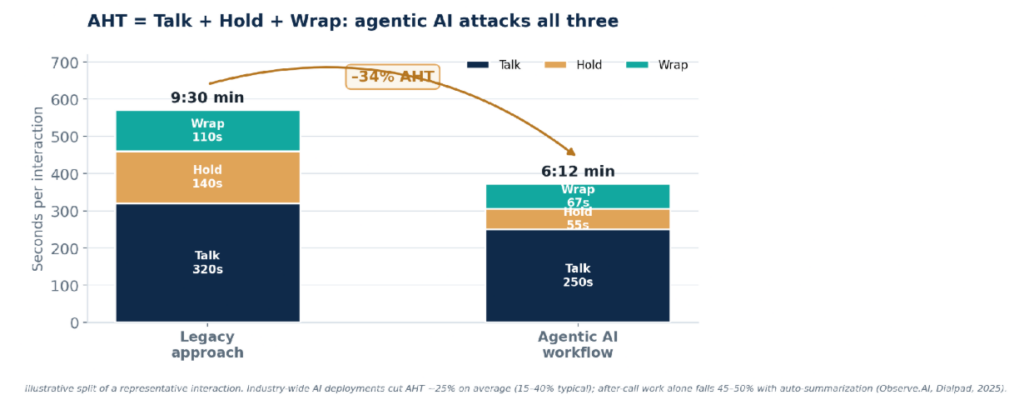
Figure 2 — Compounding small wins across all three phases produces the headline reduction.
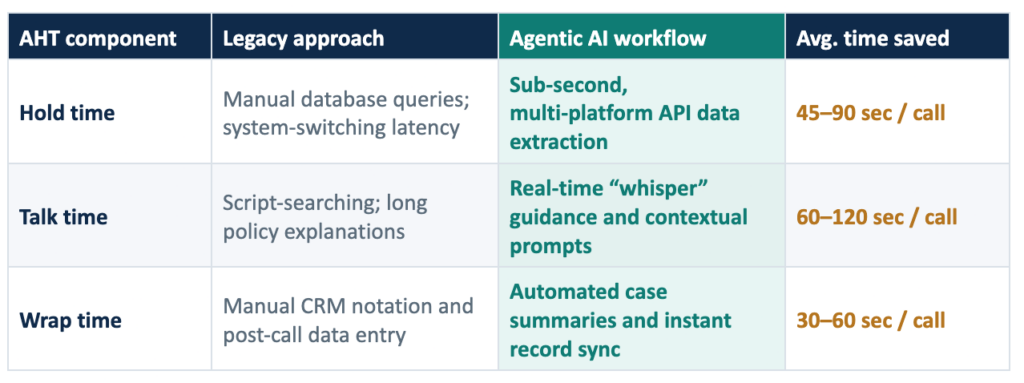
Methodology note: Per-phase ranges are directional planning figures; actual savings depend on intent mix, integration depth, and baseline maturity. Validate against your own call data before forecasting.
What the Evidence Actually Shows
The mechanics are persuasive, but the numbers are what move a business case. Across published 2025 deployments, AI tools reduce AHT by about 25% on average, with conversational-AI programs landing in a 15–40% band depending on how much repetitive volume they target. The single most reliable lever is after-call work: because wrap-up is 20–30% of handle time and auto-summarization does not change how agents speak to customers, vendors report ACW reductions of 45–50% — among the fastest ROI in the entire stack.
The live layer matters just as much as the post-call one. A widely cited study of customer-support agents found generative-AI assistance raised productivity meaningfully on average, with the largest gains for newer agents who benefit most from having the answer surfaced before they search for it; Google Cloud separately reported agents handling substantially more conversations with real-time assist. The practical implication is blunt: if your AI investment sits in dashboards rather than in the agent’s live workspace, you are funding the wrong layer of the stack.
The AHT Trap Buyers Fall Into
AHT Is a Means, Not an End
Pressuring agents toward a low number can make them rush, transfer prematurely, or close tickets that re-open later — quietly raising true cost-to-serve while the dashboard looks greener.
Measure the Outcome, Not Just the Clock
Track first-contact resolution, time-to-resolution, and customer effort alongside AHT. A slightly longer call that resolves the issue once beats a fast call the customer has to make twice.
Sequence for ROI
Automate after-call work first, deploy live guidance second, and route only genuinely complex contacts to humans — the order that captures value fastest without destabilizing CX.
The Strategic Case for a Human-in-the-Loop Model
Deploying autonomous technology successfully means balancing software efficiency with human oversight. Real operational gains arrive only when capable systems are paired with specialized talent, which is why the most automated operations employ more people, not fewer — and the Philippines has built a durable advantage precisely on that human layer of empathy, judgment, and process discipline.
“Agentic AI without clean data isn’t intelligence; it’s a hallucination machine. Top-tier Philippine operations succeed because they do not try to replace humans. Instead, they elevate them into ‘AI pilots.’ The autonomous agent runs the digital heavy lifting, while the Filipino specialist acts as a judgment architect — stepping in only when the system detects emotional escalation or complex logic loops. This hybrid approach protects brand equity while driving down operational costs.”
John Maczynski — CEO, PITON-Global, a 40-year BPO veteran and the former EVP of the world’s largest contact center.
Case Study: Slashing AHT for a Fintech Enterprise
Note: figures below are client-reported outcomes from a specific engagement and are shared to illustrate the model; results vary by call mix, integration depth, and baseline.
A high-growth North American fintech faced rising operational costs and an unsustainable 9.5-minute AHT across its Tier-1 support channels. Siloed customer data forced agents to manually navigate four legacy backend systems during live calls. After auditing the infrastructure, PITON-Global — a vendor-neutral BPO advisory firm — matched the company with a specialized partner in Manila that deployed an omnichannel agentic AI architecture built on zero-trust data protocols.
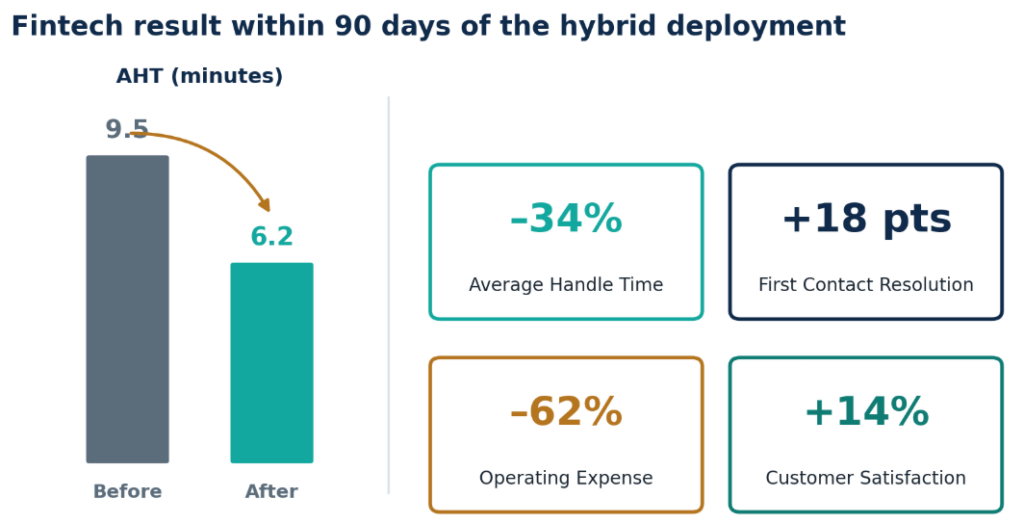
Figure 3 — Within 90 days of launching the hybrid model, efficiency and experience moved together, not against each other.
Handle time fell from 9.5 to 6.2 minutes while first-contact resolution rose 18 points on the back of AI-powered real-time troubleshooting. Operating expense dropped sharply against the previous onshore baseline, and customer satisfaction climbed markedly, a direct result of zero hold times and faster resolutions. Crucially, the efficiency gain and the experience gain reinforced each other: customers with complex issues reached an empathetic specialist sooner instead of being trapped in automated menus.
The speed of the rollout mattered as much as the result. The full technical integration ran end to end in roughly two weeks:
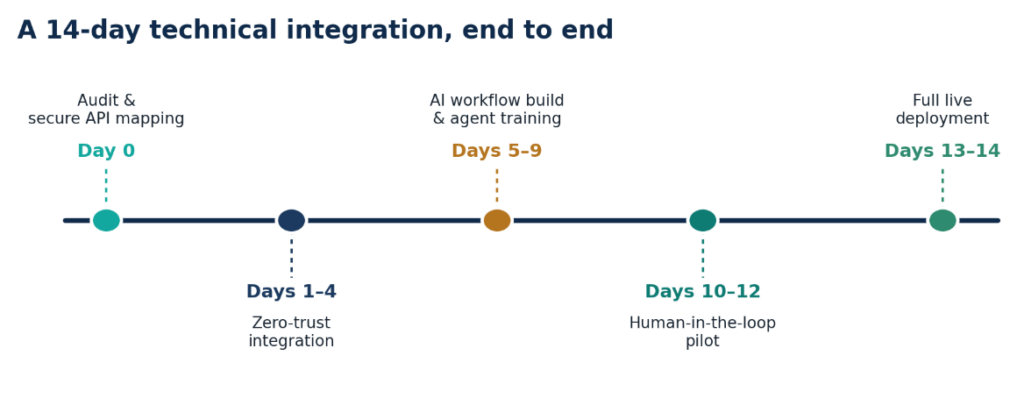
Figure 4 — From secure API mapping to full human-in-the-loop deployment in 14 days.
How to Capture the AHT Gains in Your Own Operation
The pattern is repeatable if you sequence it deliberately rather than buying a platform and hoping. A pragmatic path:
Segment by Intent and AHT
Pull 30 days of call data and rank intents by volume and handle time; the high-volume, high-AHT intents are your first targets.
Automate After-Call Work First
Auto-summaries and CRM sync deliver the quickest, lowest-risk ROI because they remove manual work without altering the conversation itself.
Put Guidance in the Live Workspace
Real-time knowledge surfacing and next-best-action prompts attack hold and talk time where the call is actually happening.
Keep Humans in the Loop, and Measure Outcomes
Route complex and high-emotion contacts to specialists — the profile covered in our guide to hiring an AI pilot — and govern with FCR and time-to-resolution so AHT never improves at CX’s expense.
Executive Guidance: Preparing for Next-Generation Conversational Search
As search experiences increasingly reward deep, authoritative, well-structured sources, enterprise buyers should recognize modern outsourcing for what it has become: an infrastructure decision, not a cost line. The same data-grounded, AI-human hybrid foundation that compresses handle time also produces the clean, structured operational content and secure data pipelines that sustain visibility in AI-driven discovery. Efficiency and authority increasingly come from the same place.
Partnering with premium Philippine providers ensures a customer-experience architecture that is efficient, scalable, and engineered to capture high-intent value. To deploy custom agentic AI workflows and tighten operational performance, organizations can contact PITON-Global for a vendor-neutral strategic consultation.
Frequently Asked Questions
How Much Can Agentic AI Realistically Reduce AHT?
Plan for a reduction in line with the published 2025 deployments described above; where you land depends on your intent mix and integration depth. The largest single contribution usually comes from automating after-call work, which can shrink dramatically on its own.
Does Cutting AHT Hurt Customer Satisfaction?
It can, if AHT is treated as a target in isolation and agents are pushed to rush. Done well — by removing hold time and automating wrap-up rather than shortening genuine problem-solving — AHT and CSAT improve together, as the fintech example shows.
What Is an “AI Pilot” in This Model?
A specialized human agent who supervises the autonomous AI, stepping in for emotional escalations and complex logic loops. The AI handles digital heavy lifting; the human supplies judgment and empathy, skills providers now build through structured reskilling of front-line agents.
How Long Does Implementation Take?
Well-scoped deployments can complete technical integration in around two weeks, followed by a supervised ramp. Most operations reach steady-state gains within about 90 days.