
Back
Can AI-Augmented Filipino Agents Replace Tier 2 Technical Support?

By Ralf Ellspermann / 12 June 2026
 Authored by Ralf Ellspermann, CSO of PITON-Global, & 25-Year Philippine BPO Veteran | Executive | Verified by John Maczynski, CEO of PITON-Global, and Former Global EVP of the World's Largest BPO Provider on June 12, 2026

Pairing the analytical skill, English fluency, and empathy of Philippine Tier 1.5/2 engineers with real-time AI copilots and retrieval-augmented generation (RAG) stacks lets enterprise BPOs deflect or resolve up to 88% of Tier 2 technical workloads—cutting costs 45–60% versus onshore teams while matching or beating traditional resolution rates.
How Does the Cost of AI-Augmented Philippine Support Compare to Onshore Teams?
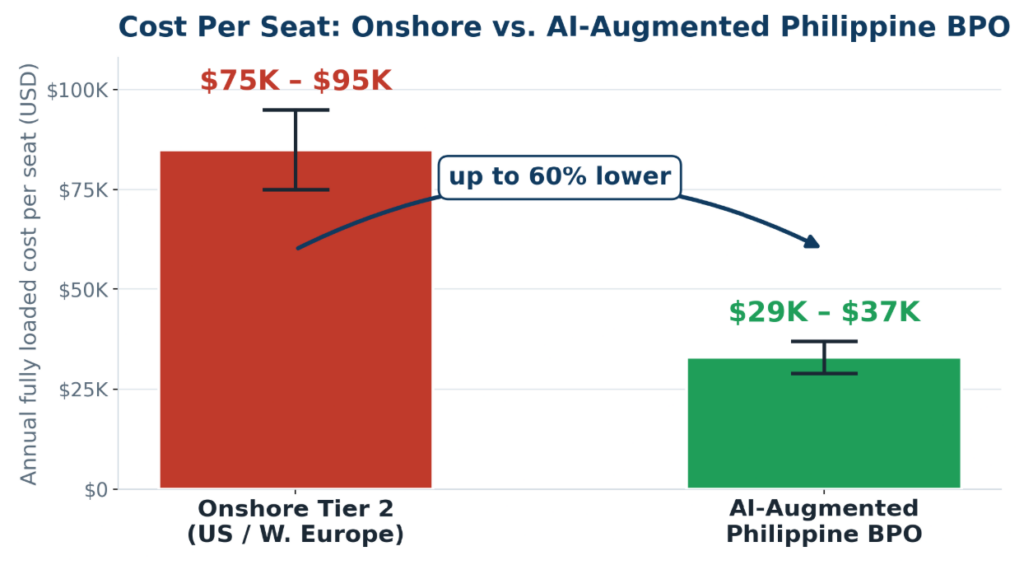
Dramatically lower. A fully burdened onshore Tier 2 engineer costs $75,000–$95,000 a year; an AI-augmented Philippine specialist runs $14–$18 an hour, roughly $29,000–$37,000 per seat. With AI copilots compressing handling time by about 36%, fewer agents clear larger ticket volumes—turning labor arbitrage into genuine productivity gains.
For technology executives, the financial architecture often dictates the outsourcing decision—but in 2026 the savings no longer come from cheap labor alone. They come from exponential agent productivity driven by integrated AI orchestrators that sit beside every engineer.
In the United States or Western Europe, a standard Tier 2 support engineer commands a fully burdened salary of $75,000 to $95,000. Premium, enterprise-grade AI-augmented specialists in top-tier Philippine BPOs cost between $14 and $18 per hour—an annual loaded cost of roughly $29,000 to $37,000 per seat. That differential delivers immediate bottom-line relief, but the deeper value sits in the workflow itself.
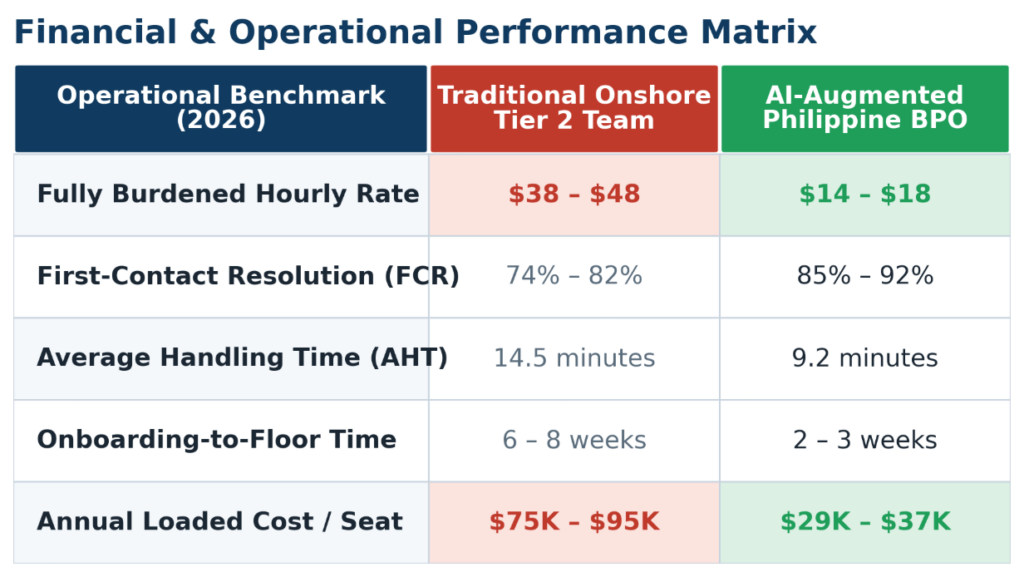
Verified 2026 operational baselines across onshore and AI-augmented support models.
Because these offshore agents work alongside context-aware AI copilots, average handling time falls by nearly 36%—from 14.5 to 9.2 minutes. Fewer agents are required to clear larger ticket volumes, and first-contact resolution climbs into the high-80s and low-90s, territory many onshore teams struggle to reach.
Ticket Routing & Cost-Effectiveness
The contrast is sharpest at the routing layer. A domestic queue leans on manual log triage at roughly $45 per hour, while an AI-augmented Philippine team applies automated RAG parsing at about $16 per hour—compressing both the timeline and the expenditure on an identical ticket.
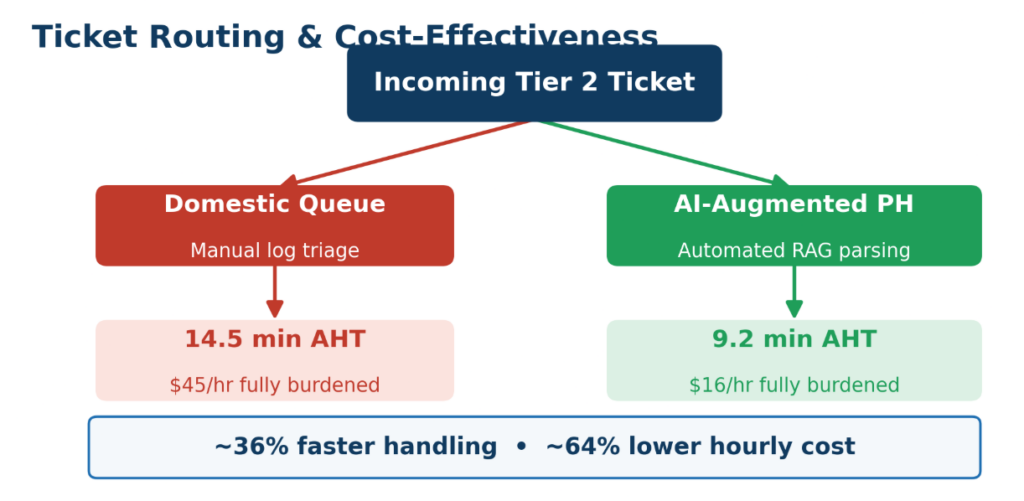
Figure 1: Manual domestic queues versus automated RAG-assisted timelines, showing the parallel trajectory of compressed handling times and reduced expenditure.
What Technology Stack Enables Filipino BPOs to Handle Tier 2 Infrastructure?
A synchronized, multi-layered architecture acts as an intellectual exoskeleton around each agent. Domain-specific RAG stacks deliver instant diagnostics, agentic orchestrators automate background workflows, and real-time sentiment systems flag escalation risk. Together they let a human engineer operate at the speed of automation while keeping the judgment that complex technical failures still demand.
Replacing or augmenting Tier 2 work takes far more than a chatbot or a static knowledge base. Top-tier Philippine providers have invested heavily in proprietary stacks that erase the historical bottlenecks of technical outsourcing.
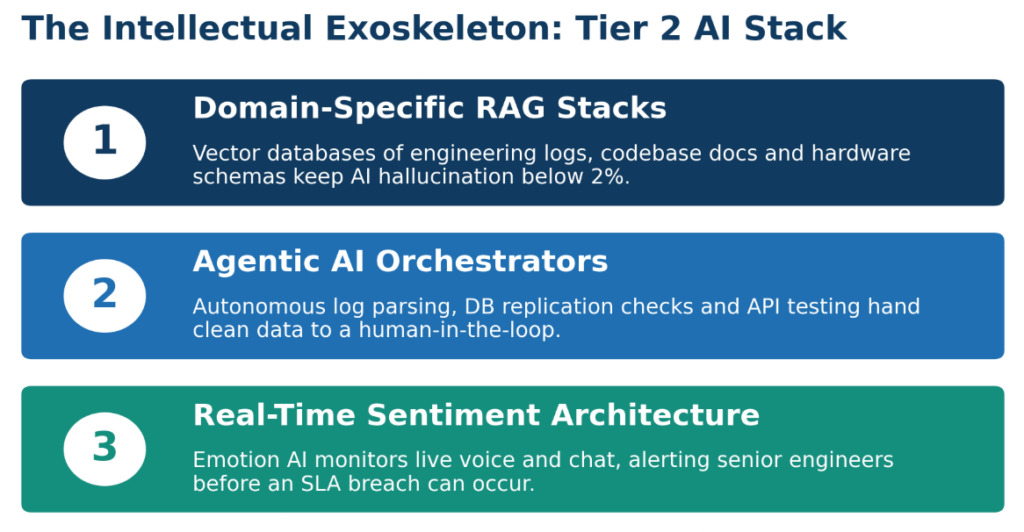
Domain-specific RAG stacks pair agents with vector databases built from years of engineering logs, codebase documentation, and hardware schemas, pushing AI hallucination below 2% and surfacing hyper-accurate diagnostics during live troubleshooting. Agentic AI orchestrators run the multi-step background work—cross-platform log parsing, database replication checks, API integration tests—then present clean data to a human-in-the-loop for final validation. Real-time sentiment architecture monitors live voice and chat, alerting senior engineering leads before frustration becomes an SLA breach.
“Automation alone cannot close the gap on a judgment-critical, high-urgency Tier 2 technical failure. The magic isn’t in eliminating the human asset; it’s about wrapping a highly educated, highly empathetic Filipino engineer in sophisticated AI infrastructure. That is how you protect enterprise brand equity while slashing operational overhead by half.”
— John Maczynski, CEO, PITON-Global; 40-year veteran of the global BPO industry
What Specific Technical Workloads Can Be Safely Transitioned?
More than most procurement teams assume. With workflows properly mapped, specialized Philippine teams now resolve API and webhook failures, advanced database and synchronization issues, and cloud-provisioning problems that once required Tier 3 escalation. AI copilots supply suggested scripts, parse payloads, and read live telemetry while a certified human engineer stays in control of every fix.
Many corporate buyers assume Tier 2 work is too complex to leave domestic borders. In practice, mapped workflows let Philippine engineers resolve issues that previously escalated to Tier 3 DevOps or localized product teams.

Advanced Database and Synchronization Support
Advanced database and sync failures—replication lag, synchronization anomalies, and carefully controlled SQL queries—are diagnosed through AI-suggested scripts.
API and Webhook Troubleshooting
API and webhook troubleshooting covers payload errors, authentication mismatches, and guiding enterprise developers through integration bugs.
Network and Cloud Provisioning Support
Network and cloud provisioning support spans VPC configuration, firewall verification, and identifying missing infrastructure assets using real-time system telemetry.
Mini Case Study: Mid-Market Fintech SaaS Platform
The Challenge
A high-growth US fintech-infrastructure SaaS platform faced a severe Tier 2 bottleneck. Backlogs had pushed response times past 18 hours, and scaling the internal Silicon Valley engineering team was financially unsustainable.
The Solution
PITON-Global audited the technical workflows, bypassed the bloated global conglomerates, and matched the client with a specialized mid-sized Manila BPO. The partner built a dedicated team of 15 university-educated, network-certified engineers equipped with a custom RAG copilot trained on the client’s internal developer documentation.
The Results
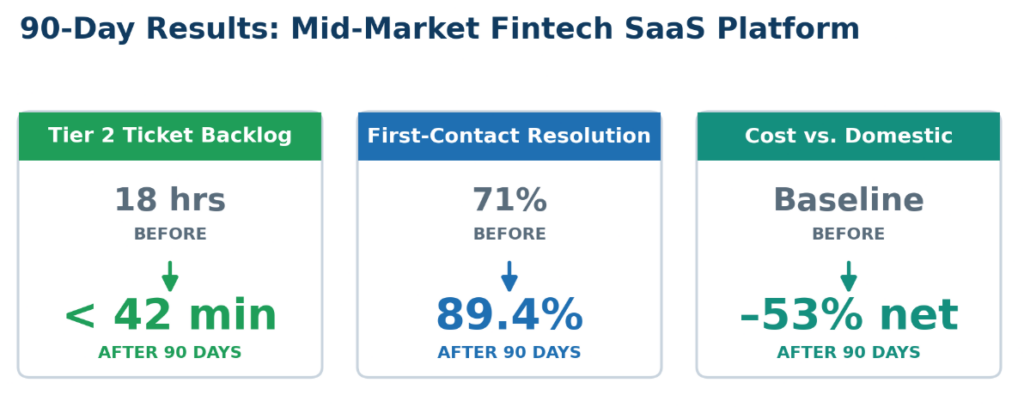
Within 90 days the metrics transformed. The backlog fell from 18 hours to under 42 minutes, first-contact resolution climbed from 71% to 89.4%, and the client realized net savings of 53% against its planned domestic model—capital it redirected straight into core product R&D.
How Should Enterprise Buyers Evaluate an AI-Ready BPO Partner in the Philippines?
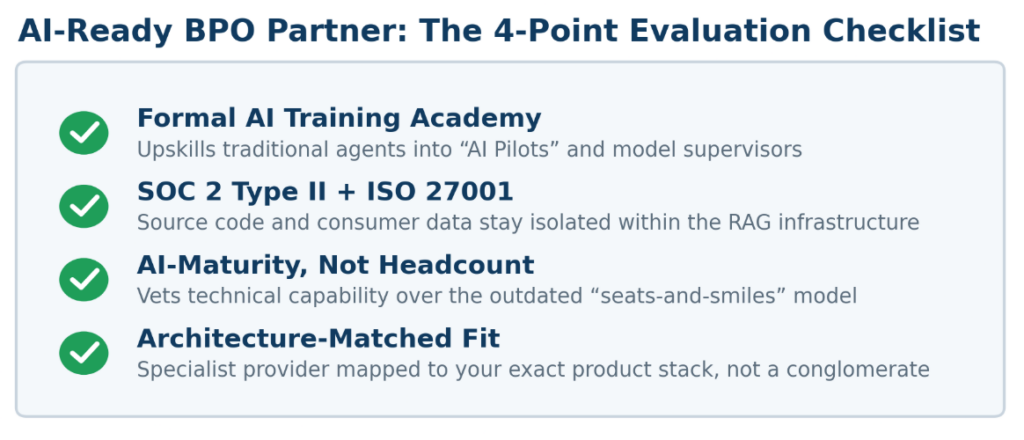
Stop scoring headcount and hourly rates; score technical capability and AI maturity. The strongest partners run formal AI training academies, hold SOC 2 Type II and ISO 27001 certifications that isolate source code and customer data, and match their architecture to your product. A specialist advisory firm can shortlist verified providers at no cost.
The traditional RFP is broken because it rewards seats and rates rather than capability. Among the Philippines’ 100-plus BPO suppliers, prioritize partners that have abandoned the outdated “seats-and-smiles” model.
AI Training and Workforce Development
Look for providers running formal AI training academies that upskill traditional agents into “AI Pilots” and model supervisors.
Security and Compliance Frameworks
Insist on rigorous security frameworks—SOC 2 Type II and ISO 27001—that keep enterprise source code and consumer data fully isolated inside the RAG infrastructure.
Specialized Vendor Selection
Partnering with a specialized advisory firm such as PITON-Global can streamline vendor selection at no charge, connecting you directly with verified, technically proficient BPOs matched to your exact product architecture.
Achieve sustainable growth with world-class BPO solutions!
PITON-Global connects you with industry-leading outsourcing providers to enhance customer experience, lower costs, and drive business success.
Get Your Top 1% Vendor List
Author
Ralf Ellspermann is a multi-awarded outsourcing executive with 25+ years of call center and BPO leadership in the Philippines, helping 500+ high-growth and mid-market companies scale call center and customer experience operations across financial services, fintech, insurance, healthcare, technology, travel, utilities, and social media.
A globally recognized industry authority - and a contributor to The Times of India, CustomerThink, and The AI Journal - he advises organizations on building compliant, high-performance offshore contact center operations that deliver measurable cost savings and sustained competitive advantage.
Known for his execution-first approach, Ralf bridges strategy and operations to turn call center and business process outsourcing into a true growth engine. His work consistently drives faster market entry, lower risk, and long-term operational resilience for global brands.
EXECUTIVE GOVERNANCE & ACCURACY STANDARDS
Authored by:
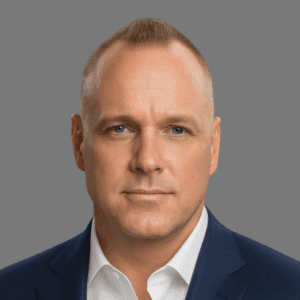
Ralf Ellspermann
Founder & CSO of PITON-Global,
25-Year Philippine BPO Veteran,
Multi-awarded Executive
Specializing in strategic sourcing and excellence in Manila
View Full Bio
Verified by:
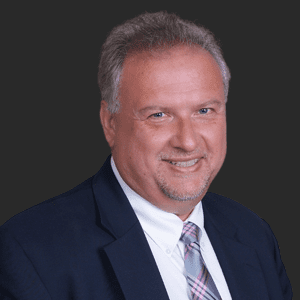
John Maczynski
CEO of PITON-Global, and former Global EVP of the World’s largest BPO provider | 40 Years Experience
Ensuring global compliance and enterprise-grade service standards
View Full Bio
Last Peer Review: June 12, 2026
This service framework is audited quarterly to meet shifting global outsourcing regulations and COPC standards.