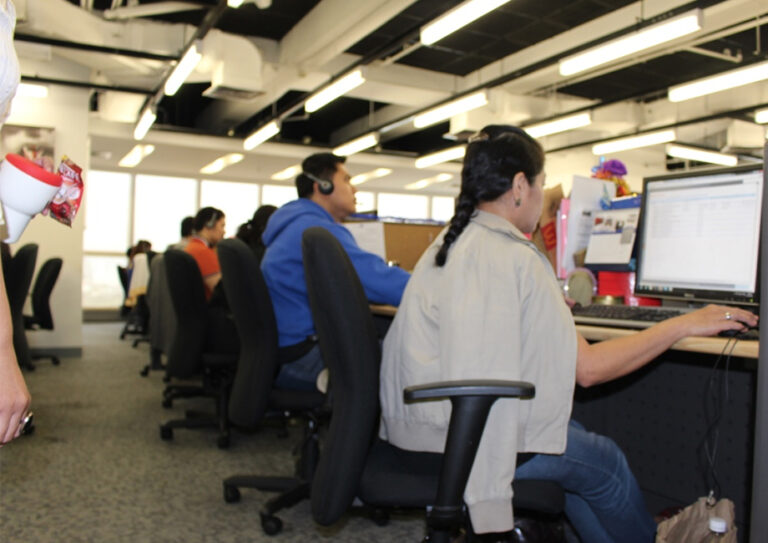

Call center services in Colombia and in the Philippines answer different versions of the same question: do you need a team that works your hours and speaks Spanish natively, or a team that covers the clock in English at a lower total cost? This comparison is part of an evenhanded look at offshore and nearshore locations for North American buyers, and it is written to show where Colombia wins as clearly as where Manila does.
The short answer: Colombia is usually the stronger choice for Spanish-first service, same-hour collaboration with US teams, and programs where managers need to visit often. The Philippines is usually stronger for English-language volume, overnight and 24/7 coverage, and large ramps at a lower cost per resolved contact. Many programs end up using both.
What Colombian call center services do well
Colombia has built a nearshore industry around bilingual service, time-zone alignment and cultural closeness to the Americas. Its providers cluster in Bogotá, Medellín, Barranquilla and Cali, and they serve US, Canadian and Spanish-speaking customers from the same floors.
Three strengths come up again and again with buyers. The first is Spanish: agents speak it natively, with a clear, widely understood accent that suits Hispanic customers across the United States and Latin America. The second is proximity: Bogotá sits in the same time band as the US East Coast and Midwest, and a short flight from Miami or Houston gets a manager on the floor the same day. The third is collaboration: when a support team works the same hours as your product, logistics and engineering staff, problems spotted on the phones can reach the people who fix them within the same working day.
That last point is the core of the nearshore argument. If callers report a broken checkout, a shipping error or a confusing policy, a team on your clock can flag it to your product owners in real time rather than in a handoff report the next morning. For companies whose support function feeds product decisions, that speed has real value.
Hours and same-time collaboration
Colombia works your day; the Philippines works your night. That single difference drives most of the trade-offs between the two.
Colombia runs on UTC−5 all year with no daylight saving time, so it matches US Eastern time in winter and US Central time in summer. A normal Bogotá day shift covers the North American business day without anyone working through the night. Manila is 12 to 13 hours ahead of US Eastern time, so its day shift is your night shift: overnight queues, weekend backlogs and back-office processing get done while your own staff are asleep, at no night premium for the provider.
The flip side matters too. Covering the US daytime from Manila means a night shift, which Filipino providers have run as a standard pattern for decades, with transport, security and scheduling built around it. Covering US evenings or overnight from Colombia means paying Colombian night rates, which Colombia’s recent labor reform has made more expensive, as the cost section below explains. Our 2026 efficiency index for offshore and nearshore delivery scores both models on the same scorecard if you want the wider view.
Language: Spanish first, English strong at the top
For Spanish-language customers, Colombia is the more natural fit; for English at scale, the Philippines has the deeper pool. Both countries have excellent English speakers, but they are distributed differently.
In the EF English Proficiency Index 2025, Colombia scored 480 and ranked 76th worldwide, while the Philippines scored 569 and ranked 28th in the same 2025 index. Those scores describe the adults who take EF’s test, not the agents a provider hires. Colombian centers recruit the strongest English speakers for US-facing work, and at the top of that pool the English is very good. The practical consequence is that fully bilingual agents are a smaller, more contested group in Colombia, which shows up in pay and in how quickly a program can grow.
Filipino agents offer English that North American callers tend to find familiar, along with a service culture shaped by decades of US-facing work. Spanish is a different story: Filipino providers can staff small Spanish queues, but Spanish-first programs of any size are better placed in Latin America.
What drives cost in Bogotá, Medellín and Manila
Colombian seats usually cost more than Filipino seats for comparable English-language work, and 2026 has pushed Colombian labor costs up further. The gap narrows when the work is Spanish-first or when same-hour collaboration saves time elsewhere in your business.
On the Colombian side, the minimum wage sets the floor under the whole pay scale. The government raised the monthly minimum wage by 23% for 2026, to COP 1,750,905, under Decree 159 of 2026, which was issued as a provisional decree in February 2026 while a court challenge to the original wage decree continued. Bilingual agents earn well above that floor, but statutory contributions, bonuses and surcharges all move with it.
On the Philippine side, our 2026 pricing guide models a $12 per hour fully loaded base rate that already includes team-lead and QA supervision, and puts typical savings at 50–70% against a US in-house team benchmarked at $33 per hour. We publish no Colombian rate card, so we will not quote one; ask bidders in both countries to price the same scope, hours and service levels.
Hourly rates are only half the picture. Compare cost per resolved contact, the cost of management travel, the price of overnight and weekend coverage in each country, and the value of faster product feedback. A program that saves money per hour but loses customers to slow fixes is not cheaper.
Colombia’s 2025 labor reform and what it changes for buyers
Colombia’s Law 2466 of 2025 changes the working week, night hours and Sunday pay, and any Colombian proposal you receive should show how it prices those changes. Treat a bid that ignores them as a warning sign.
The reform finishes cutting the maximum working week to 42 hours from July 15, 2026, and it raises the surcharge for Sunday and holiday work to 90% in 2026 and 100% in 2027, according to the Labor Ministry’s September 2025 circular on the law, which also restates the 35% surcharge for night work. The law itself defines night work as the hours between 7 p.m. and 6 a.m., a change that took effect six months after it was signed in June 2025, as the published text of Law 2466 sets out.
For North American programs, the night-hours rule matters most. Service that runs into the US evening now falls partly into Colombian night hours, and weekend coverage costs more each year. Well-run providers handle this with careful scheduling and clear pricing; ask each bidder to show the premium hours in its staffing model rather than folding them into a single blended rate.
Scale, industries and continuity
The Philippines offers the larger English-language talent pool and more room to scale within one country; Colombia offers a focused, fast-maturing market that suits programs of moderate size. The IT and business process management sector in the Philippines reported revenue above $40 billion and 1.9 million workers in 2025, according to IBPAP figures reported by Philstar in January 2026.
That depth lets a Filipino program grow from dozens to hundreds of seats, or add a second site in Cebu, Clark, Davao or Iloilo, without leaving the country. Colombian providers are strong in retail, travel, financial services and technology support, and a multi-city footprint across Bogotá and Medellín gives buyers a continuity option of their own. In either country, ask where the backup site is, how quickly traffic moves when the primary site goes down, and how remote agents are secured.
AI and the changing agent role
In both countries, the agent’s job is shifting from following scripts to supervising automation and handling the conversations it cannot. The strongest providers in Bogotá, Medellín and Manila now pair agents with AI tools that draft answers, summarize calls, process routine refunds and flag angry customers early.
That makes judgment more valuable, not less. Someone still has to step in when a policy is unclear, a customer is distressed or an automated action looks wrong. Colombian providers pitch this role as a natural fit for bilingual agents working your hours; Filipino providers pitch it as English-language judgment at scale around the clock. Ask any bidder to show which decisions its automation makes alone, where a person reviews them, and how errors are caught.
Using both: a split model
A split model often beats an either-or decision. A common pattern puts Spanish-language service, daytime escalations and product-facing collaboration in Colombia, and English volume, nights, weekends and back-office processing in the Philippines.
Before you add any offshore or nearshore team, test the case against doing the work yourself. Our guides to comparing an offshore team with domestic hiring and weighing a provider against expanding internal staff set out the cost and control trade-offs. Whatever mix you choose, hold every site to the same quality form, the same service levels and the same reporting.
Frequently asked questions
Is Colombia more expensive than the Philippines for call center work?
Usually, for comparable English-language work, and Colombia’s 2026 wage increase and labor reform add to the gap. For Spanish-first work, the comparison changes, because Colombia offers native speakers at depth.
Does Colombia really share US time zones?
Yes. It runs on UTC−5 all year, which matches US Eastern time in winter and US Central time in summer, so daytime US coverage needs no night shift.
Can Filipino teams handle Spanish?
For small queues, yes. For programs where most customers speak Spanish, a Latin American team is the better base.
What should I ask a Colombian provider about Law 2466?
Ask how its pricing reflects the 42-hour week, the earlier start of night hours and the rising Sunday surcharge, and ask to see the premium hours in its staffing model.