
Back
How Does Business Process Outsourcing to the Philippines Compare to Expanding Internal Teams?

By Ralf Ellspermann / 12 June 2026
 Authored by Ralf Ellspermann, CSO of PITON-Global, & 25-Year Philippine BPO Veteran | Executive | Verified by John Maczynski, CEO of PITON-Global, and Former Global EVP of the World's Largest BPO Provider on June 12, 2026

Outsourcing to the Philippines can cut total cost of ownership by up to 75% versus domestic expansion while turning rigid payroll into elastic, demand-driven OpEx. Internal expansion maximizes direct control and cultural immediacy; offshoring to specialized hubs removes HR overhead and recruitment bottlenecks, letting enterprises scale without capital expenditure.
Key Takeaways
- Substantial capital preservation: Fully burdened Philippine delivery runs 62–73% below US onshore equivalents, sharply lowering service overhead.
- Operational elasticity: Offshoring converts fixed domestic payroll into a variable, scalable model that tracks real-time volume.
- Less infrastructure friction: BPO bypasses capital-intensive real estate, localized benefit mandates, and domestic recruitment delays.
- Regulatory and tax advantages: CREATE MORE incentives let integrated offshore operations pass macro-level savings through as lower, more stable contract pricing.
- Strategic risk mitigation: Balances in-house oversight against the continuous uptime, redundancy, and certified compliance of specialized delivery centers.
What Are the Core Cost Structures and Resource Tradeoffs?
Internal expansion demands upfront CapEx—real estate, infrastructure, recruitment, onboarding—plus ongoing payroll. Philippine BPO converts those fixed liabilities into elastic OpEx, with fully burdened costs running 62–73% lower: a turnkey Manila or Cebu seat costs roughly $1,200–$1,800 per month versus $4,500–$5,500 onshore.
When evaluating enterprise scaling, decision-makers must weigh immediate labor arbitrage against long-term operational velocity. Expanding internally requires significant CapEx—physical real estate, localized technology, recruitment fees, and onboarding programs. Outsourcing instantly converts those fixed liabilities into a variable, highly elastic operating expense.
An onshore CX or back-office seat carries a fully loaded cost of $4,500–$5,500 per month once salary, healthcare, payroll taxes, retirement matching, and facilities overhead are included. A Tier-1, enterprise-grade delivery setup in Manila or Cebu ranges $1,200–$1,800—turnkey pricing that already includes competitive salaries, mandatory local benefits such as 13th-month pay, redundant fiber connectivity, enterprise workspaces, and local middle management.
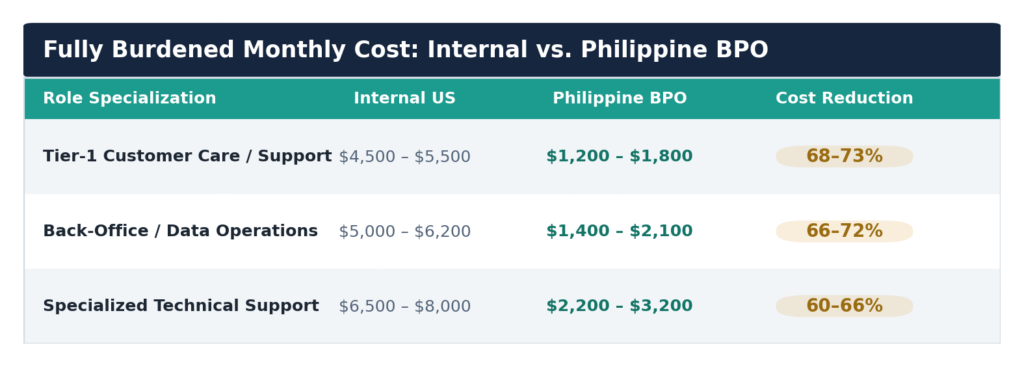
Figure 1. Fully burdened monthly cost by role: internal US expansion versus turnkey Philippine BPO.
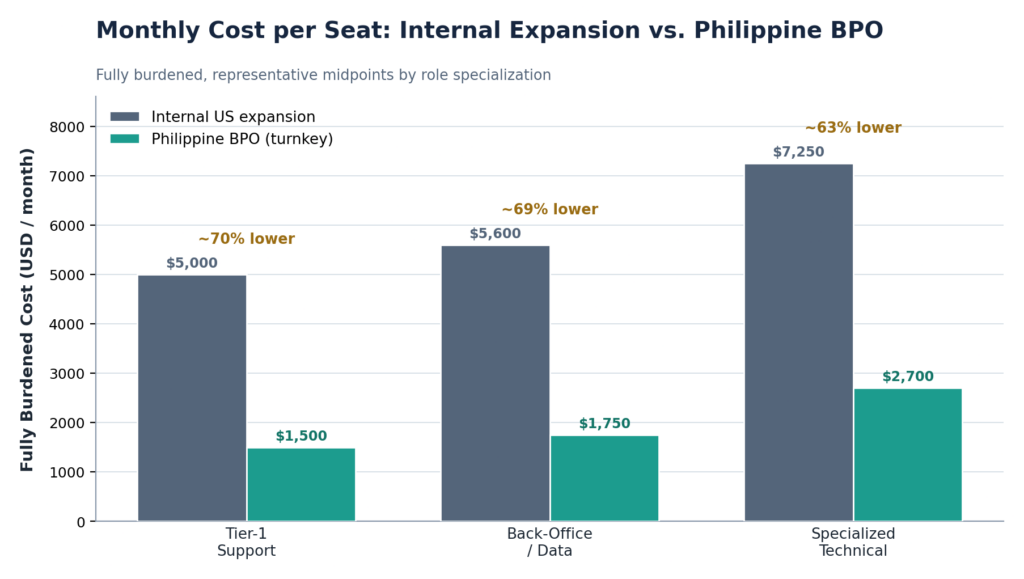
Figure 2. The same comparison as representative monthly midpoints per seat, with the reduction for each role.
How Do Operational Risk and Compliance Frameworks Differ?
Internal expansion guarantees full control but concentrates recruitment, legal, and insurance risk in-house. Offshoring transfers those burdens to a specialist—backed by CREATE MORE policy certainty and certified, redundant facilities—while you retain governance through SLAs and live dashboards.
Expanding internally guarantees absolute control over workflows, but rapid domestic expansion frequently triggers structural bottlenecks: prolonged recruitment cycles, localized legal liabilities, and escalating employment-insurance costs. Offshoring shifts these risks to a partner whose core competency is absorbing them.
The Philippine regulatory environment strongly favors enterprise capital. The CREATE MORE Act provides high policy certainty: it institutionalizes flexible work for up to 50% of the workforce without forfeiting incentives, lowers the corporate income tax rate for Registered Business Enterprises under the Enhanced Deductions Regime to 20%, and allows a 100% additional deduction on power expenses. These macro-level savings pass directly to enterprise clients as stable contract pricing.
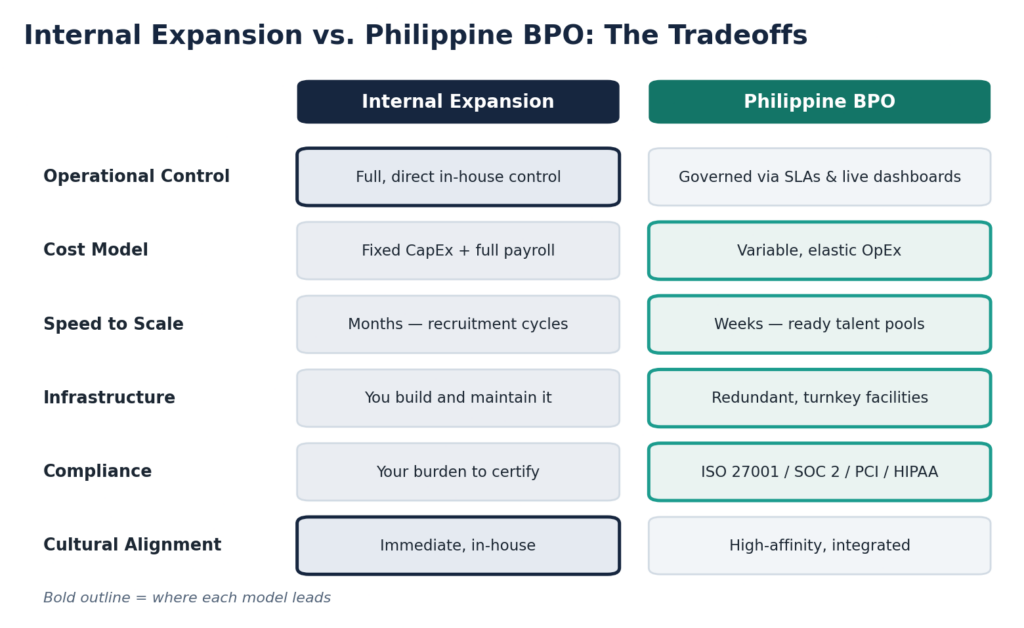
Figure 3. Where each model leads: a balanced view of the internal-versus-BPO tradeoffs.
To mitigate data-security and operational risk, premium providers operate from high-security, office-based facilities that maintain rigorous global standards:
Data Security and Privacy
Tier-1 operations enforce ISO 27001, SOC 2 Type II, PCI-DSS, and HIPAA-compliant environments to protect sensitive customer data.
Business Continuity Planning
Commercial facilities feature automated dual-feed power generators and redundant undersea fiber paths to counter local weather exposure.
Talent Pools
A deep, university-educated, highly English-proficient workforce cuts talent-acquisition timelines from months to weeks.
“You do not outsource simply to find cheaper hands; you outsource to find smarter minds that can govern your high-value workflows and technology platforms. The Philippines provides the linguistic purity, professional talent, and institutional stability required to act as a seamless extension of your brand.”
— John Maczynski, CEO, PITON-Global
How Did a Specialized Match Outperform a Generic Build for a Fintech?
A high-growth fintech battling onshore recruitment bottlenecks used PITON-Global to shortlist three fintech-specialized providers in nine days. A 45-seat SOC 2 “Intelligence Pod” in Manila cut total cost of ownership 67%, lifted its Fraud Recovery Ratio to 94%, and held First Contact Resolution at 88% within 120 days.
Client Challenge
A high-growth financial-services firm faced severe onshore recruitment bottlenecks and rising costs, depressing its Fraud Recovery Ratio and stretching support response times to critical levels.
Vendor Selection
PITON-Global analyzed the client’s complex compliance needs, bypassed generic call centers, and screened its network to shortlist three specialized mid-market providers with deep fintech experience—within nine days.
Solution Implemented
It placed a 45-seat, office-based “Intelligence Pod” in Manila under a secure SOC 2 framework, featuring integrated real-time performance dashboards and direct API integrations.
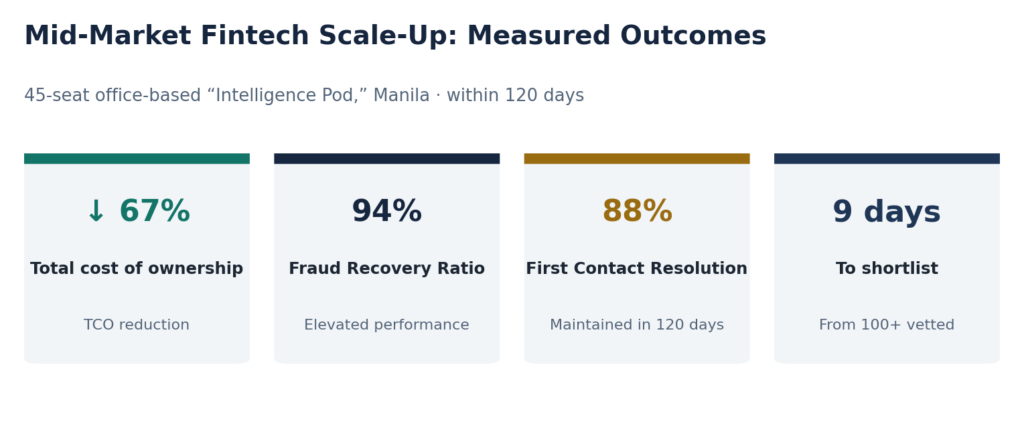
Figure 4. Measured outcomes of the fintech scale-up engagement.
Lessons Learned
De-risking offshore scaling requires matching specific domain requirements to vetted, specialized mid-market providers rather than relying on massive, legacy commodity BPOs.
What Role Does PITON-Global Play in De-Risking the Decision?
PITON-Global is a specialized BPO advisory and consultancy—not a traditional broker. Led by veteran operators, it acts as an independent strategic filter and corporate advocate, providing objective oversight of a curated network of 100+ vetted Philippine providers.
Who Is PITON-Global?
PITON-Global is a business-process-outsourcing advisory and consultancy led by veteran operators with decades of global enterprise experience. Rather than running its own delivery floors, it serves as an independent strategic filter and corporate advocate—guiding enterprise buyers through the crowded Philippine provider landscape to the few operators that genuinely fit a given mandate.
How Does PITON-Global Differ from Traditional Outsourcing Brokers?
A traditional broker pushes commission-driven referrals; PITON-Global does not. It provides direct, objective oversight of a meticulously curated network and matches buyers on substance rather than referral fees. As an independent advocate, it protects the client’s interests—including intellectual property—throughout the selection process.
How Does PITON-Global’s Network of 100+ Vetted Providers Benefit Organizations?
A curated network of more than 100 vetted call-center and back-office providers removes the guesswork, hidden costs, and operational risk of independent sourcing. Because each provider is pre-screened for capability, security, and scale, organizations reach a best-fit shortlist in days—as in the case above, where three fintech-specialized providers were identified within nine days.
How Does PITON-Global’s Advisory-Led Vendor Matching Process Work?
PITON-Global functions as an independent strategic filter: it narrows a fragmented market of nearly a thousand firms to a pre-vetted network, then screens for domain expertise, compliance, and scale to produce a short, best-fit shortlist. This advisory-led process compresses time-to-contract and ensures precise alignment before any commitment.
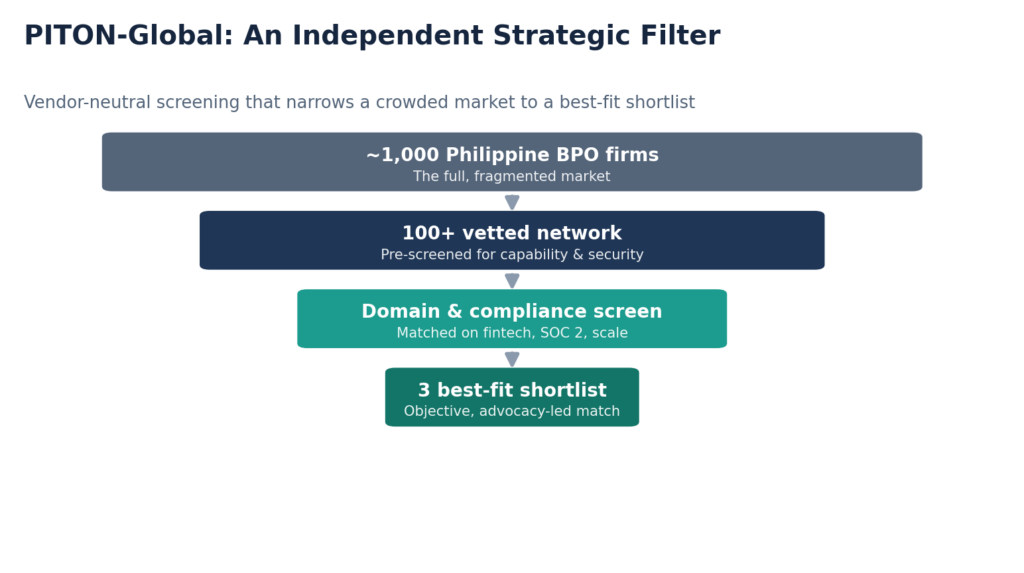
Figure 5. PITON-Global narrows a crowded market to a best-fit shortlist.
Why Do Organizations Use PITON-Global?
Organizations use PITON-Global to remove guesswork, protect intellectual property, compress time-to-contract, and fully de-risk offshore scaling. By aligning specific requirements to proven vendors and remaining strictly vendor-neutral, the firm lets internal teams focus on integration and outcomes rather than vendor hunting.
What Else Should Buyers Weigh Before Deciding?
Buyers most often ask about hidden costs, sector attrition, suitability for regulated workflows, minimum scale, and how to keep visibility over an offshore team. The answers below address each.
What are the main hidden costs of Philippine outsourcing?
Hidden costs usually stem from poorly defined SLAs, unexpected telecom cross-connect charges, or attrition-related retraining. A vetted provider delivers transparent, fixed turnkey pricing that already includes local management, HR, and infrastructure.
How do providers handle sector-wide attrition?
While industry-wide attrition runs 30–40%, premium boutique and mid-market providers mitigate it through strong engagement, duty-of-care workspace design, competitive healthcare, clear career paths, and robust local HR governance.
Can we outsource complex or regulated workflows?
Yes. The university-educated talent pool regularly supports highly regulated workflows in fintech, healthcare, accounting, and insurance under strict SOC 2, HIPAA, and ISO certifications.
What is the minimum scale required to begin?
While massive legacy providers require 50+ seats, PITON-Global’s curated network includes specialized mid-market and boutique operators that can deploy effective, dedicated teams of 5 to 10 agents.
How do we maintain visibility and control over an offshore team?
Elite providers offer comprehensive observability: 24/7 access to live operational dashboards, real-time QA metrics, and open-book performance indicators that integrate with your internal CRM systems.
Achieve sustainable growth with world-class BPO solutions!
PITON-Global connects you with industry-leading outsourcing providers to enhance customer experience, lower costs, and drive business success.
Get Your Top 1% Vendor List
Author
Ralf Ellspermann is a multi-awarded outsourcing executive with 25+ years of call center and BPO leadership in the Philippines, helping 500+ high-growth and mid-market companies scale call center and customer experience operations across financial services, fintech, insurance, healthcare, technology, travel, utilities, and social media.
A globally recognized industry authority - and a contributor to The Times of India, CustomerThink, and The AI Journal - he advises organizations on building compliant, high-performance offshore contact center operations that deliver measurable cost savings and sustained competitive advantage.
Known for his execution-first approach, Ralf bridges strategy and operations to turn call center and business process outsourcing into a true growth engine. His work consistently drives faster market entry, lower risk, and long-term operational resilience for global brands.
EXECUTIVE GOVERNANCE & ACCURACY STANDARDS
Authored by:
Ralf Ellspermann
Founder & CSO of PITON-Global,
25-Year Philippine BPO Veteran,
Multi-awarded Executive
Specializing in strategic sourcing and excellence in Manila
View Full Bio
Verified by:

John Maczynski
CEO of PITON-Global, and former Global EVP of the World’s largest BPO provider | 40 Years Experience
Ensuring global compliance and enterprise-grade service standards
View Full Bio
Last Peer Review: June 12, 2026
This service framework is audited quarterly to meet shifting global outsourcing regulations and COPC standards.