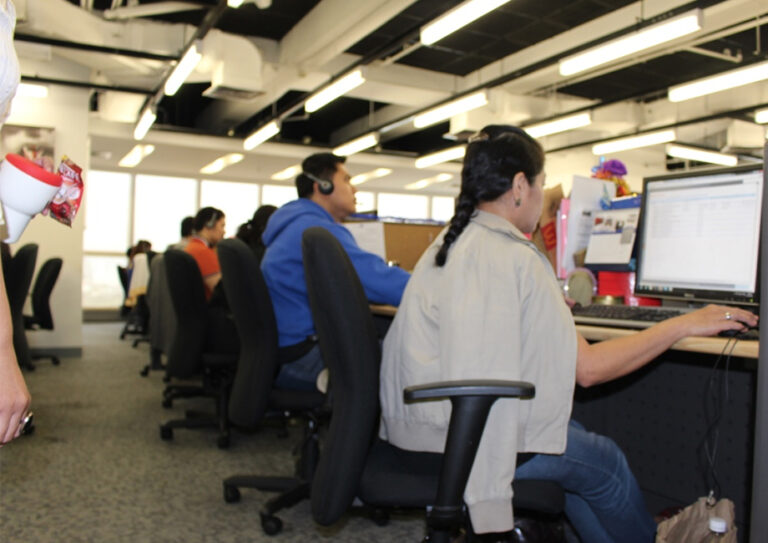

Outsourcing high-velocity LLM fine-tuning and RLHF support to the Philippines means running the human-judgment side of alignment at scale: preference ranking and reward-model data, instruction tuning, and adversarial red-teaming that pressure-tests a model against hallucination and jailbreak vectors before production. The loop only improves as fast as that human data is trustworthy, so calibration, drift monitoring, and red-team coverage — not raw annotation volume — are what a serious partner is measured on. This is the fastest-moving part of how model builders outsource RLHF and fine-tuning.
Key Takeaways
- Alignment runs on human judgment. Preference rankings and reward-model data are the signal that tunes behavior — their quality caps the model’s.
- Red-teaming is a coverage problem. Humans construct the jailbreak and injection cases automated filters miss; breadth of coverage is the deliverable.
- Calibration beats consensus. Annotators must share a rubric, or preference data becomes noise; calibration is a standing process, not onboarding.
- Drift is detected by people. Regression sets scored by trained reviewers catch behavioral drift that automated metrics quietly miss.
- Velocity needs a standing pod. High-frequency loops demand a trained, retained team — a rotating crowd can’t hold the rubric or the context.
What Does an Outsourced RLHF and Preference-Data Pipeline Actually Produce?
Trustworthy human-judgment data: pairwise preference rankings, reward-model training data, instruction- and safety-tuning examples, and the calibration that keeps them consistent across annotators and over time.
The output of an RLHF operation is not text — it is calibrated human judgment encoded as data. Annotators rank competing model responses, label safety and quality dimensions, and produce the instruction- and preference-examples a reward model learns from, the same raw material behind customizing foundation models with domain expertise. The whole alignment loop is only as good as that signal: inconsistent rankings teach the reward model noise, and the policy faithfully learns the noise. That is why the work is less about volume than about a shared, enforced rubric and the calibration that keeps a hundred annotators scoring the same response the same way. The Philippine advantage here is a literate, retainable workforce that can hold a nuanced rubric — provided the partner runs calibration as a standing discipline.
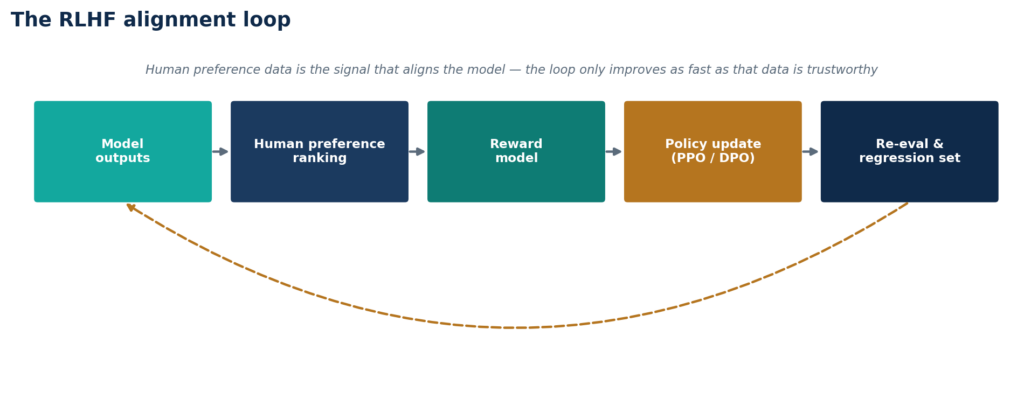
Figure 1 — Human preference data is the signal that aligns the model; the loop improves only as fast as that data is trustworthy.
According to John Maczynski, CEO, PITON-Global, “Everyone wants to talk about the algorithm — PPO, DPO, whatever is current — but the algorithm just amplifies whatever your human data says. If your preference rankings disagree with each other, you have built a very expensive way to teach a model to be inconsistent. The calibration is the product.”
How Do Human Red-Teams Pressure-Test Models Against Jailbreaks and Hallucination?
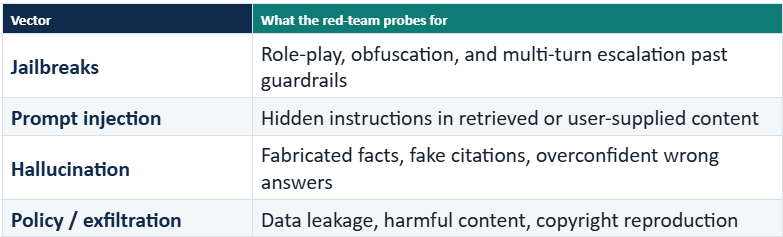
By systematically constructing adversarial cases across a coverage map — jailbreak vectors, prompt injection, hallucination probes, and policy or exfiltration attacks — that automated filters cannot generate, then escalating what breaks.
Automated safety filters catch the known; human red-teams find the unknown. A disciplined red-team works a coverage map rather than improvising: multi-turn jailbreak escalation, instructions hidden inside retrieved or user content, probes that surface fabricated facts and fake citations, and attempts to extract data or elicit policy-violating output. The value is breadth and creativity of coverage — the adversarial cases a model has never seen — plus a clean escalation path so each break becomes a regression test, the pre-launch counterpart to live prompt and output moderation. This is judgment work that rewards trained, curious people, and it is measured by coverage and reproducibility, not by tickets closed.
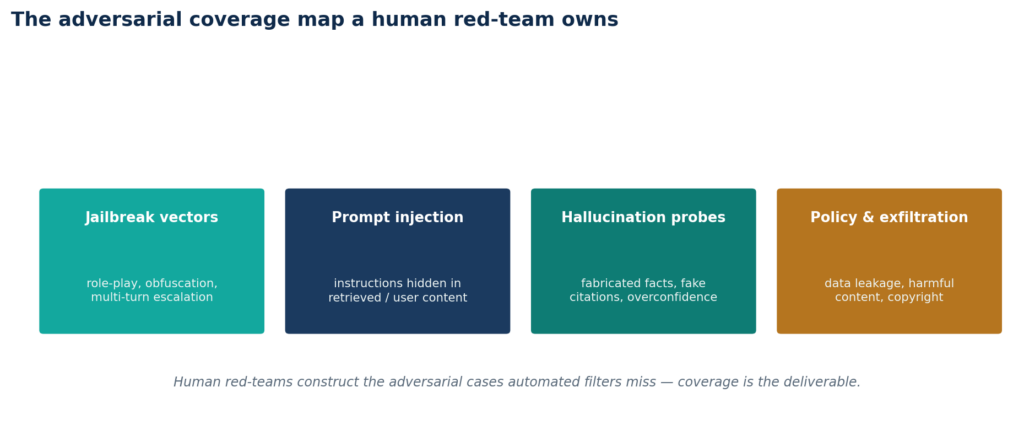
Figure 2 — Human red-teams construct the adversarial cases automated filters miss; coverage is the deliverable.
“A model that passes your automated evals can still be one clever prompt away from an incident. The job of a human red-team is to be that clever prompt first, on your schedule, in a controlled setting — so the failure shows up in a regression set instead of on social media,” said Ralf Ellspermann, CSO, PITON-Global.
How Do You Manage Model Drift and Token-Spend Efficiency at Velocity?
With human-scored regression sets that catch behavioral drift automated metrics miss, run on a high-frequency cadence by a standing pod — and with eval discipline that targets token spend where it changes outcomes.
Two operational risks bite at velocity. The first is drift: each fine-tuning pass can silently degrade behavior an aggregate metric won’t flag, and the exposure grows when several LLM instances run in parallel, so a curated regression set scored by trained reviewers is the early-warning system. The second is cost discipline: high-frequency RLHF loops can burn token and review budget on low-value cases, so the operation should concentrate human effort where it actually moves the model — hard, high-impact, and adversarial examples — rather than re-scoring the easy majority. Both depend on a retained pod that holds the rubric and the context across cycles; velocity without that is just faster noise.
“The teams that win at RLHF treat their human raters as a product, not a cost line. Calibrate them, retain them, measure their agreement, and your reward model stops drifting. Skimp there and you are fine-tuning on noise,” noted John Maczynski, CEO, PITON-Global.
Frequently Asked Questions
What Is the Deliverable of an RLHF Outsourcing Partner?
Calibrated human-judgment data: pairwise preference rankings, reward-model training data, and instruction- and safety-tuning examples, plus the calibration and inter-annotator consistency that keep that signal trustworthy across people and over time.
Can Automated Tools Replace Human Red-Teaming?
No. Automated filters catch known patterns; human red-teams construct the novel jailbreak, injection, and hallucination cases models have never seen. Coverage breadth and reproducible escalation into regression tests are the value, and they require trained people.
How Is Model Drift Caught Between Fine-Tuning Passes?
Through curated regression sets scored by trained human reviewers, run on a high-frequency cadence. Aggregate automated metrics can stay flat while specific behaviors degrade; human-scored regressions surface that drift early.
About PITON-Global
PITON-Global connects AI labs and enterprises with the alignment-grade teams that run RLHF, preference data, and red-teaming as a discipline — not a crowd. Our network spans 100-plus leading Philippine BPOs, 20 of them AI-first front-runners, and we shortlist only those whose calibration and coverage hold up under audit. Our leaders bring more than six decades of combined global outsourcing experience, 25+ of them in the Philippines. Advisory and sourcing are free, with no obligation; we are paid by the provider network, not the client.