

To manage multiple LLM instances at once, they use centralized human-in-the-loop (HITL) orchestration dashboards that unify several API streams — GPT-4o for reasoning, Claude 3.5 Sonnet for technical drafting, localized models for sentiment — into one coherent workspace. As “AI Pilots,” these specialists validate outputs in real time, stitch context, and override the system whenever model confidence drops below a set threshold. The role is one strand of the wider LLM tuning and evaluation support AI firms buy offshore.
Running several frontier models at once sounds like a recipe for chaos — a dozen browser tabs and an overwhelmed operator. Elite Philippine providers solve it the opposite way: by collapsing the complexity into a single command center where a trained specialist supervises the convergence of multiple model streams rather than juggling them. The result is concurrency without cognitive overload. It is the same shift that turned pilots from stick-and-rudder operators into systems managers — the human moves up a level, supervising the models rather than executing every step by hand.
What Is the Technical Framework Behind Multi-LLM Orchestration?
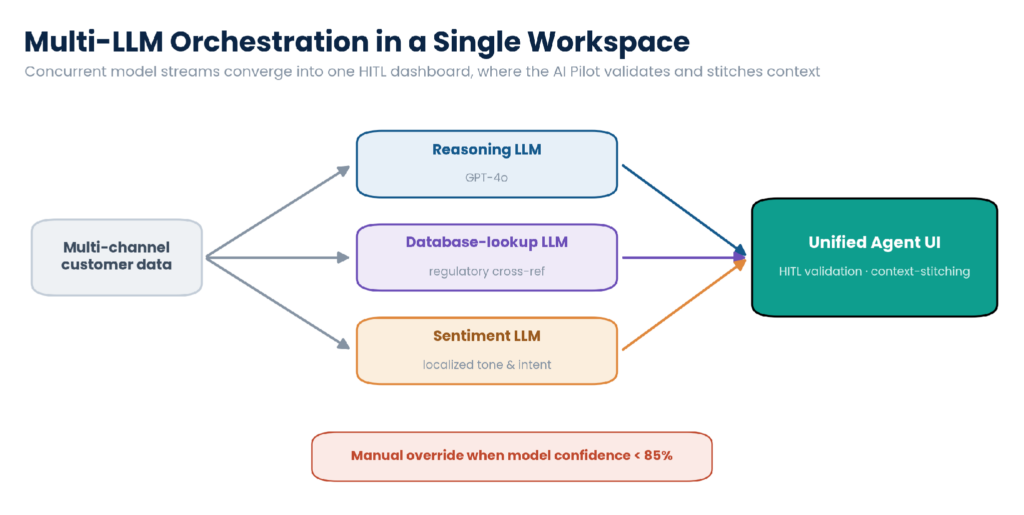
A specialized middleware layer acts as a traffic controller for AI models. Instead of forcing agents to toggle between disparate tabs, it pulls each model’s output into one interface. The Filipino specialist works as a strategic gatekeeper — monitoring where the streams converge and intervening only to resolve anomalies.
While one model extracts metadata from an incoming invoice, another cross-references that data against a regulatory database, and a third reads sentiment. The orchestration layer routes all three into a unified view, and the agent watches their convergence, stepping in only when outputs conflict. This turns the BPO floor into a high-tech command center for cognitive task management rather than a room of people racing between windows. Because the agent reads convergence instead of chasing it, a single specialist can hold far more cognitive ground than the old one-tab, one-task model ever allowed.
How Do BPO Providers Optimize Cost and Token Efficiency?
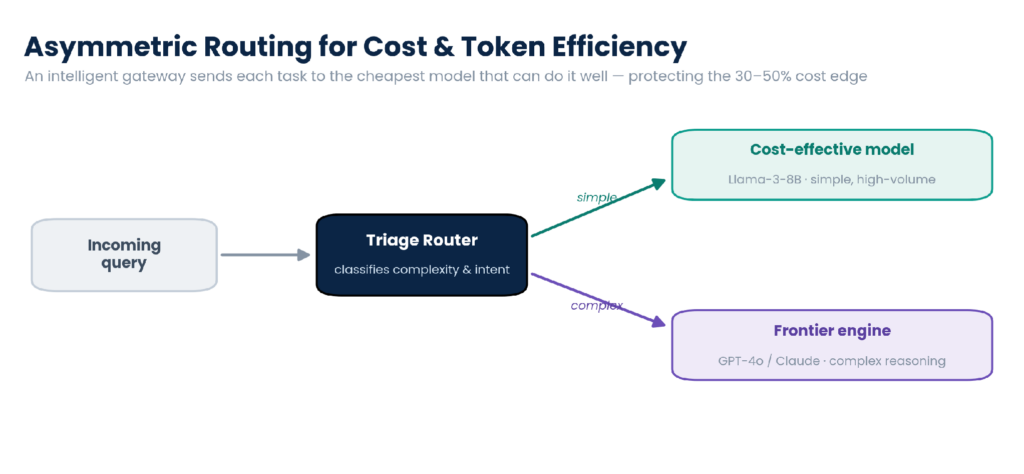
Through asymmetric routing. Rather than sending every task to expensive frontier models, an intelligent gateway triages each query by complexity, dispatches simple high-volume work to cost-effective models like Llama-3-8B, and escalates only complex reasoning to frontier engines — protecting the cost advantage global buyers expect.
The economics only work if precision is spent where it matters. A lightweight router classifies incoming queries, routine transactions go to highly optimized small models, often ones shaped through domain-specific fine-tuning of foundation models, and complex enterprise reasoning is selectively escalated to frontier-grade engines. The savings come not from cheaper labor but from never paying frontier-model rates for work a smaller model handles perfectly well.
The operational difference between this unified, triaged model and the old multi-tab approach is stark across every metric a buyer tracks — handle time, concurrency, token waste, and agent fatigue. Crucially, the gains compound: faster handling frees capacity, which is then re-spent on the judgment work that only humans can do.

What changes when concurrent LLM streams are unified under one HITL interface.
Why Is the Philippines the Ideal Hub for HITL Management?
Because the work now demands judgment, not scripts — and the Filipino workforce pairs deep Western cultural alignment with high technical literacy. When parallel models drift, conflict, or hallucinate, these specialists have the context-awareness and emotional intelligence to catch the nuance and protect enterprise brand consistency, the same skills behind training chatbots that hold a natural conversation.
Managing multiple LLM instances inevitably surfaces “behavioral drift” — moments when models generate conflicting outputs or hallucinate plausibly, the failure modes that high-velocity RLHF and red-teaming support is designed to catch. Catching those requires more than technical skill; it takes the judgment to sense when an answer is subtly wrong for the brand or the customer. That blend of cultural fluency and technical literacy is exactly what makes the role defensible against pure automation. Western buyers also value the cultural proximity: idiom, tone, and expectation align closely enough that a flagged response reads as genuinely off, not merely unfamiliar.
“The era of the scripted response is over. In 2026, enterprise outsourcing is about deploying high-value ‘Judgment Architects’ who provide the reasoning guardrails that keep autonomous digital workforces accurate and compliant.”
— John Maczynski, CEO of PITON-Global
How Do Data Security Protocols Isolate Parallel LLM Instances?
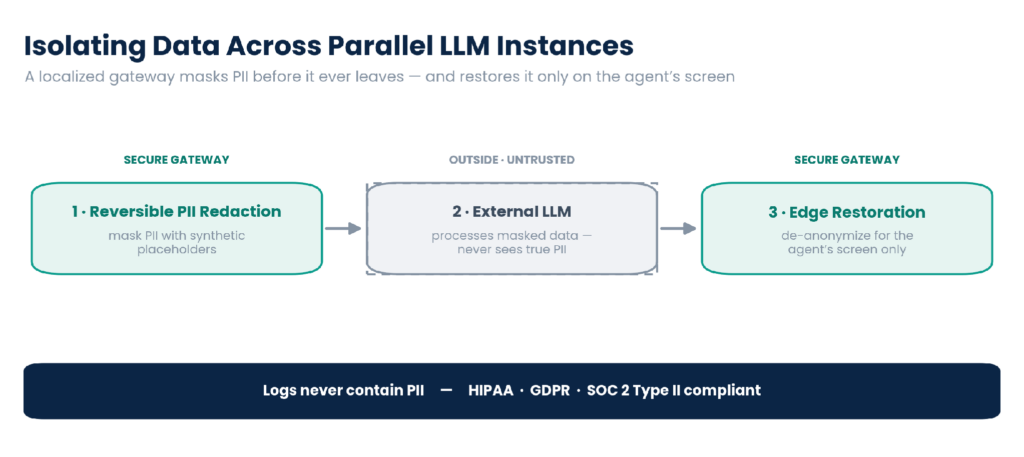
With a localized gateway that masks data before it leaves. Reversible PII redaction replaces sensitive fields with synthetic placeholders, so the external model never sees true data; edge restoration de-anonymizes the response for the agent’s screen only. Logs never contain PII, keeping the workflow inside HIPAA, GDPR, and SOC 2 Type II boundaries.
Running multiple models in parallel multiplies the surface area for data exposure, so isolation is engineered into the pipeline itself. Before any prompt leaves the secure environment, the gateway detects and masks Personally Identifiable Information with synthetic placeholders; when the model returns its answer, the same gateway restores the original values locally. The external LLM does its work blind to the real data. The design means that even a breach of the external model would expose only placeholders — turning a potential compliance catastrophe into a non-event.
How Did a Manila Team Fix Insurtech Back-Office Bottlenecks?
An insurtech disrupter was buried in manual claims reconciliation across photos, medical bills, and policy documents. PITON-Global matched it to a Manila partner skilled in multi-model orchestration. A 25-agent team ran a unified dashboard — Claude 3.5 Sonnet, GPT-4o, and a custom fraud model — lifting claims volume sharply while holding the error rate very low.
The client’s bottleneck was the manual reconciliation of wildly different document types — photos, medical bills, and policy paperwork — that no single model handled well. The Manila partner deployed a unified dashboard running three specialized models in concert: Claude 3.5 Sonnet for text parsing, GPT-4o for policy validation, and a custom model for fraud-pattern detection, all supervised by 25 AI Pilots.
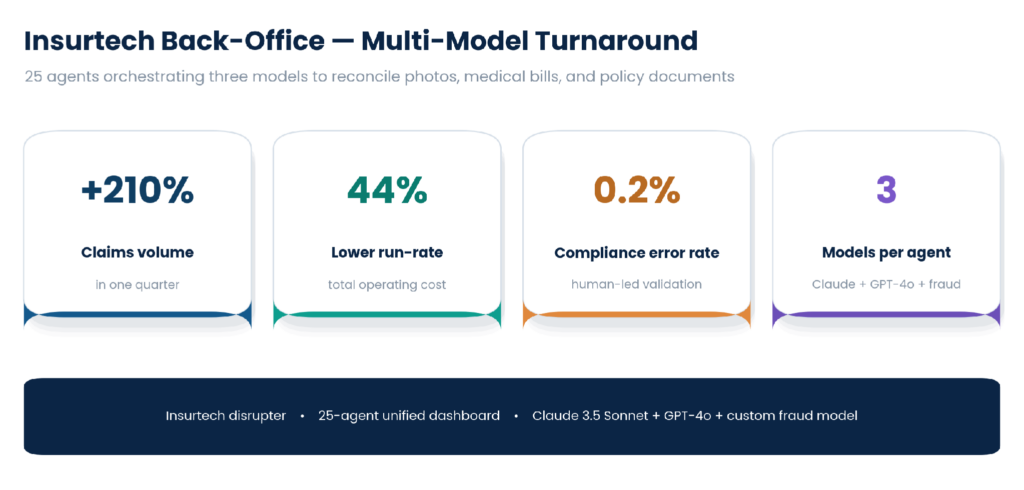
Within a single quarter, claims volume rose sharply, total run-rate fell substantially, and compliance errors dropped to a statistically negligible level — the last result owed directly to human-led validation. It is the clearest illustration of the model’s premise: orchestration delivers the speed, and the human delivers the trust. For a regulated insurer, that error rate is the headline number — speed is welcome, but auditable accuracy is what keeps the program alive.