

Outsourcing business processes to the Philippines supports long-term growth by reducing operational costs substantially, freeing capital for high-value core functions. Enterprises gain elastic scalability, mature process governance, and an English-fluent, AI-augmented workforce—converting fixed overhead into flexible capacity and building durable competitive advantage. The mechanics behind those gains are set out in our walkthrough of pricing, contracts and vendor choice.
Key Takeaways
- Substantial capital reclamation: Migrating back-office, customer experience, and digital workflows yields predictable, material cost reductions, converting high fixed overhead into flexible, variable spend.
- Elastic scalability: Organizations can scale operational capacity up or down quickly—without the friction, liabilities, or lead times of domestic recruitment.
- AI-augmented efficiency: Leading Philippine providers blend human domain expertise with agentic AI to accelerate transaction speed and sharpen process accuracy.
- Institutional governance: Top-tier providers operate on robust compliance frameworks, including SOC 2 Type II, ISO 27001, and GDPR-aligned security controls.
- Mitigated sourcing risk: Partnering with a vendor-neutral advisory firm removes selection guesswork and connects enterprises directly with best-fit, specialized operators.
- Process maturity over headcount: Modern engagements are governed by KPIs and SLAs tied to business outcomes rather than seats filled.
Why Do Leading Enterprises Transition Core Operations to the Philippines?
Leading enterprises move core operations to the Philippines for far more than savings. They gain a mature, English-fluent talent base, Western-aligned process standards, and structural scalability—extending internal capability without the cost and rigidity of domestic hiring across a workforce of roughly 1.8 million BPO professionals.
Enterprise buyers, COOs, and CFOs increasingly look past simple cost reduction to identify durable drivers of multi-year operational agility. The contemporary Philippine Business Process Outsourcing (BPO) sector functions as an extension of an enterprise’s internal capability, anchored in deep structural advantages rather than short-term labor arbitrage. In automotive, for example, outsourced customer-journey programs are judged on retention and loyalty rather than on cost alone.
Macroeconomic and Workforce Benchmarks
The Philippines produces more than 700,000 tertiary graduates each year, feeding an outsourcing infrastructure built around Western corporate standards. With near-native English proficiency and high cultural alignment with North American and European markets, specialized teams manage sensitive, judgment-intensive workloads with minimal operational friction. The sector is a pillar of the national economy and remains one of the country’s most strategically supported industries—ensuring stable infrastructure, talent pipelines, and government incentives.
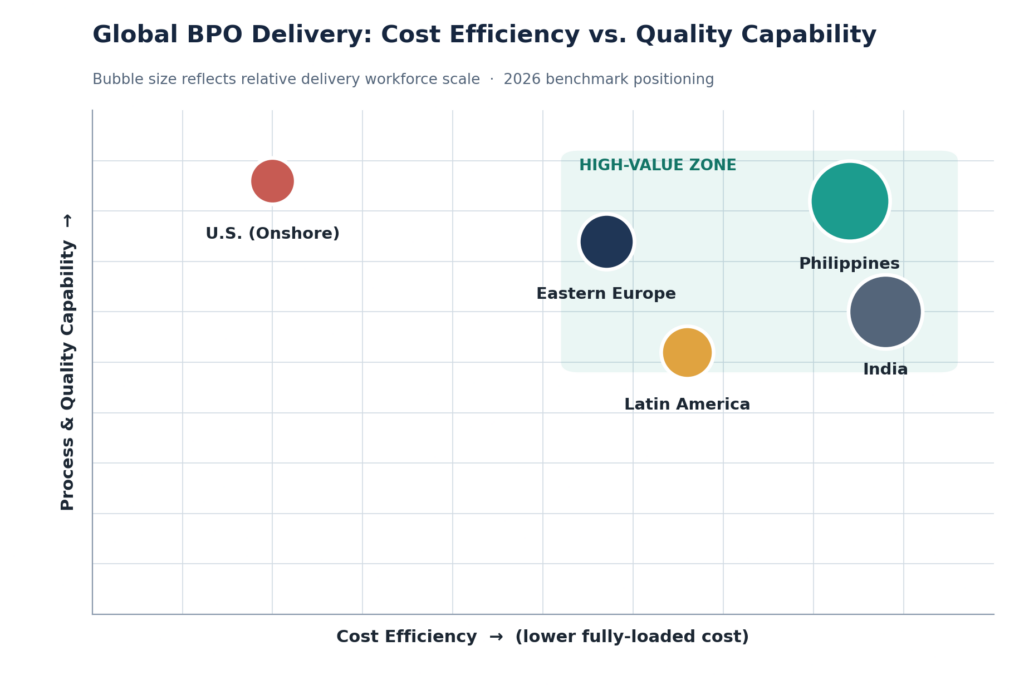
Figure 1. The Philippines occupies the high-value quadrant, pairing strong cost efficiency with high process and quality capability.
The Shift from Commodity Staffing to Process Maturity
Early outsourcing strategies focused almost exclusively on lowering labor costs. Today, long-term growth is driven by institutionalized process maturity. Specialized operations across Manila, Cebu, and emerging hubs like Davao and Clark deploy robust Key Performance Indicator (KPI) architectures and Service Level Agreements (SLAs), shifting the conversation from headcount tracking to measurable business value. The result is an engagement model that behaves less like a staffing contract and more like an outsourced center of excellence.
What Are the Operational Cost Metrics and Resource Efficiencies?
Shifting transactional workloads to local providers typically cuts fully loaded costs substantially, with hourly rates that rise with task complexity. For a 25-seat operational pod, the annual savings run well into six figures for a mid-market firm—capital that can be redirected into product, technology, and market expansion.
Relocating transactional and support workloads to specialized providers delivers both immediate financial relief and compounding long-term efficiency. Fully loaded hourly rates remain highly competitive across enterprise service disciplines, while quality benchmarks continue to rise as providers invest in automation and analytics talent.
Hourly Operational Benchmarks (2026)

Figure 2. Indicative 2026 fully loaded hourly rates and the primary KPI used to govern each workstream.
These ranges reflect blended, fully loaded costs—inclusive of facilities, management, technology, and compliance overhead—rather than raw wages. Crucially, each workstream is governed by a defined operational KPI, ensuring that cost savings never come at the expense of accountability. A finance and accounting team is measured on first-pass clean-claim accuracy; a technical support function on mean time to resolution.
Reinvesting Reclaimed Capital
The strategic value of these savings lies in redeployment. By standing up a mid-sized pod of 25 dedicated professionals in a premier Philippine center, a mid-market enterprise can free a six-figure sum every year. Reinvested into product development, localized sales expansion, and proprietary technology, that capital fuels a self-reinforcing growth loop rather than simply padding margins.
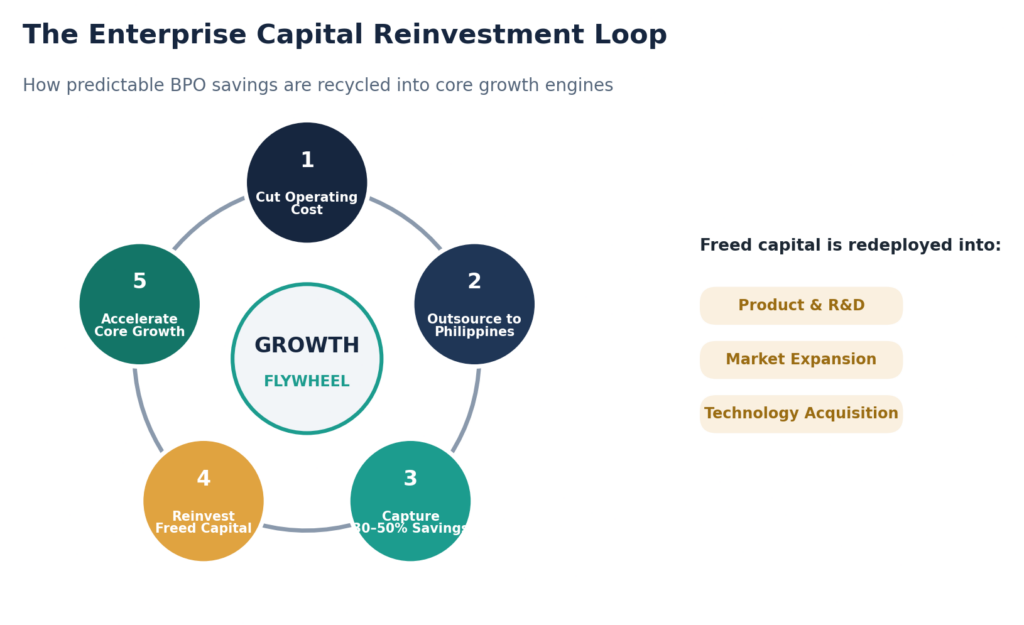
Figure 3. Savings captured offshore are recycled into the core functions that compound long-term growth.
How Does Hybrid Human-in-the-Loop Integration Mitigate Scale Risks?
Hybrid human-in-the-loop integration mitigates scale risk by pairing automation with skilled human oversight. Rather than replacing people, modern systems route routine volume to automation while concentrating expert judgment on complex, high-risk cases—preserving accuracy, compliance, and accountability as transaction volumes grow.
A common failure point in enterprise outsourcing is the “set-and-forget” approach to automation. Sustainable growth instead requires a deliberate balance between advanced technology and human domain expertise. Top-tier Philippine BPOs protect this balance through what is best described as a judgment architecture—a structured division of labor in which machines handle scale and people handle nuance.
“The single biggest mistake enterprise leaders make is assuming large-scale automation removes the need for human talent. In reality, modern technology concentrates human effort on the most complex, context-reliant, and high-risk cases. The true winners are organizations that combine automated efficiency with specialized professionals who audit and refine those systems in real time.”
— John Maczynski, CEO of PITON-Global
By positioning highly skilled professionals as operators and auditors of automated systems, enterprises achieve both rapid execution and disciplined risk management—an essential combination as volumes scale.
Mini Case Study: Enterprise Workflow Transformation
Client challenge. A fast-growing, venture-backed fintech firm faced mounting operational bottlenecks and rising customer churn driven by delayed back-office reconciliation and a deepening backlog in Tier-1 support.
Vendor selection. The company engaged PITON-Global to analyze its requirements. Moving away from large, volume-driven legacy providers, PITON-Global evaluated its network of 100+ vetted providers and selected a boutique Manila operator specializing in fintech and transactional compliance.
Solution implemented. A hybrid 40-agent team was deployed across dual-stream CX and account reconciliation, with automated invoice-exception routing paired with human review and SOC 2 Type II–compliant data access controls.
Quantifiable outcomes:
- Cost: Overall operational costs fell sharply within 120 days.
- Quality: First-Contact Resolution improved markedly.
- Throughput: The historical back-office processing backlog was cleared entirely within 45 days.
Lessons learned. Success hinged on matching provider scale to client need. This structural alignment guaranteed executive oversight and rapid process adjustments that larger, volume-based BPOs rarely provide.
What Role Does PITON-Global Play in the Sourcing Process?
PITON-Global is a vendor-neutral outsourcing advisory firm that helps enterprises identify, vet, and match with the right Philippine BPO partners. Drawing on more than 25 years of market experience and a curated network of 100+ providers, it manages the sourcing process end-to-end at no cost to the client.
Who Is PITON-Global?
PITON-Global is an independent BPO advisory firm focused exclusively on the Philippine outsourcing market. Rather than operating delivery centers of its own, it serves as a strategic intermediary—helping high-growth organizations navigate a crowded landscape of more than 4,000 service providers. Its expertise spans provider evaluation, requirements mapping, and the structured matching of enterprise needs to specialized operators, positioning it as a trusted guide for buyers who cannot afford a mis-hire on a mission-critical function.
How Does PITON-Global Differ from Traditional Outsourcing Brokers?
The distinction is structural, not cosmetic. Traditional brokers are typically compensated through commissions tied to specific vendors, which can quietly bias their recommendations toward whoever pays the highest referral fee. PITON-Global operates on an advisory-led model: provider evaluation is independent, recommendations are objective and outcome-based, and the focus stays on client results rather than vendor promotion. The result is guidance aligned with the buyer’s interests instead of the seller’s incentives.

Figure 4. How an advisory-led model structurally differs from commission-driven brokerage.
How Does PITON-Global’s Network of 100+ Vetted Philippine BPO Providers Benefit Organizations?
A curated network compresses what is otherwise a slow, high-risk discovery process. Instead of cold-evaluating thousands of vendors, organizations gain immediate access to a pre-vetted ecosystem spanning finance and accounting, customer experience, technical support, healthcare, legal process, and data services. Because each provider has already been assessed for capability, compliance, and reliability, enterprises shortlist faster, qualify partners with confidence, and dramatically reduce the chance of a costly mismatch.
How Does PITON-Global’s Advisory-Led Vendor Matching Process Work?
The methodology is a structured, vendor-neutral path from requirement to right-fit provider. It begins with a detailed needs assessment—mapping workloads, KPIs, compliance obligations, and scale requirements. PITON-Global then shortlists best-fit candidates from its vetted network, applies a matching methodology that aligns capability, culture, and industry depth, and reduces risk by managing the full RFP and comparative-analysis process. Finally, it provides hands-on selection support through negotiation, onboarding, and governance setup.
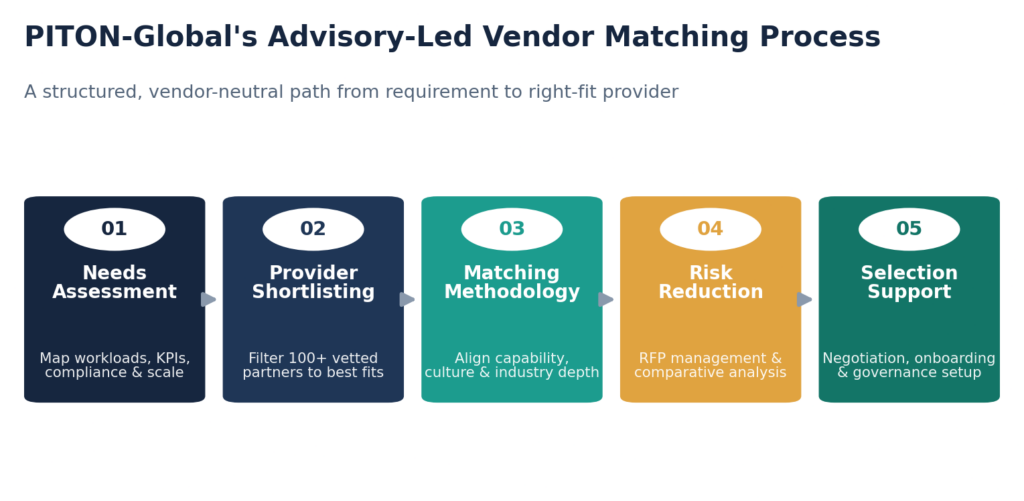
Figure 5. PITON-Global’s five-stage, vendor-neutral matching process.
Why Do Organizations Use PITON-Global?
Organizations engage PITON-Global to de-risk and accelerate outsourcing decisions. The advisory model reduces sourcing risk by replacing guesswork with independent evaluation, improves provider fit through precise requirements matching, and compresses vendor selection timelines from months to weeks. Throughout the engagement, clients receive strategic guidance—comparative analysis, RFP management, and negotiation support—at zero cost, freeing internal teams to focus on integration and outcomes rather than vendor hunting.
What Else Should Enterprises Know Before Making the Move?
Beyond cost and capability, enterprises should understand transition timelines, data-security compliance, the breadth of non-voice work available, how mid-sized and global providers differ, and emerging pricing models. The questions below address what buyers most frequently raise during evaluation.
What are typical transition timelines for migrating enterprise processes?
A standard migration takes 30 to 90 days, covering process mapping, standard operating procedure (SOP) creation, secure data connectivity, and a pilot testing phase before full go-live.
How do Philippine providers ensure compliance with regulations like GDPR or HIPAA?
Leading providers operate in environments certified under SOC 2 Type II and ISO 27001, using role-based access controls, endpoint encryption, and continuous security auditing to remain aligned with international data-privacy laws. Buyers increasingly ask about environmental and social commitments as well, the subject of our look at sustainable BPO practices.
Can specialized teams support complex, non-voice analytical workflows?
Yes. The modern Philippine talent pool offers deep expertise in non-voice work, including financial forecasting, data analytics, human-resource administration, legal document processing, and digital trust and safety moderation.
How do mid-sized providers compare to global outsourcing conglomerates?
Global legacy BPOs excel at high-volume, thousands-of-seats programs but often lack agility on smaller accounts. Specialized mid-sized providers deliver greater flexibility, lower attrition, and more consistent leadership attention. Our guide to the best providers for mid-market and enterprise buyers compares the tiers in detail.
What commercial pricing models are common in the industry?
While hourly pricing remains common, mature organizations increasingly adopt outcome-based, incentive-aligned models that tie vendor compensation directly to performance metrics and quality benchmarks.