
After auditing live support operations across our fintech partner network, the pattern is consistent: the teams with the best combination of cost, compliance, and customer satisfaction converge on a 40:60 human-to-AI split. The same logic runs through Manila financial-operations desks measured on risk-adjusted yield rather than headcount. This is not an arbitrary target. It is the point where automation absorbs the highest-volume, lowest-judgment work and human specialists are concentrated exactly where regulatory exposure and emotional stakes are greatest.
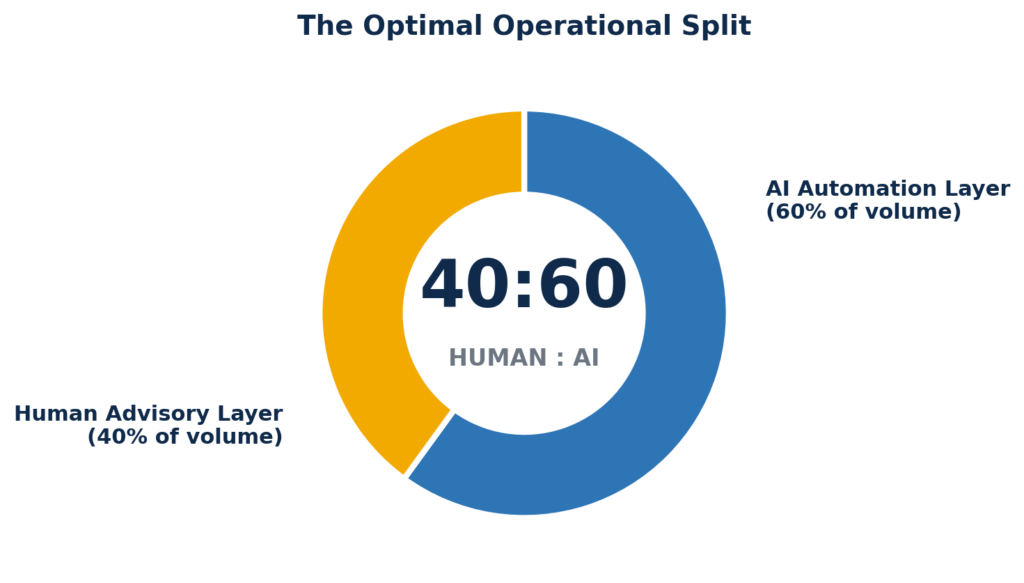
Figure 1 — The 40:60 model: AI resolves the majority of contact volume, and the remainder is routed to human advocates.
Why is a 40:60 ratio critical for fintech scaling?
Fintech support is structurally different from e-commerce or SaaS. Every touchpoint involves regulated financial data, systemic trust, and immediate emotional stakes. Going fully automated creates legal and reputational risk when AI mishandles a fraud event or a compliance exception, the failure mode behind the case for human-led AI in AML screening. Going fully human caps growth and ties overhead linearly to user acquisition. The 40:60 model is the inflection point of operational equilibrium: AI carries the massive predictable baseline, humans absorb the unpredictable, high-risk edge cases.
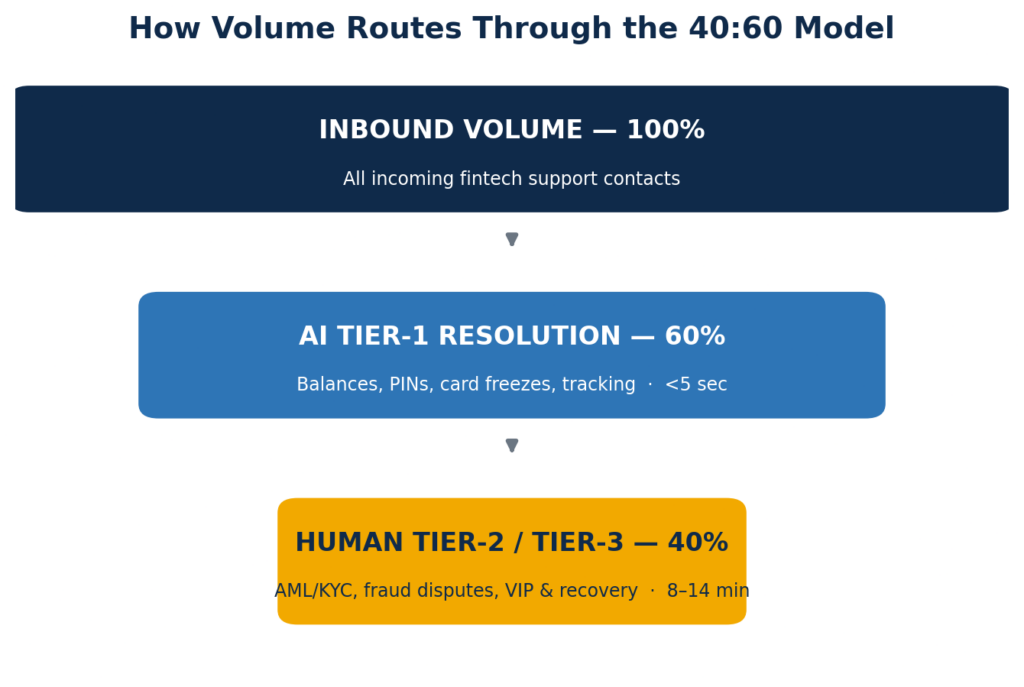
Figure 2 — Inbound volume is filtered top-down: AI clears the routine majority, humans own the complex remainder.
AI automation layer vs. human advisory layer
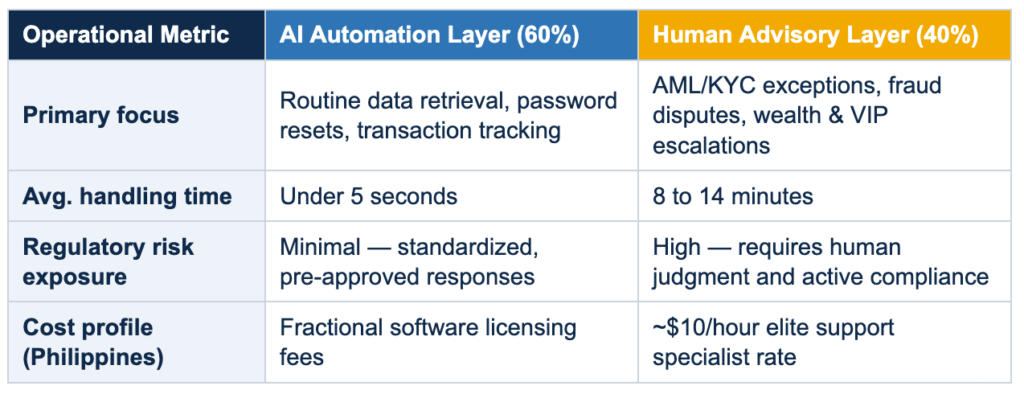
The two layers are engineered for opposite jobs. The table below maps where each excels, and why mixing them at the wrong ratio breaks either cost or compliance.
How automated AI layers transform Tier-1 workflows
The AI allocation acts as an unyielding front-line filter. Conversational LLM pipelines and automated retrieval systems eliminate wait times for routine queries before they ever reach a human queue:
Instant verification processing
Balance inquiries, card freezes, and address updates resolved with no human touch.
Proactive fraud alerts
Flagging transaction anomalies and guiding users through automated verification loops.
Multi-channel deflection
Contextual bots across mobile apps, WhatsApp, and SMS capture volume before it hits phone queues.
Offloading these repetitive data-pulls to software prevents agent burnout and ties human overhead tightly to genuine value creation rather than ticket count. It is one piece of the wider shift covered in how AI is reshaping fintech support and back-office work.
When human expertise must take absolute priority
The human share is where brand equity and regulatory safety are protected. When money is delayed, missing, or compromised, users experience acute anxiety. Forcing a panicked customer through a rigid AI loop destroys trust and triggers immediate churn. Human advocates step in instantly during high-stakes scenarios:
Disaster recovery & true fraud events
Calming a cardholder while executing multi-party recovery protocols.
Regulatory onboarding hurdles
Manually reviewing conflicting identity documents to stay compliant without alienating legitimate users, a burden that weighs even heavier on support desks serving crypto and digital-asset platforms.
High-net-worth technical support
White-glove service for premium account holders who expect a human voice.
Expert Insight
“AI is a brilliant utility for scale, but it lacks the contextual judgment and empathy required when a customer’s financial security is on the line. Our partners in the Philippines build elite teams of financial advocates who understand the nuance of AML flags, complex account recoveries, and VIP relations. You cannot automate the preservation of consumer trust.” — John Maczynski, CEO, PITON-Global
Case Study: Restructuring a Neo-Bank Support Model
A rapidly growing global neo-bank approached PITON-Global in a scalability crisis. Support costs were rising linearly with user acquisition, and an all-human team in the US was drowning under a 45-minute average hold time.
The Challenge
80,000 monthly support tickets, most of them routine (balance disputes, forgotten PINs, app troubleshooting) — creating severe backlogs for critical fraud investigations.
The Solution
PITON-Global audited the workflows, matched the client with a tier-one financial BPO in Manila, and engineered a definitive 40:60 split:
- Deployed an intelligent AI layer to resolve routine account queries directly in-app.
- Built a dedicated 90-seat team of university-educated, compliance-certified specialists to own every escalation.
The Results (within 90 days)
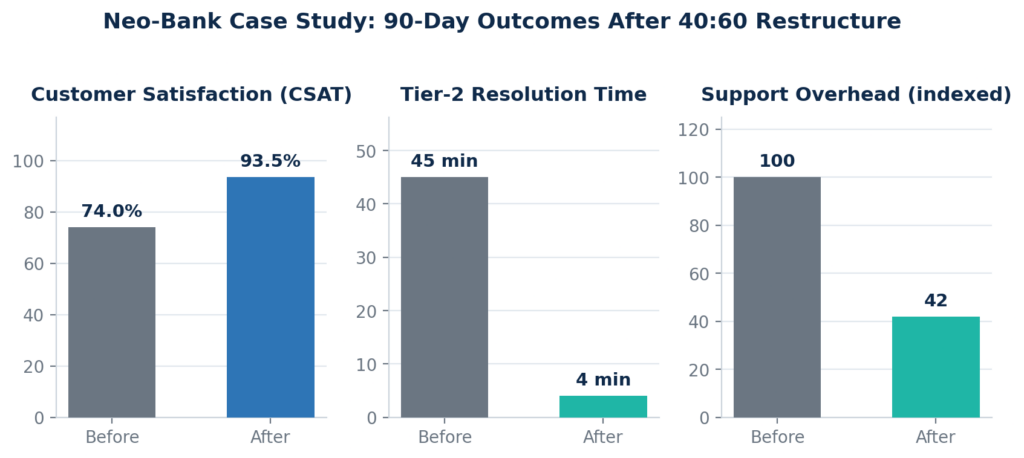
Figure 3 — CSAT rose 19.5 points, Tier-2 resolution fell from 45 to under 4 minutes, and overhead dropped sharply.

Methodology & About the Authors
How we derived the 40:60 benchmark
Figures are drawn from operational audits across PITON-Global’s fintech BPO partner network, covering ticket-routing logs, average-handling-time data, and CSAT surveys. The neo-bank case study reflects a single anonymized client engagement; results vary by product mix, regulatory jurisdiction, and onboarding maturity.
PITON-Global is an advisory firm that matches financial-services companies with vetted, compliance-certified support providers in the Philippines. The Operations Research Team analyzes contact-center performance across regulated industries.