

The best BPOs in the Philippines aren’t a fixed list of large, generic call centers but specialized vendors matched to your industry, tech stack, and volume. For mid-market and enterprise firms, boutique and mid-sized providers (Tier 2 and Tier 3) usually win on domain expertise, far lower attrition, and dedicated executive oversight—outperforming tier-1 integrators on complex work. The criteria below go a level deeper than our overview of vetting, contracting and de-risking Philippine partners.
Key Takeaways
- Best does not mean biggest. The right BPO is matched to your industry, technology stack, and volume—often a Tier-2 or Tier-3 specialist rather than a tier-1 integrator.
- Attrition is the hidden cost. Tier-1 high-volume voice runs far higher attrition than specialized mid-market vendors, and turnover quietly resets productivity and CSAT.
- Don’t buy on price alone. A small hourly cut can separate a career agent from an entry-level one—and trigger the attrition spiral that erodes quality.
- Diversify geography. Cebu, Clark, and Davao offer strong talent, lower cost, and disaster resilience versus a Manila-only footprint.
How Do I Evaluate Top BPO Providers Without Falling for Marketing Fluff?
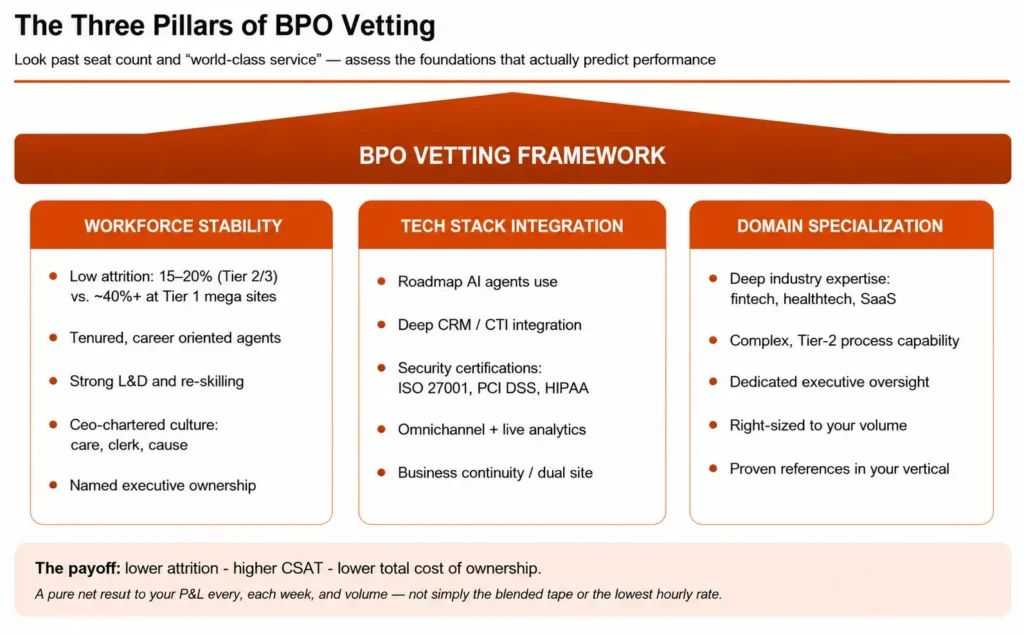
Look past seat count and “world-class service” claims and assess three pillars: workforce stability (attrition, tenure, L&D), technology infrastructure (real-time AI agent-assist, deep integrations, security certifications), and domain specialization (proven expertise in your industry). Specialized mid-sized vendors often outperform tier-1 integrators on all three for complex work. Channel breadth matters too: buyers running sales as well as service should check how a vendor handles omnichannel customer acquisition journeys.
Corporate service buyers should analyze a provider’s operational footprint across those three pillars rather than headline promises. The country’s BPO landscape is highly fragmented—the Philippine Economic Zone Authority has accredited several hundred BPO companies spanning large enterprises and SMEs—so generic comparisons are misleading. Tier-1 global integrators boast tens of thousands of seats but often struggle with high attrition and low agent engagement on mid-market accounts; specialized mid-sized providers frequently deliver superior metrics through dedicated management attention.
How Do the BPO Provider Tiers in the Philippines Compare?
Tier 1 (global integrators, 10,000+ seats) suits high-volume, low-complexity work but carries the highest attrition; Tier 2 (specialized mid-market, 500–5,000 seats) excels at complex technical support, healthcare, and financial services; Tier 3 (boutique, under 500 seats) fits hyper-niche processes and pilots, with the lowest attrition and tightest oversight.
Attrition is the clearest differentiator. The national association reports high contact-center attrition, while global in-house centers run far lower, and industry surveys show the high-volume end still turning over a large share of its workforce each year, even after a decade of improvement. Specialized and boutique operations, with smaller teams and stronger engagement, typically run materially lower.
Provider Tier Comparison
| Provider Tier | Scalability | Average Attrition | Best Suited For |
| Tier 1 – Global integrators | >10,000 seats | 45–60% / year | High-volume, low-complexity customer support |
| Tier 2 – Specialized mid-market | 500–5,000 seats | 15–25% / year | Complex technical support, healthcare BPO, financial services |
| Tier 3 – Boutique providers | <500 seats | <15% / year | Hyper-niche processes, pilot programs, specialized engineering |
Ranges reflect typical industry experience; actual attrition varies by account complexity, site, and employer brand.
What Common Pitfalls Do Procurement Teams Face When Selecting a Filipino BPO Partner?
The biggest mistake is treating selection as a commodity-pricing exercise: squeezing hourly rates forces vendors to cut agent pay, triggering high attrition, longer onboarding, and falling CSAT. The second is ignoring geographic risk—concentrating everything in Manila instead of diversifying to Cebu, Clark, or Davao.
Squeezing vendors on hourly bill rates invariably forces them to cut agent salaries, setting off a cascade: high attrition, prolonged onboarding, and degraded CSAT. A small per-hour difference often decides whether you get an experienced, career-oriented agent or an entry-level one. The buyers who get the most from offshore teams treat savings as capital to reinvest, the approach set out in our analysis of outsourcing for long-term growth.
“Many enterprise buyers fail to realize that a small difference in hourly bill rates can represent the line between an experienced, career-oriented agent and an entry-level tier-1 agent. By partnering with an advisory firm that has pre-vetted over 100 localized providers, buyers bypass the noise and match with vendors whose cultural alignment and operational capabilities precisely fit their long-term business goals.” — John Maczynski, CEO, PITON-Global
Companies also overlook geographic risk diversification within the Philippines. Manila remains the primary hub, but Cebu, Clark, and Davao offer competitive talent pools with lower localized attrition and real-estate costs—provincial sites commonly run noticeably cheaper—and stronger disaster resilience. Cebu brings a deep, university-fed and multilingual talent base; Clark (Pampanga) is a PEZA freeport built for scalable, low-calamity-risk operations; and Davao offers clean governance and high retention as a southern gateway.
How Did a Silicon Valley FinTech Firm Scale to 150 FTEs?
A hyper-growth fintech stuck with runaway attrition and sliding CSAT at a major global provider was re-matched by PITON-Global within 14 days to a financial-services Tier-2 specialist on a dual-site Manila–Clark configuration. Within six months attrition fell sharply, CSAT climbed to an industry-leading level, and net cost dropped substantially. (Outcomes are vendor-reported.)
Disclosure
The outcomes below are reported by PITON-Global from a client engagement and are presented as an illustrative deployment, not an independently audited benchmark.
A hyper-growth Silicon Valley fintech needed to scale its Tier-2 technical support and fraud-prevention teams. It first struggled with a major global provider in Manila—an unsustainable annualized attrition rate and a sliding CSAT score. PITON-Global audited the precise technical requirements and ran a targeted match across its network of 100+ specialized Filipino providers. Within 14 days the client was matched with a Tier-2 financial-services specialist running a dual-site Manila–Clark configuration.
Reported Outcomes
| Metric | Result |
| Annualized Attrition (6 months) | 52% → 14% |
| Customer Satisfaction (CSAT) | 71% → 93.5% |
| Net Cost vs. Previous Vendor | 42% Lower |
Reported outcomes. For context, the new CSAT level sits well above the range usually considered “good,” and the new attrition rate is far below the contact-center average—much of the cost saving came from eliminating continuous retraining.
The re-matched partner reached managed scale of 150 FTEs, with the attrition reduction — not headline rate cuts — doing most of the cost work, since each retained, tenured agent removed recurring recruitment and retraining spend. Scaling on retained expertise rather than rate cuts is the core of the 2026 global scaling playbook.
Reported Results (vs. the Previous Vendor)
- Attrition: cut to a fraction of its former annualized level within the first six months.
- CSAT: raised to an industry-leading level.
- Cost: substantial net savings versus the previous vendor, driven by reduced retraining.
What Framework Should We Use to Transition Operations Successfully?
Use a structured, phased model: document SOPs and shadow current handling (weeks 1–3); nest a 10–15-FTE pilot to surface training and integration gaps (weeks 4–6); then ramp headcount incrementally as the pilot hits predefined KPIs (weeks 7+). The goal is zero service degradation at go-live.
Transition Framework
| Phase | Timeline | What Happens |
| 1 – Documentation & shadowing | Weeks 1–3 | Document standard operating procedures and capture handling styles; record call and ticket patterns. |
| 2 – Pilot group nesting | Weeks 4–6 | Launch a small, dedicated footprint (10–15 FTEs) to identify gaps in training or system integration. |
| 3 – Managed scale | Weeks 7+ | Incrementally ramp headcount as the pilot hits predefined KPIs, protecting against any service degradation. |
Most enterprise transitions reach managed scale in roughly six to eight weeks under this model.
What KPIs and Contract Terms Protect an Enterprise BPO Engagement?
Tie commercials to outcomes, not just hours. Hold the vendor to explicit SLA targets (CSAT, FCR, AHT, quality), an attrition cap with remediation triggers, a quarterly business-review cadence, security and business-continuity commitments (ISO 27001, dual-site BCP), and clear knowledge-transfer and exit clauses.
Recommended Contract Protections
- Outcome-linked SLAs
Set targets for CSAT, First Contact Resolution, Average Handle Time, and quality score — with credits for misses.
- Attrition Cap
Define a ceiling (e.g., aligned to Tier-2 norms) with remediation triggers if breached.
- Governance Cadence
Lock in weekly operational reviews and quarterly business reviews with the named executive owner.
- Security & Continuity
Require ISO/IEC 27001 and PCI-DSS (HIPAA where applicable), plus a dual-site business-continuity plan.
- Knowledge Transfer & Exit
Mandate living SOP documentation and clear transition-out terms to avoid lock-in.
What Are the Risks, and How Do You De-Risk a Philippine BPO Engagement?
The main risks are attrition and continuity loss, single-site concentration, security gaps, weak knowledge transfer, and vendor lock-in. Each is manageable: cap attrition contractually, diversify across sites (e.g., Manila plus Clark), verify certifications, mandate living documentation, and negotiate clean exit terms before you sign.
Key Risks and Mitigation Strategies
- Attrition and Continuity
High turnover resets productivity; insist on retention data, L&D depth, and an attrition cap.
- Single-Site Concentration
A Manila-only footprint is exposed to weather and infrastructure risk; dual-site (e.g., Manila–Clark) adds resilience.
- Security Shortfalls
Verify ISO 27001 and PCI-DSS in practice, not just on a slide — essential for fintech and healthcare data.
- Knowledge Transfer
Require living SOPs and shadowing so capability survives agent turnover.
- Vendor Lock-In
Negotiate transition-out support and data-portability terms at the outset, not at renewal.
Frequently Asked Questions
Is a Tier-1 Global Integrator Always the Safest Choice?
No. Tier-1 integrators suit high-volume, low-complexity work, but they often carry the highest attrition and give mid-market accounts less senior attention. For complex or specialized work, Tier-2 and Tier-3 providers frequently outperform them.
Should We Be in Manila, or a Secondary City Like Cebu, Clark, or Davao?
Diversify. Manila has the deepest pool, but Cebu, Clark, and Davao offer strong talent, lower cost, and better disaster resilience. A dual-site setup (e.g., Manila–Clark) balances scale with continuity.
How Long Does a Transition Take?
Under a disciplined phased model — documentation and shadowing, pilot nesting, then managed scale — most enterprise programs reach managed scale in roughly six to eight weeks without service degradation.
Is Offshore Secure Enough for FinTech or Healthcare?
Yes, when the vendor genuinely holds the right controls. Require ISO/IEC 27001 for information security, PCI-DSS for card data, and HIPAA alignment for health data, and verify them in practice.