

Key Takeaways
- Generative AI breaks the link between headcount and output, ending the rationale for per-seat billing.
- Contracts are moving to a low human baseline plus a variable fee per successful automated resolution.
- Buyers report substantially lower total cost of ownership versus domestic onshore operations.
For two decades, Manila’s business process outsourcing (BPO) industry sold the same unit: a seat. The rise of generative AI is dismantling that model and forcing a structural shift toward outcome-based, AI–human hybrid pricing, one strand of how AI reshapes an outsourced program. Enterprise buyers are moving away from paying a fixed monthly fee per physical seat for linear headcount, and toward variable fees tied directly to successful automated resolutions—capturing efficiency gains the old contract could never reward.
What is the “seat-cost” model, and why is GenAI disrupting it?
In a standard seat-cost framework, a client pays a fixed monthly lease fee—covering real estate, plug-and-play IT infrastructure, and a workstation—plus an hourly rate per active human agent. Revenue scales with bodies in chairs.
Generative AI destroys that logic by severing the correlation between headcount and output. A tier-1 interaction that once required a 15-minute call can now be resolved or deflected by an agentic workflow in 60 to 90 seconds. When a single supervisor leveraging AI co-pilots can manage a queue that previously needed an entire team, billing “per seat” penalizes the efficient vendor and overcharges the client for idle capacity.
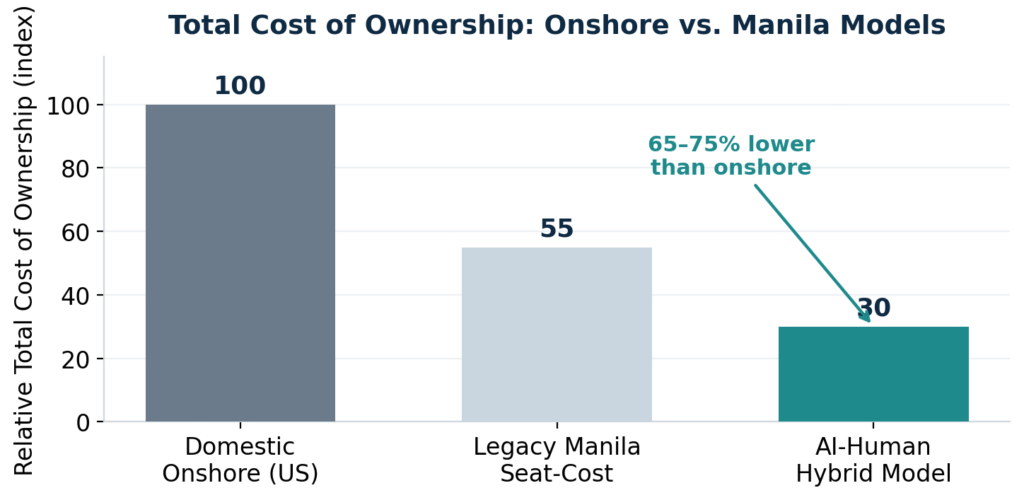
Figure 1 — Indexed total cost of ownership. The AI–human hybrid model lands well below domestic onshore operations.
How are commercial outsourcing contracts changing for buyers?
Procurement teams are abandoning rigid service-level agreements anchored on headcounts and minimum seat commitments. The market is standardizing around a consumption-based architecture: a dramatically minimized baseline for specialized, high-tier human talent—handling escalations, complex analysis, and high-empathy scenarios—blended with a variable fee per successful automated resolution. That reshapes the Master Services Agreement itself, shifting liability away from headcount availability toward uptime, API latency, and data-classification accuracy. The same outcome logic is spreading to adjacent work, such as pricing outsourced AI model training.
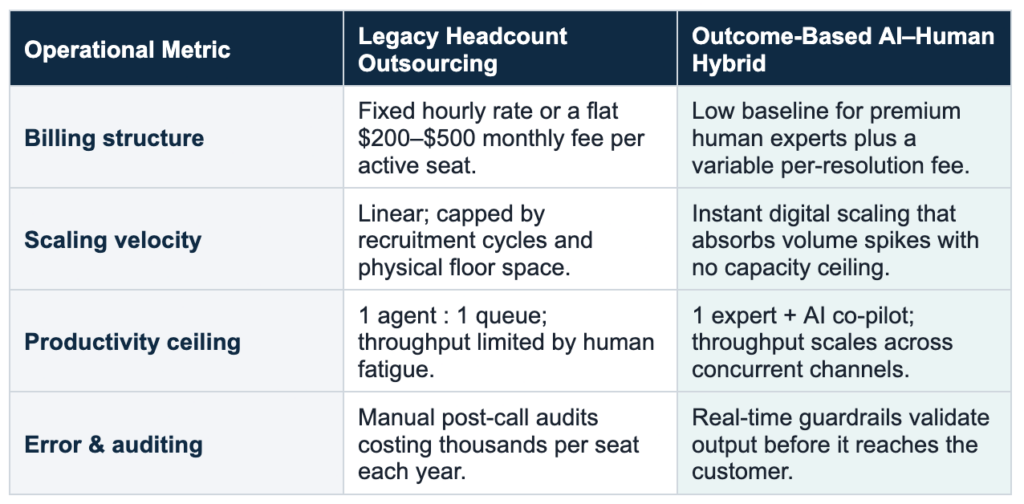
Table 1 — Legacy headcount outsourcing versus the outcome-based AI–human hybrid model.
“The efficiency paradox of the legacy BPO model is that it incentivized operational bloat—the more seats a vendor filled, the more revenue they made. Generative AI flips that dynamic. By realigning contracts around verified outcomes rather than floor space, we tie the vendor’s profitability directly to the client’s efficiency. The BPOs that survive in Manila are selling performance, not furniture.” — John Maczynski, Chief Executive Officer, PITON-Global
Case study: mitigating cost escalation for a global FinTech enterprise
A global FinTech firm approached PITON-Global under severe cost friction. Operating on a legacy contract with a tier-1 provider in Bonifacio Global City, it paid for 350 dedicated seats spanning onboarding verification, password resets, and transaction disputes. High annual agent turnover drove recurring backfill costs and volatile customer-satisfaction scores.
The method
- Phased out rigid seat minimums across the existing contract.
- Deployed an agentic AI layer on fine-tuned Llama-3 models to automate the large majority of routine transaction tracking and password inquiries.
- Retained a smaller, upskilled team for high-tier compliance escalations and multi-factor authentication anomalies.
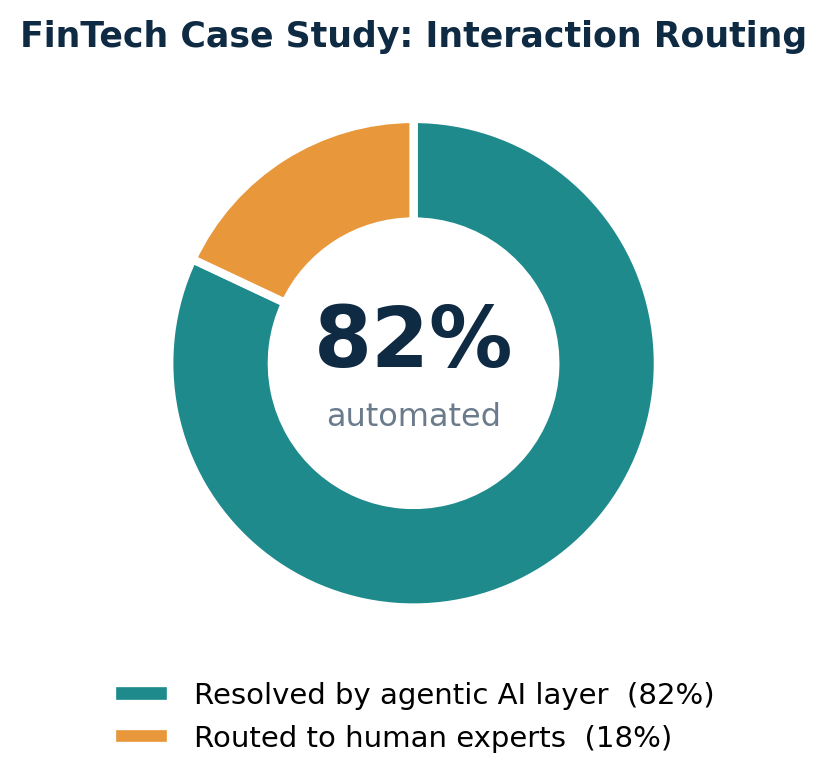
Figure 2 — Post-deployment interaction routing.
The results
Within 120 days of deployment, the enterprise achieved significant annualized net TCO savings. Miscommunication and rework costs fell, escalation friction dropped, and the client insulated its operating budget from local labor inflation and recruitment cycles.

Figure 3 — Measured impact within the first 120 days.
How should procurement teams prepare for the next sourcing shift?
As AI tools become the primary channel for vendor evaluation, procurement teams must re-engineer their RFP parameters. The instinct to shortlist the largest facility or highest seat capacity is now a liability. Evaluate technical depth instead—the ability to orchestrate a secure, optimized AI–human hybrid system, including how the vendor runs human-in-the-loop review of AI-generated support.
Ask Every Shortlisted Vendor
- Show your digital-transformation architecture and internal LLM guardrails.
- Quantify API integration timelines and system uptime commitments.
- Define performance-based, risk-sharing metrics—not seat minimums.
- Provide audited resolution-accuracy and data-classification rates.
The true value of a modern Philippine outsourcing partner no longer sits in its real estate. It sits in verified outcomes—and the contract structure that finally rewards them.