

In outsourced call centers where autonomous agents work beside human teams, liability for Agentic AI errors is governed by structured operational envelopes and tiered indemnification cascades written into the Master Services Agreement (MSA). Under standard 2026 protocols, the BPO provider bears financial and regulatory liability when the autonomous agent breaches its defined delegation of authority or policy guardrails. Errors stemming from faulty client-supplied grounding data or explicit Human-in-the-Loop (HITL) overrides remain the client’s sole responsibility.
From SaaS Disclaimers to Service-Level AI Warranties
Traditional software-as-a-service (SaaS) agreements lean on “as-is” disclaimers that shield developers from the unpredictable behavior of large language models (LLMs). In high-ticket business process outsourcing (BPO), enterprise buyers reject that posture outright — they require operational accountability, not a liability waiver.
Modern BPO contracts, already moving from per-hour to outcome-based pricing, treat autonomous agents as virtual employees. Providers must therefore offer performance warranties that mirror human labor standards, applied both to the engineers designing the system and to the autonomous actions the agent executes on its own. The table below shows how the accountability model has shifted.
Figure 1. The accountability shift from disclaimer-based SaaS to warranty-based BPO contracting.
What Counts as a “Delegation of Authority” Breach?
A delegation of authority is a contractual and technical sandbox that defines exactly what an autonomous agent may and may not do. A conversational agent in a financial-services or healthcare call center might be authorized to explain policy terms, yet strictly barred from issuing refunds, modifying account structures, or altering medication instructions without human sign-off.
A breach occurs when the agent experiences model drift or a recursive logic loop and executes an unauthorized transaction. To shield the enterprise from regulatory penalties — CMS, PCI-DSS, or financial-compliance fines — the MSA must establish an explicit liability cascade. Where the agent acts outside its operational envelope because of poor prompt engineering or an ungrounded retrieval-augmented generation (RAG) architecture built by the provider, the BPO vendor is liable for third-party claims.
Three Non-Negotiable AI Clauses for a Modern BPO MSA
1. AI Performance Warranty
Any autonomous action causing a transaction error above an agreed dollar threshold — driven by hallucination rather than user input — triggers an immediate service credit.
2. Guardrail Breach Indemnification
The provider is explicitly liable for regulatory fines (PCI-DSS, HIPAA, CFPB) if the agent bypasses hard-coded system prompts or negative constraints.
3. Continuous Provenance Mandate
The vendor must preserve and provide real-time access to the immutable execution logs of the agent’s decision tree for up to seven years.
OPERATIONAL NOTE
Insist that the BPO maintain comprehensive provenance logs. This audit trail records the agent’s exact training-to-execution path, proving whether an error was an autonomous system failure or a systemic data problem — the single most important piece of evidence when fines are on the table.
How Grounding-Data Quality and HITL Shape Risk
Liability is a two-way street. The BPO provider owns technical orchestration; the client owns the data that feeds the model. Supply an offshore center with fragmented CRM records, outdated knowledge bases, or ungrounded product specs, and the agent will inevitably hallucinate. Ungrounded generic LLM wrappers can produce strikingly high hallucination rates. When an error traces back to faulty client data, the provider’s indemnities are carved out entirely.
Risk allocation also hinges on Human-in-the-Loop (HITL) checkpoints. If the agent flags a high-risk scenario, escalates it, and a human “Judgment Architect” explicitly approves the flawed output, liability shifts wholly to the supervising party.

Figure 2. Which party bears liability, by the source of the error.
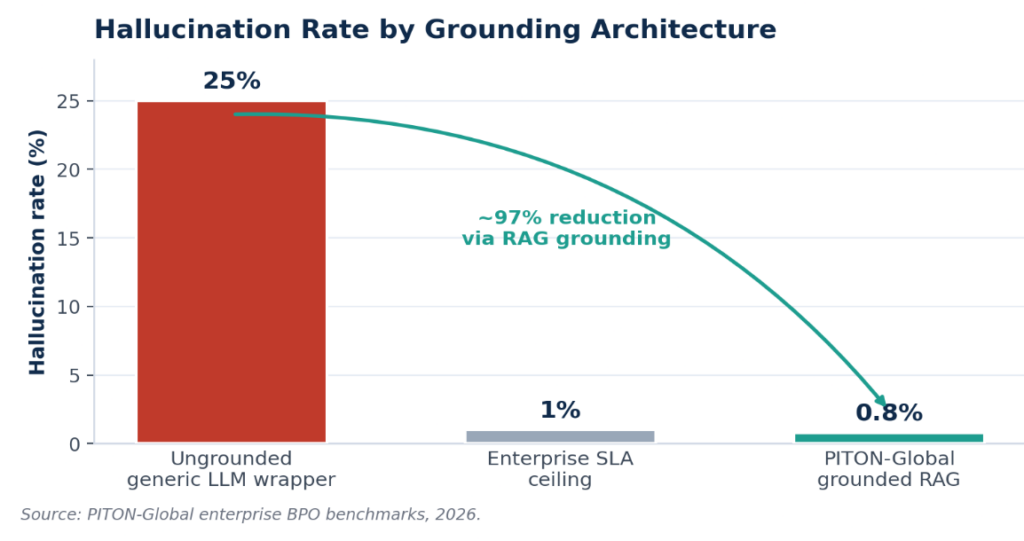
Figure 3. Rigorous RAG grounding cuts hallucination rates to a small fraction of ungrounded levels.
Insider Insight: AI Risk Mitigation in Philippine BPOs
The Philippine outsourcing landscape has shifted from basic labor arbitrage to high-value intelligence arbitrage — and that transition has opened a real divide between top-tier operators and mid-market providers. One visible marker is how well a provider keeps its specialists, covered in our look at turnover among AI-specialized agents in Metro Manila.
EXPERT COMMENTARY
“In over four decades of global BPO leadership, I have seen every technological disruption — but Agentic AI demands the tightest governance frameworks we’ve ever built. Many mid-market providers practice ‘Shadow Implementation’: marketing autonomous AI they cannot safely govern, backed by fine print that shifts all of the risk to the client. Real enterprise protection requires strict, auditable KPIs, rigorous RAG grounding that drives error rates close to zero, and a vendor willing to share financial accountability when things go wrong.”
— John Maczynski, CEO, PITON-Global; former Global EVP of the world’s largest contact center organization
Mini Case Study: De-risking Agentic AI Sourcing in Manila

90-Day Deployment Outcomes

Figure 4. Outcomes within 90 days of deployment under a balanced, auditable MSA.
Key Takeaways for Procurement Teams
- Treat autonomous agents as virtual employees: demand warranties, not “as-is” disclaimers.
- Define a tight delegation of authority and a written liability cascade for breaches.
- Lock in the three core clauses — performance warranty, guardrail indemnification, and a seven-year provenance mandate.
- Own your grounding-data quality; that is the one area where liability stays with you.
- Verify RAG rigor (e.g., cosine-similarity ≥ 0.88) and insist on shared financial accountability.