
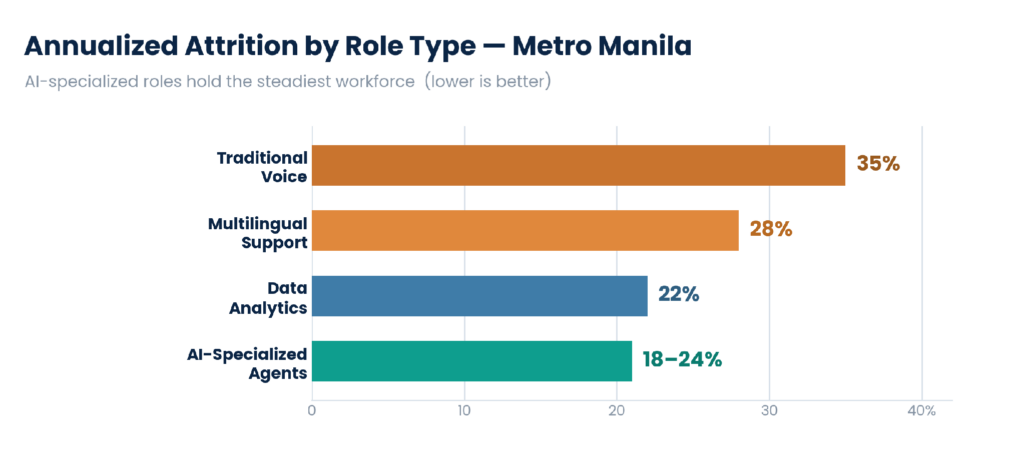
Between 18% and 24% annually — well below the 30–40% historical average for traditional voice BPO roles. It reflects a highly engaged workforce commanding a technical premium; where turnover does happen, it is driven by aggressive poaching rather than burnout.
For two decades, sky-high turnover was treated as an unavoidable cost of doing business in the Philippine contact-center industry. That assumption no longer holds for the workforce that matters most. AI-specialized agents — prompt engineers, data annotators, and agentic-AI orchestrators — now churn at roughly half the historical rate, and the reasons say a great deal about where the industry is heading. What was once the sector’s defining problem has, for its most valuable roles, quietly become one of its quieter ones.
Why Is Turnover for AI Specialists So Much Lower?
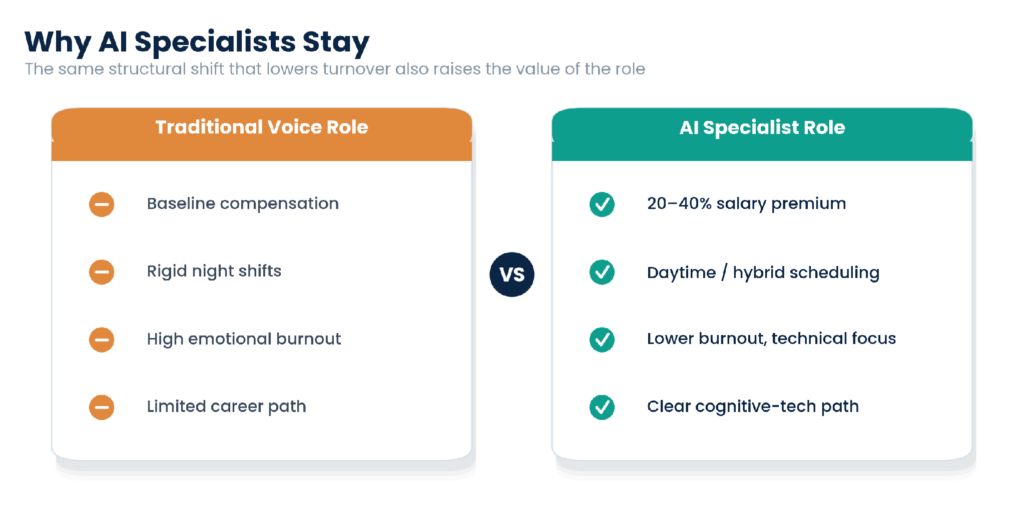
Because the work itself changed. AI-specialist roles offer higher baseline pay, daytime or hybrid schedules, and a genuine career path — replacing the burnout and rigid night shifts of voice work. The turnover that remains is driven by poaching from boutiques and GCCs, not dissatisfaction.
In tier-1 hubs such as Bonifacio Global City, Makati, and Ortigas, traditional contact-center programs still post annual turnover above 35%, while AI specialties hold a far steadier 18–24%. The divergence is structural rather than cosmetic: the work is more engaging, better paid, and clearly a step up rather than a treadmill. For buyers, that stability is not incidental — it is what keeps institutional knowledge inside the team instead of walking out the door every quarter.
The contrast in the day-to-day role is just as telling. Where the traditional voice seat means baseline pay, rigid night shifts, and limited progression, the AI-specialist role pairs a 20–40% salary premium with hybrid scheduling and a clear path into cognitive technology. That distinction is precisely why specialists who do leave are usually out-bid, not burned out.
What Macro Forces Shape AI-Agent Attrition?
Three forces: premium talent arbitrage (specialists command a 20–40% salary premium), the captive shift (Fortune 500 GCCs poaching vendor talent for proprietary AI data), and geographic optimization (Next-Wave Cities cut attrition a further 15%). Each carries a proven operational mitigation.
Retaining high-tier cognitive talent means reading the structural market forces at play — and pairing each with the mitigation that mature providers now deploy rather than improvise after the resignations start.
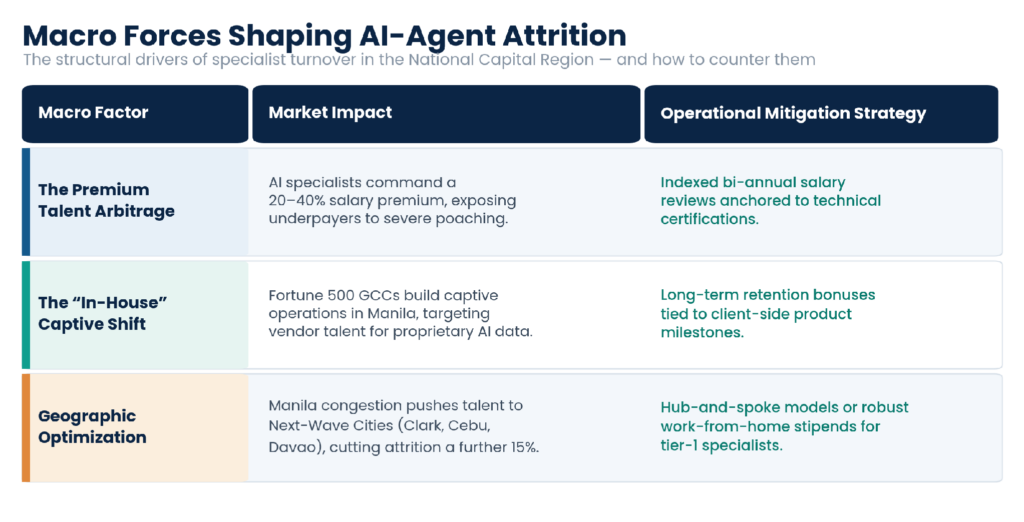
The primary drivers of AI-specialist attrition in Metro Manila — and how leading providers counter them.
In short, premium pay protects against arbitrage, milestone-linked bonuses blunt the pull of captive GCCs, and geographic flexibility taps the calmer labor markets of the Next-Wave Cities, where attrition falls a further 15%. Providers that ignore any one of the three tend to discover the gap only after a competitor has already hired their best people.
How Does “Malasakit” Affect Retention?
Decisively. Compensation alone cannot solve attrition; the cultural trait of Malasakit — deep care and shared ownership — is the defining retention variable. Providers that pair structured upskilling with genuine human connection are seeing a 15% year-on-year reduction in attrition.
Numbers and schedules explain part of the story; the rest is cultural, and it is the part generic vendors most often miss.
“As the Philippine BPO sector transitions from labor arbitrage to intelligence arbitrage, technology alone cannot solve the attrition equation. Even the most advanced generative AI architectures fail without human oversight. In the Philippines, the defining variable in talent retention remains Malasakit — the cultural trait of deep care and shared ownership. BPOs that blend structured upskilling with genuine human connection are seeing a 15% reduction in year-on-year attrition.”
— John Maczynski, CEO of PITON-Global
For enterprise buyers, the implication is direct: relying on generic vendors to staff sophisticated AI pipelines quietly exposes them to hidden training and replacement costs. Minimizing turnover means partnering with providers who invest systematically in continuous micro-learning and premium engagement — not those who treat retention as something to patch up after the resignations begin.
How Did a FinTech Unicorn Cut Attrition From 45% to 14%?
A Silicon Valley unicorn’s self-sourced team of 150 annotation specialists was churning at 45%, degrading its training data. PITON-Global rematched it to a PEZA-accredited niche provider recruiting elite CS and linguistics graduates. Within nine months: attrition fell to 14%, data-quality throughput rose 32%, and total cost of ownership dropped 28%.
The unicorn needed an elite team to train its customer-facing autonomous agents, but a 45% annualized churn rate was steadily corrupting the consistency of the very data those models depended on. The fix was not more recruiting — it was a structurally better-matched partner, with a custom recruitment profile aimed at top-tier NCR computer-science and linguistics graduates.
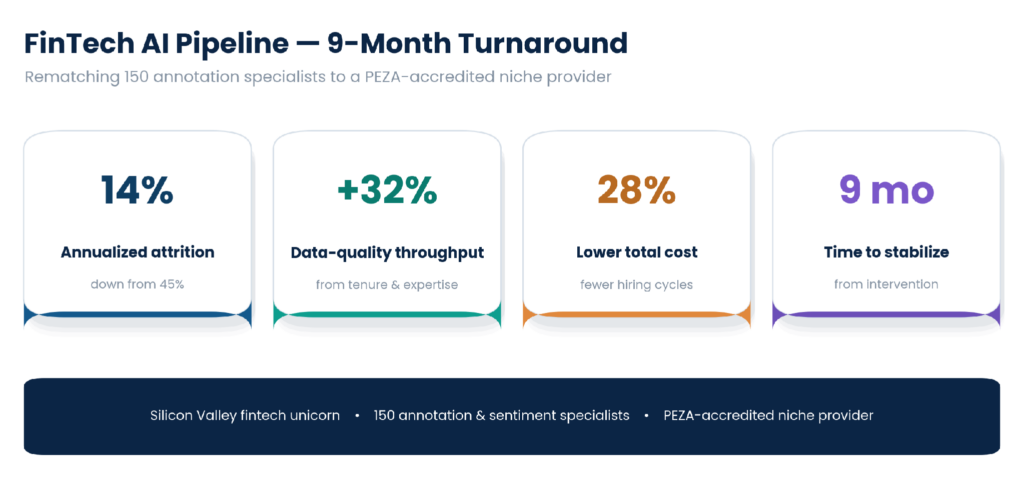
Stability, it turned out, was not a soft metric. As tenure and expertise accumulated, data-quality throughput climbed and the relentless, expensive cycle of recruiting and onboarding largely disappeared — the gains compounding directly into both cost and quality.
How Should Buyers Structure RFPs for Workforce Stability?
Quick answer: Look past hourly rates. Require legally binding team-continuity SLAs, and make prospective partners detail their talent pipeline, upskilling frameworks, and compensation relative to Metro Manila tech benchmarks. Favor boutique specialists over generalized call centers to protect proprietary workflows from turnover.
To mitigate retention risk during vendor selection, procurement teams must look past basic hourly rates. A well-built request for proposal converts a vague promise of stability into something measurable and enforceable before any work begins. Each clause — continuity SLAs, pipeline transparency, upskilling frameworks, benchmarked pay — forces a vendor to prove stability rather than merely assert it.

Above all, favor specialized providers whose entire operating model is built to keep scarce cognitive talent in place. In a market this competitive for AI skills, that protection — not the headline rate — is fast becoming the real deliverable enterprise buyers are paying for.