
TL;DR: The Key Takeaway
LLM fine-tuning outsourcing in the Philippines represents a strategic shift from deploying generic AI to cultivating bespoke, high-performance models. This evolution is powered by the nation’s elite cognitive workforce, transforming foundation models into precision instruments of domain-specific intelligence.
LLM fine-tuning outsourcing in the Philippines enables enterprises to transform generalized foundation models into specialized, industry-aware assets. By leveraging a high-aptitude workforce for Supervised Fine-Tuning (SFT) and Reinforcement Learning from Human Feedback (RLHF), companies can infuse proprietary knowledge and brand-specific logic into their AI. This process optimizes accuracy, reduces hallucinations, and ensures peak performance in specialized sectors like law, finance, and healthcare.
Executive Briefing
- Bespoke Intelligence: Pivot from “one-size-fits-all” AI to highly specialized models that understand your specific industry jargon and internal workflows.
- Precision and Trust: Utilize Filipino subject matter experts to minimize AI hallucinations and ensure outputs align with factual, domain-specific truths.
- Strategic Velocity: Deploy curated “AI Tutors” to accelerate the retraining process, moving from raw foundation models to specialized tools in weeks, not months.
- Data Sovereignty and Security: Benefit from a mature BPO infrastructure that integrates GDPR and HIPAA-compliant frameworks into the data curation pipeline.
- Competitive Differentiation: Build defensible intellectual property by embedding unique company logic directly into the model’s internal weights.
From General Intelligence to Specialized Mastery: The Fine-Tuning Imperative
The current era of artificial intelligence has been defined by the awe-inspiring breadth of foundation models like GPT-4. These systems possess a vast, encyclopedic grasp of human language, capable of drafting poetry or explaining quantum physics with equal ease. However, for the modern enterprise, “generalized” is often a synonym for “insufficient.” A standard model might recognize a legal document, but it lacks the critical eye of a specialized paralegal who understands the specific risk profiles of jurisdictional clause construction. This performance gap is exactly what fine-tuning bridges.
Fine-tuning represents the academic “specialization” of an AI. If a foundation model is a brilliant university graduate with a liberal arts degree, fine-tuning is the intensive medical or law school residency that follows. By retraining a model on a concentrated, high-quality dataset of domain-specific information, organizations instill specialized terminology and reasoning patterns. This transformation results in an LLM that doesn’t just predict the next word, but generates contextually accurate reports, nuanced code, and insightful analysis tailored to a specific business environment.
“We are witnessing a fundamental shift in how the world adopts AI. The novelty of raw power is being replaced by a demand for granular, domain-specific utility. Our clients require AI that understands their business at a molecular level. Fine-tuning is the engine of this transformation, and the Philippines provides the intellectual capital to drive it.” — John Maczynski, CEO, PITON-Global
The Philippine Advantage: A Hub for Cognitive Excellence in AI
Choosing the Philippines for LLM fine-tuning is a strategic move centered on cognitive excellence rather than simple labor arbitrage. The nation has cultivated a unique talent pool characterized by high literacy, native-level English fluency, and a cultural aptitude for the analytical rigor required in AI development. These specialists act as “AI Tutors,” providing the human-in-the-loop validation that foundation models lack.
Beyond talent, the established Philippine BPO infrastructure offers a turnkey solution for complex, data-sensitive projects. With stringent security protocols—including full alignment with GDPR and HIPAA standards—AI innovators can integrate Philippine teams into their core dev cycles without compromising intellectual property. The result is a powerful synergy where global tech firms provide the models, and the Philippine workforce provides the human intelligence and operational discipline to refine them.
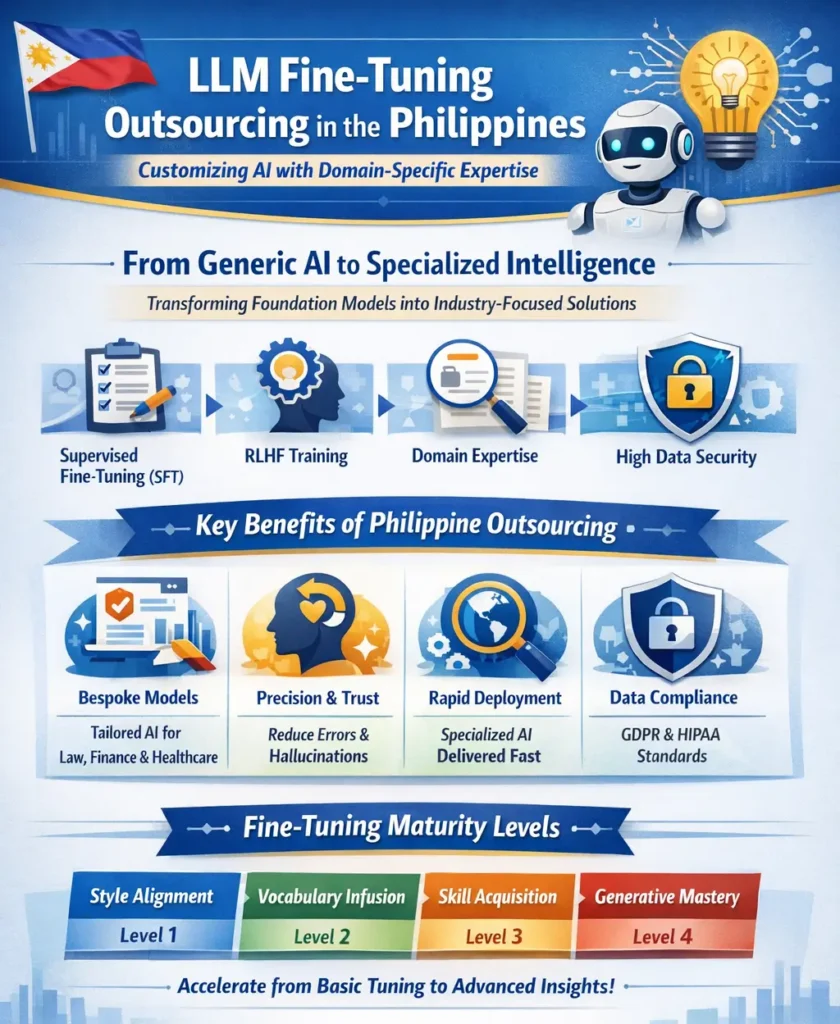
Fine-Tuning Maturity Model: From Stylistic Alignment to Generative Mastery
The evolution of a fine-tuned model follows a distinct maturity curve. Understanding these levels allows organizations to align their outsourcing strategy with their ultimate business goals.
| Maturity Level | Primary Objective | Key Activities | Expertise Required |
| Level 1: Style Alignment | Mirror brand voice and formatting. | Style guide curation, prompt-response ranking. | Linguistic precision, brand awareness. |
| Level 2: Vocabulary Infusion | Teach industry-specific jargon. | Technical document annotation, glossary creation. | Subject matter expertise (Finance, Legal). |
| Level 3: Skill Acquisition | Perform multi-step technical tasks. | Workflow simulation, logical validation of code/summaries. | Advanced domain knowledge, logical reasoning. |
| Level 4: Generative Mastery | Generate novel, expert insights. | RLHF, red teaming, adversarial testing. | Deep mastery, critical thinking, evaluation skills. |
Intelligence Arbitrage: The Human Element of Precision
In the realm of fine-tuning, the concept of Intelligence Arbitrage is the primary value driver. While foundational training relies on the massive, often “noisy” public internet, fine-tuning thrives on small, pristine datasets. The quality of this data dictates the model’s success. This is where the human element is irreplaceable; machines cannot yet curate the “truth” for themselves.
In the Philippines, AI Tutors engage in a sophisticated form of knowledge transfer. They don’t just label text; they architect instructional prompts and provide corrective feedback that resets a model’s logical compass. This process ensures that the resulting dataset is significantly more valuable than the sum of its raw parts, enabling a level of precision that automated scraping could never achieve.
The Governance Framework: Ensuring Accuracy and Trust
As AI moves into critical sectors, the risks associated with “hallucinations” or biased outputs become existential for a brand. A robust governance framework is the only way to deploy fine-tuned models with confidence. In the Philippines, this framework is built on three pillars:
- Data Privacy: Protecting proprietary datasets within ISO-certified environments.
- Quality Assurance (QA): Layered human review to ensure the model isn’t introducing new biases or errors during the retraining process.
- Regulatory Alignment: Designing workflows that satisfy the strict auditing requirements of the healthcare and financial sectors.
PITON-Global orchestrates these frameworks, ensuring that when a model is “graduated” from the fine-tuning phase, it is not only intelligent but also safe and trustworthy.
LLM Fine-Tuning Service Tiers
| Service Tier | Primary Goal | Ideal For… |
| Tier 1: Persona | Aligning AI with company communication styles. | Customer-facing support and marketing bots. |
| Tier 2: Industry Knowledge | Embedding core concepts (e.g., Engineering, Pharma). | Specialized research and regulatory compliance. |
| Tier 3: Task Specific | Automating complex, knowledge-based workflows. | Financial modeling, bug detection, medical reporting. |
| Tier 4: Full-Stack | Building proprietary, defensible AI advantages. | AI-native startups and industry leaders. |
Expert FAQs
How does fine-tuning differ from simple prompt engineering?
Think of prompt engineering as giving a student better instructions for a test. Fine-tuning is actually changing what is in the student’s brain. It updates the model’s internal weights, making specialized knowledge part of its core architecture rather than a temporary instruction.
Can fine-tuning stop AI “hallucinations”?
While it doesn’t eliminate them entirely, it drastically reduces them. By grounding the model in a factual, curated dataset provided by Philippine experts, the AI is much less likely to “guess” when it doesn’t know an answer, opting instead to stay within its specialized knowledge base.
What is the role of RLHF in the Philippine context?
Reinforcement Learning from Human Feedback (RLHF) is where Filipino specialists rank different model responses based on quality and safety. This “preference ranking” is what makes models like GPT-4 feel so human and helpful; it is a labor-intensive process that the Philippines executes at a world-class scale.
How do we measure the ROI of a fine-tuning project?
ROI is typically measured by task-specific KPIs: a 30% reduction in manual auditing time, a 20% increase in code accuracy, or higher customer satisfaction scores for automated interfaces. The value is found in the tangible efficiency gains of the specialized tool.