

On this page
- Key Takeaways
- What Is the Real Financial Delta Between Domestic Hiring and Philippine BPO Models?
- How Do Talent Quality, Turnover, and Scale Compare Across Both Models?
- What Are the Tradeoffs, Risks, and Decision Criteria Executives Must Weigh?
- What Does a Successful Move from an In-House Team Look Like?
- How Does PITON-Global Guide Executive Decision-Making?
- Frequently Asked Questions
Companies should compare Philippine outsourcing with domestic hiring on fully loaded cost, operational scalability, talent availability, and administrative overhead rather than base salary. Domestic hiring offers proximity and direct control; offshore models deliver substantial fully loaded cost savings, shift fixed CapEx into variable OpEx, and grant immediate access to mature, scalable talent pools. The in-house option is also weighed against India, Latin America and other locations in our guide to offshore destinations versus keeping work at home.
Key Takeaways
- Fully loaded cost advantage: Domestic hiring carries heavy indirect burdens—taxes, benefits, infrastructure, and HR overhead—that inflate total costs well above base salary, whereas offshore providers consolidate all overhead into a single all-inclusive hourly rate.
- Scalability and ramp speed: Expanding domestic teams takes an average of 42–60 days per hire because of local labor shortages; established offshore partners scale multi-seat teams in 15–30 days.
- Capital efficiency: Domestic expansion requires capital expenditure for real estate, IT infrastructure, and recruitment, whereas offshore BPO models transition those liabilities into flexible operating expenditure.
- Operational risk transfer: Partnering with specialized BPO providers transfers recruitment, attrition management, continuous training, and facility management liabilities to the vendor.
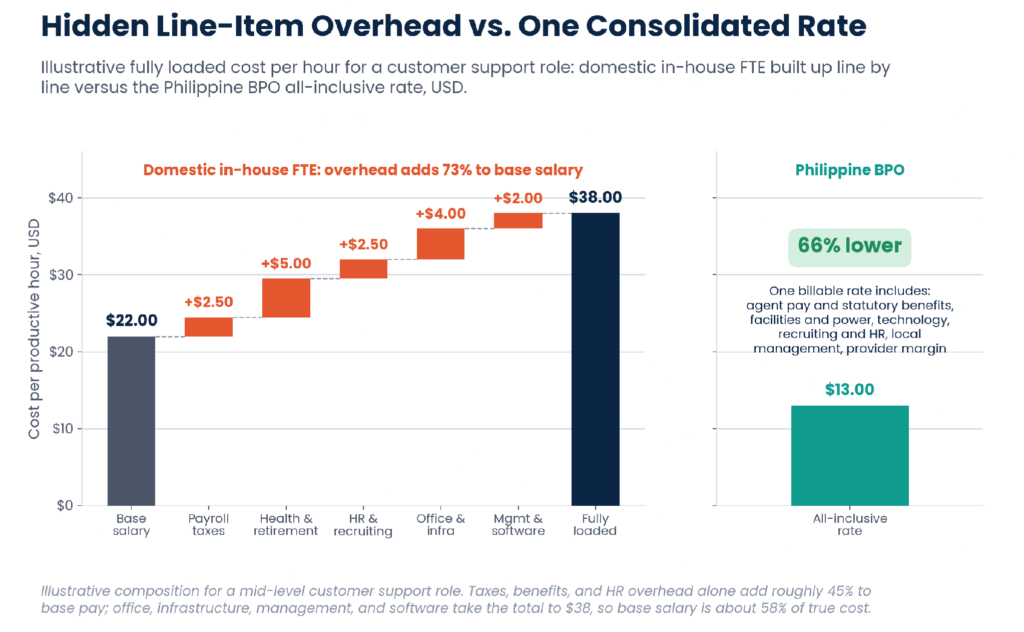
Figure 1. Side-by-side cost structure: the hidden line-item overhead of a domestic in-house FTE versus the consolidated all-inclusive rate of a Philippine BPO provider (illustrative).
What Is the Real Financial Delta Between Domestic Hiring and Philippine BPO Models?
Base salary represents only part of a domestic employee’s true cost once payroll taxes, health insurance, 401(k) matching, office space, hardware, software licensing, and talent acquisition are added, taking fully loaded hourly rates far above the headline wage. Offshore models in Manila and Cebu package infrastructure, technology, recruiting, HR, management, and compensation into one billable rate that sits well below that figure.
When evaluating domestic hiring against offshore BPO deployment, executive decision-makers often make the mistake of comparing base salaries rather than fully loaded costs. In North America and Western Europe, payroll taxes, health insurance, 401(k) matching, office space, hardware, software licensing, and talent acquisition overhead compound the direct cost per employee significantly; taxes, benefits, and HR overhead alone add a substantial premium to base salary before facilities and technology are counted. Top-tier offshore providers, by contrast, package physical infrastructure, enterprise-grade technology stacks, recruiting, human resources, local management, and base compensation into a single predictable billable rate. The table below compares the two models by expense category.
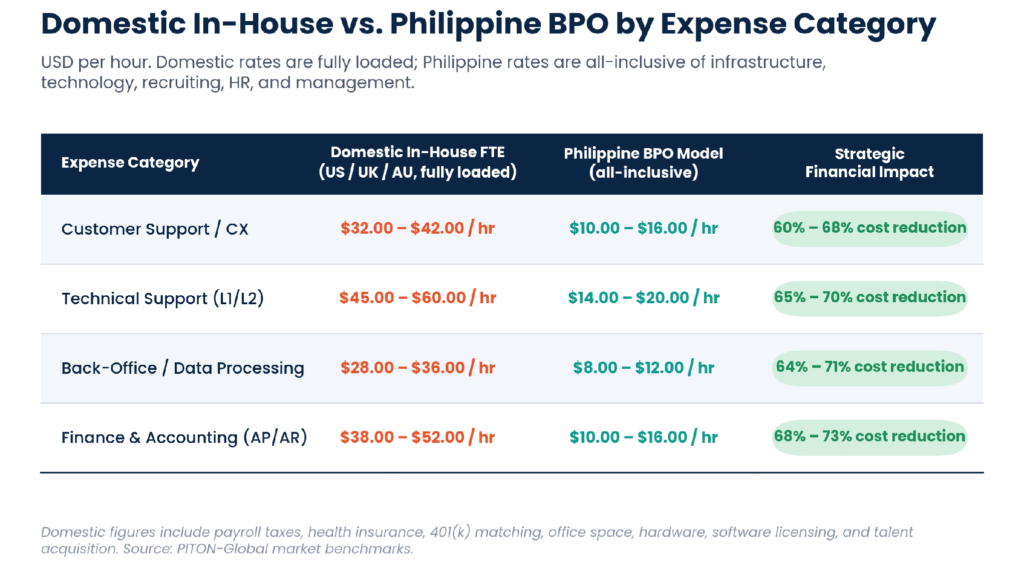
Figure 2. Domestic in-house FTE cost versus the all-inclusive Philippine BPO rate by expense category, with strategic financial impact.
This structural financial difference allows enterprise buyers to reinvest capital into core product innovation and strategic growth initiatives while preserving EBITDA margins. It also changes the shape of the cost: a domestic team’s overhead is largely fixed and rises in steps with each lease, hire, and hardware refresh, while the offshore rate is variable and scales down as readily as it scales up.
How Do Talent Quality, Turnover, and Scale Compare Across Both Models?
Domestic front-line roles in customer service, IT helpdesk, and administration suffer high annual turnover, wage competition, and shrinking pipelines, with each hire taking 42–60 days. In the Philippines, BPO is a prestige career path backed by tailored university programs, clear progression, and competitive local compensation, producing far higher retention and the ability to scale multi-seat teams in 15–30 days.
Domestic labor markets—particularly in customer service, IT helpdesk, and administrative operations—suffer from high attrition, wage competition, and shrinking talent pipelines. Front-line roles are frequently viewed as temporary stepping stones, driving high annual turnover, and every departure restarts a 42–60 day recruiting cycle that leaves queues under-staffed in the meantime.
Across Manila and Cebu, the sector represents a prestige career path supported by university degree programs specifically tailored to business services, finance, and technical support. Its employees benefit from clear career progression, comprehensive medical coverage, and competitive compensation within their local economy, resulting in far higher retention and operational continuity. The chart below illustrates how that retention gap translates into First Contact Resolution over a 24-month engagement.
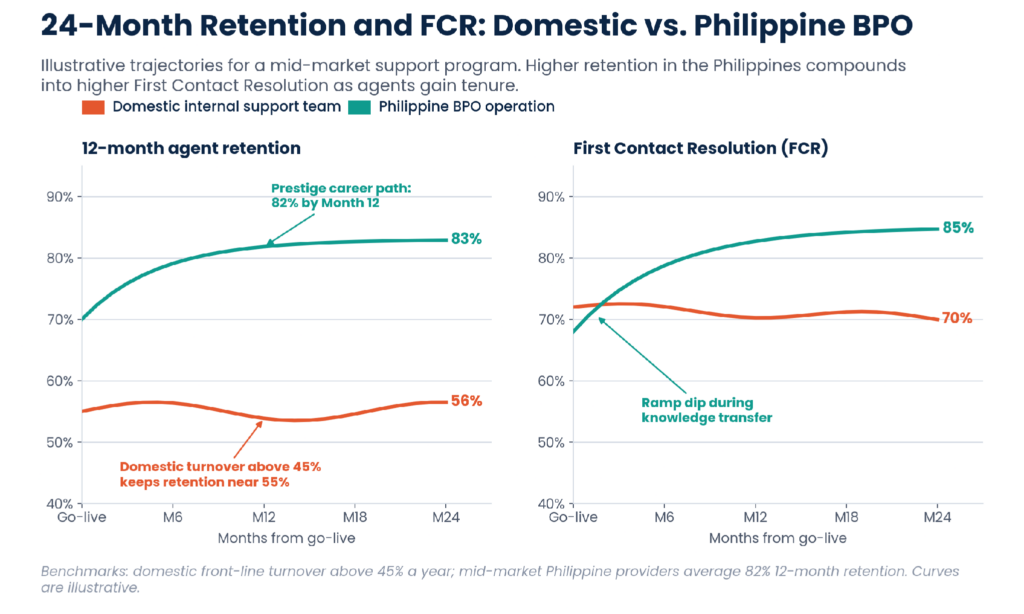
Figure 3. Illustrative 24-month retention and First Contact Resolution: domestic internal support teams versus Philippine BPO operations.
Comparing domestic hiring to offshore outsourcing purely on cost misses the point entirely. Domestic hiring binds your organization to local labor bottlenecks and fixed overhead. A mature Philippine BPO partnership gives you instant access to process discipline, high-tier talent, and operational flexibility that lets you scale up or down without taking on massive balance sheet risk.
— John Maczynski, CEO, PITON-Global
What Are the Tradeoffs, Risks, and Decision Criteria Executives Must Weigh?
Three tradeoffs frame the decision: control versus leverage, since domestic hiring offers direct physical oversight while BPO models require structured governance, SLAs, and KPIs; time zone alignment, where domestic teams cover standard hours and Philippine operations provide 24/7/365 coverage and overnight processing; and cultural alignment, where strong English proficiency and Western affinity still require deliberate brand immersion during onboarding.
While the financial and operational advantages of offshore deployment are compelling, executive teams must evaluate the inherent tradeoffs before deciding. None is a reason to stay domestic by default; each is a design requirement for the engagement.
Control vs. Leverage
Domestic hiring offers direct, physical oversight of employees, whereas BPO models require structured governance, clear SLAs, and key performance indicators. The trade is real but asymmetric: a well-governed BPO program produces more measurement and accountability than most in-house teams, because the contract forces both sides to define what good looks like.
Time Zone Alignment
Domestic teams operate during standard business hours, while offshore teams in Manila and Cebu excel at providing continuous 24/7/365 coverage and overnight back-office processing. For customer-facing work the time difference becomes a follow-the-sun advantage; for collaborative or strategic roles it argues for keeping leads onshore in a hybrid model, or for weighing a nearshore site, as our nearshore-versus-Philippine-offshore analysis sets out.
Cultural Alignment
The Philippines possesses exceptional English proficiency and strong cultural affinity with Western markets, but effective cross-border operations still require detailed brand alignment during onboarding—brand-immersion modules, shadow sessions, and onshore process experts leading the first training waves. Cultural fit is also the crux of the nearshore-versus-offshore debate for customer service. The decision tree below maps these priorities to the delivery model that fits.
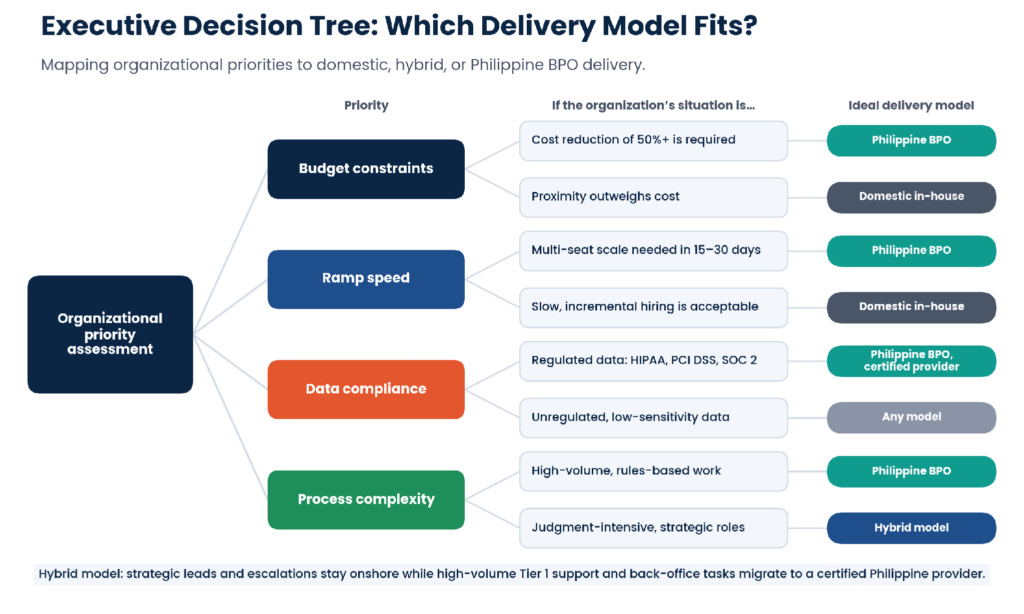
Figure 4. Executive decision tree mapping budget, ramp speed, data compliance, and process complexity to the ideal delivery model.
What Does a Successful Move from an In-House Team Look Like?
A successful transition replaces a hiring bottleneck with a governed, scalable team. A North American SaaS enterprise facing rapid user growth deployed a dedicated 40-seat multi-channel support team in Manila within 21 days on a 24/7 follow-the-sun model, cut support operating costs sharply, improved First Contact Resolution, and eliminated ticket backlogs within 45 days.
Client Challenge
A North American software enterprise experienced a surge in user growth, causing domestic customer support costs to skyrocket while ticket response times deteriorated because local hiring could not keep pace with demand.
Vendor Selection
The company partnered with advisory experts to evaluate mid-market BPO providers in Manila, filtering for specialized SaaS support experience, SOC 2 Type II certification, and agent retention metrics rather than for the lowest hourly rate.
Solution Implemented
A dedicated 40-seat multi-channel support team covering voice, chat, and email was deployed in Manila within 21 days, featuring a 24/7 follow-the-sun operational coverage model and standardized process documentation completed during transition.
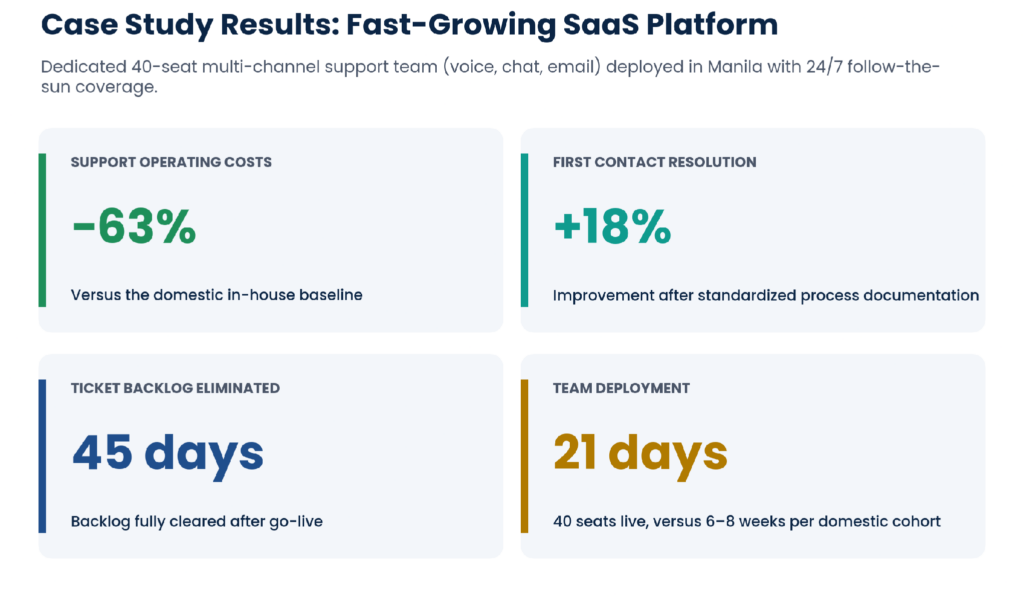
Figure 5. Quantifiable business outcomes of the SaaS customer support transition.
Outcomes and Lessons
Customer support operating costs fell sharply, First Contact Resolution improved, and ticket backlogs were completely eliminated within 45 days. The lesson: establishing standardized process documentation during transition accelerated ramp time and ensured brand voice consistency from day one—the two risks executives most often cite against offshore models were neutralized by the way the transition was run.
How Does PITON-Global Guide Executive Decision-Making?
PITON-Global is a vendor-neutral BPO advisory and sourcing consultancy headquartered in Manila, led by executive leaders with over 65 years of global outsourcing governance. Operating as an independent executive advisor, it matches enterprise buyers with the ideal provider from a curated network of more than 100 vetted Philippine BPO partners, at zero advisory cost to the client.
Who Is PITON-Global?
PITON-Global is a premier, vendor-neutral BPO advisory and sourcing consultancy headquartered in Manila, led by executive leaders with more than 65 years of combined global outsourcing governance. CEO John Maczynski is a 40-year global BPO industry veteran who has governed large-scale BPO contracts, and the firm applies that operator experience to help enterprises decide between domestic, hybrid, and Philippine delivery models on evidence rather than assumption.
How Does PITON-Global Differ from Traditional Outsourcing Brokers?
Traditional brokers push specific call centers and earn commissions on placement. PITON-Global operates as an independent executive advisor: it conducts deep vendor landscape diligence, evaluates providers on retention, certifications, and domain expertise rather than sales relationships, recommends on the buyer’s outcomes rather than provider promotion, and structures SLA-protected commercial agreements before stepping into an ongoing governance role.
How Does PITON-Global’s Network of 100+ Vetted Philippine BPO Providers Benefit Organizations?
A curated network of more than 100 thoroughly vetted Philippine BPO partners across Manila, Cebu, and secondary hubs lets enterprises skip the unstructured vendor search. Because every partner has already been assessed for SOC 2 Type II, ISO 27001, PCI DSS, and HIPAA readiness, agent retention, and specialization, buyers can move from a decision to deploy to a capability-matched shortlist in days.
How Does PITON-Global’s Advisory-Led Vendor Matching Process Work?
The process runs from delivery-model assessment to selection support: comparing fully loaded domestic costs, ramp needs, compliance requirements, and process complexity to determine the right model; filtering the vetted network for specialization, retention, and right-sized capacity; delivering a shortlist within 48–72 hours; verifying security, SLA history, and pricing transparency; then structuring the SLA-protected agreement and governance framework.
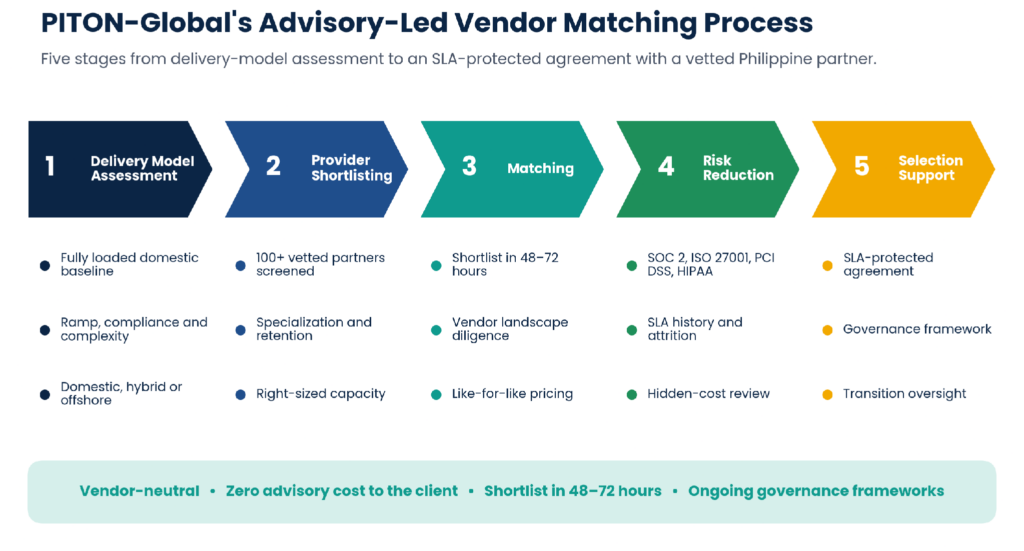
Figure 6. PITON-Global’s five-stage advisory-led matching process, from delivery-model assessment to SLA-protected agreement.
Why Do Organizations Use PITON-Global?
Organizations use PITON-Global to eliminate vendor selection risk, accelerate speed-to-market, and ensure long-term operational success. Because the advisory service is delivered at zero cost to the client, it provides the diligence, negotiation leverage, and governance frameworks of an experienced operator at the exact point where a domestic-versus-offshore decision is hardest to reverse.
Frequently Asked Questions
What is the typical timeframe to deploy a team in the Philippines compared to domestic hiring?
Domestic hiring usually takes 6 to 8 weeks per cohort because of recruiting and onboarding cycles. An offshore team can be fully sourced, onboarded, and operational within 2 to 4 weeks.
How do data security and compliance standards in the Philippines compare to domestic environments?
Top-tier Philippine BPO facilities maintain SOC 2 Type II, ISO 27001, PCI DSS, and HIPAA compliance, using strict physical security controls, clean-desk policies, and encrypted virtual environments.
Can companies start with a hybrid model before fully transitioning processes?
Yes. Many organizations adopt a hybrid approach by keeping core strategic leads onshore while migrating high-volume Tier 1 support and back-office tasks offshore to validate quality before scaling.
How are training and brand voice consistency managed offshore?
BPO providers use dedicated trainers, shadow sessions, and brand-immersion modules during transition, often led by onshore process experts to ensure seamless alignment.
What size company benefits most from comparing these models?
Mid-market enterprises to large global corporations seeking to scale operations, lower SG&A expenses, or eliminate hiring bottlenecks gain the highest operational leverage from an offshore model; those choosing between destinations for AI-assisted teams can start with how the Philippines and India compare for hybrid teams.