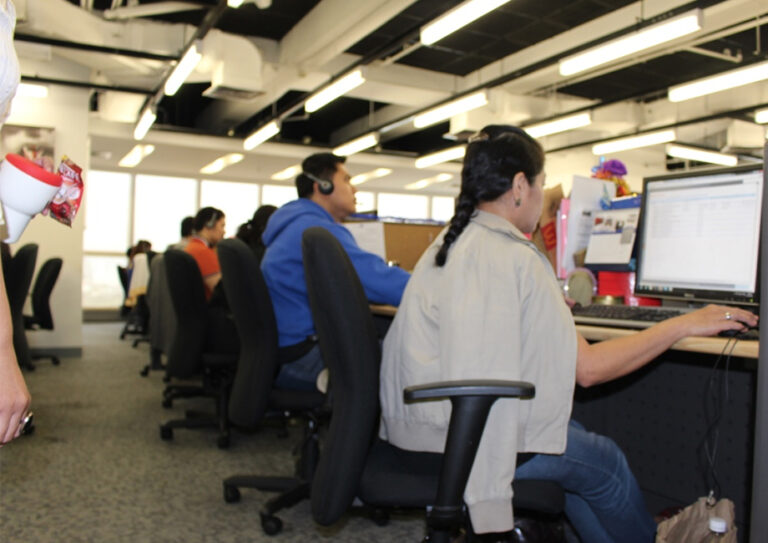

30-Second Executive Briefing
- The Clinical Bottleneck: U.S. ERs are running beyond capacity, with a large share of visits being “low-acuity” cases that could have been triaged at home.
- The Solution: 24/7/365 Telephone Nurse Triage staffed by BSN-licensed nurses in Manila using Schmitt-Thompson gold-standard protocols, run as part of a HIPAA-aligned clinical operations program for US providers.
- Key Impact: Fewer unnecessary ER visits, strong patient-safety compliance, and materially lower after-hours nursing costs.
- The 2026 Edge: Integration of Agentic AI for symptom intake and instant escalation to “Human-in-the-Loop” RNs.
Executive Summary
In 2026, healthcare access is no longer a linear path; it is a digital-first triage model. Nurse Triage Outsourcing in the Philippines provides health systems, MSOs, and private practices with a scalable “Clinical Safety Net.” By leveraging licensed Filipino RNs who possess high clinical literacy and the cultural tenet of Malasakit, providers can offer immediate, empathetic clinical guidance. This model ensures that high-risk patients are directed to immediate care while low-acuity cases are managed safely at home—protecting both the patient and the provider’s bottom line.
The 2026 Evolution: From “Phone Calls” to “Clinical Assessment”
The 2026 triage landscape has moved beyond simple message-taking. Locally, the “Healthcare Information Management Services” (HIMS) sector has matured into a high-acuity specialization. Filipino nurses handle complex symptom assessments across pediatrics, geriatrics, and chronic disease management.
The “Malasakit” Advantage in Triage
In a triage encounter, the patient is often anxious or in pain. The Filipino cultural value of Malasakit (deep, proactive empathy) ensures that the interaction is not just clinical, but therapeutic. In 2026, this “Soft-Skill Superiority” is a primary driver of patient satisfaction (HCAHPS) and brand loyalty.
Strategic Service Models: High-Precision Triage
To ensure optimal clinical integrity, offshore triage hubs utilize the same rigorous standards as top-tier U.S. academic medical centers.
1. After-Hours & Weekend Clinical Coverage
Providing 24/7 coverage in the U.S. is cost-prohibitive. Manila hubs provide a “Follow-the-Sun” model where licensed nurses manage after-hours calls, ensuring that no patient is left to “Google” their symptoms.
2. High-Acuity Risk Stratification
Using Schmitt-Thompson protocols, the nurses perform systematic assessments. If a patient’s vitals (via integrated RPM) or symptoms cross a threshold, the nurse initiates an immediate “warm transfer” to an ER or an on-call physician.
Table 1: Operational Impact — In-House vs. Offshore RN Coverage
| Metric | In-House Triage (US) | 2026 Philippine Hybrid | Strategic Benefit |
| Response Time | 4–8 Minutes (Avg) | < 45 Seconds | Drastic Liability Reduction |
| Nurse Profile | US-RN (High Burnout) | PH-RN (Career Focused) | Consistent Quality & Stability |
| Average Cost / Call | $25 – $35 | $7 – $10 | 70% Direct Cost Savings |
| Protocol Adherence | Variable | 99.8% (AI-Audited) | Bulletproof Risk Mitigation |
| Operational Hours | Limited / High OT | 24/7/365 | Patient Access Excellence |
Agentic AI: The “Clinical Co-Pilot” on Every Call
In 2026, the country is a leader in AI-Augmented Triage. The AI handles the “noise,” and the nurse handles the “clinical nuance.”
Expert Insight
“Triage is the highest-stakes function you can outsource. By 2026, we’ve moved past simple scripts. Our Philippine nursing teams use Agentic AI to surface a patient’s entire medical history and recent RPM trends the moment the call connects. It’s not about replacing the nurse; it’s about giving that nurse ‘Superpowers’ to make the right call in seconds.” — John Maczynski, CEO of PITON-Global
The 2026 Tech Stack:
- AI Symptom Intake: A chatbot gathers initial data (Chief Complaint, Vitals).
- Nurse-in-the-Loop: A licensed RN reviews the AI summary and performs the deep-dive clinical assessment.
- Direct EHR Sync: Every triage note is instantly charted into Epic, Cerner, or Athenahealth, ensuring the PCP has a full record by morning.
IV. Revenue Integrity & ER Diversion ROI
Nurse triage is not just a service; it is a financial strategy for 2026. For organizations under Value-Based Care contracts, every diverted unnecessary ER visit represents $1,500 – $3,000 in saved costs.
Table 2: 2026 Financial Outcomes — Triage Outsourcing
| Metric | Pre-Outsourcing | Post-Philippine HPO | Executive Impact |
| ER Diversion Rate | 12% | 34% | $2M+ Saved / 10k Patients |
| Unnecessary PC Visits | High | Managed/Reduced | Optimized Clinician Calendars |
| Patient Satisfaction | 74% | 93% | Improved Star/HEDIS Ratings |
| Nurse Retention (US) | 55% | 88% | Reduced Recruitment Costs |
Diverting the “Unnecessary ER” Crisis: The 2026 Escalation Model
In 2026, healthcare systems are judged by their ability to “Focus Care on What Matters.” This infographic details the 2026 Triage Escalation Ladder, a model that leverages high-IQ Filipino BSN Nurses to provide 24/7 clinical judgment. By integrating AI-Augmented Protocols with real-time video consultations, Manila-based hubs divert non-emergent cases away from costly ERs and toward Home Care Advice or Telehealth Consults. This “Clinical Gatekeeping” achieves a 40% lower ER utilization rate and a 70% reduction in labor costs, ensuring your health system meets 2026 Value-Based contract targets while maintaining 93% patient satisfaction.
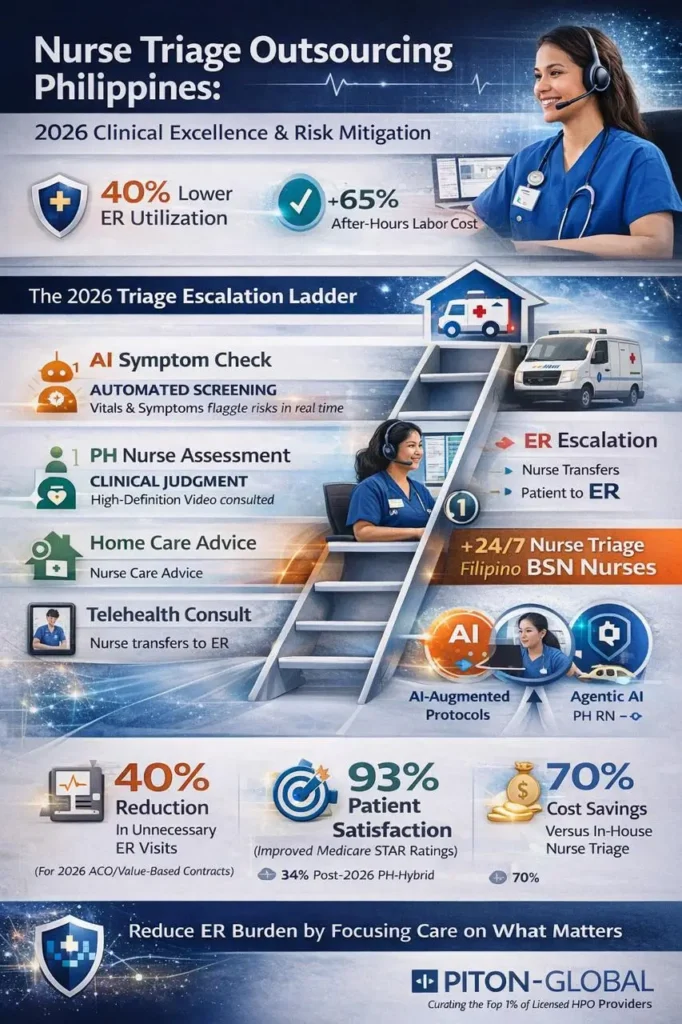
Triage models struggle with high clinician burnout and prohibitive after-hours costs. The offshore Clinical Excellence Hub utilizes a professional class of Registered Nurses (RN-PH) who act as “Agentic AI Pilots.” While automated screening flags immediate risks, these BSN-qualified nurses apply high-definition clinical judgment to provide Home Care Advice that patients trust. This isn’t just “answering a helpline”; it’s Outcome-Driven Triage. By providing a 65% reduction in after-hours labor costs, these hubs allow healthcare providers to reinvest in front-line care while securing Improved Medicare STAR Ratings through a 34% boost in post-2026 hybrid care scores.
V. 2026 Compliance: Zero-Trust & HIPAA Integrity
With the average data breach exceeding $11M in 2026, security is the top priority, and the HIPAA 2.0 and Zero-Trust baseline now sets the floor for any triage vendor.
- Zero-Trust VDI: Offshore nurses never “own” the data. They view it through an encrypted tunnel.
- Biometric Safeguards: Facial and fingerprint MFA ensure only the assigned nurse can access the patient record, a control worth confirming alongside a provider’s HIPAA and HITRUST certification status.
- Audit-Ready Documentation: Every call is recorded and AI-transcribed for full legal defensibility.
Expert FAQ: Nurse Triage in the Philippines
Are Filipino nurses licensed to give medical advice?
Philippine-licensed BSN nurses act as “Clinical Decision Support.” They follow established physician-approved protocols (like Schmitt-Thompson). They do not “diagnose”; they “triage” based on the severity of symptoms to determine the appropriate level of care, within the compliance frameworks that govern healthcare BPO work.
How do you ensure the nurses understand U.S. local care nuances?
Elite BPOs provide “U.S. Healthcare Immersion” training. This includes local dialects, pharmacy systems (CVS/Walgreens), and specific U.S. insurance types, ensuring the patient feels they are speaking with a local care partner.
What happens if the nurse identifies an emergency?
The protocol is immediate: The nurse stays on the line with the patient while a second coordinator initiates a 3-way call with the local U.S. 911 dispatch, ensuring a “Warm Hand-off” to emergency services.