
The leading providers are the healthcare-specialized BPOs that are fully HIPAA-compliant and hold a current, in-scope HITRUST CSF certification—not generalists with a compliance page. PITON-Global partners with the top 24 such providers in the Philippines: dedicated healthcare specialists, fully HIPAA and HITRUST certified, with decades of experience. The right one for you depends on your use case, which a vendor-agnostic advisor can match at zero cost.
Key Takeaways
- “HIPAA certified” is a misnomer. The U.S. government issues no HIPAA certificate; compliance is evidenced by a signed BAA plus an independent assessment.
- HITRUST is the verifiable bar. A current, in-scope HITRUST CSF certification—ideally r2—is the strongest third-party proof, harmonizing HIPAA, NIST, ISO 27001, and PCI.
- Specialization beats size. True healthcare specialists derive a large majority of revenue from healthcare and run multiple comparable U.S. accounts; generalists deprioritize healthcare investment.
- There is a vetted shortlist. PITON-Global partners with the top 24 Philippine healthcare BPOs—all HIPAA-compliant, HITRUST-certified, decades-experienced—and matches buyers to the best fit at no cost.
Who Actually Qualifies as a “Leading” Healthcare BPO in the Philippines?
A leading provider is a healthcare specialist—not a generalist with a healthcare page—that is fully HIPAA-compliant, holds a current and in-scope HITRUST CSF certification, runs multiple comparable U.S. healthcare accounts, and has years of domain experience in your function (RCM, medical billing and coding, eligibility, patient support). PITON-Global partners with the top 24 such providers in the Philippines.
There is no single official ranking of healthcare BPOs, and any list that names “the top 10” without a verification date is already going stale—certifications are scoped, and they expire. What does not go stale is the definition of a leading provider, and the method for confirming one. The Philippines is a premier destination for this work because its workforce pairs clinical literacy with strong English, and top delivery centers operate in tightly controlled, HIPAA-aligned environments backed by global standards such as SOC 2 Type II and ISO 27001.
PITON-Global’s answer to “who are the leading providers” is concrete: a curated network of the top 24 healthcare-specialized BPOs in the Philippines—every one of them fully HIPAA-compliant and HITRUST-certified, with decades of healthcare experience among them. Rather than publish a static ranking, the firm matches each buyer to the specific providers in that network that fit their use case, size, and sub-vertical, then runs a competitive process. The sections below give you the same evaluation lens it uses—so you can recognize and verify a leading provider yourself.
HIPAA vs. HITRUST: What Does “Certified” Really Mean?
HIPAA is a U.S. law—mandatory, but with no official government certificate; a provider evidences it through a signed Business Associate Agreement and an independent assessment. HITRUST CSF is a voluntary, third-party-assessed certification that is scoped, time-bound, and verifiable, harmonizing HIPAA with NIST, ISO 27001, and PCI. For healthcare work, you want both: HIPAA compliance as the floor and HITRUST as the proof.
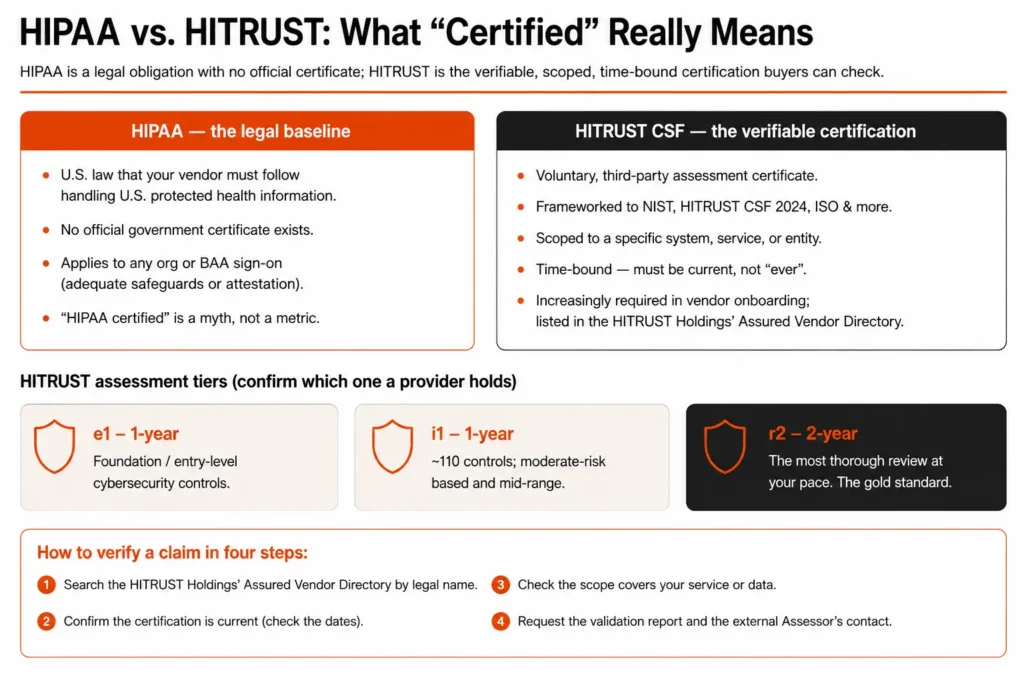
The distinction matters because buyers are routinely reassured by the phrase “HIPAA certified,” which strictly does not exist—HHS issues no such certificate. HIPAA compliance is real and mandatory, but it is evidenced, not certified, typically through a signed BAA and an independent gap assessment against the Security Rule’s safeguards. HITRUST fills that gap with a prescriptive, certifiable framework: its CSF (now in the v11 generation) integrates dozens of standards into one assessment, so a single HITRUST certification maps to HIPAA, NIST, ISO, and PCI at once. In an enforcement investigation, regulators increasingly look for exactly this kind of recognized framework—and HITRUST reports that the large majority of certified environments go breach-free year over year.
How Do You Verify a Provider’s HIPAA and HITRUST Certification?
Don’t take a logo on faith. For HITRUST, search the HITRUST Relying Party Directory by the provider’s legal name, confirm the certification is current, check that its scope covers your service and delivery site, and request the validated assessment report plus the Authorized External Assessor’s contact. For HIPAA, require a signed BAA and an independent assessment or attestation.
Cross-Reference the HITRUST Relying Party Directory
Query the directory using the vendor’s exact legal corporate-entity name. If the delivery center operates as a subsidiary, secure documentation tying the entities together.
Validate Currency and Expiration
Confirm the certification’s issuance and expiry dates: e1 and i1 must be active within their one-year window; r2 must be valid within its two-year lifecycle with an interim review on record.
Audit the Scope Boundaries
A HITRUST certificate applies to a defined system, service, environment, or entity—not necessarily the whole company. Confirm the specific systems, applications, and physical delivery sites serving your account fall inside the certified scope.
Extract the Validated Report and Assessor Contact
Request the complete Validated Assessment Report from the vendor’s compliance officer, and confirm authenticity directly with the listed Authorized External Assessor.
Execute a Binding BAA
Formalize a comprehensive Business Associate Agreement alongside an independent HIPAA gap-assessment report. Reject self-declared “HIPAA compliant” badges in place of evidence.
Why Does Healthcare Specialization Matter More Than Size?
Because a provider only invests where its revenue concentrates. True healthcare specialists derive the large majority of their revenue from healthcare and run multiple active U.S. healthcare accounts of comparable size; for a generalist, healthcare is a side line that never drives investment in security, training, or domain talent. Specialization shows up as certified coders, healthcare-trained agents, and purpose-built compliance.
“If healthcare represents ten percent of a provider’s business, healthcare will never drive their investment priorities. Specialization isn’t a marketing claim—it’s an operating reality.” — John Maczynski, CEO, PITON-Global
In practice, genuine specialists tend to share a profile: a large majority of revenue (often 35–100%) earned from healthcare services, multiple active U.S. healthcare clients of similar size and complexity to yours, certified coders (CPC, CCS) and experienced billers on staff, and a security program built for PHI rather than retrofitted. That profile is exactly what PITON-Global screens for in its network of 24, so that “specialist” is verified rather than asserted.
What Is the Complete Checklist for a Healthcare BPO?
Beyond HIPAA and HITRUST, confirm the supporting security stack (SOC 2 Type II, ISO 27001, PCI DSS where cards are handled), a signed BAA, certified coders and healthcare-trained agents, a controlled delivery environment, named comparable U.S. references, transparent fully-loaded pricing, and a realistic 30–60-day onboarding plan.
Healthcare BPO Checklist
| Dimension | What to Require | Why It Matters |
| HIPAA | Signed BAA + independent assessment | Legal baseline for handling PHI |
| HITRUST CSF | Current, in-scope certification (ideally r2) | Verifiable, prescriptive proof of controls |
| Supporting standards | SOC 2 Type II, ISO 27001, PCI DSS (if cards) | Defense-in-depth beyond HIPAA |
| Specialization | Majority healthcare revenue; comparable U.S. clients | Ensures healthcare drives investment |
| Talent | Certified coders (CPC/CCS); trained agents | Accuracy in billing, coding, RCM |
| Delivery environment | Access control, device restrictions, monitoring | Prevents PHI leakage |
| Onboarding | Trained team in ~30–60 days | Realistic, low-disruption ramp |
ISO 27001, SOC 2 Type II, and PCI DSS are common supporting standards; the right mix depends on your data and whether card payments are in scope.

How Does PITON-Global Connect Buyers to the Right Certified Provider?
It runs a vendor-agnostic, provider-funded process: a complimentary requirements audit, a match against its network of 24 HIPAA-compliant, HITRUST-certified healthcare specialists, a shortlist of the best-fit providers for your sub-vertical and size, a rigorous RFP, and a competitive bid. The buyer verifies each certification live and pays nothing for the advisory.
The model is designed to remove both the sourcing risk and the compliance-verification burden from the buyer. Because every provider in the network is pre-screened for healthcare specialization and current certification, the shortlist starts from a qualified base; because the advisor is paid by the provider network rather than the buyer, the audit, RFP, and introductions are free and without obligation. Crucially, this does not replace your own due diligence—you should still verify each provider’s HITRUST scope and dates directly in the directory before contracting.
Frequently Asked Questions
Can a Philippine BPO Be HIPAA Compliant if It Operates Offshore?
Yes. A provider handling U.S. protected health information is treated as a HIPAA business associate and must implement HIPAA safeguards even when the work is performed offshore, evidenced by a signed BAA and an independent assessment.
Is HITRUST Required by Law?
No. HITRUST is voluntary, but it has become a de facto requirement in many U.S. healthcare vendor-onboarding processes because it provides prescriptive, third-party-validated proof that HIPAA’s broad rules are actually implemented.
Does HITRUST Certification Guarantee HIPAA Compliance?
Not automatically—HITRUST facilitates rather than substitutes HIPAA compliance. But because the HITRUST CSF incorporates HIPAA controls, a current, in-scope HITRUST certification is strong evidence that HIPAA safeguards are in place.
Which HITRUST Level Should I Look For?
For sustained PHI handling, the r2 (two-year, risk-based) certification is the gold standard. An i1 (one-year) is a solid mid-range credential; e1 is foundational. Always confirm the level, scope, and current dates.
How Do I Get the Shortlist of 24 Providers?
Through a complimentary, no-obligation requirements review with PITON-Global, which matches your use case to the best-fit certified specialists in its network and runs a competitive RFP—while you verify each certification independently.