
TL;DR: The Key Takeaway
Leveraging keypoint annotation outsourcing allows AI and robotics firms to access specialized talent for accurately mapping human motion, driving innovation in gesture recognition and robotic automation. This strategic approach to data labeling ensures high-quality training data, accelerating development cycles and enhancing model performance. It sits within the broader human support for robot operations and training.
In the high-stakes sectors of robotics and gesture-controlled technology, the difference between a fluid, intuitive machine and a clumsy one lies in the precision of its “skeletal” understanding. Keypoint annotation outsourcing in the Philippines has become the vital engine for companies mapping human motion. By identifying specific anatomical landmarks—joints, facial features, and extremities—this workforce provides the high-fidelity training data that allows AI to interpret posture, intent, and movement with surgical accuracy.
Executive Briefing
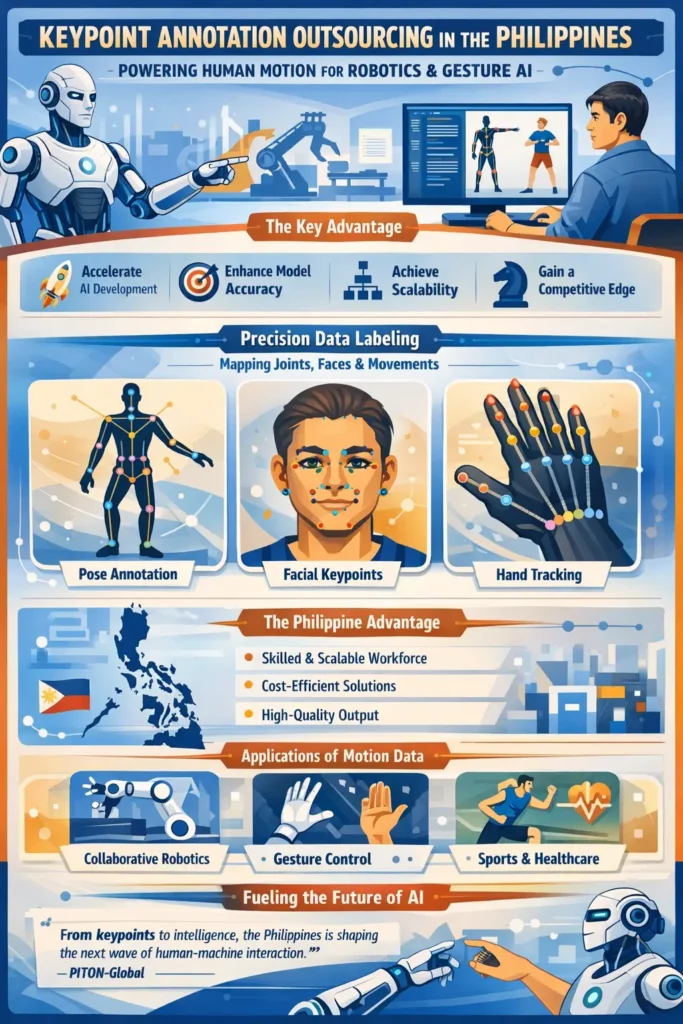
- Accelerate AI Development: Leverage a highly skilled offshore talent pool to bypass internal bottlenecks and speed up the launch of motion-sensing systems.
- Enhance Model Accuracy: Utilize meticulous point-mapping to improve the detection of human pose and gesture, reducing error rates in real-world applications.
- Achieve Scalability: Dynamically adjust team sizes to handle massive video datasets, ensuring the development pipeline remains elastic and cost-efficient.
- Gain a Competitive Edge: Offload the labor-intensive labeling process to focus internal engineering resources on core algorithmic innovation.
Summary
In the race to perfect human-machine interaction, the ability to accurately digitize human motion is a primary differentiator. Outsourced keypoint annotation provides the strategic foundation for this capability. By marking specific “landmarks” on the human body across thousands of frames, Filipino specialists create the skeletal framework that teaches robots and gesture-based interfaces how to “read” movement. This specialized data labeling ensures that AI models are robust, reliable, and capable of nuanced interaction. PITON-Global facilitates this evolution, connecting AI pioneers with elite Filipino teams to transform raw visual data into actionable robotic intelligence.
“The sophistication of modern AI is directly proportional to the quality of its training data. Keypoint annotation is the critical link that translates visual frames into actionable intelligence. By outsourcing this intricate task to the Philippines, our clients build robust systems while focusing their internal energy on core innovation.” — John Maczynski, CEO, PITON-Global
The Foundation of Intelligent Motion: Precision is Non-Negotiable
In robotics and gesture AI, “garbage in, garbage out” is more than a cliché—it is a technical reality. A robot learning to assist on a factory floor or a smart device interpreting sign language requires pixel-perfect data to function safely. Keypoint annotation involves identifying specific landmarks (such as the wrist, elbow, or bridge of the nose) to create a map of human posture. A deviation of just a few pixels can result in a robot miscalculating a reach or a device failing to recognize a critical hand command.
Achieving this level of consistency across millions of frames—often in poor lighting or with partially obscured limbs—is a cognitively demanding task. The Filipino workforce is widely recognized for its meticulous attention to detail and ability to adhere to complex, rules-based guidelines. By leveraging this talent, companies ensure that their models are trained on datasets that are not just large, but incredibly accurate, enabling machines to interact with humans in a natural, intuitive way.
Scaling AI Ambitions: The Philippine Advantage
Building an in-house team to annotate the hundreds of thousands of images required for a market-ready AI is often a logistical and financial nightmare for tech firms. The investment in recruitment, management, and specialized software can stall research and development. This is why keypoint annotation outsourcing to the Philippines has become a strategic standard.
The Philippine BPO sector has evolved into a sophisticated partner for the AI industry. It offers immediate access to an educated, tech-savvy workforce that can be rapidly mobilized. This scalability ensures that as an AI project grows, the data pipeline keeps pace without sacrificing quality, whether the work is gesture AI or warehouse robotics training for automated fulfillment. With robust QA processes and seasoned project managers, these providers act as an extension of a company’s R&D department, accelerating timelines from concept to deployment.
| Factor | In-House Annotation | Outsourced (Philippines) |
| Cost Structure | High upfront CAPEX (salaries, overhead). | Variable OPEX (pay-per-project/hour). |
| Scalability | Slow; limited by hiring/office space. | Highly elastic; scales in days. |
| Expertise | Significant time to build/train. | Instant access to trained specialists. |
| Business Focus | Diverts focus from core algorithms. | Frees internal teams for innovation. |
| Time-to-Market | Potential for internal bottlenecks. | Accelerated via a ready-made workforce. |
Unlocking New Frontiers: From Cobots to Gesture Interfaces
The impact of high-fidelity motion data is felt across diverse industries:
- Collaborative Robotics (Cobots): In manufacturing and healthcare, robots must work safely alongside humans. Keypoint data allows these machines to anticipate human movement and avoid collisions, ensuring a safe, symbiotic workspace, and complementing robot perception training for the rest of the scene.
- Consumer Electronics: Gesture AI is redefining how we interact with TVs, gaming consoles, and AR/VR headsets. Precise annotation of hand and finger joints enables interfaces that respond to a wave or a pinch with zero latency.
- Biomechanical Analysis: In sports and medicine, tracking motion points helps analyze an athlete’s form or a patient’s recovery gait, providing insights that were previously impossible to quantify.
Annotation Complexity Tiers
- Level 1 (Basic Pose): 2D keypoints on major joints (knees, elbows). Used for fitness apps and basic crowd counting.
- Level 2 (Detailed Body): Includes facial landmarks and high-density hand points. Vital for sign language recognition and AR avatars.
- Level 3 (Full Skeleton/3D): 3D annotation with depth information. Essential for advanced robotics, including humanoid robot task demonstration, and medical diagnostics.
- Level 4 (Dynamic Motion): Tracking points across video sequences to capture temporal logic. Used for action recognition in sports and gait analysis.
The Future of Human-Machine Interaction
As we move toward 2026, the boundary between humans and technology continues to blur. This convergence is not about replacement, but augmentation—creating a world where machines understand our most natural form of expression: movement. The meticulous work of keypoint annotation specialists in the Philippines is the “invisible hand” guiding this evolution. By teaching machines the language of human motion, they are building the foundation for a more intuitive, collaborative, and intelligent future.
Expert FAQs
How does annotation for robotics differ from gesture AI?
Robotics focuses on the full-body skeleton to ensure safety and spatial awareness in physical environments. Gesture AI focuses intensely on the hands and face to interpret commands and emotional subtext, often requiring a higher density of keypoints in those specific areas.
What are the main challenges in keypoint annotation?
Occlusion (when a limb is hidden) and consistency across frames are the biggest hurdles. Philippine providers address these through multi-layered QA and “temporal tracking” expertise, where annotators are trained to infer the position of a joint even when it is temporarily out of view.
How is quality guaranteed when outsourcing?
Top-tier Philippine partners use a multi-step review process. This includes automated validation checks in the software followed by manual audits by senior quality leads to ensure every point aligns with the client’s specific anatomical guidelines.
What is the direct impact on model performance?
High-quality keypoint data leads to a “flatter” learning curve and better generalization. For the user, this means a device that recognizes their gesture on the first try, or a robot that moves with human-like grace rather than jerky, mechanical stutters.