
TL;DR: The Key Takeaway
The next frontier in robotics is not just about hardware; it’s about imparting machines with the nuanced, dexterous skills to perform complex human tasks. This is where humanoid robot task demonstration outsourcing to the Philippines comes in. This strategic sourcing model is not about cost reduction but about accessing a unique pool of cognitive talent capable of “teaching” humanoid robots through teleoperation and imitation learning, one strand of the teleoperation and training-data work robotics firms outsource. This Southeast Asian powerhouse is becoming the central hub for programming robotic dexterity, providing the critical human intelligence needed to translate complex actions into machine-executable logic. PITON-Global is the architect of this ecosystem, connecting robotics pioneers with the specialized human demonstrators who are turning science fiction into operational reality.
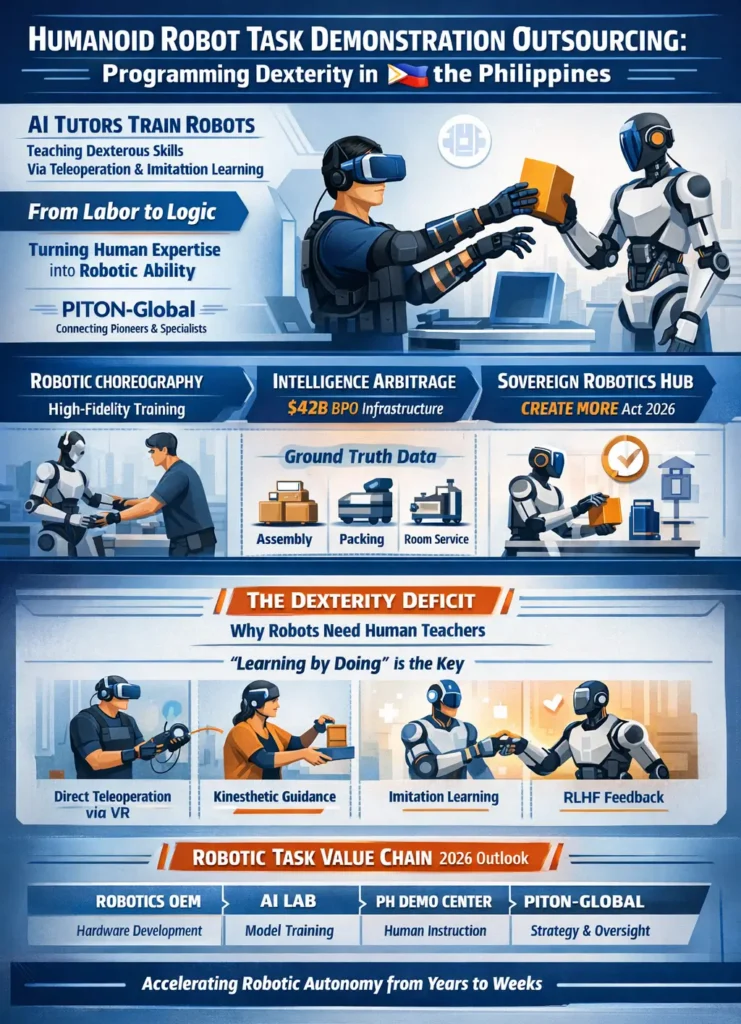
Humanoid robot task demonstration in the Philippines is the high-fidelity process of using human “AI Tutors” to teach robots complex, non-uniform physical tasks—such as delicate assembly, packing, or room service—via teleoperation and haptic feedback. In 2026, the Philippines has moved from data entry to “Robotic Choreography,” where Filipino specialists provide the embodied intelligence and “Logic Verification” required for Imitation Learning. This strategic partnership accelerates a robot’s path to autonomy, turning years of traditional coding into weeks of behavioral training.
Executive Briefing
- Closing the Dexterity Deficit: Shifting from rigid, line-by-line coding to “Behavioral Cloning,” where robots learn by watching and mimicking expert human movement.
- The “Robotic Choreographer” Role: Specialists in Manila and Cebu use VR headsets and haptic suits to “inhabit” humanoid frames, transferring human intuition and pressure-sensitivity to the machine.
- Intelligence Arbitrage: Leveraging the Philippines’ mature BPO infrastructure to provide high-quality “Ground Truth” data that shortens a robot’s development time substantially.
- Sovereign Robotics Hub: Utilizing the CREATE MORE Act to claim enhanced deductions on power and training, making the Philippines the world’s most cost-effective “Gym” for training Physical AI.
- Agentic Alignment: Ensuring that humanoid agents operate within safety and ethical guardrails through continuous Reinforcement Learning from Human Feedback (RLHF).
The Dexterity Deficit: Why Robots Need Human Teachers
By 2026, the mechanical hardware for humanoids (like Tesla Optimus, Figure 02, or 1X Neo) has matured, but the “software of movement” remains a bottleneck. Robots struggle with “compliance”—the ability to adjust grip force or navigate a cluttered room—without explicit instruction for every variable, a gap that robot perception training addresses on the sensing side.
Filipino teams provide the solution through Human-in-the-Loop (HITL) Training. Filipino Robotic Choreographers perform the task through the robot, capturing raw data on torque, velocity, and visual intent, often paired with keypoint annotation of human motion. This data becomes the “textbook” for the robot’s neural network, allowing it to learn the “feel” of a task rather than just the coordinates.
“We are moving beyond programming robots with code and are now programming them with human intent. The teams in the archipelago are the choreographers of robotic movement.” — John Maczynski, CEO, PITON-Global
Demonstration Methods: The Filipino AI Tutor’s Toolkit
PITON-Global orchestrates various levels of instruction depending on the complexity of the robotic platform:
| Method | Description | Primary Use Case | Key Benefit |
| Direct Teleoperation | Real-time control via VR/Haptics. | Complex, non-uniform tasks. | Captures raw human intuition. |
| Kinesthetic Teaching | Physically guiding robot limbs. | Precise industrial assembly. | High-fidelity motor control. |
| Imitation Learning | Robot observes human via sensors. | General task sequencing. | Scalable data without a pilot. |
| RLHF for Robotics | Human rates/corrects robot attempts. | Fine-tuning & safety. | Aligns robot with human logic. |
The Value Chain for Physical AI (2026 Outlook)
Building a general-purpose humanoid requires a multi-stage ecosystem where each component focuses on its core competency.
| Component | Responsibility | Key KPI |
| Robotics OEM | Hardware & Control APIs. | Mechanical Uptime & Safety. |
| AI Development Lab | Learning Model Architecture. | Autonomous Success Rate. |
| PH Demo Center | Human Instruction & Data Capture. | Data Quality & Logic Consistency. |
| PITON-Global | Strategic Governance & Vetting. | Reduction in Time-to-Autonomy. |
The Key Takeaway: From “Labor” to “Logic”
In the 2022 era, BPO work was “Manual Tagging” (drawing boxes). In 2026, it is Logic Verification.
- The Old Way: A robot is told “Pick up object at X, Y, Z.” If the object moves 1cm, the robot fails.
- The New Way: A Filipino Tutor shows the robot how to pick up the object, how to recover if it slips, and how to identify it in different lighting. The robot learns the logic of picking, not just the math, the same principle behind warehouse robotics training.
Expert FAQs
Why is the Philippines better for this than other low-cost hubs?
The Philippines has a unique combination of high-tech literacy and a cultural history of precision (e.g., electronics manufacturing). This “Process-Oriented” mindset is critical for robotics, where a single sloppy demonstration can “poison” an AI model’s training data.
How does the CREATE MORE Act (RA 12066) lower costs for Robotics AI?
Training humanoids is energy-intensive, requiring high-bandwidth VR streams and GPU-heavy local processing. The Act allows BPOs to claim enhanced deductions on power and training, effectively subsidizing the infrastructure needed to run global “Robotic Training Camps.”
Is teleoperation just a temporary phase?
No. While robots will become more autonomous, the need for “Edge Case Teaching” and Safety Auditing will grow. As robots enter the home and the public square, the offshore hub will shift from “Basic Teaching” to “Agentic Governance”—acting as the human safety net for unpredictable social interactions.
How is data security handled for proprietary robot movements? In 2026, we use On-Device Edge Training and secure “Data Vaults.” The demonstration data is processed in-country under strict sovereign laws, ensuring that a company’s proprietary “secret sauce” for movement is never exposed to public networks.