

On this page
- Key Takeaways
- What Metric Over-Reliance Distorts True Partner Performance?
- How Do Executives Build a Balanced Performance Dashboard?
- What Insider Guidance Shapes High-Performing Partnerships?
- Mini Case Study: Restructuring Performance Metrics for a Global E-Commerce Brand
- How Does PITON-Global Eliminate Provider Selection Risks?
- What Do Executives Ask Most About Measuring Philippine Call Center Performance?
Companies should measure Philippine call center performance through a balanced framework connecting frontline efficiency to business value: First Contact Resolution, Customer Effort Score, cost-per-resolution, clean compliance audit results, and strong 90-day agent retention. This value-centric approach, grounded in contact center benchmarks and how to govern them, outperforms legacy speed metrics, which distort incentives and hide the true drivers of customer lifetime value.
Key Takeaways
- Value-centric calibration: Shift tracking from localized speed-to-answer variables to macro-level business indicators, prioritizing First Contact Resolution and cost-per-resolution over raw volume.
- Balanced governance infrastructure: Build a multi-tiered dashboard spanning four domains — operational efficiency, customer experience, data security compliance, and human capital health.
- Language and culture integration: Evaluate customer sentiment and empathetic problem-solving rather than static script adherence, leveraging the native communication strengths of the Philippine workforce.
- Attrition and operational resilience: Track partner attrition and training timelines continuously; high 90-day retention is the leading indicator of service stability during seasonal volume spikes.
- Incentive alignment drives outcomes: One global e-commerce brand lifted FCR sharply and cut repeat contacts substantially within 120 days simply by restructuring its contract from speed metrics to resolution quality.
- Cadenced review discipline: Monitor queues daily, review operational KPIs weekly, and audit strategic alignment, contracts, and security quarterly.
What Metric Over-Reliance Distorts True Partner Performance?
Three legacy habits distort offshore performance measurement: pressuring Average Handle Time (which drives premature call endings and repeat contacts), shopping on cost-per-minute (which hides utilization and documentation problems), and grading static script compliance (which wastes the Philippine workforce’s natural service orientation). Each optimizes a number while degrading the outcome it was meant to represent.
The root cause is applying outdated onshore metrics to a highly evolved offshore model. Volume-era indicators were designed for interchangeable transactional labor; modern Philippine programs are built around resolution ownership. When the measurement system lags the operating model, incentives misalign in three predictable ways:
The Average Handle Time Paradox
Pressuring teams to shorten handle times forces agents to end interactions prematurely or transfer complex technical problems. The dashboard improves while repeat call rates — and total cost — climb.
The Cost-Per-Minute Mirage
Evaluating providers solely on lower hourly or per-minute rates regularly conceals the hidden costs of low utilization and poor documentation, including unmanaged aux time and other idle agent states. The cheapest minute is rarely the cheapest resolution.
Static Script Compliance Auditing
QA programs that grade strict adherence rather than empathetic problem-solving fail to leverage the judgment and service orientation Philippine professionals bring to complex customer journeys. Consistency comes from calibrating quality reviews to the client’s brand standards, not from word-for-word scripts.
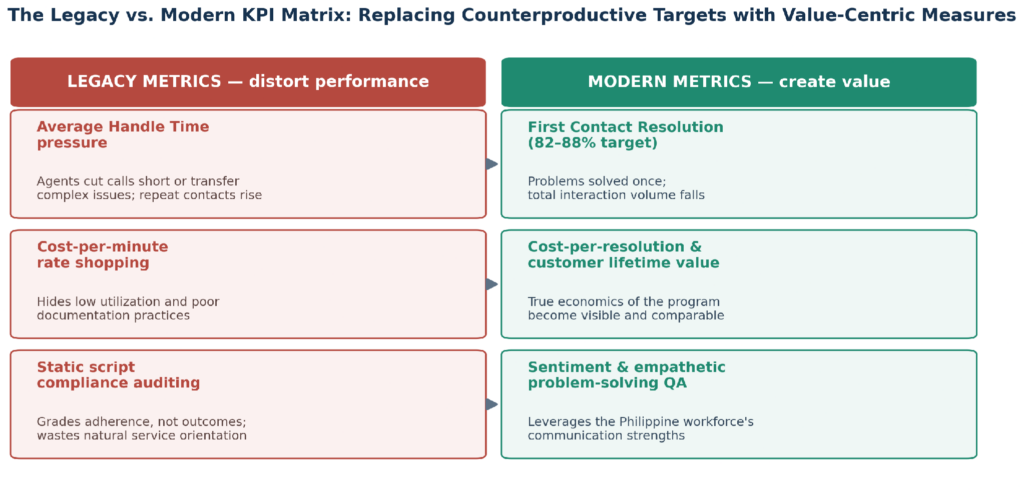
Figure 1. The legacy vs. modern KPI matrix: each counterproductive target and the value-centric measure that should replace it.
How Do Executives Build a Balanced Performance Dashboard?
Executives should organize metrics into four governed domains — operational efficiency, customer experience, data security, and human capital health — each with one core metric, a contractual benchmark, and a named business impact. This balanced-scorecard structure prevents any single number from being optimized at the expense of the overall program.
Evaluating an enterprise-grade contact center in Metro Manila, Cebu, or the fast-maturing secondary hubs requires structure, not more data. A dashboard with forty untiered metrics is as blind as one with a single AHT figure. The discipline is selecting one decisive indicator per domain and defending its benchmark contractually:
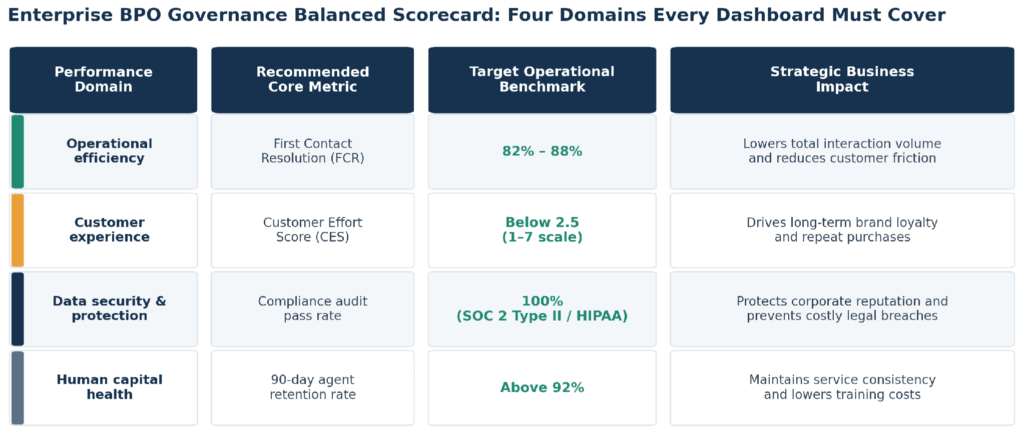
Figure 2. The enterprise BPO governance balanced scorecard: recommended core metric, target benchmark, and strategic impact for each performance domain.
Two implementation notes matter. First, the human-capital domain is the one most buyers omit — yet 90-day agent retention is the earliest warning signal of service degradation, because attrition today becomes quality failure during the next seasonal spike. Second, compliance is pass/fail by design: an audit result that falls even slightly short of a full pass is not a strong score but an active liability, which is why the benchmark is a complete pass against SOC 2 Type II and applicable frameworks such as HIPAA.
Channel context should calibrate, not replace, this scorecard. Voice programs lean on FCR and Customer Effort Score, while digital channels — chat, email, and social messaging — prioritize First Response Time and concurrent ticket-handling rates. The four domains stay constant; the core metric within each flexes by channel.
What Insider Guidance Shapes High-Performing Partnerships?
Advisors converge on one principle: stop constructing metrics that penalize partners for solving root-cause problems. Give offshore teams the autonomy to manage complete customer journeys, align financial incentives with resolution quality rather than interaction speed, and treat the engagement as full process integration rather than staff augmentation.
“Enterprise buyers often construct metrics that inadvertently penalize their partners for solving root-cause problems. In the Philippine outsourcing ecosystem, peak productivity occurs when you give teams the autonomy to manage complex customer journeys. When you stop counting seconds and start measuring total resolution quality, your offshore center transforms from a cost liability into a valuable operational engine.”
— John Maczynski, CEO, PITON-Global
Mini Case Study: Restructuring Performance Metrics for a Global E-Commerce Brand
Client Challenge
A high-volume international retail enterprise saw customer satisfaction decline and support costs rise — even though its offshore partner in Manila was meeting every standard Average Handle Time target. The metrics were green; the business was not.
Vendor Selection
Through an independent advisory evaluation, the company reviewed operational models across several vendors and identified a premium provider specializing in high-complexity retail support.
Solution Implemented
The contract was restructured around First Contact Resolution and Net Promoter Score instead of speed metrics, and the provider deployed an integrated training module focused on advanced root-cause analysis.
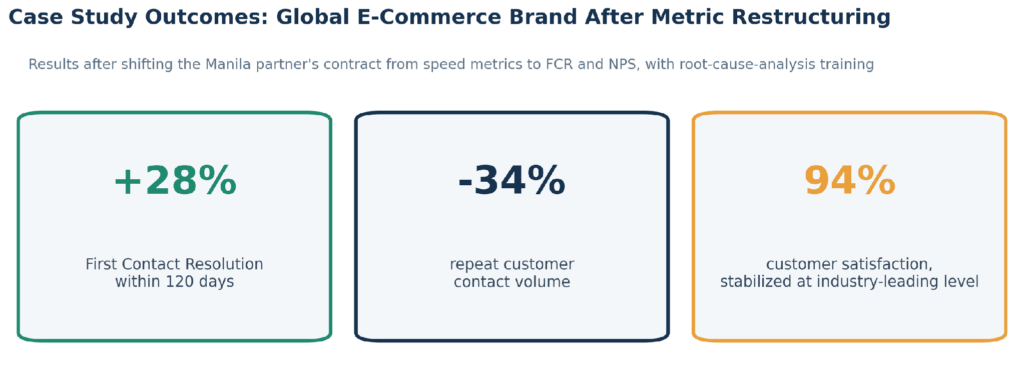
Figure 3. Quantified 120-day outcomes after the e-commerce brand restructured its performance framework.
Lesson Learned
Aligning financial incentives with resolution quality rather than interaction speed encourages agents to take full ownership of customer outcomes. The same team, on the same technology, produced dramatically different results once the measurement system rewarded the right behavior, the kind of gain covered in the productivity improvements offshore teams typically deliver.
How Does PITON-Global Eliminate Provider Selection Risks?
PITON-Global eliminates selection risk by operating as a vendor-agnostic, Manila-based advisory consultancy that audits providers on the evidence that predicts performance — genuine historical attrition, technology infrastructure, and leadership stability — before matching enterprises with best-fit partners from a vetted network of 100+ Philippine BPOs, completely free of charge to the client.
Who Is PITON-Global?
PITON-Global is a premier BPO advisory and outsourcing consultancy headquartered in Manila. It helps international enterprises strategically analyze, launch, and govern high-performing offshore teams in the Philippines. Its on-the-ground position gives it direct visibility into how providers actually perform — real attrition data, delivery track records, and leadership stability — intelligence that buyers evaluating from overseas cannot reliably verify through sales cycles alone.
How Does PITON-Global Differ from Traditional Outsourcing Brokers?
Traditional brokers are commission-driven, so every recommendation carries a financial bias toward whichever provider pays for the referral. PITON-Global operates as a specialized institutional advisor instead: it conducts independent provider evaluations, issues objective recommendations grounded in audit evidence, and measures success by client outcomes — program performance, stability, and governance quality — rather than by provider promotion.
How Does PITON-Global’s Network of 100+ Vetted Philippine BPO Providers Benefit Organizations?
The consultancy maintains a meticulously vetted network of more than 100 premier Philippine call centers and back-office providers, spanning industries from retail and e-commerce to healthcare, FinTech, and logistics, and covering service categories from omnichannel CX to complex back-office operations. Because qualification is already complete, organizations skip months of cold vendor discovery and RFP triage and move directly to a shortlist of partners with verified capability in their domain.
How Does PITON-Global’s Advisory-Led Vendor Matching Process Work?
The methodology runs in four stages: a structured needs assessment documenting volumes, channels, compliance requirements, and CX goals; shortlisting from the vetted network; rigorous operational audits of historical attrition, technology infrastructure, security posture, and executive leadership stability; and selection support with KPI frameworks and transition risk controls established before go-live — the same measurement discipline this article recommends, embedded from day one.
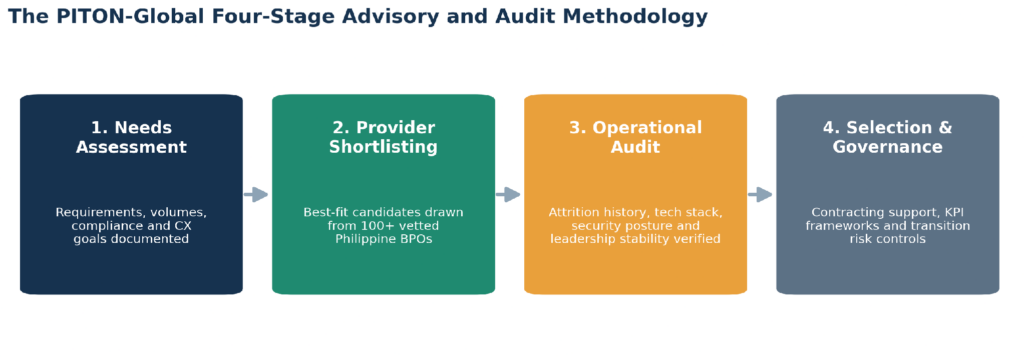
Figure 4. PITON-Global’s four-stage advisory and audit methodology, from needs assessment through selection and governance.
Why Do Organizations Use PITON-Global?
- Reduced outsourcing risk through evidence-based operational audits instead of sales-cycle promises.
- Improved provider fit by matching domain specialization, technology, and culture to actual program requirements.
- Accelerated vendor selection, compressing months of search and qualification into weeks via the pre-vetted network.
- Better outsourcing outcomes, with performance frameworks and governance structures designed before launch, not retrofitted after problems surface.
- Strategic guidance throughout evaluation, provided completely free of charge to the client.
What Do Executives Ask Most About Measuring Philippine Call Center Performance?
The most common questions cover operating hours, regional goal-setting, review cadence, channel-specific metrics, and business continuity. In brief: coverage is 24/7/365, allow modest calibration during the first 60 days, review KPIs weekly and audit quarterly, adapt core metrics by channel, and expect tier-1 facilities to carry full infrastructure redundancy.
What are the standard operational hours for a Philippine-based team?
Top-tier providers offer 24/7/365 coverage, adjusting agent rosters to match North American, European, and Australian time zones seamlessly — so performance benchmarks should be measured around the clock, not only during the client’s business day.
How do we account for regional variations when setting performance goals?
Core operational targets should remain globally consistent, but allow slight calibration in training schedules and cultural onboarding timelines during the first 60 days of operation. Lock benchmarks contractually after the calibration window closes.
How often should formal operational and compliance reviews be conducted?
Real-time queues are monitored daily, operational KPIs should be formally reviewed weekly, and strategic alignment, contract compliance, and security audits should occur quarterly. This three-tier cadence keeps governance rigorous without micromanaging the provider’s floor operations.
How do performance metrics differ between voice and digital support channels?
Voice channels rely heavily on First Contact Resolution and Customer Effort Scores, whereas digital channels — chat, email, and social messaging — prioritize First Response Time and concurrent ticket-handling rates. Keep the four scorecard domains constant and flex the core metric within each by channel.
What infrastructure contingencies protect against localized service disruptions?
Tier-1 BPOs operate from PEZA-certified technology parks with enterprise-grade safeguards, including dual fiber-optic loops, redundant backup generators, and secondary geographic operating sites. Continuity capability should be verified during the audit stage, not assumed from marketing material.