

On this page
- Key Takeaways
- What Foundations Are Required to Replicate Brand Voice Across Borders?
- How Do Quality Assurance Frameworks Prevent Metric Deviations?
- What Strategic Risks Exist When Aligning International Quality Teams?
- What Does a Successful Brand-Alignment Deployment Look Like?
- How Does PITON-Global Help Brands Keep Service Consistent Across Borders?
- What Are the Most Common Questions About Brand Standards in Philippine Call Centers?
Call centers in the Philippines ensure customer interactions reflect brand standards through cross-cultural training, programmatic quality calibration, and continuous performance governance, all tracked against how an outsourced contact center’s quality is measured. By embedding brand-immersion modules into onboarding and aligning offshore QA teams with onshore corporate stakeholders, providers systematically mirror an enterprise’s tone, vernacular, and operational values.
Key Takeaways
- Cultural calibration: Tier-1 providers replace generic scripts with comprehensive brand-voice guidelines aligned to specific regional idioms and customer sentiment.
- Continuous governance loops: Structured weekly calibration sessions ensure offshore QA evaluation benchmarks exactly match onshore corporate criteria.
- Integrated knowledge infrastructure: Real-time Learning Management Systems and localized knowledge bases reduce response variability across voice and digital channels.
- Proactive attrition mitigation: Competitive local compensation and data-driven workforce allocation and staffing models limit agent turnover, protecting institutional brand knowledge.
What Foundations Are Required to Replicate Brand Voice Across Borders?
Replicating brand voice offshore requires moving beyond rigid script-reading to deep brand understanding. Vetted Philippine providers use immersion playbooks that define vocabulary, tone, and engagement philosophy, then have agents study high-performing interactions and rehearse in simulated nests before going live.
Replicating an enterprise brand voice in an offshore environment starts by abandoning traditional, rigid script-reading. Top-tier support requires agents to internalize a brand’s identity, persona, and corporate values rather than recite fixed phrases.
The work begins during recruitment and onboarding. Vetted call centers use comprehensive brand-immersion playbooks that go well beyond product features, explicitly defining the brand’s vocabulary, conversational tone, and customer-engagement philosophy. Agents then analyze previous high-performing interactions, review buyer personas, and rehearse real scenarios in simulated nests—transforming transactional agents into empathetic extensions of the internal team.
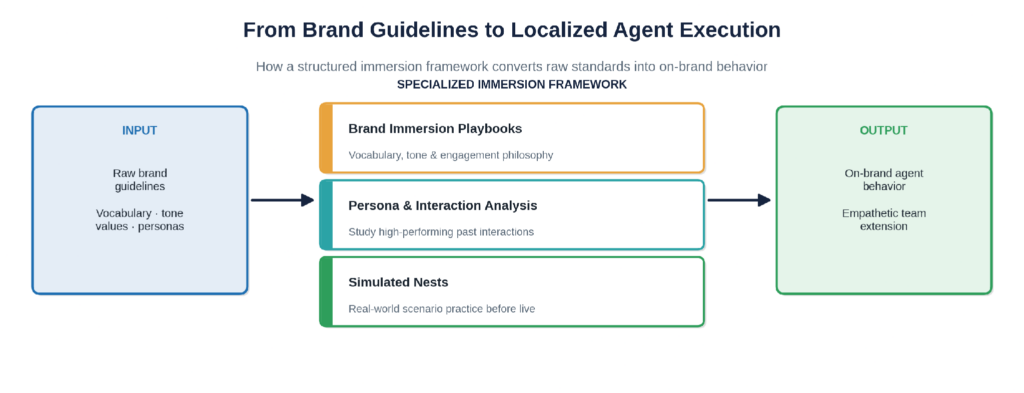
Figure 1. A structured immersion framework converts raw brand guidelines into localized, on-brand agent behavior.
How Do Quality Assurance Frameworks Prevent Metric Deviations?
QA frameworks prevent deviations by using brand-aligned evaluation rubrics that weight soft-skill alignment, conversational context, and resolution accuracy as heavily as efficiency. Unlike traditional rubrics that punish script omissions and chase handle time, they reward organic, on-brand resolutions.
Maintaining identical service standards across multi-tenant environments, including blended accounts where agents handle inbound and outbound work, requires clear, measurable operational definitions. Enterprise providers rely on specialized rubrics that value soft-skill alignment, conversational context, and problem-solving accuracy alongside raw efficiency. The comparison below shows how a brand-aligned rubric diverges from a traditional one—and why each shift improves the consumer experience.
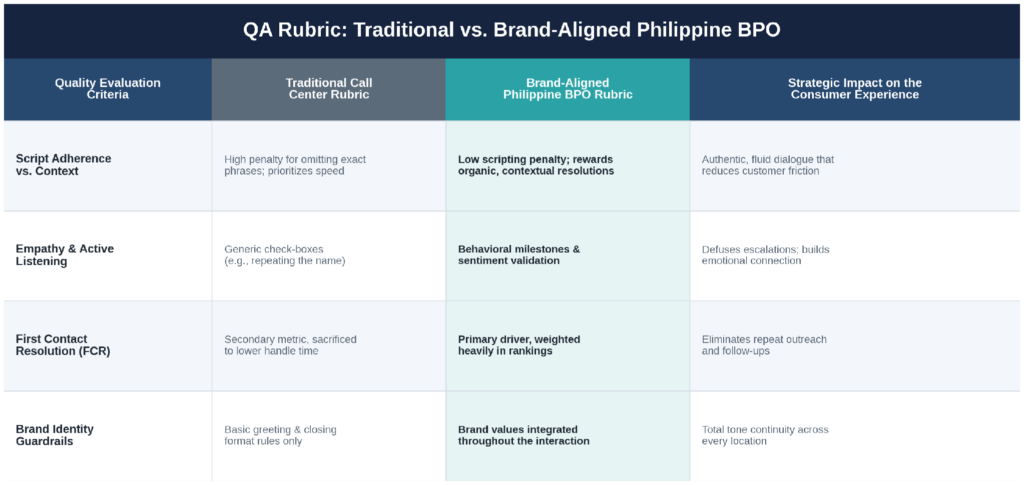
Figure 2. How a brand-aligned QA rubric differs from a traditional call-center rubric, criterion by criterion.
The decisive shift is the treatment of First Contact Resolution. Where a traditional rubric treats FCR as secondary to Average Handle Time, a brand-aligned rubric weights it heavily, because repeat outreach is one of the strongest drivers of customer friction and churn. Equally important, empathy is scored against behavioral milestones rather than mechanical check-boxes, producing interactions that feel authentically human.
What Strategic Risks Exist When Aligning International Quality Teams?
The primary risk is the “calibration gap”—offshore QA standards drifting from onshore expectations over time, so the BPO reports strong internal metrics while the client sees rising friction and churn. Structural governance keeps scoring synchronized and closes that gap.
A leading vulnerability in international customer care is the calibration gap. Over time, an offshore QA team’s evaluation standards can drift from the onshore corporate team’s expectations. If the gap widens, the BPO can report excellent internal quality while the client observes mounting customer friction and churn—a dangerous blind spot. Disciplined governance keeps offshore scoring within a tight tolerance of the onshore benchmark, as illustrated below.
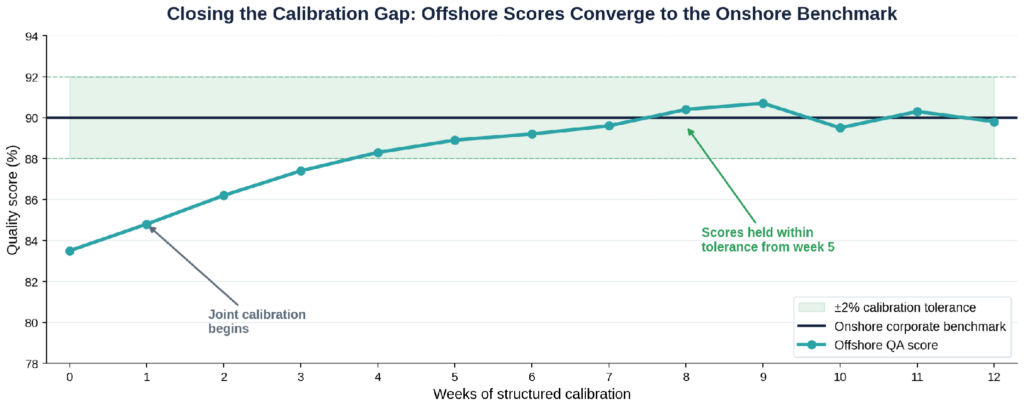
Figure 3. Structured calibration pulls offshore QA scores into a tight tolerance band around the onshore benchmark.
To mitigate the risk systematically, enterprise buyers should establish three structural governance mechanisms:
Joint Calibration Sessions
Weekly or bi-weekly reviews in which onshore operations leads and offshore QA managers score identical recordings to synchronize their habits.
Direct Communication Pathways
Cloud-based platforms linking frontline team leaders directly with internal product managers to resolve policy updates quickly.
Dynamic Knowledge Bases
Centrally managed, real-time reference systems that propagate documentation changes across all global locations within seconds, the practical core of knowledge management in an outsourced operation.
What Does a Successful Brand-Alignment Deployment Look Like?
A successful deployment treats onboarding as cultural immersion, not a technical tutorial. One luxury apparel brand built a 35-agent concierge pod with a three-week immersion course and daily voice calibration, lifting FCR sharply, raising NPS from +41 to +63, and cutting cost-per-interaction roughly in half within 90 days.
Client Challenge
A premium direct-to-consumer luxury apparel brand saw a double-digit rise in customer churn after rapid domestic expansion overloaded its in-house support teams.
Vendor Selection
Using an advisory-led sourcing strategy, the brand evaluated options across a private network of 100+ vetted Philippine providers and selected a boutique customer-experience firm in Cebu known for high-touch service.
Solution Implemented
A dedicated 35-agent concierge pod was built. Agents completed an intensive three-week brand-immersion course led by the client’s internal design and executive teams, reinforced by daily voice-calibration routines.
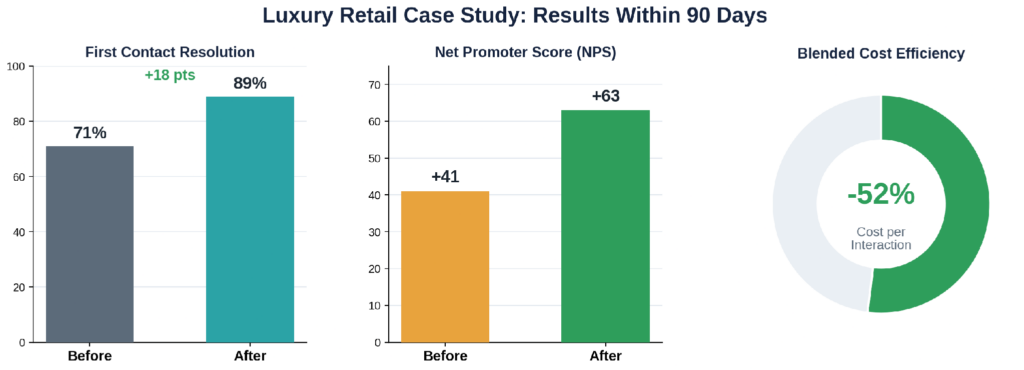
Figure 4. Measurable outcomes achieved within 90 days of the brand-aligned deployment.
Outcomes and Lessons
Within 90 days, First Contact Resolution improved sharply, Net Promoter Score rose from +41 to an all-time high of +63, and blended cost-per-interaction dropped by roughly half. The lesson: true brand alignment requires treating onboarding as a cultural immersion process, not a purely technical tutorial.
Many enterprise organizations struggle with offshore customer support because they treat their provider like a distant vendor rather than an integrated operational partner. If you provide a Philippine BPO with nothing but a basic employee handbook and a list of forbidden words, your brand voice will degrade almost immediately. Total alignment requires absolute transparency, shared performance data, and continuous calibration. The most successful deployments occur when the frontline agents in Manila or Cebu feel completely indistinguishable from your internal staff in Chicago, London, or Sydney.
— John Maczynski, CEO, PITON-Global
How Does PITON-Global Help Brands Keep Service Consistent Across Borders?
PITON-Global is an independent, advisory-led BPO consultancy that maps a brand’s voice and values against a private network of 100+ vetted Philippine providers. By staying provider-agnostic and governing alignment from onboarding through calibration, it removes deployment risk and prevents vendor mismatch.
Who Is PITON-Global?
PITON-Global is a premium, advisory-led business process outsourcing consultancy focused on the Philippine market. Rather than reselling capacity, it serves as a strategic guide for enterprise buyers, bringing deep expertise in BPO advisory and provider selection. Its role in the ecosystem is to translate a brand’s voice, values, and service expectations into a precise, defensible vendor decision and a governed alignment program.
How Does PITON-Global Differ from Traditional Outsourcing Brokers?
Traditional brokers are commission-driven and tend to steer clients toward the largest providers that pay the highest referral fees. PITON-Global is provider-agnostic. It evaluates vendors objectively using a data-driven methodology, makes recommendations based purely on strategic operational fit, and focuses on client outcomes rather than provider promotion—so guidance reflects alignment, not financial incentive.
How Does PITON-Global’s Network of 100+ Vetted Philippine BPO Providers Benefit Organizations?
Access to a pre-vetted ecosystem of more than 100 specialized mid-market and boutique providers accelerates discovery and qualification in a highly fragmented market. The network spans industries and service tiers—including high-touch and premium support—so organizations can quickly identify partners whose culture and capabilities match their brand standards instead of screening an unfamiliar market alone.
How Does PITON-Global’s Advisory-Led Vendor Matching Process Work?
The process moves systematically from requirements to assured performance: mapping brand voice and service tier, matching needs to vetted providers, designing brand immersion and simulated nests, governing onshore-offshore calibration, and tracking FCR, NPS, and attrition continuously.

Figure 5. PITON-Global’s five-stage process for building and governing brand-aligned delivery.
Why Do Organizations Use PITON-Global?
Organizations engage PITON-Global to reduce outsourcing risk, improve provider fit, accelerate sourcing, and secure better outcomes. By guiding the full evaluation and governing alignment from onboarding through ongoing calibration, the consultancy preserves brand voice, closes the calibration gap, retains institutional knowledge, and ensures customer touchpoints are handled exclusively by high-performance partners.
What Are the Most Common Questions About Brand Standards in Philippine Call Centers?
Common questions concern handling localized slang and culture, keeping training accurate during rapid product rollouts, managing attrition’s effect on alignment, replicating premium high-touch support, and maintaining brand standards across non-English lines. Each is addressed below.
How do call centers in the Philippines handle localized slang and cultural nuances?
Top-tier providers run continuous cultural-neutralization and contemporary Western-culture training modules. This ongoing education keeps agents current on regional idioms, cultural trends, and localization nuances within their specific target markets.
What methods keep agent training accurate during rapid product rollouts?
Providers use cloud-based learning management systems and start-of-shift huddles. These platforms push immediate, trackable updates to agent terminals and require a mandatory review before personnel can handle incoming inquiries.
How does agent attrition affect brand alignment, and how is it managed?
High turnover degrades institutional brand knowledge. Premium Philippine BPOs mitigate this by paying well above market wages, offering clear internal career paths, and maintaining engaging workplaces—keeping annualized attrition far below industry norms.
Can a Philippine BPO replicate specialized, high-touch premium support?
Yes. Through dedicated recruiting pipelines, providers source specialized agents with advanced degrees and backgrounds in high-end hospitality or premium technical account management, enabling true concierge-level service.
How are multilingual brand standards maintained across non-English lines?
Providers maintain native-speaking QA specialists for every language tier they support. These specialists run parallel tracking and multi-party calibration sessions to keep the brand voice consistent across all language channels.