

On this page
- Key Takeaways
- What Distinct Metrics Quantify the Efficiency Gains of Philippine Operations?
- How Do Structured BPO Management Layers Eliminate Onshore Supervisory Friction?
- What Does a Productivity Transformation Look Like in Practice?
- How Does PITON-Global De-Risk Strategic Provider Matching?
- What Are the Most Common Questions About Productivity Improvements from Philippine BPO?
Businesses that move core back-office and customer-experience workflows to specialized Philippine BPO companies can expect an immediate, measurable productivity lift in operational throughput and transactional velocity. This leap is driven by specialized talent, programmatic SLA governance, and a standardized 24/7 operating model—freeing onshore resources for high-margin strategic initiatives—and it holds only with a disciplined approach to setting and governing contact center KPI targets.
Key Takeaways
- Throughput optimization: Structured Philippine BPO environments routinely yield an immediate, substantial increase in processing speed and transactional output.
- Drastic error reduction: Rigid operational compliance frameworks across specialized workflows lower administrative error rates materially.
- Turnkey operational velocity: Leading providers absorb routine training and onboarding friction, shortening internal deployment cycles from 90 days to 30.
- Continuous 24/7/365 coverage: Timezone differentials ensure continuous execution of business processes, eliminating standard domestic backlogs.
- Strategic reallocation: Shifting high-volume transactional workloads frees onshore executive teams to focus on margin expansion and revenue growth.
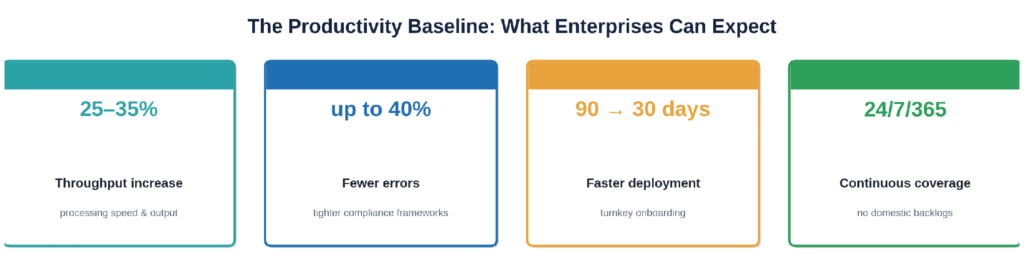
Figure 1. The productivity baseline enterprises can expect across throughput, errors, deployment, and coverage.
What Distinct Metrics Quantify the Efficiency Gains of Philippine Operations?
True productivity optimization requires hard benchmarks, not vague promises. The primary gains appear across three domains—customer experience and technical support, finance and back-office processing, and healthcare information management—each with measurable KPIs like FCR, handle time, AP/AR throughput, and claims accuracy.
When enterprise buyers evaluate business-process transformation, vague promises of “increased efficiency” are insufficient. True productivity optimization requires hard, measurable benchmarks across high-volume functions. Specialized Philippine teams deliver structural advantages that translate into quantifiable KPIs across three major operational domains.
1. Customer Experience (CX) and Technical Support
Traditional internal teams are limited by local operating hours, producing high abandonment and unresolved queues. Around-the-clock Philippine operations remove these bottlenecks: specialized training and clear linguistic alignment yield a clear baseline increase in First Contact Resolution, while automated desktop workflows paired with skilled talent compress Average Handle Time without sacrificing CSAT.
2. Finance, Accounting, and Back-Office Processing
Manual processing of repetitive financial transactions introduces error and systemic delay. Disciplined back-office teams accelerate AP/AR throughput with automated data capture and dedicated document analysts, and an asynchronous night-shift model for ledger, CRM, and order updates ensures clean data is ready for domestic teams at the start of every business day.
3. Healthcare Information Management Services (HIMS)
As a highly complex vertical, specialized medical support requires exact compliance and exceptional speed. Certified billing specialists navigate complex payer rules, accelerating revenue cycles and significantly lowering initial claim-denial rates. The table below quantifies the gains across all four high-volume verticals.
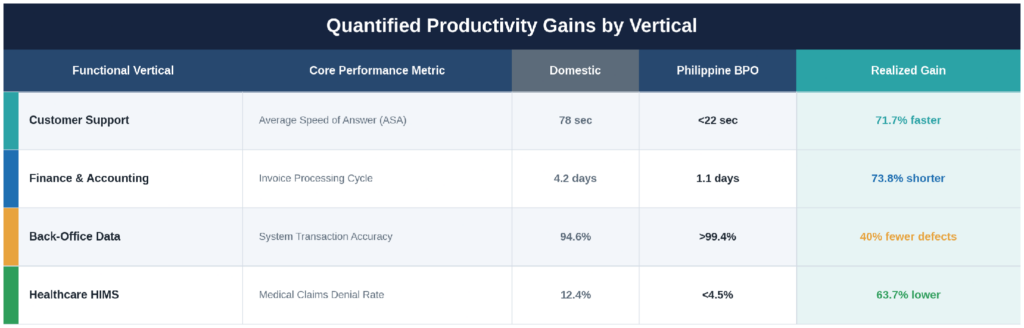
Figure 2. Hard before-and-after benchmarks across customer support, finance, back-office data, and healthcare.
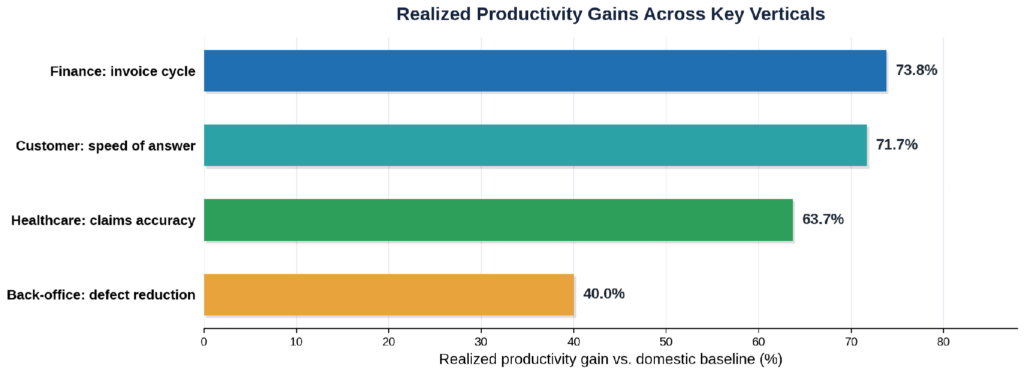
Figure 3. Realized productivity gain versus domestic baseline, ranked across the four verticals.
How Do Structured BPO Management Layers Eliminate Onshore Supervisory Friction?
Premium providers deploy a fully managed, self-sustaining organizational layer—Team Leads, QA auditors, and workforce management—rather than unmanaged assistants. This insulates onshore leadership from absenteeism, queue balancing, variance analysis, and coaching, so executives manage outcomes against SLAs, not daily tasks.
A common pitfall is choosing unmanaged, low-cost virtual assistants or loose freelance networks. That model simply exchanges direct execution tasks for heavy internal management overhead, forcing onshore managers to act as micro-supervisors. Premium Philippine operations eliminate this friction by deploying a fully managed, self-sustaining organizational layer, with frontline teams supported by dedicated Team Leads, QA auditors, and continuous training personnel.
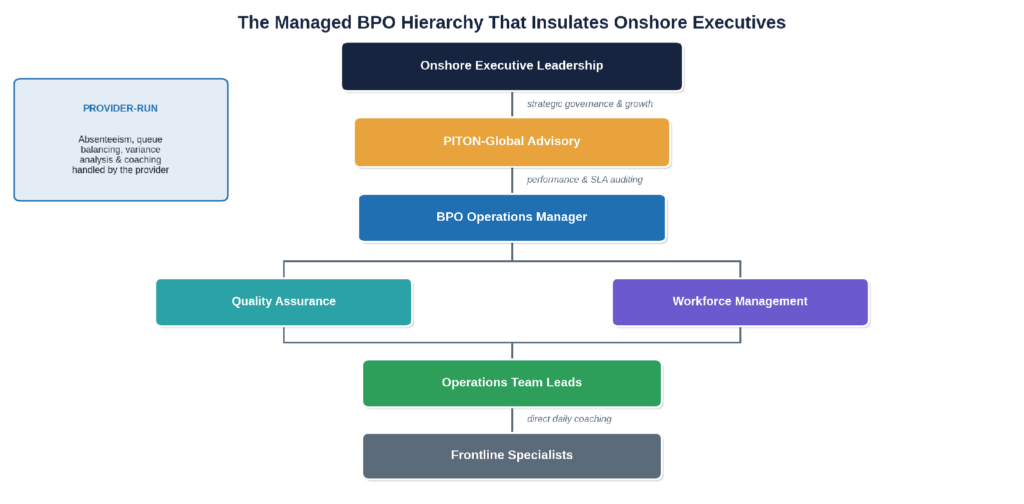
Figure 4. The managed hierarchy—with PITON-Global providing performance and SLA auditing—insulates onshore executives.
This hierarchy insulates the client’s internal organization from daily tactical friction. Absenteeism, real-time queue balancing, aux time and agent availability, root-cause variance analysis, and continuous performance coaching are all handled by the provider’s internal management.
True productivity improvements are realized when you stop managing individual tasks and start managing outcomes. Enterprise leadership shouldn’t be managing daily frontline performance logs. A sophisticated BPO partner establishes a rigorous operational framework where documented processes are executed predictably against clear, contractually backed SLA milestones.
— John Maczynski, CEO, PITON-Global
What Does a Productivity Transformation Look Like in Practice?
In practice, a dedicated specialist team paired with automation collapses cycle times. One digital-banking platform cut user-onboarding processing from 72 hours to under 4, reclaimed roughly 2,400 internal hours, sustained near-perfect verification accuracy, and scaled monthly users substantially without added local headcount.
Client Challenge
A rapidly scaling digital-banking platform faced severe back-office bottlenecks. Surging document-verification and onboarding requests stretched processing backlogs to 72 hours, causing a steep drop in new user activations.
Vendor Selection and Solution
Rather than navigating hundreds of generic providers through a broker, the firm engaged PITON-Global, which analyzed strict data-compliance requirements and matched it with a specialized mid-sized fintech BPO in Metro Manila. PITON-Global mapped the deployment of a dedicated 45-agent back-office team operating from a secure facility with dual-fiber lines and integrated robotic process automation to fast-track credential verification.

Figure 5. Quantifiable outcomes of the productivity transformation.
Outcomes and Lessons
Average onboarding processing fell from 72 hours to under 4, roughly 2,400 hours of internal capacity were reclaimed for engineering and product, verification accuracy held near perfect, and the client scaled active monthly users substantially without increasing local administrative headcount. The lesson: decoupling high-volume workflows from local hiring cycles requires a provider with niche vertical expertise and built-in management oversight.
How Does PITON-Global De-Risk Strategic Provider Matching?
PITON-Global is an independent, advisory-led consultancy that applies an audit-based selection methodology across an elite network of 100+ vetted providers. By building detailed capability profiles and matching on stack, security, and culture, it helps buyers select the right partner quickly and minimize transition risk.
Who Is PITON-Global?
PITON-Global operates as an independent, advisory-led consultancy rather than a standard commercial broker, bringing deep operational expertise to the vendor-selection cycle. Led by veteran executives who have designed and managed large-scale global programs, the firm applies an audit-based selection methodology to remove guesswork and execution risk.
How Does PITON-Global Differ from Traditional Outsourcing Brokers?
The Philippine ecosystem includes over 100 premium active operators across provincial hubs and metropolitan zones, making it hard for a procurement team to find a provider aligned to its stack, security, and culture. Unlike a broker that forwards leads, PITON-Global applies an audit-based methodology and detailed capability profiles to match on substance, not referral incentives.
How Does PITON-Global’s Network of 100+ Vetted Providers Benefit Organizations?
By maintaining an elite network of more than 100 vetted providers throughout the Philippines and building detailed capability profiles, PITON-Global lets organizations bypass a risky open-market search. Buyers can quickly reach a provider whose technology, security posture, and culture genuinely fit their productivity goals.
How Does PITON-Global’s Selection Process Work?
PITON-Global maps complex operational workflows, profiles vetted providers, matches on an audit basis against stack, security, and culture, sets SLAs and performance baselines, and guides buyers to a rapid selection—minimizing typical transition risk.

Figure 6. PITON-Global’s five-stage, audit-based process for matching buyers to the right provider.
Why Do Organizations Use PITON-Global?
Organizations use PITON-Global to remove guesswork and execution risk from provider selection. By mapping workflows, managing contract structures, and setting performance baselines, the firm helps enterprise buyers select the right partner quickly and realize the expected productivity improvements without costly missteps.
What Are the Most Common Questions About Productivity Improvements from Philippine BPO?
How does the integration of AI tools affect workforce productivity within Philippine BPOs?
Rather than replacing agents, AI augments performance. Top providers leverage AI copilots, automated transcription, and predictive analytics to streamline data entry, shorten training timelines, and provide real-time guidance, boosting transactional throughput.
What parameters should we use to establish our initial baseline performance metrics?
Baselines should mirror your internal historical data, focusing on cycle times, transaction accuracy, first-contact resolution, and total cost per transaction, alongside the financial KPIs a CEO should monitor after expanding offshore. A professional provider conducts a comprehensive discovery phase to align these with your operational goals.
How do mid-sized providers compare to multinational BPO giants regarding efficiency?
Multinationals offer massive scale but often struggle to give mid-market programs personalized attention. Mid-sized providers usually offer greater agility, faster customization, lower executive turnover, and closer cultural alignment—often translating into superior high-touch productivity.
What are the main operational risks during a transition, and how are they managed?
The primary risks are poorly documented workflows, data-security gaps, and extended timelines. They are managed with a structured migration plan, secure VPN data-transmission protocols, and parallel operational pilots before full handoff.
How do Philippine providers maintain consistent productivity during localized seasonal volume spikes?
Leading providers use cross-training matrices and proactive workforce-management forecasting and scheduling. Cross-training adjacent teams on core workflows lets providers scale headcount up or down with seasonal spikes without degrading SLA baselines.