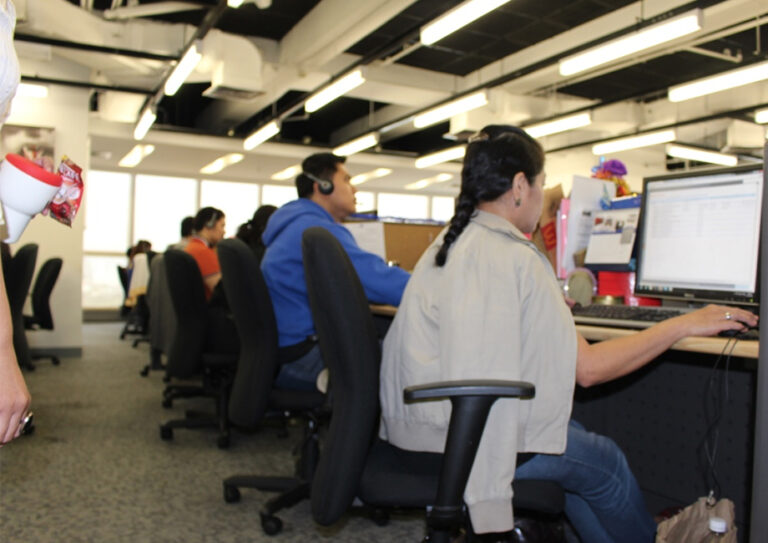

A queue that holds its service level through a product launch, a billing error or a holiday peak is the result of four decisions made weeks earlier, not of agents working faster on the day. Managing high-volume call traffic comes down to forecasting the interval accurately, routing and deflecting the contacts that do not need a person, keeping a trained bench that can be switched on within hours, and refusing to let quality collapse while occupancy is high. Each of those is easier with outsourced customer support delivered from Manila and Cebu than with a fixed onshore team, and this article explains why in operational terms a COO or head of support can check against their own numbers.
Start with the forecast, not the headcount
Every volume problem that reaches the floor began as a forecasting problem, so the first question to ask any Philippine provider is how it predicts contacts by half-hour interval and how far off it was last month. A workforce management team builds the forecast from historical arrival patterns, known drivers such as marketing sends, billing cycles and release dates, and the client’s own calendar. It then converts contacts into required staff using an Erlang model, adds shrinkage for breaks, training and absence, and schedules against an occupancy ceiling so agents are not run flat out for eight hours.
The buyer’s contribution is information. A spike the provider knew about a week ahead is a schedule change; the same spike discovered at 9 a.m. is a service-level breach. Share the campaign calendar, the release plan and any known billing or shipping issues with the WFM team as a standing weekly feed. The best offshore desks assign a named WFM analyst to the account whose job is to ask for exactly this, and to report forecast accuracy alongside service level so both sides can see whether misses came from the model or from surprises.
Route and deflect before you staff
The cheapest contact to handle in a surge is the one that never reaches an agent, and the second cheapest is the one that reaches the right agent first time. Four mechanisms do most of the work:
- Skills-based routing through the automatic call distributor sends each contact to the agent group best equipped to close it, using intent, language, customer value or history, so transfers and repeat calls fall.
- A short, well-designed IVR or conversational front end pre-qualifies the reason for calling and resolves balance checks, order status and appointment changes without a queue.
- Scheduled and virtual callbacks convert a long hold into a promise, flattening the peak into the following intervals and cutting abandonment.
- Digital channels such as chat, messaging and email absorb the contacts that do not need a live voice, and a cross-trained team can move agents between voice and digital as the queue shifts.
Process work belongs here too. Scripts that reach the fix in three questions rather than eight, knowledge articles that surface on the agent’s screen, and authority to resolve a credit without escalation each shave handle time, and handle time is capacity. A Philippine provider that reviews its top ten contact reasons monthly with the client and removes the causes of the avoidable ones is doing volume management at the source.
How a Philippine desk absorbs the spike
A Philippine team in Metro Manila or Cebu can add capacity faster and hold it at lower cost than a domestic desk because it draws on a very large, experienced labor pool and typically runs multiple client programs from which cross-trained agents can be borrowed for a defined window. The scale is real: the IT-BPM sector generated more than $40 billion in revenue in 2025 with 1.9 million digital workers, and set a 2026 baseline of $42 billion and 1.97 million jobs, according to industry association figures reported by the Philippine Star in January 2026. A provider hiring from that pool can stand up a surge class of agents who have already handled North American billing and order queues.
Three delivery mechanics make the elasticity practical. First, a trained bench: a group of agents certified on your program but scheduled on other work, who can be switched to your queue within a shift when the forecast calls for it. Second, cloud seats, which let the Philippine provider provision new positions in days rather than the months a physical expansion would take onshore. Third, time-zone coverage, which lets a Philippine team take the North American evening and overnight intervals as a normal day shift; follow-the-sun support models explain how that coverage is designed so no interval is left thin.
Speed of ramp is the question buyers ask most, and the honest answer depends on whether the surge is planned or a surprise. A planned seasonal peak is staffed by recruiting and training a class in advance; an unplanned spike is covered from the bench and from cross-trained agents on adjacent programs, with new hires following. We set out realistic timelines and what governs them in our guide to how quickly capacity can be added. Continuity planning is the other half: the provider should be able to show how the queue is covered if a site loses power or a typhoon closes roads, which is why scalable, multi-site continuity is a selection criterion rather than a nice-to-have.
Protect quality and agents while volume is high
Volume is managed badly when the service level is saved by rushing customers off the line, because the repeat contacts arrive next week and the surge extends itself. Hold first-contact resolution and CSAT as governing measures through the peak, and let handle time float. Speech and text analytics that score every contact rather than a sample make this possible even when QA staff are stretched, because they flag the calls that ended without a resolution and the agents who need a coaching conversation that day.
Agents are the other asset that degrades under sustained pressure. Cap occupancy so people are not on back-to-back contacts for an entire shift, protect breaks, rotate the hardest queues, and give team leads the room to pull someone off the phones after a difficult call. Philippine providers that treat these as soft benefits see attrition climb after every peak and pay for it in retraining; providers that treat them as capacity management keep the tenured agents who make the next peak easier. Ask for attrition during and after the last two surges as part of any evaluation.
Close the loop after the peak with a structured review. Compare the forecast to actual arrivals by interval, list the top contact reasons and which could have been prevented, check whether callbacks and digital deflection performed as designed, and feed the findings into the next forecast. A provider that runs this review with the client is managing volume as a system rather than fighting each spike as an emergency.
What surge capacity costs in 2026
The economics of an elastic offshore desk rest on the seat rate, and the difference from onshore is what makes it affordable to hold a bench at all. The PITON pricing calculator uses a 2026 fully loaded base rate of $12 per hour, already including team-lead and QA supervision, against a US in-house benchmark of $33 per hour, and models typical savings of 50–70% versus running the same seats domestically; the assumptions are documented on our pricing page. At that differential a buyer can fund a permanent surge bench for less than the onshore overtime bill from a single bad quarter.
Commercially, write the surge into the agreement rather than negotiating it in the moment. Define the notice period for planned peaks, the bench size the provider holds, the rate for bench hours activated, and the service level that applies during the surge window. Providers that run volume well agree to these terms readily, because they already operate this way for other clients.
Frequently asked questions
What service level should I target during a peak?
Keep the standard target and agree a defined surge window in which a slightly relaxed level applies, rather than abandoning the measure. Pair it with an abandonment ceiling and a callback commitment so customers who cannot be answered immediately are still served the same day.
How much notice does a Philippine provider need for a planned spike?
Bench activation needs days; a new trained class needs weeks, because recruiting, training and nesting take time regardless of location. Share the marketing and release calendar as a standing weekly feed so the WFM team is never planning from surprises.
Will deflecting calls to chat and self-service hurt satisfaction?
Not when the customer is offered the channel rather than forced into it, and when the digital channel can actually resolve the issue. Deflection that ends in a dead end drives a second, angrier call; deflection that resolves is usually rated higher than a long hold.
How do I keep quality from slipping when everyone is on the phones?
Score every contact with analytics rather than a sample, keep first-contact resolution and CSAT as the governing measures, cap occupancy, and hold a short daily review of the flagged contacts. Quality maintained through a peak is what prevents the peak from repeating as callbacks the following week.