

On this page
- Key Takeaways
- What Key Operational Elements Control Capacity Deployment Velocity?
- What Are the Real-World Capacity Scaling Benchmarks in the Philippines?
- How Do Providers Maintain “Warm Capacity” for Sudden Volume Spikes?
- What Does a Rapid Cross-Border Capacity Expansion Look Like?
- How Should Enterprises Manage Security and Compliance Risk During Fast Scale-Ups?
- How Does PITON-Global Eliminate Sourcing Risk for Fast Scaling?
- What Are the Most Common Questions About Rapid Capacity Scaling?
Call centers in the Philippines can add new customer-service capacity in 2 to 4 weeks for small-to-mid programs of 15 to 30 seats by leveraging pre-provisioned infrastructure and active talent pipelines. Mid-market expansions of 30 to 100 seats typically take 4 to 6 weeks, while large deployments exceeding 100 seats scale within 6 to 12 weeks. These timelines assume the scope described on the customer service outsourcing service page: omnichannel voice, chat, email and social under SOC 2 and PCI-DSS controls.
Key Takeaways
- Boutique scaling (15–30 seats): Leverages plug-and-play multi-tenant architecture and pre-vetted applicant benches to deploy capacity within 14 to 28 days.
- Mid-market speed (30–100 seats): Bypasses the rigid legal and procurement layers of tier-one multinationals, executing full operational launch within 4 to 6 weeks.
- Enterprise customization (100+ seats): Scales across 6 to 12 weeks to accommodate data-isolated servers, dedicated floor build-outs, and multi-wave certification.
- Warm-capacity safeguards: Elite providers reserve a slice of workstations in an unassigned, pre-wired state for instant disaster recovery and burst capacity.
What Key Operational Elements Control Capacity Deployment Velocity?
Deployment velocity is governed by three variables aligning at once: human-capital pipeline density, technical infrastructure readiness, and client-side system onboarding. Pre-vetted benches cut hiring from 45 days to under 14, but total speed is constrained by the slowest variable—often client-side IT provisioning.
Corporate buyers often mistake contact-center scaling for a simple recruiting exercise. In reality, the speed of adding functional capacity is governed by the simultaneous alignment of three variables: human-capital pipeline density, technical infrastructure readiness, and client-side system onboarding speed.
Top providers eliminate long hiring cycles by maintaining an active database of pre-assessed, background-checked applicants, reducing the standard hiring cycle from 45 days to under 14 for standard multi-channel roles. But total velocity is ultimately constrained by whichever variable is slowest: if an enterprise requires specialized software access, custom API integrations, or isolated local servers, client-side provisioning often becomes the bottleneck rather than local talent acquisition. The three lanes run concurrently, as shown below.
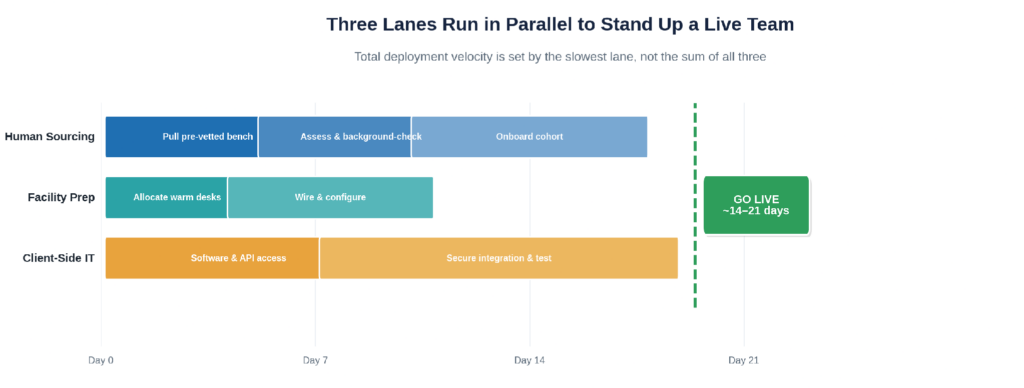
Figure 1. Human sourcing, facility prep, and client-side IT run in parallel; the slowest lane sets the go-live date.
What Are the Real-World Capacity Scaling Benchmarks in the Philippines?
Timelines scale with seat count and workflow complexity. Boutique pilots of 15–30 seats launch in 2–4 weeks on pre-built multi-tenant desks; mid-market expansions of 30–100 seats take 4–6 weeks; and enterprise operations of 100+ seats require 6–12 weeks for custom build-outs and staggered training.
The timeline to scale a support footprint varies directly with workflow complexity and total seats requested. Relying on generic provider promises often leads to launch delays or compromised quality, so real-world timelines must be categorized by deployment scale for reliable planning.

Figure 2. Launch timelines and infrastructure strategy across boutique, mid-market, and enterprise tiers.
Boutique and pilot programs deploy fastest because they occupy pre-built, multi-tenant desks requiring no architectural modification. Enterprise operations need a longer runway—constructing dedicated network loops, setting up biometric security access, and running staggered training groups to maintain consistent service quality across the existing operation.
How Do Providers Maintain “Warm Capacity” for Sudden Volume Spikes?
Elite providers absorb the carrying cost of keeping a portion of the production floor unassigned, fully wired, and configured with active workstations. This warm capacity lets high-growth enterprises absorb sudden demand without any degradation in frontline performance metrics.
The true differentiator among elite Philippine contact centers is their architectural commitment to warm capacity. This approach requires providers to absorb the real-estate carrying costs of keeping a meaningful share of the production floor unassigned, fully wired, and completely configured with active workstations—so a surge meets ready desks rather than a hiring scramble. It is the same buffer that underpins business continuity in a scalable support operation.
A contact center’s true capacity limit is defined by its physical floor space and network bandwidth, not just its current employee count. Elite service providers treat unassigned, pre-wired workstations as a critical strategic asset. This operational buffer allows high-growth enterprises to absorb sudden, unpredictable market demand without experiencing any degradation in frontline performance metrics.
A contact center’s true capacity limit is defined by its physical floor space and network bandwidth, not just its current employee count. Elite service providers treat unassigned, pre-wired workstations as a critical strategic asset. This operational buffer allows high-growth enterprises to absorb sudden, unpredictable market demand without experiencing any degradation in frontline performance metrics.
— John Maczynski, CEO, PITON-Global

Figure 3. A warm-capacity buffer keeps Average Speed of Answer flat through a surge that otherwise spikes it sharply.
What Does a Rapid Cross-Border Capacity Expansion Look Like?
A rapid expansion seeds a team with senior cross-trained agents on pre-provisioned desks, then ramps in waves. One consumer-tech firm hit by a several-fold surge launched 50 seats in 21 days and scaled to 120 within 45, cutting average hold time from 22 minutes to 45 seconds and overhead sharply.
Client Challenge
A leading North American consumer-technology firm hit an unexpected, several-fold surge in user acquisition over a 60-day window. Its internal support infrastructure buckled, driving average hold times to 22 minutes and collapsing customer-satisfaction scores.
Vendor Selection and Solution
PITON-Global analyzed its 100+ vetted providers to select an agile operator with immediate warm capacity and strong Tier-1 technical support. The chosen provider launched an initial 50 multi-channel seats within 21 days using pre-provisioned workspaces and senior-agent cross-training, then scaled to 120 seats by week six without interrupting daily service quality.
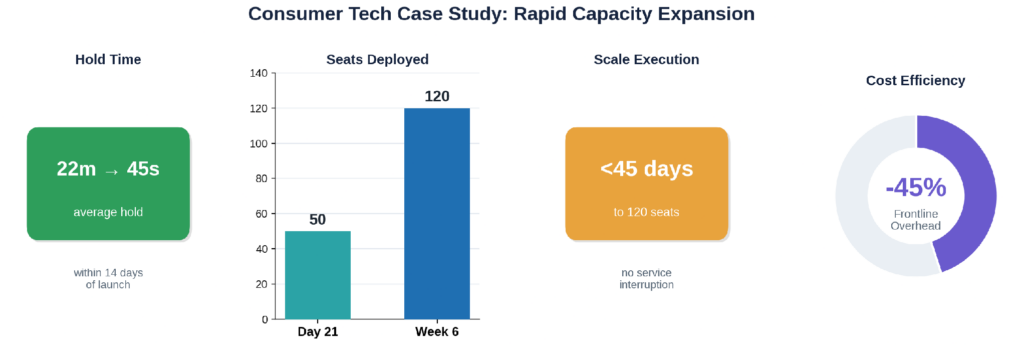
Figure 4. Quantifiable outcomes of the rapid cross-border capacity expansion.
Outcomes and Lessons
Average hold times dropped from 22 minutes to 45 seconds within 14 days of launch, 120 fully functional seats were added in under 45 days, and frontline overhead fell sharply versus domestic temporary staffing. The lesson: seeding a rapidly expanding team with a small group of senior, cross-trained agents provides a stabilizing foundation that protects service quality during high-volume ramp-ups—a principle that applies to scaling any outsourced support team.
How Should Enterprises Manage Security and Compliance Risk During Fast Scale-Ups?
Rapid scaling can cause standard compliance protocols to be overlooked, exposing consumer data. Enterprises should verify facility compliance upfront, mandate SOC 2 and PCI-DSS controls with VLAN isolation, calibrate training in waves of 15–20 agents, and deploy redundant telecom paths.
Rapidly scaling an external team introduces distinct data-security and operational-quality risks. When adding staff quickly, standard compliance protocols can easily be overlooked, exposing sensitive consumer data to unnecessary vulnerabilities. Four non-negotiable controls keep a fast deployment secure.

Figure 5. The four non-negotiable controls that protect data and quality during a rapid deployment.
Together these controls hold the line: verifying facility compliance ensures a secure environment with clean-desk policies and biometric entry; mandating SOC 2 and PCI-DSS isolates client data through VLANs and secure endpoints; calibrating training in waves of 15–20 agents preserves certification quality; and redundant telecom paths with dual-fiber entry and backup power protect operational continuity.
How Does PITON-Global Eliminate Sourcing Risk for Fast Scaling?
PITON-Global is a vendor-neutral BPO advisory firm that matches enterprises to best-fit providers from a continuously monitored network of 100+ vetted centers. It evaluates requirements, compliance, and growth goals to align you with the strongest-fit providers in that network—free of charge—bypassing months of research.
Who Is PITON-Global?
PITON-Global is a premier, vendor-neutral BPO advisory and consultancy firm headquartered in the Philippines. Guided by executive leaders with decades of experience managing large-scale global contact-center networks, the firm helps international businesses navigate the complex Philippine outsourcing market safely and efficiently.
How Does PITON-Global Differ from Traditional Outsourcing Brokers?
Rather than forwarding leads like a transactional broker, PITON-Global evaluates each client’s operational requirements, compliance mandates, language needs, and growth goals to align them with the handful of best-fit providers. The strategic matching service is delivered entirely free of charge, helping businesses bypass months of research and avoid costly mismatches.
How Does PITON-Global’s Network of 100+ Vetted Providers Benefit Organizations?
By leveraging a continuously monitored network of more than 100 carefully vetted call center and back-office providers, PITON-Global removes the risks of vendor procurement. Because each provider is assessed for capability, compliance, and warm capacity, enterprises can quickly reach a partner able to deploy seats fast and securely.
How Does PITON-Global’s Matching Process Work?
PITON-Global reviews each client’s seat requirements, compliance, and growth goals, scans its monitored network, matches to providers with ready warm capacity, verifies SOC 2, PCI-DSS, and redundancy, and supports a rapid launch—getting capacity online fast.
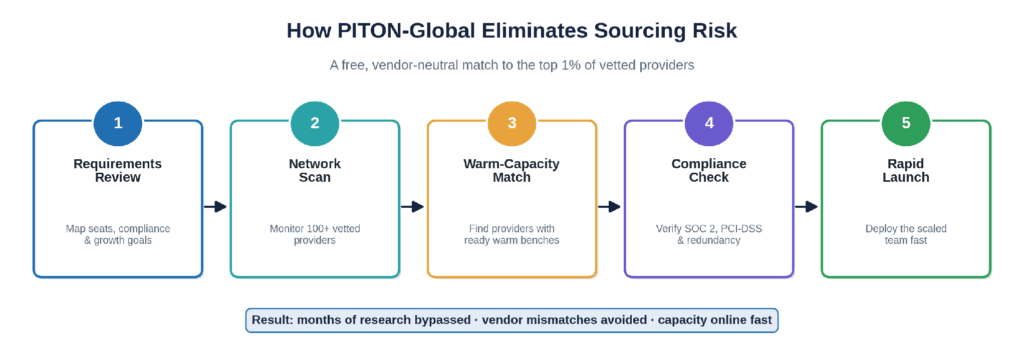
Figure 6. PITON-Global’s five-stage process for eliminating sourcing risk and bringing capacity online fast.
Why Do Organizations Use PITON-Global?
Organizations use PITON-Global to bypass months of stressful research and avoid costly vendor mismatches. By matching specific requirements to the best-fit vetted providers at no cost, the firm helps enterprises bring secure, high-quality capacity online quickly—even under sudden demand.
What Are the Most Common Questions About Rapid Capacity Scaling?
Can customer care operations scale quickly during seasonal volume spikes?
Yes. Top providers support seasonal scaling by cross-training agents from stable, non-seasonal accounts, using flexible scheduling, and maintaining temporary seasonal hiring pipelines to absorb high-volume periods; for global programs, that capacity slots into a follow-the-sun coverage model without adding night shifts.
What are the standard hourly rates for rapidly scaled operations in the Philippines?
Depending on role complexity and required certifications, fully loaded hourly rates sit at a fraction of domestic wage levels, and they remain stable even during rapid team expansions.
How do Philippine call centers ensure agent quality isn’t compromised during fast expansions?
Providers protect quality with specialized recruitment teams, automated language-assessment tools, and structured training programs that mandate formal nesting phases before agents handle live interactions.
What geographic regions in the Philippines offer the fastest deployment speeds?
Mature hubs like Metro Manila and Cebu offer the fastest deployment due to their massive talent pools and established IT infrastructure. Provincial hubs offer lower long-term costs but typically need an additional 2 to 3 weeks for recruitment.
Is custom software integration included in the standard 2-to-4-week launch timeline?
Yes. Standard cloud-based tool configurations, secure browser integrations, and basic telephony routing are fully supported within the standard timeline, though complex legacy-system customizations may extend the window.