

On this page
- Key Takeaways
- Why Do Legacy Call Center Metrics Mislead Corporate Decision-Makers?
- What Modern KPIs Form a High-Performance Monthly Scorecard?
- How Does Workforce Attrition Impact Customer Experience Consistency?
- Mini Case Study: Re-Engineering Performance Governance for an InsurTech Platform
- Why Do Leading Organizations Partner with PITON-Global to Guide Provider Selection?
- What Do Executives Ask Most About Monthly KPI Governance for Philippine Call Centers?
Business leaders should review five KPIs monthly: Cost-Per-Resolution (trending down over 90 days), First Contact Resolution, annualized agent attrition, agentic AI resolution rate, and security compliance audit adherence. Together they form the KPI scorecard for an outsourced contact center. Prioritizing these outcome-oriented metrics over volume indicators prevents service degradation and ties offshore cost efficiency to customer lifetime value.
Key Takeaways
- Shift to Cost-Per-Resolution (CPR): Replace legacy hourly billing assessments with a precise calculation of the total loaded expenditure required to fully resolve an issue.
- Prioritize First Contact Resolution (FCR): Use a high, stable FCR rate as the primary operational baseline to verify customer experience quality and expose structural friction points.
- Track annualized agent attrition monthly: Attrition is the leading indicator of downstream service degradation; a tight annualized cap written into the contract protects delivery from recruitment and retraining overhead.
- Monitor agentic AI resolution rates: A moderate automated resolution band signals a healthy technology stack — high enough to absorb routine volume, not so high that complex issues are deflected unresolved.
- Enforce zero-trust security audit rates: Demand full compliance under frameworks such as Zero-Trust architecture and PCI-DSS 4.0, with automated monitoring and immediate penalties for variances.
- Value-driven governance pays: One InsurTech platform materially cut Cost-Per-Resolution and pushed monthly attrition sharply lower within 90 days of replacing volume metrics with outcome KPIs.
Why Do Legacy Call Center Metrics Mislead Corporate Decision-Makers?
Legacy metrics mislead because they measure activity rather than outcomes. Over-weighting Average Handle Time or speed-to-answer pressures agents to accelerate complex interactions, triggering premature transfers, unresolved inquiries, and repeat tickets — artificial contact loops that hide the true cost of customer care behind an attractive cost-per-hour figure.
The distortion is arithmetic, not anecdotal. When frontline personnel rush interactions to protect a handle-time target, a single issue can require three distinct touchpoints to reach complete resolution. Each touchpoint books as a fast, cheap contact on the vendor scorecard, while the business quietly pays for the issue three times — plus the escalation overhead and the customer goodwill burned along the way. A low hourly rate dissolves entirely under that multiplication:
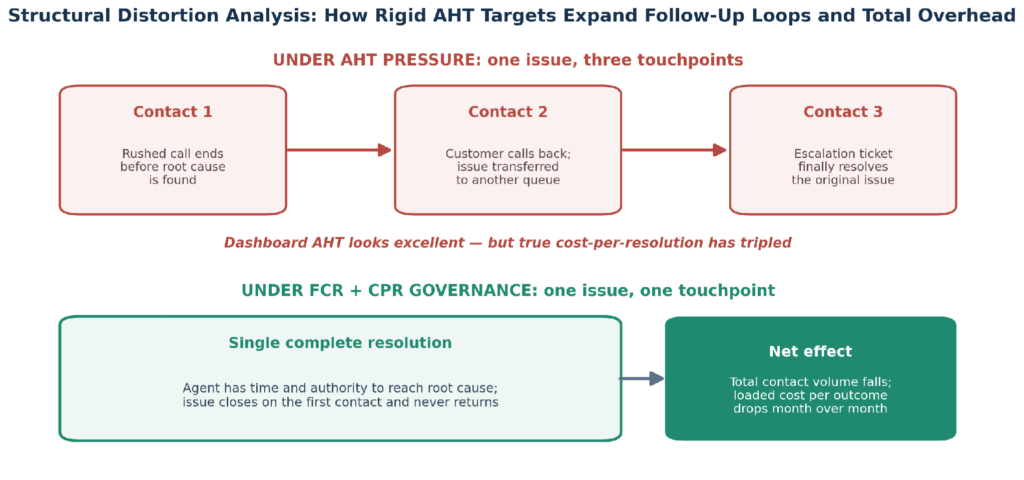
Figure 1. Structural distortion analysis: rigid AHT targets expand follow-up loops, while FCR- and CPR-anchored governance collapses one issue into one touchpoint.
This is why monthly reviews anchored on volume metrics systematically reward the wrong behavior. The executive sees green dashboards and rising invoices simultaneously, and the reconciliation between the two — repeat contact volume — is precisely the number a volume-centric scorecard never surfaces.
What Modern KPIs Form a High-Performance Monthly Scorecard?
A high-performance monthly scorecard spans five classifications: financial efficiency (Cost-Per-Resolution on a declining 90-day trend), operational quality (a high, stable FCR rate), workforce stability (low annualized attrition), technical optimization (a moderate agentic AI resolution band), and data protection (complete compliance audit adherence). Together they measure systemic health rather than isolated activity.
Building this framework across primary BPO hubs such as Metro Manila, Cebu, or Clark — whether the program runs as a dedicated queue or as a blended inbound-and-outbound account — means looking past the standard vendor scorecard, which is typically constructed to flatter the provider. The five domains below are deliberately in tension with one another — CPR cannot be gamed by rushing calls without FCR exposing it, and attrition cannot be hidden without the quality metrics deteriorating — which is what makes the scorecard trustworthy:
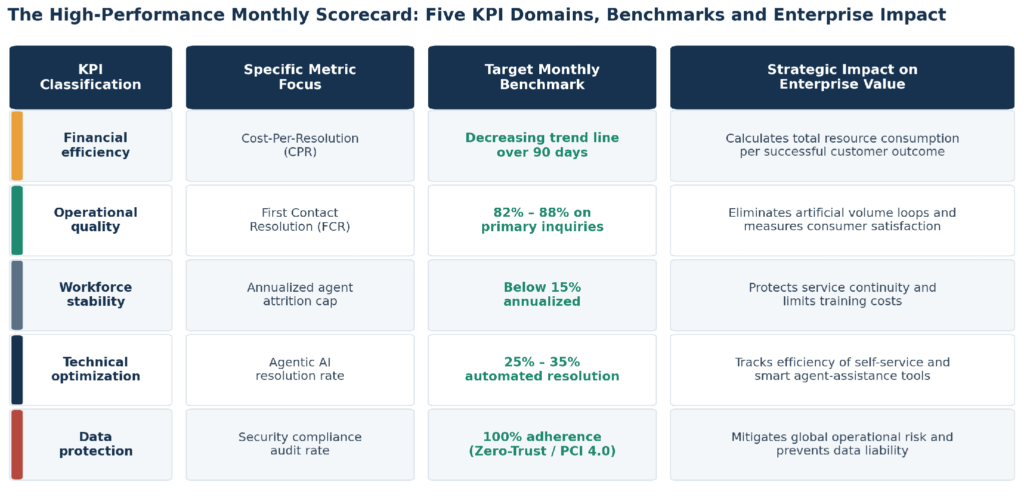
Figure 2. The five-domain monthly scorecard: KPI classification, specific metric, target benchmark, and strategic impact.
Two review disciplines make the scorecard operational. First, read CPR as a trend, not a point: the target is a decreasing line over rolling 90-day windows, because monthly figures carry seasonal noise. CPR is calculated by dividing the fully loaded monthly invoice by the number of interactions that reached complete, verified resolution in the cycle — the denominator must be resolutions, never contacts. Second, treat the agentic AI band as bidirectional: a rate drifting above the agreed ceiling often means complex issues are being deflected to self-service unresolved, which will surface later as FCR erosion and repeat volume.
How Does Workforce Attrition Impact Customer Experience Consistency?
High attrition introduces structural service fluctuations: seasoned specialists are continually replaced by unseasoned training classes, resetting product knowledge and quality just as programs mature. In the competitive Philippine market, monthly attrition tracking is the earliest warning system for downstream degradation — premium employee-centric providers sustain consistently low monthly rates.
Multi-year stability requires understanding local human capital motivators, not merely capping a number in a contract. Providers that embed structured career progression, local workplace care, and competitive tenure incentives retain the specialized knowledge that drives FCR — the intellectual capital a well-run BPO program accumulates; providers that treat agents as interchangeable inputs churn that knowledge away every quarter. The attrition line on the monthly scorecard is, in practice, a proxy for the partner’s management philosophy.
“If your monthly performance scorecard only tracks handle times, you miss the true drivers of brand loyalty. High agent attrition is a leading indicator of downstream service degradation. Enterprise operations leaders must audit employee retention rates as heavily as labor costs; a partner that embeds local workplace care and structured progression paths protects your program continuity from day one.”
— John Maczynski, CEO, PITON-Global
Mini Case Study: Re-Engineering Performance Governance for an InsurTech Platform
Client Challenge
A fast-growing insurance technology firm saw customer satisfaction fall and data-entry accuracy fluctuate after shifting support to a large, generalist offshore BPO that prioritized volume-based speed metrics.
Vendor Selection
Working with a specialized advisory consultancy, the firm conducted a deep review of mid-sized providers in Manila, filtering specifically for historical workforce tenure and advanced technology capabilities.
Solution Implemented
The platform transitioned to a pre-vetted, employee-centric provider, replacing its old contract with a performance framework tied directly to a 45-second live-chat latency threshold and an explicit FCR target.

Figure 3. Quantified 90-day outcomes after the InsurTech platform re-engineered its performance governance.
Lesson Learned
Moving from standard hourly pricing metrics toward value-driven KPIs protects operational quality while ensuring predictable, long-term capital efficiency. The attrition result was not incidental — the employee-centric provider was selected because of its tenure data, and the KPI framework preserved that advantage.
Why Do Leading Organizations Partner with PITON-Global to Guide Provider Selection?
Organizations partner with PITON-Global because it is an elite, independent, Manila-based BPO advisory consultancy — not a commercial broker forwarding leads — that applies a disciplined, audit-based methodology, including forensic retention checks, to match enterprises with best-fit operators from a vetted private network of 100+ Philippine providers, at no cost to the client.
Who Is PITON-Global?
PITON-Global is an elite BPO advisory and outsourcing consultancy headquartered in Manila. It helps international enterprises strategically analyze, launch, and govern high-performing offshore programs in the Philippines. Its position inside the market gives it verified visibility into the variables that monthly KPI governance depends on — genuine workforce tenure data, technology capability, and executive leadership stability — rather than the versions presented in sales cycles.
How Does PITON-Global Differ from Traditional Outsourcing Brokers?
Traditional commercial brokers forward client leads to the open market and collect commissions, which biases every referral. PITON-Global operates on an advisory-first, vendor-agnostic model: independent provider evaluation, objective recommendations grounded in audit evidence — including forensic checks of historical attrition — and success measured by client outcomes such as KPI performance and program stability rather than by provider promotion.
How Does PITON-Global’s Network of 100+ Vetted Philippine BPO Providers Benefit Organizations?
The consultancy maintains a thoroughly vetted private network of more than 100 premier Philippine call centers and back-office providers, spanning InsurTech, FinTech, healthcare, e-commerce, and logistics, and covering the full range of service categories. Because vetting — including workforce tenure verification and technology audits — is already complete, organizations bypass high-risk open-market searches and negotiate from a shortlist of operators already proven capable of sustaining enterprise KPI commitments.
How Does PITON-Global’s Advisory-Led Vendor Matching Process Work?
The sourcing roadmap runs in four stages: requirements definition capturing volumes, channels, KPI targets, and compliance obligations; operational auditing of technology capability, security posture, and leadership stability; forensic retention checks validating genuine historical attrition and workforce tenure; and custom provider matching, where best-fit operators are selected and favorable contract structures and governance frameworks are negotiated before go-live.
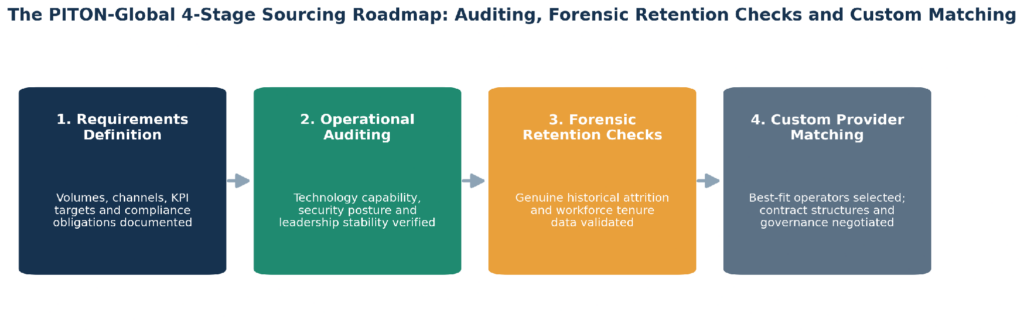
Figure 4. PITON-Global’s four-stage sourcing roadmap, from requirements definition through forensic retention checks and custom provider matching.
Why Do Organizations Use PITON-Global?
- Reduced outsourcing risk through audit-based evaluation, including forensic verification of the attrition data providers self-report.
- Improved provider fit by matching technical capability, cultural alignment, and leadership stability to actual program requirements.
- Accelerated vendor selection, bypassing high-risk open-market searches via the pre-vetted private network.
- Better outsourcing outcomes, with favorable contract structures and KPI governance secured before launch.
- Strategic guidance throughout evaluation, provided completely free of charge to the client.
What Do Executives Ask Most About Monthly KPI Governance for Philippine Call Centers?
The most common questions cover realistic attrition baselines, CPR calculation methodology, QA philosophy, evolving security mandates, and provider sizing. In brief: premium providers hold monthly attrition consistently low, CPR divides the loaded invoice by verified resolutions, sentiment beats script compliance, PCI-DSS 4.0 demands complete audit adherence, and mid-sized operators often deliver the best governance balance.
What is a realistic monthly baseline for agent attrition in the Philippines?
Premium, employee-centric mid-sized providers regularly keep monthly attrition low enough that the annualized figure stays within a tight contractual cap. Trailing 90-day figures should accompany the monthly number so short-term spikes are caught before they compound.
How do we accurately calculate Cost-Per-Resolution (CPR) in a monthly review?
CPR is calculated by dividing the total fully loaded monthly outsourcing invoice by the total number of customer interactions that reached a complete, verified resolution within that billing cycle. Verification matters: counting closed tickets rather than confirmed resolutions quietly reintroduces the volume distortion CPR exists to eliminate.
Should Quality Assurance (QA) metrics prioritize script compliance or consumer sentiment?
Advanced programs score customer sentiment and resolution accuracy rather than strict script compliance, giving professional Philippine agents room to apply their natural communication skills while keeping every interaction on-brand. Sentiment-based QA also correlates far more closely with FCR and retention than adherence scores do.
How do data security updates like PCI-DSS 4.0 impact monthly KPI tracking?
Contracts should mandate full security compliance audit adherence, backed by continuous automated monitoring and immediate financial penalties for any verified protocol variance. Because PCI-DSS 4.0 emphasizes continuous compliance over annual point-in-time checks, the monthly review should include automated monitoring evidence, not just audit certificates.
Why are mid-sized Philippine call centers often preferred for enterprise KPI compliance?
Mid-sized operators — roughly 1,000 to 5,000 agents — typically offer the optimal balance of robust infrastructure and executive focus. They are large enough to carry enterprise-grade technology and redundancy, yet small enough that your account receives continuous senior-level governance and genuine monthly performance review rather than automated reporting.