

On this page
- Key Takeaways
- Which Front-Office Functions Drive the Most Immediate Value?
- Which Back-Office Operations Yield the Highest Financial Efficiencies?
- What Strategic Tradeoffs and Blind Spots Must Leadership Anticipate?
- What Does a Successful Customer-Operations Re-Engineering Look Like?
- How Does PITON-Global De-Risk the Provider Selection Process?
- What Are the Most Common Questions About Outsourcing Business Processes to the Philippines?
The business processes that benefit most from outsourcing are high-volume, rules-based operations requiring deep technical competence and high emotional intelligence—specifically customer experience, technical helpdesk support, and financial accounting. Offshoring these workflows cuts fully loaded labor overhead by roughly two-thirds while compressing cycle times and increasing transactional accuracy, and you can size that saving for your own headcount with an offshore cost model anyone can run.
Key Takeaways
- Front-office scale: Customer experience and omnichannel support achieve immediate first-contact-resolution gains via native, Western-aligned English fluency and high emotional intelligence.
- Complex financial accounting: Accounts payable, receivable, and corporate bookkeeping transition into strict compliance frameworks at roughly a third of domestic run-rates.
- Technical support resolution: SaaS troubleshooting, network diagnostics, and Tier-1 through Tier-3 IT helpdesk workflows benefit from an abundant, university-educated tech workforce.
- Mitigated transactional risk: High-volume data management, document verification, and content moderation reach near-zero error rates under specialized SLA structures.
Which Front-Office Functions Drive the Most Immediate Value?
Front-office functions drive the most immediate value because high-touch human communication remains an unautomated differentiator. Omnichannel customer experience and ITIL-aligned technical helpdesk operations lift NPS and CSAT while running on a continuous follow-the-sun model without local night-shift premiums.
While back-office automation continues to evolve, high-touch human communication remains an essential, unautomated differentiator for enterprise brands. The Philippine outsourcing landscape dominates front-office interactions because its workforce combines native Western-aligned English fluency with high emotional intelligence.
Omnichannel Customer Experience (CX) Delivery
The core of the country’s outsourcing leadership is multi-channel customer care across voice, live chat, email, and social media. Operating natively within Western cultural nuances, Philippine agents excel at customer empathy and rapid conflict de-escalation, which translates into measurable lifts in Net Promoter Score and CSAT.
Technical Support and IT Helpdesk
Moving beyond basic call centers, specialized providers now manage ITIL-aligned helpdesk operations spanning SaaS application troubleshooting to complex VoIP diagnostics. A continuous follow-the-sun model keeps technical infrastructure support fully active around the clock without local night-shift premiums. The performance gap against typical domestic teams is substantial.
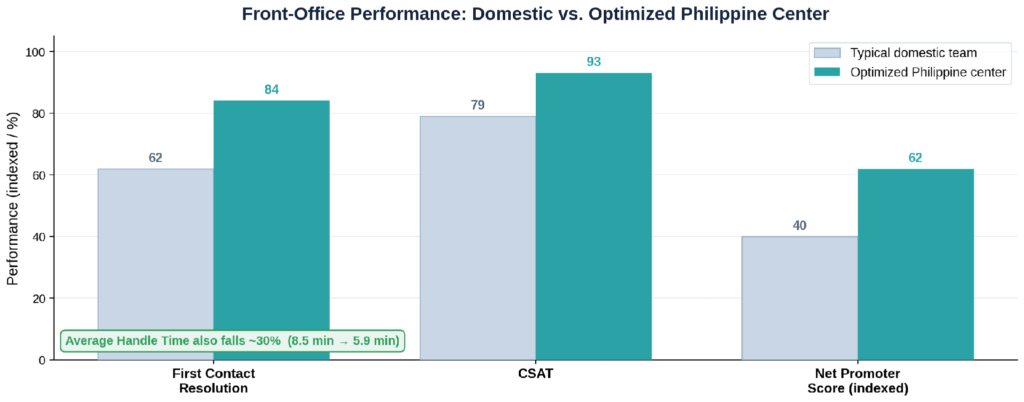
Figure 1. Front-office performance deltas—FCR, CSAT, NPS, and handle time—versus typical domestic teams.
Which Back-Office Operations Yield the Highest Financial Efficiencies?
High-volume, repetitive administration yields the highest financial efficiencies: accounts payable/receivable, SaaS and tech data management, legal process outsourcing, and medical billing. Delegating these converts fixed capital expense into a flexible variable-cost model with measurable metric gains.
Managing high-volume, repetitive corporate administration in-house drains onshore leadership focus and inflates fixed costs. Delegating these structural workflows to a specialized offshore team transforms fixed capital expense into a highly flexible, variable-cost model. The table below maps four high-impact back-office processes to the bottleneck each resolves and the metric it improves.
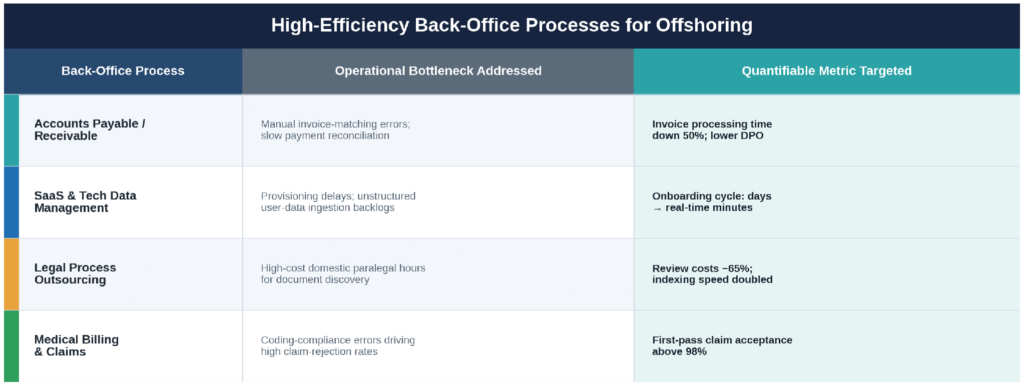
Figure 2. Four high-efficiency back-office processes, the bottleneck each addresses, and its target metric.
The cost advantage holds across knowledge-intensive roles. Indexed against in-house delivery, Philippine structures cut fully loaded cost by roughly two-thirds in accounting, data engineering, and technical support alike.

Figure 3. Cost arbitrage by role: Philippine delivery runs at roughly a third of in-house cost across accounting, data engineering, and technical support.
These workflows gain structural stability when established within infrastructure centers registered under the Philippine Economic Zone Authority (PEZA). These custom IT parks feature independent power backups, Tier-3 data-center architectures, and multiple redundant fiber-optic lines to keep operations running smoothly.
What Strategic Tradeoffs and Blind Spots Must Leadership Anticipate?
Leadership must anticipate three vulnerabilities: knowledge-transfer friction, information-security standards, and SLA misalignment. The mitigations are a mandatory 4–6 week shadow-and-pilot sequence, verified security certifications, and contracts that bind vendor incentives to business outcomes.
An enterprise outsourcing model should never be approached as a simple hands-off transaction. Transitioning core workflows offshore requires active operational governance, deliberate change management through the transition, and a clear understanding of systemic limitations.
Many organizations experience friction not because the offshore talent lacks capability, but because the onshore management fails to provide comprehensive documentation. Our internal performance audits indicate that operational efficiency is a reflection of process clarity. If your internal standard operating procedures are fragmented, moving them offshore will simply accelerate those hidden systemic errors.
— John Maczynski, CEO, PITON-Global

Figure 4. The three primary transition vulnerabilities, each paired with a concrete protection.
What Does a Successful Customer-Operations Re-Engineering Look Like?
A successful re-engineering deploys a dedicated, compliant offshore pod integrated with the client’s systems. One digital-banking app whose sign-ups quadrupled cut first response from 24 hours to under 90 seconds, cut support opex by well over half, and stabilized CSAT at a level that halted churn.
Client Challenge
A rapidly growing digital-banking application saw user sign-ups quadruple in a short span, driving ticket queues into a 24-hour backlog. The delay caused friction during account verification, pushed churn up by double digits, and strained a small, expensive domestic support staff.
Vendor Selection and Solution
The platform engaged PITON-Global for an advisory assessment. Using its audit framework across 100+ vetted providers, PITON-Global matched the brand within seven business days to a specialized, highly compliant mid-sized BPO in Metro Manila with deep financial-services experience. The partner deployed a dedicated 50-agent customer-support and data-verification pod integrated with the platform’s CRM and automated ticket routing for 24/7 coverage.

Figure 5. Quantifiable outcomes of the re-engineered customer operations.
Outcomes and Lessons
Average first-response times dropped from 24 hours to under 90 seconds, fully loaded support cost fell by well over half, and CSAT rebounded to the mid-nineties and held there, halting the churn trend. The lesson: a successful migration relies on tight technical integration and clear communication—treating the offshore team as a core part of the company, in the spirit of partnership-based client relationship management, and including their leads in weekly product syncs let them identify and resolve user-verification bugs far faster.
How Does PITON-Global De-Risk the Provider Selection Process?
PITON-Global is a premier, advisory-led consultancy that removes provider-selection risk from the Philippine BPO market. Acting as an independent strategic advisor across 100+ audited providers, it handles the diagnostic, RFP, and verification process at no cost to the buyer.
Who Is PITON-Global?
PITON-Global is a premier, advisory-led outsourcing consultancy that removes provider-selection risk from the complex Philippine BPO market. Rather than operating like a traditional sales broker that drives volume to preferred suppliers, it acts as an independent strategic advisor aligning enterprise buyers with specialized providers.
How Does PITON-Global Differ from Traditional Outsourcing Brokers?
Unlike a volume-driven broker, PITON-Global leverages an extensively audited network of more than 100 award-winning boutique and mid-sized operators and handles the complete diagnostic assessment, structured RFP design, and capability verification—at no cost to the buyer. The result is a partner matched on technical specialization, compliance standing, and cultural fit rather than referral incentives.
How Does PITON-Global’s Network of 100+ Vetted Providers Benefit Organizations?
An extensively audited network of more than 100 boutique and mid-sized providers lets organizations bypass a risky open-market search. Because each provider is vetted for specialization, compliance, and capability, buyers can quickly shortlist partners genuinely able to deliver the front- and back-office gains their specific processes require.
How Does PITON-Global’s Selection Process Work?
PITON-Global runs a diagnostic assessment of processes, volume, and compliance needs; audits its vetted network; designs a structured RFP around exact requirements; verifies certifications and technical fit; then matches the buyer to the best-fit specialized partner—replacing guesswork with disciplined, data-driven matching.
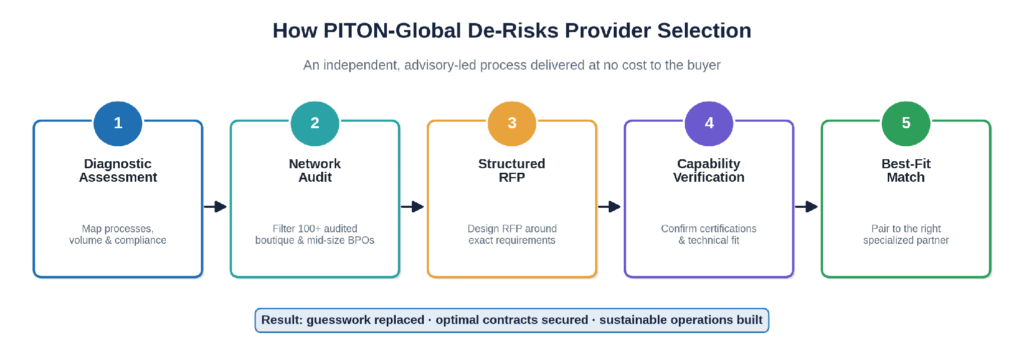
Figure 6. PITON-Global’s five-stage process for de-risking provider selection.
Why Do Organizations Use PITON-Global?
Organizations use PITON-Global to minimize structural transition risk, secure optimal contractual models, and build sustainable offshore operations. By replacing guesswork with disciplined matching and verifying capability up front, the firm helps leadership realize the greatest benefits from the right processes without the common pitfalls of unguided offshoring.
What Are the Most Common Questions About Outsourcing Business Processes to the Philippines?
What is the typical timeline required to transition a complex administrative function to the Philippines?
Most mid-market and enterprise transitions take 30 to 45 days, allowing for process mapping, technical infrastructure integration, security configuration, and agent training before a live pilot.
How do Philippine providers ensure business continuity during power grid or weather disruptions?
Top-tier providers operate from secure PEZA-registered IT parks with automatic generator backups, continuous fuel contracts, and multiple fiber-optic feeds routed from independent telecom carriers.
What is the minimum team scale needed to make an offshore transition financially practical?
While large enterprises scale to hundreds of positions, the financial tipping point often starts at just 5 to 10 dedicated full-time agents. The reduction in labor overhead—roughly two-thirds on a fully loaded basis—quickly covers onboarding and transition costs within months.
Are specialized Philippine teams capable of executing highly regulated data workflows?
Yes. The workforce features university-educated professionals specializing in regulated fields such as clinical healthcare data management, legal discovery, corporate accounting, and financial fraud detection under strict security standards.
What commercial pricing models are available when structuring agreements with these providers?
Contracts are highly flexible: organizations can choose fixed monthly fees per agent, hourly service rates, or variable transaction-based models that scale directly with actual business volume; our comparison of value-based BPO pricing models walks through the trade-offs of each.