

On this page
- Key Takeaways
- Why Does the “Cultural Nuance Gap” Frequently Disrupt First Contact Resolution Rates?
- What Contingencies Protect Against Localized Infrastructure Vulnerabilities?
- How Can Leadership Teams Control Onboarding Costs Driven by Vendor Attrition?
- Mini Case Study: Stabilizing an Enterprise Logistics Support Transition
- Why Do Leading Enterprises Partner with PITON-Global to Secure Sourcing?
- Who Is PITON-Global?
- How Does PITON-Global Differ from Traditional Outsourcing Brokers?
- How Does PITON-Global’s Network of 100+ Vetted Philippine BPO Providers Benefit Organizations?
- How Does PITON-Global’s Advisory-Led Vendor Matching Process Work?
- Why Do Organizations Use PITON-Global?
- What Do Buyers Ask Most About Transitioning Support Operations to the Philippines?
The most common operational challenges in a call center transition are cultural misalignment on problem-solving nuance, infrastructure vulnerability during severe weather events, and hidden training overhead from partner-side attrition. Mitigation requires comprehensive transition playbooks, multi-city infrastructure redundancy, and co-managed retention frameworks — including wage calibration and jointly tracked attrition caps established before launch. Most can be caught before signing through a disciplined vendor selection process.
Key Takeaways
Address the nuance gap
Replace rigid script compliance with behavioral, intent-based training that empowers local agents to handle complex, gray-area escalations independently.
Build infrastructure redundancy
Insulate support channels from localized power and connectivity disruptions through multi-city geodiversification, active-active fiber loops, and tested generator backup.
Control attrition spikes
Mandate joint oversight of retention metrics and audit the provider’s culture and compensation before signing; persistently high turnover traps leadership in perpetual onboarding.
Standardize operational handoffs
Coordinate parallel training periods so performance data stays aligned across the outgoing and incoming teams during cutover, after a technology compatibility assessment confirms the systems line up.
Beware entry-level pricing
Unusually low bill rates typically signal underfunded salaries and supervisor ratios — the direct precursors of the attrition that destroys transitions.
Recovery is achievable
One logistics firm cut turnover sharply after a launch spike and reduced cost-per-resolution by re-sourcing to an employee-focused partner with shared retention bonuses.
Why Does the “Cultural Nuance Gap” Frequently Disrupt First Contact Resolution Rates?
The nuance gap disrupts FCR because buyers confuse language fluency with native problem-solving intuition. Philippine agents deliver exceptional English and polite service, but if training enforces rigid script adherence, complex multi-layered issues get deflected or cycled through unhelpful troubleshooting — keeping QA scores high on paper while first-contact resolution quietly falls.
The pattern is subtle precisely because nothing looks wrong. Enterprises are drawn to the Philippines by the population’s exceptional English proficiency and strong affinity for Western culture — both real and durable advantages. The failure occurs one level deeper: in standard care environments, local teams may lean on script adherence to guarantee polite interactions, and when a customer presents an issue no script branch anticipates, an unempowered agent’s safest move is a polite deflection or another loop through standard steps. The customer returns, often on a different channel, and the repeat contact lands as fresh volume rather than as the unresolved issue it actually is.
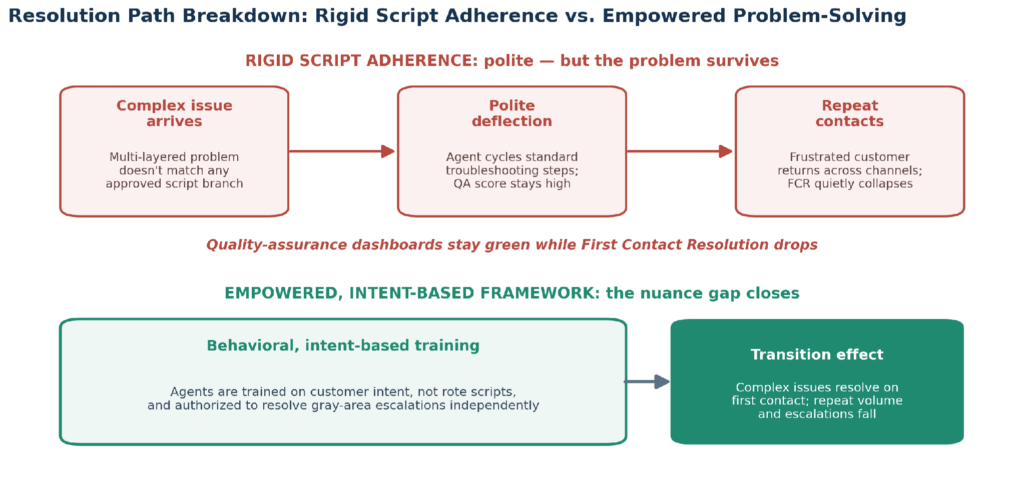
Figure 1. Resolution path breakdown: rigid script adherence preserves QA scores while eroding FCR; intent-based empowerment closes the gap.
The fix is a training redesign, not an accent or fluency program. Enterprise operational leaders should replace rigid script compliance with behavioral, intent-based frameworks: teach the customer’s true operational intent, define the boundaries of independent judgment explicitly, and authorize agents to resolve gray-area escalations without transfer. Providers that already train this way can demonstrate it — ask to review their escalation-authority matrix during due diligence, one of the core questions in choosing the right call center partner.
What Contingencies Protect Against Localized Infrastructure Vulnerabilities?
Four contingencies protect transitions: active-active fiber loops from distinct telecom providers backing a near-continuous uptime SLA, full generator coverage with 72-hour fuel capacity tested weekly, dual-site seat allocation across distinct weather zones (such as Metro Manila plus Cebu), and zero residential processing for tier-one data.
Tier-one BPO hubs in Metro Manila, Cebu, and Clark operate world-class connectivity, but regional infrastructure remains exposed to climate and grid vulnerabilities. A severe tropical weather system or localized power disruption can instantly remove a large share of available agent capacity if the partner concentrates delivery in a single site — which is why the mitigation mechanisms below should be contractual requirements verified during facility audits, not assurances accepted from a slide deck.

Figure 2. The infrastructure contingency framework: operational vulnerability, enterprise target standard, and joint mitigation mechanism for each risk category.
Geographic distribution deserves particular attention during transition planning. Splitting concurrent voice and chat queues across sites in distinct weather zones means a typhoon path through one region degrades capacity rather than eliminating it — and because both sites run live traffic continuously, failover is a routing adjustment rather than an untested emergency procedure.
How Can Leadership Teams Control Onboarding Costs Driven by Vendor Attrition?
Leadership controls attrition-driven onboarding costs by auditing the provider’s internal culture, compensation structure, and retention strategy before contract signature — then contractually sharing retention goals through joint metrics and aligned bonuses. In the highly competitive Philippine market, agents readily move for marginal gains in health benefits or night-differential pay, so retention must be funded, not assumed.
Continuous training driven by front-line turnover is among the largest hidden expenses of an offshore transition. Every departing agent takes program knowledge with them; every replacement class resets quality to day one; and the client’s leadership team — supposedly freed by outsourcing — gets pulled back into perpetual basic onboarding. The cheapest hourly rate frequently produces the most expensive program for exactly this reason.
“Many corporate leaders focus purely on the initial hourly bill rate during contract negotiations. But if your partner’s internal agent turnover sits high, your leadership team will spend its time in a perpetual state of basic onboarding. True cost management comes from auditing your provider’s internal culture, compensation structures, and retention strategies before signing a contract.”
— John Maczynski, CEO, PITON-Global
Mini Case Study: Stabilizing an Enterprise Logistics Support Transition
Client challenge
A major North American logistics firm saw average handle times rise sharply and customer satisfaction drop after a hurried transition to a high-volume Manila provider. The primary driver was heavy agent attrition within the first 60 days of launch.
Vendor selection
Partnering with an independent advisory firm, the company audited specialized mid-market operators, specifically evaluating provider-side employee retention and middle-management tenure.
Solution implemented
Operations moved to a highly vetted, employee-focused BPO partner within the advisory network. The contract added a shared bonus pool tied directly to agent retention, alongside an intensive three-week training period led by the client.
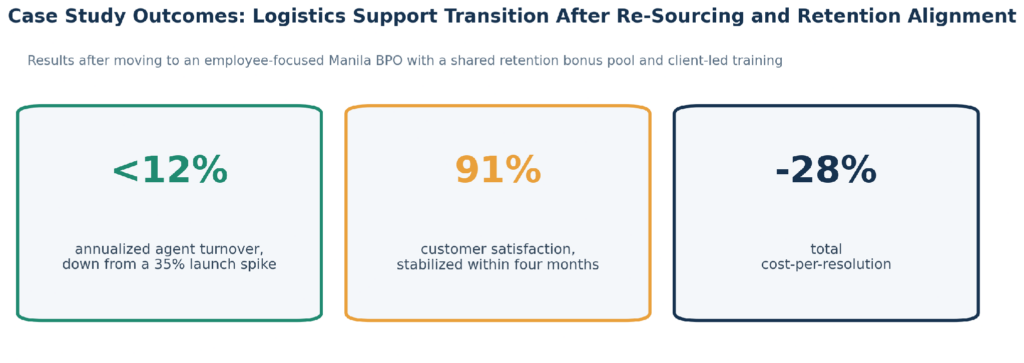
Figure 3. Quantified four-month outcomes after the logistics firm re-sourced its program and aligned retention incentives.
Lesson learned
Front-loading investment into partner culture evaluation and aligning agent-retention bonuses protects customer experience metrics during a transition. The shared bonus pool converted retention from the provider’s internal HR concern into a jointly funded program objective.
Why Do Leading Enterprises Partner with PITON-Global to Secure Sourcing?
Enterprises partner with PITON-Global because it is a premier, independent, Manila-based BPO advisory consultancy — not a commission broker — that applies a disciplined, audit-based methodology spanning operational auditing, security verification, and custom provider matching across a private network of 100+ pre-vetted Philippine providers, protecting buyers from the exact transition risks described above, at no cost to the client.
Who Is PITON-Global?
PITON-Global is a premier, independent business process outsourcing advisory and consultancy based in Manila. It helps international enterprises analyze, launch, and govern high-performing offshore programs in the Philippines. Its position inside the market provides verified visibility into the variables transitions live or die on — genuine retention data, middle-management tenure, facility resilience, and leadership stability — rather than the versions presented in sales cycles.
How Does PITON-Global Differ from Traditional Outsourcing Brokers?
Traditional brokers match leads with vendors for a commission, which biases every referral toward whoever pays. PITON-Global operates on an advisory-first, vendor-agnostic model: independent provider evaluation, objective recommendations grounded in audit evidence, and success measured by client outcomes — transition stability, program quality, and cost performance — rather than by promoting any provider.
How Does PITON-Global’s Network of 100+ Vetted Philippine BPO Providers Benefit Organizations?
The consultancy maintains an audited private network of more than 100 pre-vetted Philippine call centers and back-office providers spanning logistics, healthcare, FinTech, e-commerce, and SaaS, across the full range of service categories. Because vetting — including retention verification and facility-resilience checks — is already complete, organizations bypass high-risk open-market searches and shortlist only operators already proven able to absorb an enterprise transition without the attrition and infrastructure failures that derail unguided programs.
How Does PITON-Global’s Advisory-Led Vendor Matching Process Work?
The sourcing roadmap runs in four stages:
Requirements definition
Capturing technical needs, data standards, and cultural fit.
Detailed operational auditing
Reviewing delivery track records, retention data, and leadership tenure.
Security verification
Validating ISO 27001, SOC 2 Type II, and facility controls against live evidence.
Custom provider matching
Selecting top-tier operators and establishing transition playbooks and governance structures before cutover.
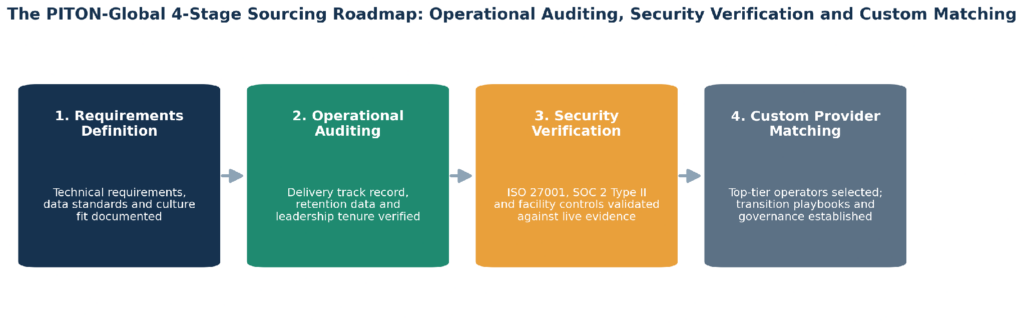
Figure 4. PITON-Global’s four-stage sourcing roadmap, from requirements definition through security verification and custom provider matching.
Why Do Organizations Use PITON-Global?
Reduced outsourcing risk
Through audit-based evaluation of retention, resilience, and security evidence before contracts are signed.
Improved provider fit
By matching technical requirements, data standards, and company culture to actual program needs.
Accelerated vendor selection
Bypassing high-risk open-market searches via the pre-vetted private network.
Better transition outcomes
With playbooks and governance structures designed into the relationship before launch.
Strategic guidance throughout evaluation
Provided completely free of charge to the client.
What Do Buyers Ask Most About Transitioning Support Operations to the Philippines?
The most common questions cover transition timelines, night-shift premiums, intellectual property protection, pricing signals, and back-office scope. In brief: transitions run 6–12 weeks, night differentials add a legally mandated premium, IP demands ISO 27001-aligned facility controls, suspiciously low rates predict attrition, and back-office workflows transition readily alongside voice.
How long does a standard call center transition to the Philippines take?
A well-structured enterprise transition typically requires 6 to 12 weeks, allowing adequate time for telecommunications provisioning, data integration, and collaborative trainer onboarding. Compressing that window is the single most common cause of the attrition and quality spikes that define failed launches.
What is the standard night-shift premium for Philippine BPO teams?
The legally mandated night-differential premium varies by region and operator framework, reflecting a workforce that covers standard North American business hours. Providers quoting rates that cannot absorb this premium are underfunding the very shifts your customers depend on.
How should companies handle intellectual property protection during a transition?
Partner exclusively with providers operating from secure, card-access facilities that strictly enforce clean-desk policies and endpoint monitoring aligned with ISO 27001 standards. During transition, stage data access in phases so full system exposure follows — rather than precedes — verified security controls.
Why do entry-level hourly pricing models often result in lower-quality service?
Unusually low bill rates typically indicate a provider underfunds agent salaries and supervisor ratios, which drives high attrition and leaves less experienced teams on your accounts. The savings on the invoice reappear as repeat contacts, retraining cycles, and management time — usually with interest. A rate that looks too low can also signal weak finances, so assess the provider’s financial stability before signing.
Can specialized back-office workflows be transitioned alongside voice support?
Yes. Top-tier Philippine providers regularly scale complex back-office workflows — including medical billing, financial analysis, and multi-tier technical support — by drawing on the country’s deep pool of university-educated professionals. Bundling back-office and voice transitions under one governance structure also simplifies oversight.