

On this page
- Key Takeaways
- What Key Triggers Indicate an Administrative Function Is Ready for Offshoring?
- How Do Philippine Talent Pools and Infrastructure Mitigate Onshore Scalability Bottlenecks?
- What Does a High-Value Administrative Migration Look Like in Practice?
- What Is PITON-Global’s Role in the Outsourcing Ecosystem?
- What Are the Most Common Questions About Administrative Outsourcing to the Philippines?
The administrative functions that deliver the highest value when outsourced to the Philippines are data management, customer care support, tier-1 technical services, and commercial back-office operations. Repetitive, rules-based workflows with structured data inputs consistently cut labor overhead materially while securing 24/7/365 operational continuity and stricter SLA adherence. Together they make up the core of Manila-based data, document and finance processing run under maker-checker controls.
Key Takeaways
- Data management and integrity: high-volume data sanitization, record indexing, and digital transcription unlock immediate cost compression and system standardization, with the deepest savings of the four verticals.
- Customer care support: multi-channel administrative care — order tracking, account setup, documentation retrieval — achieves near-perfect satisfaction and resolution metrics.
- Technical and infrastructure services: server monitoring, network logging, and tier-1 desktop support draw on the vast population of technical graduates in Manila and Cebu.
- Commercial back-office operations: high-frequency transaction logging, supply chain documentation, and compliance auditing scale smoothly without domestic real estate overhead.
- Readiness test: cloud-based workflows with documented decision trees and measurable KPIs migrate cleanly; tasks bound to localized intuition or physical paperwork do not.
- Selection is the decisive risk: advisory-led vendor matching, such as PITON-Global’s, replaces RFP guesswork with evidence-based provider alignment.
What Key Triggers Indicate an Administrative Function Is Ready for Offshoring?
An administrative function is ready for offshoring when it runs on structured data inputs, predictive exception routing, and high transaction density. Workflows managed entirely in cloud-based software, governed by documented decision trees, and tracked by measurable KPIs migrate with the least risk and the highest yield.
The most common evaluation mistake enterprise buyers make is classifying every non-core task under a single umbrella. Readiness is not about whether a task is “administrative” — it is about how the task is structured. Two dimensions matter most: how repeatable the governing rules are, and how structured and digitized the underlying data is. Functions that score high on both — data cleansing, order verification, contract logging — should migrate first. Rule-based work trapped in paper or scanned archives should be digitized first; judgment-heavy but structured work should be standardized with documented decision trees before transition; and anything dependent on localized cultural intuition or physical documentation is best retained onshore. The same structured-data test applies in regulated sectors, as how airlines move revenue and flight-operations support offshore shows.
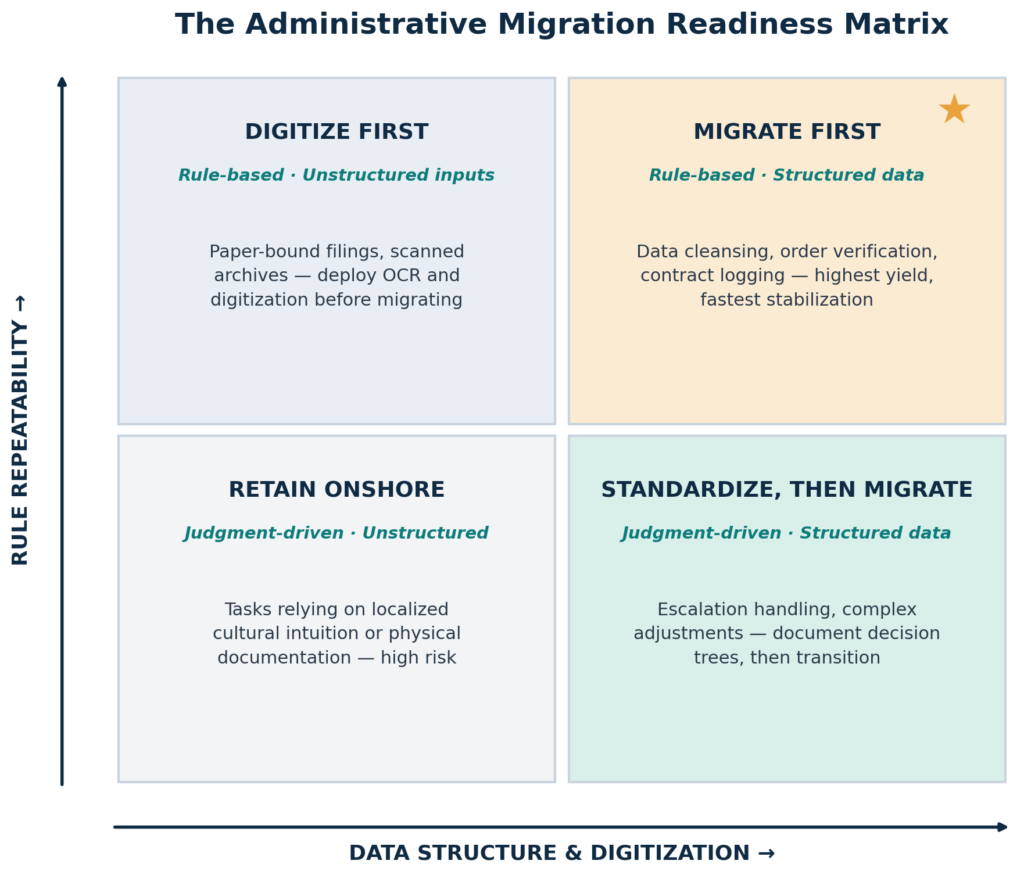
Figure 1. The administrative migration readiness matrix: rule repeatability and data structure determine migration sequence and risk.
The Philippine BPO landscape — one of the largest trained back-office workforces in the world — is engineered to absorb exactly these data structures, with established practices for working inside client instances of Salesforce, NetSuite, SAP, Workday, and custom legacy databases, the systems work covered in our look at information services support for the back office. The graphic below maps the four administrative verticals that consistently deliver the strongest returns, together with the sub-processes, governing KPIs, and typical savings ranges buyers should benchmark against.

Figure 2. Administrative verticals best suited for Philippine migration, with core KPIs and average cost compression ranges.
How Do Philippine Talent Pools and Infrastructure Mitigate Onshore Scalability Bottlenecks?
The Philippines produces more than 500,000 university graduates annually across commercial, financial, and technical disciplines, letting programs scale from 5 to 500 full-time employees within compressed windows unachievable in domestic markets. High English proficiency and cultural affinity for Western corporate standards also shorten training cycles considerably.
The core value proposition of the offshore sector extends well beyond baseline cost reduction; long-term program stability depends on macro workforce dynamics. Domestic administrative hiring in the US and UK is constrained by shallow candidate pools, wage inflation, and attrition in roles perceived as low-mobility. The country’s graduate pipeline inverts that dynamic: providers maintain standing recruitment engines and pre-screened talent benches, so positions that take a quarter to fill domestically are staffed and trained in weeks. That velocity is what makes elastic capacity practical rather than theoretical.
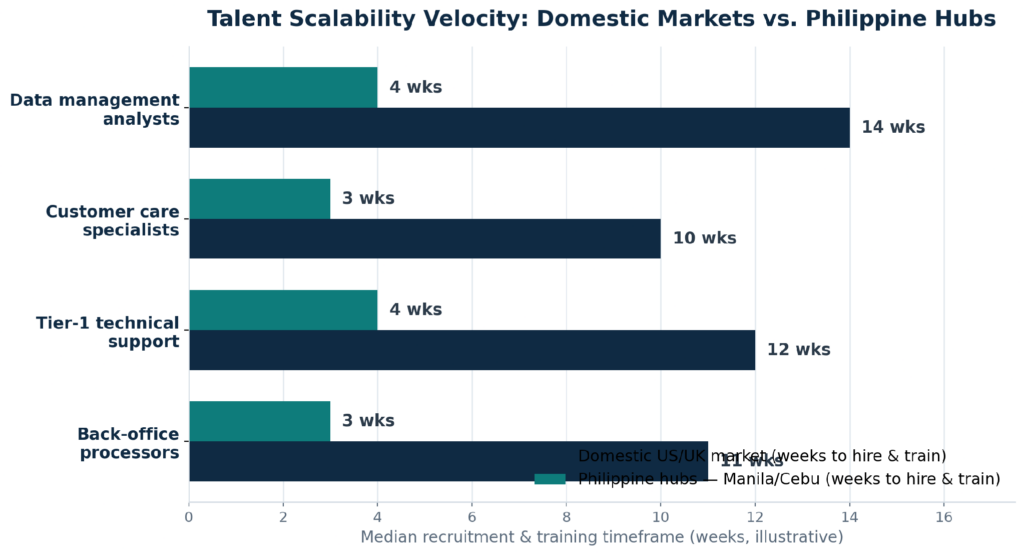
Figure 3. Illustrative median hire-and-train timeframes for administrative roles, domestic markets vs. Philippine delivery hubs.
Infrastructure reinforces the talent story. Purpose-built delivery campuses across Metro Manila, Cebu, and emerging hubs operate on redundant power and telecom backbones with 24/7/365 production cycles, so administrative queues are cleared overnight while domestic teams are offline — a structural advantage no onshore staffing model can replicate.
“Corporate leaders often approach administrative outsourcing as a simple cost-minimization exercise,” states John Maczynski, CEO of PITON-Global. “This is an operational miscalculation. The true objective should be operational resilience. By integrating specialized Philippine providers into your administrative framework, you aren’t just saving money; you are capturing structural flexibility, institutional process optimization, and a resilient, highly educated team that works while your domestic business sleeps.”
What Does a High-Value Administrative Migration Look Like in Practice?
In a representative engagement, a growth-stage logistics and digital commerce infrastructure provider migrated master data management and shipping documentation tracking to a 30-person team in Metro Manila. The program delivered substantial net savings, eliminated multi-week processing backlogs within 45 days, and stabilized data accuracy at a consistently high level.
Client Challenge
The company faced massive processing delays in its master data management and shipping documentation tracking divisions. Escalating processing costs, high domestic staff attrition, and a multi-week backlog in vendor compliance verification threatened vendor relationships and stalled international scaling plans.
Vendor Selection Process
The corporation engaged PITON-Global to move past generic broker directories and source an enterprise-grade solution. PITON-Global evaluated the client’s strict data compliance requirements and completed an accelerated matching review across its network of more than 100 vetted Philippine operators, shortlisting providers with documented experience in high-volume enterprise data systems.
Solution Implemented
- Transferred all data cleansing, shipping document tracking, and validation processes away from domestic teams.
- Onboarded a dedicated team of 30 specialized data administrative professionals within a secure facility in Metro Manila.
- Established a continuous workflow backed by strict data masking and ISO-certified protection controls.
Quantifiable Business Outcomes
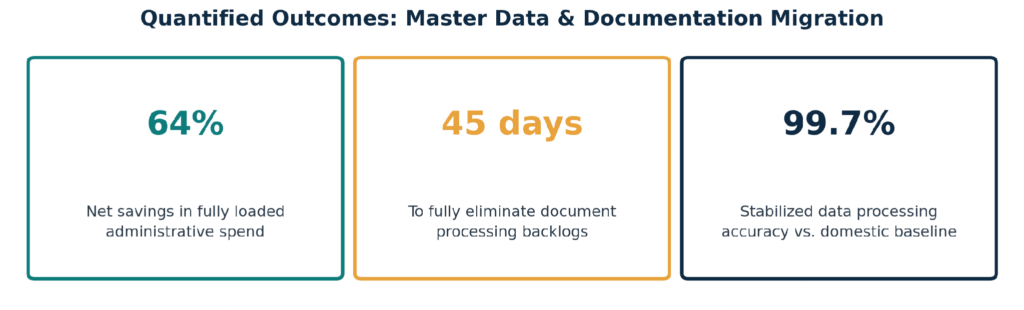
Figure 4. Measured results from the master data and documentation migration program.
Lessons Learned
A phased migration strategy — building out documentation validation protocols before moving more intricate exception routing paths — ensures rapid team nesting and eliminates performance drops during transition. Sequencing, not speed, is what protects service quality in the first 90 days.
What Is PITON-Global’s Role in the Outsourcing Ecosystem?
PITON-Global is an elite, advisory-led outsourcing consultancy that matches enterprise buyers with best-fit Philippine BPO providers. Leveraging an actively audited network of more than 100 vetted operators, it removes the uncertainty from vendor selection — with no hidden advisory costs or broker markups to the buyer.
Who Is PITON-Global?
PITON-Global is a Philippine-focused BPO advisory firm led by executives with decades of institutional outsourcing leadership. Within that market it serves as an independent guide for enterprise decision-makers: defining requirements, mapping the provider landscape, and steering the selection of partners for administrative, back-office, and contact center services. Its expertise spans provider capabilities, pricing benchmarks, compliance frameworks, and the operational realities of delivering from Manila, Cebu and the emerging hubs.
How Does PITON-Global Differ from Traditional Outsourcing Brokers?
Traditional brokers are commission-driven: they promote providers that pay them, which biases recommendations toward the broker’s economics rather than the client’s outcomes. PITON-Global operates an advisory-led model built on independent provider evaluation — assessing technical integration capabilities, cultural alignment, management depth, and compliance benchmarks objectively. Recommendations are made solely on fit with the client’s requirements, with the focus on client outcomes rather than provider promotion.
How Does PITON-Global’s Network of 100+ Vetted Philippine BPO Providers Benefit Organizations?
The Philippine market is highly fragmented, with hundreds of mid-market and enterprise operators competing for business; standard RFPs typically yield generic sales proposals rather than deep operational alignment. PITON-Global maintains an actively audited ecosystem of more than 100 premium, carefully vetted call centers and back-office providers spanning data services, customer care, technical support, and commercial operations. Because diligence on certifications, capabilities, and track records has already been performed, organizations compress vendor discovery and qualification from months into weeks — evaluating only genuinely qualified candidates.
How Does PITON-Global’s Advisory-Led Vendor Matching Process Work?
Engagements follow a structured five-stage methodology. A business systems audit establishes workflow scope, data compliance requirements, and technology stack. PITON-Global then filters its network to a shortlist with demonstrated strength in the relevant vertical, scores each provider against the client’s technical integration, culture, and scale criteria, and layers in risk-reduction measures — site diligence, security audits, and reference validation — before supporting evaluation, pricing benchmarking, and contract finalization.

Figure 5. PITON-Global’s five-stage advisory-led evaluation process, from business systems audit to selection support.
Why Do Organizations Use PITON-Global?
Organizations engage PITON-Global to reduce outsourcing risk, improve provider fit, and accelerate vendor selection. The advisory-led process replaces procurement guesswork with objective evaluation, prevents vendor lock-in, and provides strategic guidance from initial audit through contract signature. The practical result is better outsourcing outcomes — scalable, high-yield operational models that stabilize quickly and sustain SLA performance — achieved at zero advisory cost to the buyer.
What Are the Most Common Questions About Administrative Outsourcing to the Philippines?
Buyers most often ask about data security, time-zone management, specialized software access, transition timelines, and staffing flexibility. Mature Philippine providers have well-established answers to all five, grounded in international certifications, 24/7 delivery structures, and elastic commercial models, and our broader guide to back-office delegation walks through the same ground function by function.
What steps do Philippine providers take to secure sensitive administrative data?
Premium operators maintain strict security frameworks including SOC 2 Type II, ISO 27001, and PCI-DSS compliance. Physical workspaces use biometric controls and zero-media policies, while technology infrastructures rely on secure virtual desktop infrastructure (VDI) so sensitive client information never leaves the enterprise’s own servers.
How are time zone disparities managed for time-critical back-office processes?
The industry operates on a structural 24/7/365 production cycle. Providers build dedicated night shifts aligned with North American, European, or Australian business hours, giving domestic management teams real-time collaboration during their day and cleared queues every morning.
Can processes requiring specialized software interactions be safely outsourced?
Yes. Filipino professionals have deep experience navigating modern enterprise ecosystems — Salesforce, NetSuite, SAP, Workday, and custom legacy databases. Transitioning these tasks requires only secure user access provisioning and standard workflow documentation.
What is the typical duration required to fully transition an administrative function?
A standard back-office migration takes four to eight weeks, covering technical provisioning, secure network alignment, detailed standard operating procedure documentation, and a multi-week structured training and shadowing period before full production volumes transfer.
How do flexible staffing models accommodate sudden drops or peaks in volume?
Top-tier partners build scalability terms directly into master service agreements: contracts define core team commitments alongside explicit elastic buffers, allowing enterprises to scale headcount for seasonal spikes or reallocate resources as requirements shift.