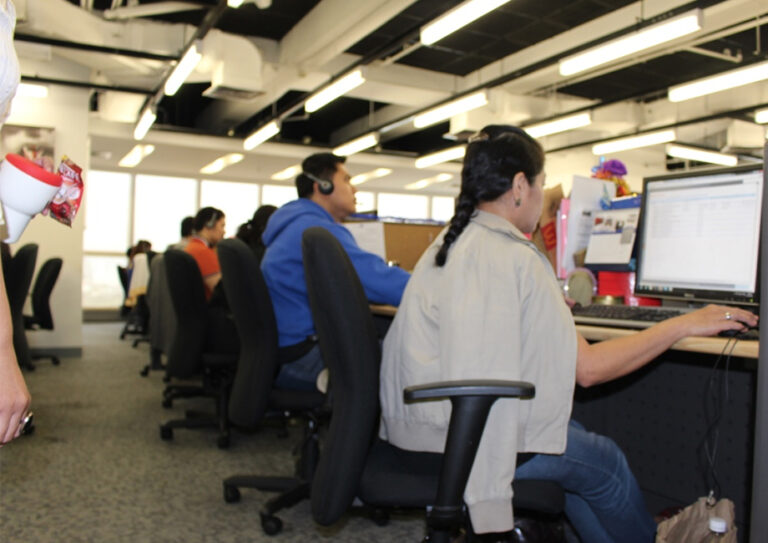

A remote contact center workforce lets a US company grow customer support faster than it could by building seats, but only if the people behind it are hired, trained and supervised for home-based work. For most North American buyers that workforce sits offshore, and the questions that decide success are the ones covered in the talent pipeline behind an offshore team: who gets recruited, how they are prepared and why they stay. This post looks at what changes when those agents work from home or on a hybrid schedule in the Philippines, and what a buyer should require before scaling a program that way.
When a remote agent model makes sense
A remote or hybrid model makes sense when you need to add headcount quickly, cover shifts that are hard to staff in an office, or reach talent that lives far from the main business districts. Philippine providers have run home-based agents at scale for years, so the model is proven; it is less suitable for work that needs tight physical controls or constant side-by-side coaching.
Policy now supports the option. The CREATE MORE Act, Republic Act No. 12066, signed in November 2024, lets registered business enterprises run work-from-home arrangements for up to half of their workforce without losing their incentives, as the Daily Tribune reported at the signing. For a buyer, that means a Philippine provider can offer home-based or hybrid seats inside its registered operation rather than as an informal workaround.
Three delivery models compared
| Model | Best for | Main trade-off |
|---|---|---|
| On-site | Payments, health records, new programs still being stabilized | Seat build-out limits how fast you can grow |
| Hybrid | Established queues with steady volume and mature agents | Needs clear rules on which work happens where |
| Fully remote | Overflow, after-hours coverage, seasonal peaks, provincial hiring | Supervision and security must be engineered, not assumed |
PITON-Global’s capabilities overview lists all three models across eight governed delivery hubs, from Metro Manila and Cebu to Davao, Iloilo and Baguio. Many buyers start on-site and move tenured agents to hybrid once quality is stable.
Hiring agents who can work without a floor
Remote hiring adds a second test on top of the usual one: can this person perform without a supervisor a few feet away? The standard screening for English, empathy and problem-solving still applies; the vendor then has to check the candidate’s work habits and home environment.
- Home setup checks confirm a quiet, private workspace, a wired or stable broadband connection with a backup, and power backup for brownouts and typhoon season.
- Behavioral interviews probe self-discipline, time management and how the candidate asks for help when stuck.
- Prior experience matters more than in an office program; many providers reserve home-based seats for agents with proven tenure and quality scores.
- Spoken-English screening is just as strict, because a remote agent has no nearby coach to rescue a difficult call. Clarity training, such as accent neutralization work, continues after hire.
The upside is reach. A remote model lets a vendor recruit strong candidates from provincial cities and towns across the Philippines, people who would never commute into Makati or Bonifacio Global City, widening the pool and often improving tenure.
Training and ramp without a classroom
Virtual onboarding works when it is more structured than classroom training, not less. The best Philippine providers run live instructor-led sessions on video, product simulations, graded assessments at each stage and a virtual nesting period before agents take unsupervised contacts.
During nesting, a remote “floor walker” monitors a small group through a shared chat channel and can join or whisper into a live call. New agents should have an obvious, fast way to ask a question mid-contact. Without that safety net, first-month quality drops and early attrition rises.
Skill-building does not stop at go-live. As automation absorbs simple contacts, the calls left for people are harder, and programs need agents who can troubleshoot, de-escalate and use several systems at once. Our piece on how vendors are closing the skills gap shows how upskilling is being built into ongoing training rather than bolted on.
Supervision and quality at a distance
Remote quality holds when supervision is designed in: smaller teams per leader, more frequent coaching and full visibility into every interaction. The measures that protect an office program still apply; they simply have to be delivered through software.
- Team leader spans should be tighter than on-site, with daily huddles on video and scheduled one-to-one coaching.
- Every call should be recorded and quality sampling should be at least as frequent as for office agents, with calibration sessions that include your own team.
- Real-time adherence tools should show who is logged in, on break or idle, so the vendor’s workforce managers can react within minutes.
- Reporting should split results by location type so you can see whether home-based agents perform differently from site-based ones.
Security controls for home-based agents
Home-based work is only acceptable when the data never really leaves the vendor’s controlled environment. That means agents work inside a virtual desktop or locked-down, vendor-issued laptop, with no local storage, no printing and multi-factor login.
Beyond the device, ask a Philippine vendor about clean-desk and no-phone rules, how it applies the country’s Data Privacy Act to home workers, how the vendor verifies who is at the keyboard, how payment card data is kept out of the agent’s view, and how HIPAA-covered records are handled. Some work, especially payments and health data, may belong on-site even in a largely remote program. Our overview of compliance and security for offshore programs covers the audit questions in detail.
Keeping a dispersed team engaged
Remote agents in the Philippines leave for the same reasons office agents do, plus one more: isolation. A provider that treats home-based staff as a cheaper seat rather than part of a team will see it in attrition, and you will see it in quality and in constant retraining.
What works in the Philippines is familiar from office programs: visible career paths, recognition tied to customer feedback, health benefits and regular in-person days that keep agents connected to their leaders and peers. Our analysis of how providers maintain workforce stability explains why provincial hiring and structured progression keep tenure up. Ask the vendor for tenure and attrition data split between remote and on-site agents on comparable accounts.
A scaling plan to hold the vendor to
Scaling a Philippines-based remote team is safest in written stages, each with a quality gate before the next wave of hires. That keeps growth from outrunning training and supervision.
- Launch a pilot team, usually on-site or hybrid, and stabilize quality, handle time and resolution against agreed targets.
- Agree the criteria an agent must meet to move to home-based work, such as tenure, quality scores and a passed home-setup audit.
- Add hiring waves in fixed sizes with a named trainer and team leader for each wave, not a pooled bench.
- Hold a quality review after each wave and pause further growth if results slip.
- Keep a contingency plan for outages, Philippine typhoon season and connectivity failures, including the option to move agents back to a site.
Frequently asked questions
Is a home-based offshore team as reliable as an on-site one?
It can be, when agents are selected for remote work, equipped with backup power and connectivity, and supervised closely. Reliability problems usually trace back to vendors that moved agents home without changing how they hire, monitor and support them.
How quickly can a remote program add agents?
Faster than a site build, because seats do not need to be constructed, but not faster than recruitment and training allow. The limit is how many trainers and team leaders the vendor can assign without diluting quality.
Which work should stay on-site?
Work that touches full payment card numbers or sensitive health records, early-stage programs still being stabilized, and any queue where your auditors or regulators require physical controls.
What should a buyer ask a provider about remote agents?
Ask how remote candidates are screened, what equipment and backup they receive, how leaders supervise them, how data is contained on the device, and what tenure and quality look like for home-based agents compared with site-based ones.