

30-Second Executive Briefing: Regulatory Reporting & Compliance Outsourcing Philippines
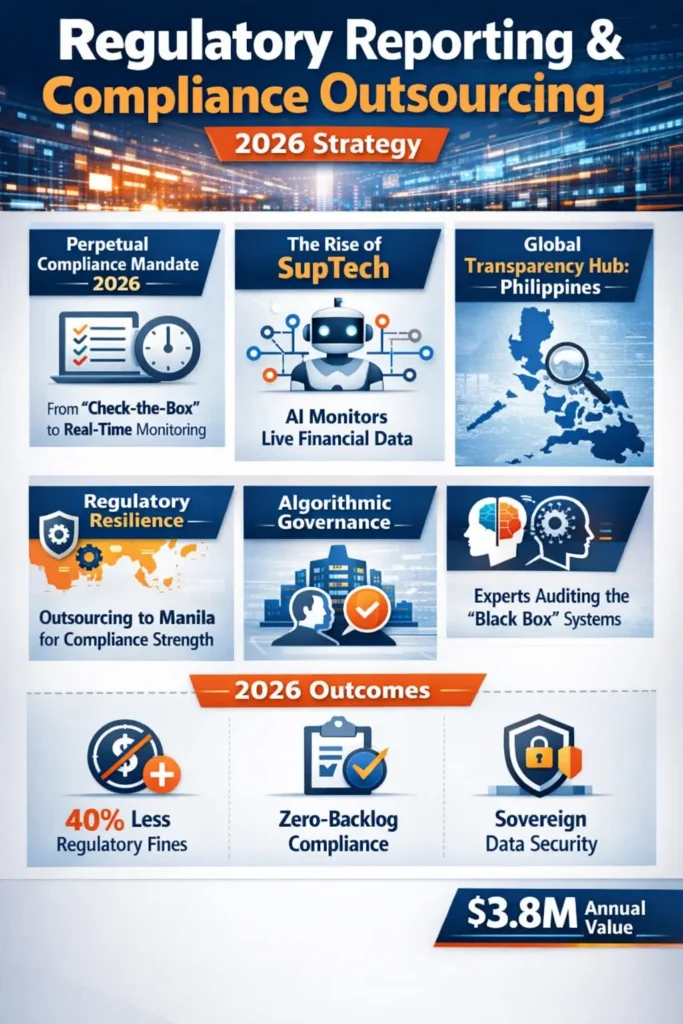
- Perpetual Compliance Mandate: In 2026, regulatory compliance has shifted from a periodic “check-the-box” reporting obligation to a perpetual, real-time operational requirement.
- The Rise of SupTech: Regulators now utilize Supervisory Technology (SupTech), deploying AI agents to monitor institutional telemetry and data integrity via direct, live APIs.
- Global “Transparency Desk”: The Philippines has solidified its role as the primary hub for global finance governance, offering specialized “Model Audit Squads” to oversee AI-driven banking algorithms as part of audit-ready financial operations for regulated firms.
- Regulatory Resilience: For C-suite leaders, outsourcing to Manila is a strategic move to build Regulatory Resilience, ensuring data pipelines meet mandates like the updated SEC Regulation S-P and, for stablecoin platforms, the GENIUS Act.
- Algorithmic Governance: Leveraging Manila-based experts provides the human-in-the-loop oversight necessary to govern “black box” systems, turning compliance from a liability into a competitive moat.
Executive Summary
The cost of non-compliance in 2026 has become an existential threat, as automated regulatory fines now trigger instantly upon data discrepancies. This blueprint outlines the strategic deployment of Philippine compliance hubs to manage High-Velocity Governance. Key focus areas include Model Risk Management (MRM) for AI explainability, real-time Suspicious Activity Report (SAR) filing, and the management of Sovereign Data Perimeters. By integrating Filipino “AI Orchestrators” into the compliance stack, financial institutions are achieving a zero-backlog integrity state, reducing regulatory friction by 40%, and ensuring that late-stage valuations and IPO readiness are never compromised by “compliance latency.” This foundation of auditable integrity allows for the seamless transition to F&A Outsourcing Philippines: 2026 Operational Velocity Blueprint, where compliant data is transformed into real-time financial leadership. For a comprehensive view of how governance, SupTech readiness, and AI oversight align within offshore operations, explore the full Financial Services Outsourcing Philippines (2026): A Strategic Blueprint.
Mastering “Perpetual Compliance”: The 2026 Manila Strategy for High-Velocity Governance
In 2026, regulators like the SEC and FINRA utilize AI Agents to monitor institutional telemetry in real-time, making automated fines an instant threat to liquidity. This strategy details the Manila Solution, where specialized “Regulatory Intelligence Units” act as a human safety valve for SupTech Data Triage. By deploying Manila-based Model Audit Squads, firms can provide human-readable “Decision Narratives” for AI-driven credit scoring or AML flags within the mandatory 24-hour window. This pivot delivers a 40% reduction in regulatory friction while ensuring that sovereign data perimeters remain secure.
Manual-first reporting cannot keep pace with 2026 SupTech monitoring; this strategy deploys Compliance-as-a-Service (CaaS) to ensure constant audit-readiness. Utilizing Clean Room Models, Manila hubs resolve AI Explainability challenges and file real-time Suspicious Activity Reports (SARs) without raw PII leaving domestic clouds. This model delivers Zero-Finding Audit Readiness and ensures absolute Biometric Accountability for console access. It transforms compliance from a defensive burden into a high-speed engine of Governance Excellence and investor trust.
The 2026 Shift: From “Batch Reporting” to “Perpetual Transparency”
The traditional era of static PDF reporting has ended. In 2026, regulators utilize autonomous agents to ingest live data from financial institutions. This “Regulator-in-the-Machine” model requires a new kind of support: the SupTech Data Triage team.
Manila has positioned itself as the global gateway for this triage. While AI correlates the data, Filipino specialists—often dual-trained in law and data analytics—ensure the data hygiene of the APIs feeding the regulators. They act as the “Human Safety Valve,” verifying that the telemetry being sent to agencies like the SEC or FINRA is accurate, contextualized, and free from the “hallucinations” common in unmonitored autonomous systems.
Model Risk Management: Auditing the Algorithmic Black Box
Under 2026 mandates from the US CFPB and the EU AI Act, financial firms must prove that their AI models (for credit scoring or AML) are unbiased and explainable. This has created a massive demand for Model Audit Squads.
Offshore compliance centers now host dedicated units that perform “Explainability Audits.” When an AI denies a loan or flags a high-net-worth client, these specialists document the “reasoning path.” This documentation is the primary defense during an SEC examination, turning a firm’s AI intellectual property from a potential liability into a verified regulatory asset.
Table 1: 2026 Regulatory Functional Matrix – Manila Execution Layer
| Compliance Pillar | Philippine Specialist Role | Strategic Impact |
| Real-Time SAR Filing | Drafts narratives for AI-flagged alerts. | Zero-backlog integrity; no late-filing fines. |
| GENIUS Act Reporting | Manages 1:1 reserve transparency for stablecoins. | Uninterrupted license security & trust. |
| Model Risk Management | Audits AI credit/compliance models for bias. | Ethical AI governance; lawsuit mitigation. |
| SupTech Data Triage | Manages integrity of real-time regulatory APIs. | Reduced automated fine exposure. |
| Sovereign Data Privacy | Executes GDPR/S-P requests via Zero-Trust. | Bulletproof privacy operations. |
Zero-Trust Governance & Data Residency
A defining challenge of 2026 is Data Sovereignty. Many jurisdictions now strictly prohibit raw personally identifiable information (PII) from leaving domestic cloud environments.
Manila hubs have solved this through the “Clean Room” Compliance Model:
- Encrypted Transit Only: Manila-based analysts never access raw, unencrypted data.
- Sovereign Data Perimeters: Using non-persistent VDI (Virtual Desktop Infrastructure), the data stays in the US or EU; only a “pixel stream” is viewed by the analyst.
- Biometric Accountability: 2026 centers utilize behavioral biometrics to ensure the person accessing the compliance console is the specific authorized expert, satisfying the “Access Control” requirements of the 2026 DORA (Digital Operational Resilience Act) standards.
Table 2: ROI of Regulatory Resilience (Mid-Market Bank Example)
| Factor | Legacy Compliance Cost | 2026 PH-Hybrid Cost | Net Annual Gain |
| Regulatory Labor | $4,200,000 | $1,450,000 | $2,750,000 Savings |
| Automated Fine Mitigation | $800k (est. annual leakage) | < $50k (Proactive Triage) | $750,000 Gain |
| Audit Readiness (PBC) | 4,000 Human Hours | Continuous/Automated | $300,000 (Fee Reduction) |
| Total 2026 Impact | — | — | $3.8M Annual Value |
Expert FAQs: SupTech, Audits and Explainability
Q1: How do Manila teams stay updated on the “weekly” shifts in SEC and FINRA priorities?
Expert Answer: In 2026, leading Manila providers operate “Regulatory Intelligence Units” that function like a legal newsroom. They utilize AI to monitor the Federal Register and SEC Staff Statements in real-time. This intelligence is fed into the agents’ Agentic Copilots, ensuring that a Manila-based analyst is applying the “2026 Examination Priorities” (like the new Regulation S-P rules) often before onshore generalist teams have even completed their internal briefings.
Q2: Can an offshore team support the “Right to Explanation” for AI-driven financial decisions?
Expert Answer: Absolutely. This is the cornerstone of the 2026 Model Risk Management workflow. Filipino specialists are trained to pull the “Model Log” for any AI-generated decision and write a human-readable “Decision Narrative.” This ensures that if a customer or regulator challenges a loan rejection, the firm can provide a compliant, non-discriminatory explanation within the 24-hour window required by 2026 consumer protection laws.
Q3: What is “Compliance-as-a-Service” (CaaS) in the context of 2026 outsourcing? Expert Answer: CaaS is a shift from hiring “staff” to buying “outcomes.” Instead of paying for hours worked, firms pay for “Zero-Finding Audit Readiness.” The offshore partner takes full ownership of the reporting pipeline, assuming responsibility for the accuracy and timeliness of filings. This model aligns the BPO’s incentives with the firm’s regulatory standing, making them a true partner in risk management rather than just a service provider, the same outcome-based logic now applied to accounts receivable and cash-flow operations.