

Philippine healthcare outsourcing firms maintain brand alignment by embedding a hospital’s core values into recruitment, delivering continuous clinical brand-voice training, and running joint governance with hospital leaders. Advanced speech analytics and natural cultural empathy keep every patient interaction synchronized with the hospital’s care philosophy — so HIPAA-trained patient CX teams for US hospitals operationalize the brand rather than dilute it.
Key Takeaways
- Cultural alignment: Offshore partners pair the innate empathy of local agents with rigorous training on U.S. healthcare consumer expectations.
- Joint governance: Weekly calibration sessions between hospital clinical leaders and BPO quality-assurance teams eliminate brand drift.
- Tech-driven quality: Speech analytics and natural language processing track empathy metrics and brand-voice adherence in real time.
- Customized playbooks: Specialized protocols translate corporate mission statements into actionable, conversational patient scripts.
- Clinical extension, not vendor: The best partners operationalize brand standards as clinical protocols, executed with the precision of a physician’s order.
What Operational Frameworks Guarantee Brand Continuity Across Borders?
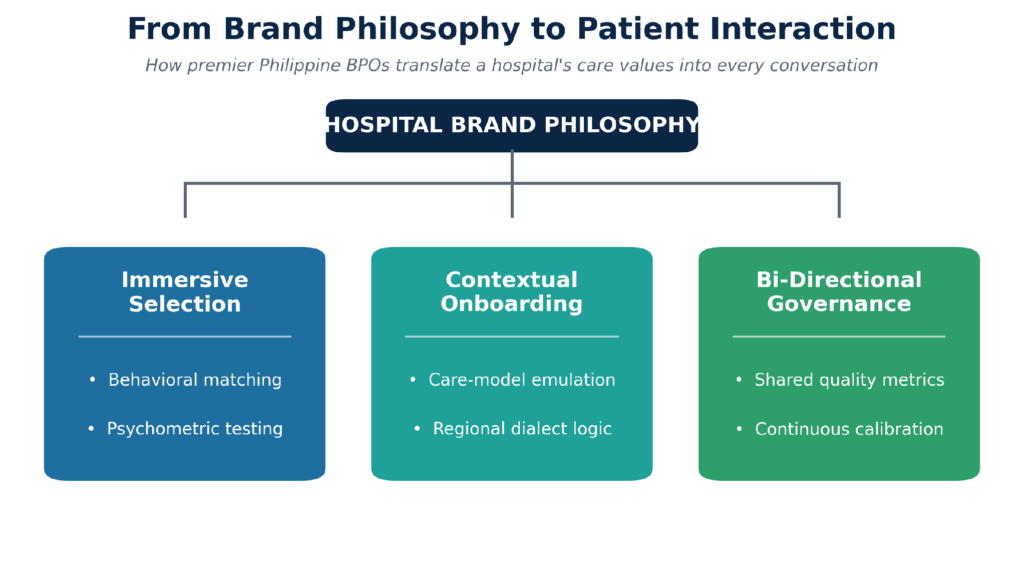
Premier healthcare BPOs use a three-tiered framework — Immersive Selection, Contextual Onboarding, and Bi-Directional Governance — to carry a hospital’s brand from philosophy to frontline execution. Each tier converts abstract care values into concrete recruitment criteria, training modules, and shared quality metrics.
To transition a hospital’s patient experience seamlessly offshore, the strongest providers begin at recruitment — screening candidates not only for technical competence or neutral accents, but for behavioral alignment with the hospital’s specific patient-care philosophy. The framework then flows downstream into onboarding and ongoing governance, so the brand is reinforced at every stage rather than assumed.
Immersive Selection
Recruitment goes beyond résumé screening. Behavioral matching and psychometric testing identify agents whose natural communication style aligns with the hospital’s values, ensuring brand fit is built in before training even begins.
Contextual Onboarding
Onboarding extends well past standard HIPAA compliance into care-model emulation and regional dialect logic. Agents study the health system’s regional patient demographics, socio-economic factors, and historical satisfaction challenges, so they understand the people they serve — not just the scripts.
Bi-Directional Governance
Quality is co-owned. Shared metrics and continuous calibration sessions keep hospital clinical leaders and BPO QA teams aligned on patient sentiment and brand voice, catching and correcting drift before it reaches patients. The table below contrasts this brand-centric model with the traditional outsourcing approach.

The top Philippine healthcare BPOs don’t just mimic a brand — they operationalize it. They treat brand standards as clinical protocols, executing them with the same precision as a physician’s order. — John Maczynski, CEO, PITON-Global
How Are Empathy and Tone Quantified to Meet Clinical Standards?
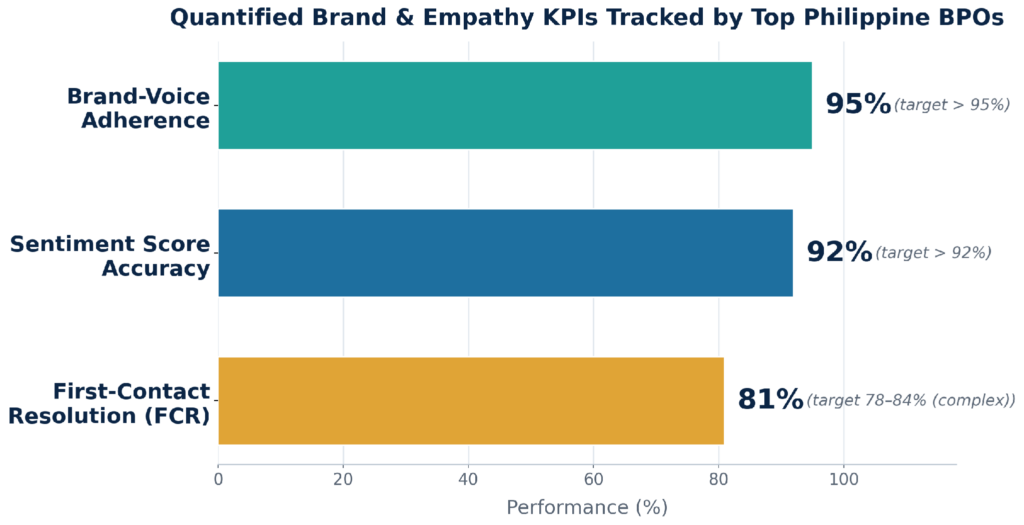
Top providers replace subjective evaluation with quantitative data. AI-powered speech analytics measure each interaction against behavioral markers — sentiment, brand-voice adherence, and resolution — with explicit targets, turning empathy and tone into trackable, coachable metrics.
Where legacy QA relied on a supervisor’s spot-check of a handful of calls, modern healthcare BPOs score interactions continuously. Natural language processing reads vocal tone, pacing, and stress markers, then benchmarks them against defined thresholds, giving both the provider and the hospital an objective view of brand fidelity at scale, the same analytics-led thinking behind digital-first innovation in pharma support.
The Core Brand & Empathy KPIs
- Sentiment Score Accuracy: NLP evaluates patient vocal tones and stress markers to confirm agent empathy. Target: an overwhelmingly positive or neutral sentiment share, agreed with the hospital.
- Brand-Voice Adherence: automated tracking verifies mandatory empathetic openings, brand phrases, and supportive closings. Target: near-complete compliance.
- First-Contact Resolution (FCR): resolving billing, scheduling, or pre-authorization queries on the first call to reduce patient frustration. Target: a high first-call rate calibrated to the complexity of healthcare queries.
What Results Can a Health System Expect from a Brand-Aligned Partner?
A multi-state U.S. health system that had lost ground after rapid expansion rebounded patient satisfaction within five months of deploying a brand-aligned Philippine team — while cutting average handle time by 74 seconds and sharply lowering patient-services cost, saving millions of dollars a year.
The Challenge
A multi-state U.S. hospital network saw a marked drop in patient satisfaction following a rapid internal expansion, driven by fragmented scheduling and inconsistent billing communication that diluted its once-cohesive patient experience.
The Solution
The system engaged PITON-Global to identify a specialized Philippine partner capable of high-touch patient interactions under strict brand alignment. PITON-Global matched the client with a mid-sized, healthcare-exclusive BPO from its network of more than 100 providers. The provider deployed a dedicated team of 80 healthcare agents — including U.S.-registered nurses for clinical triage support — co-authored a 120-page “Patient Interaction Blueprint” mirroring the hospital’s patient-first philosophy, and integrated its speech-analytics software directly with the hospital’s Epic EHR.
The Outcomes
- Patient satisfaction: rebounded strongly within five months of deployment.
- Average handle time: decreased by 74 seconds through optimized workflows.
- Operating cost: patient-services costs fell sharply, saving millions of dollars annually.

Lessons Learned
Success depends on treating the provider as a clinical extension of the hospital rather than an external vendor. Early integration of the EHR and shared quality metrics were decisive in restoring a consistent, on-brand patient experience, and the same discipline carries over to billing and other healthcare financial operations.
How Do Healthcare Brands Mitigate Compliance and Communication Risks?
Leading BPOs apply dual-layer protection: information security and cultural calibration. The first guards patient data with HITRUST CSF, SOC 2 Type II, and clean-desk controls; the second guards brand voice through accent-localization workshops and ongoing study of the U.S. healthcare landscape.
The benefits of offshore healthcare support are substantial, but protecting patient trust requires deliberate management of two distinct risks — data privacy and brand preservation. Top providers address them in parallel.
Information Security
Reputable providers operate in highly secure environments featuring HITRUST CSF certification, SOC 2 Type II compliance, biometric access control, network firewalls that block external data transmission, and strict zero-tolerance clean-desk policies — all monitored continuously by dedicated internal risk officers.
Cultural Calibration
To prevent communication gaps, teams take part in ongoing accent-localization workshops and analyze current U.S. healthcare news. This helps agents understand the financial and emotional challenges patients navigate within the U.S. healthcare ecosystem, so empathy reads as authentic rather than scripted, a prerequisite for consistent communication in patient care.
How Does PITON-Global Help Hospitals Find a Brand-Aligned Philippine BPO Partner?
PITON-Global is an advisory firm that connects healthcare brands with a vetted network of more than 100 top-tier Philippine providers. Through neutral, advisory-led matching — not commission-driven brokerage — it pairs hospitals with specialized BPOs offering deep clinical knowledge, robust security, and proven brand-alignment processes.
Who Is PITON-Global?
PITON-Global is a specialized BPO advisory and outsourcing consultancy that bridges healthcare brands and premium Philippine service providers. Within a crowded outsourcing landscape, it serves as an expert navigator — applying deep knowledge of provider capabilities, security posture, and brand-alignment maturity to guide high-stakes selection decisions for hospitals and health systems.
How Does PITON-Global Differ from Traditional Outsourcing Brokers?
Traditional brokers favor large, generic call centers that pay the highest commissions, which often leaves brand-sensitive health systems poorly matched. PITON-Global provides neutral, advisory-led matching instead. It recommends on fit — clinical depth, security, and brand-alignment capability — rather than payout, and is accountable to client outcomes rather than provider promotion.
How Does PITON-Global’s Network of 100+ Vetted Philippine BPO Providers Benefit Organizations?
Access to a curated network of more than 100 vetted, top-tier providers lets organizations bypass lengthy procurement cycles and move straight to a credible shortlist. Because every provider is pre-screened for clinical specialization, security infrastructure, and brand-alignment process, hospitals avoid the costly trial-and-error of qualifying unknown vendors and reduce operational risk from the outset.
How Does PITON-Global’s Advisory-Led Vendor Matching Process Work?
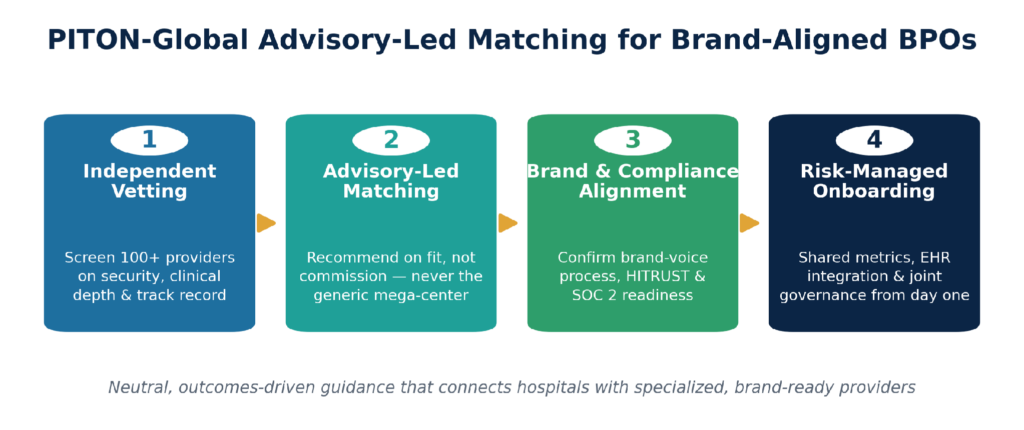
The process moves through four objective stages: independent vetting of providers on security, clinical depth, and track record; advisory-led matching based on fit rather than commission; brand and compliance alignment to confirm brand-voice process and HITRUST and SOC 2 readiness; and risk-managed onboarding built on shared metrics, EHR integration, and joint governance from day one.
Why Do Organizations Use PITON-Global?
Organizations turn to PITON-Global to minimize operational risk, bypass lengthy procurement, and establish high-performing offshore patient-care teams. Rather than gamble on a generic mega-center, leaders gain neutral guidance, a shortlist of brand-ready specialists, and governance that protects both patient data and brand reputation well beyond go-live.
What Else Should Hospital Leaders Know About Brand-Aligned Outsourcing?
Common questions concern emotionally charged complaints, regional dialect, privacy standards, clinical escalation, and cost savings. In each case, top-tier providers are built to protect both the patient relationship and the hospital’s brand.
How do Philippine agents handle complex, emotionally charged patient complaints?
Agents receive specialized training in de-escalation, patient psychology, and active listening. Structured frameworks help them acknowledge distress, validate feelings, and offer clear solutions, protecting the hospital’s reputation for compassionate care during difficult conversations.
Can a Philippine BPO mirror a hospital’s specific regional dialect and cultural nuances?
Yes. Top providers build regional dialect logic and localized cultural context into training, so agents learn the idioms, communication paces, and preferences of the specific U.S. regions they serve.
What healthcare privacy standards are enforced within Philippine BPOs?
Reputable providers enforce strict HIPAA, HITECH, and PCI-DSS compliance, with biometric access control, firewalls that block external data transmission, and continuous monitoring by dedicated internal risk officers.
How are clinical escalations handled between the offshore team and the hospital?
Automated workflows route complex clinical questions and urgent issues immediately to the hospital’s internal clinical team through secure, integrated EHR pathways, preserving patient safety and continuity of care.
What is the average cost saving when outsourcing patient interactions to the Philippines?
Organizations typically achieve substantial total operational savings versus onshore teams, freeing capital to reinvest in frontline clinical personnel and facility upgrades.