
The Philippines did not become a serious partner for US hospitals, payers and digital health companies by accident. Its place in the health tech evolution rests on three things built over two decades: clinically educated English speakers, dependable digital infrastructure, and a data-protection regime that maps onto HIPAA. Buyers who hand work to Filipino healthcare teams through outsourced healthtech support operations today are drawing on all three. This article explains each foundation, the services it made possible, and what it means for a US organization deciding what to move offshore next.
Why US health systems now send digital work to Filipino teams
They send it because the work itself went digital, and Filipino teams moved with it. As electronic records, payer portals, patient apps and virtual visits replaced paper and phone trees, almost every administrative and patient-support task became something that can be done securely from a distance.
Philippine providers followed that change step by step, from transcription and claims keying, to coding and billing, to patient access and telehealth coordination, and now to reviewing the output of AI tools. Each step needed new skills and new controls, and each one widened the set of functions a US buyer could consider. The demand is still growing: according to IBPAP figures reported by the Philippine Star in January 2026, the country’s IT-BPM industry earned above $40 billion in 2025, and its trade association named healthcare as one of the main growth drivers for 2026.
The talent and infrastructure behind the shift
Clinical education plus English fluency is the core of the offer, and modern delivery infrastructure lets that talent work on US systems in real time.
A workforce that already speaks the language of care
The Philippine education system produces large numbers of nursing, pharmacy, medical technology and allied-health graduates, and many of them build careers in healthcare operations rather than hospital wards. They arrive knowing anatomy, medical terminology and clinical workflow, which shortens training for coding, utilization review and patient education. English is an official language of instruction, and the EF English Proficiency Index 2025 places the country at a score of 569, ranked 28th worldwide and in its high-proficiency band. For US buyers, that combination means agents who can read a chart and talk to an anxious patient in the same shift. The profile of the Philippine talent pool covers the wider workforce in more depth.
Infrastructure and flexible work models
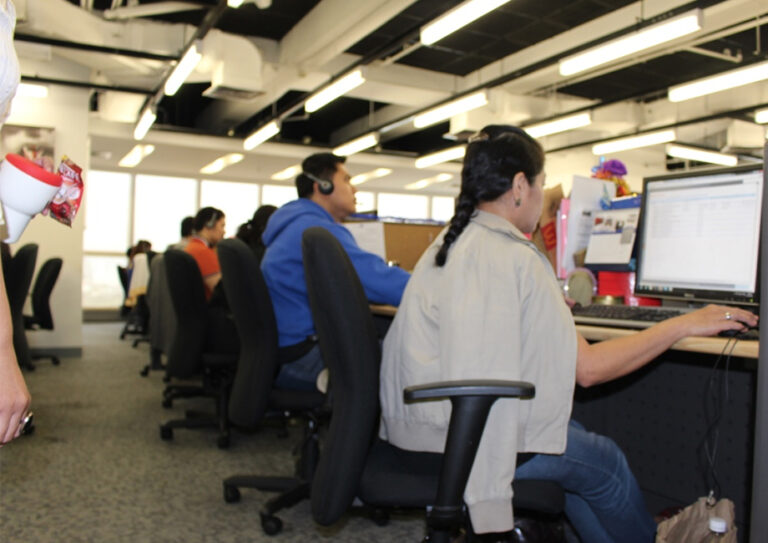
Delivery hubs in Metro Manila, Cebu, Clark, Davao and Iloilo run on redundant connectivity, backup power and secure production floors. Policy has also caught up with hybrid work. The CREATE MORE Act, signed in November 2024, lets registered business enterprises run work-from-home arrangements for up to half of their workforce without losing their incentives. For healthcare buyers, that flexibility has to be matched by controls: remote seats handling patient data need locked-down devices, monitored sessions and clear rules on where work can happen.
Services that moved from the back office to the digital front door
The service range now runs from revenue-cycle work to patient-facing digital support, and the newest roles sit next to the clinician rather than behind the billing office. The main categories are these.
- Medical coding and billing. Credentialed coders assign ICD-10-CM, CPT and HCPCS codes, billing teams submit and follow up on claims, and analysts work denials by root cause.
- Telehealth and virtual-care support. Teams schedule virtual visits, run pre-visit technology checks, troubleshoot patient apps and coordinate follow-ups for digital health companies and hospital virtual-care programs.
- Clinical support services. Nurses support disease-management outreach, patient education and health risk assessments under US clinical protocols, with licensed US clinicians making the clinical decisions.
- Pharmacy benefit support. Specialists process prescriptions and prior authorizations, answer member questions and support compliance monitoring for pharmacy benefit managers and health plans.
- Clinical documentation and scribing. Remote scribes and reviewers prepare and check visit notes, including drafts generated by ambient AI tools.
Telehealth support is where the change was most visible to patients. The story of how Philippine support teams power telemedicine shows how scheduling, technical help and care coordination came together into one patient-facing service. Documentation is the newest frontier, and the look at the 2026 clinical scribing frontier explains how remote scribes now work alongside AI.
How cloud platforms and collaborative AI changed the work
Cloud systems let Filipino teams work inside a US client’s own EHR and billing platforms, and collaborative AI turned many roles into review-and-decide jobs. Both shifts raised the skill level the work requires.
With cloud-hosted EHRs, practice-management systems and contact platforms, an offshore specialist can log into the same environment as the hospital’s own staff, with access limited by role and every action logged. That removes the old file-transfer step and keeps patient data in the client’s systems. Collaborative AI, the pairing of software suggestions with human judgment that the original version of this post called a trend on the horizon, is now routine. Coding engines suggest codes for a coder to confirm, chatbots pass complex conversations to live agents, and document-AI tools extract data that specialists validate. The work that remains is harder and more valuable than the work that was automated.
Data privacy: local law and HIPAA working together
Filipino providers handle US patient data under two layers of protection: the Philippine Data Privacy Act and the HIPAA obligations they accept contractually. The Data Privacy Act of 2012 (Republic Act 10173) treats health information as sensitive personal information and is enforced by the National Privacy Commission, so a local provider faces domestic penalties for mishandling it.
On top of that, a US covered entity signs a business associate agreement with the vendor, which binds it to HIPAA’s safeguards for protected health information. In practice, buyers should look for encrypted connections, multi-factor authentication, clean-desk or paperless production floors, device controls, regular third-party audits and a tested breach-notification process. Frameworks such as SOC 2 Type II, ISO 27001 and HITRUST give a buyer independent evidence that those controls exist and operate.
Training that keeps pace with new tools and code sets
Continuous training is what keeps an offshore team useful as rules, code sets and tools change. The strongest providers run structured programs rather than one-time onboarding.
Good programs cover annual code-set updates, payer policy changes, HIPAA refreshers, and hands-on practice with each new tool before it reaches production. They pair new hires with experienced reviewers, run regular calibration sessions against client quality standards, and track accuracy by person and workflow. Training also supports retention, which matters because experienced healthcare specialists are in demand. Hospitals that plan to grow a team over several years should factor in wage inflation trends for offshore healthcare staff when they set budgets.
Where the evolution goes next
The next stage moves offshore teams further into oversight: supervising automation, checking AI output and supporting care programs that run continuously. Personalized medicine, remote patient monitoring and AI-assisted diagnostics all generate data and exceptions that need trained people to review, triage and document.
For US buyers, the practical question is not whether the Philippines can support digital health, but which workflows are ready and which controls must be in place first. Start with work that is well documented and measurable, prove quality, and then extend into patient-facing and clinical-support roles as trust builds.
Frequently asked questions
Are Filipino healthcare specialists clinically trained?
Many are. Teams often include nursing, pharmacy and allied-health graduates, and coders typically hold US coding credentials. Confirm the credential mix for the specific roles you plan to fill.
Does Philippine privacy law replace HIPAA?
No. The Data Privacy Act applies locally, and HIPAA obligations reach the vendor through the business associate agreement. A compliant program meets both.
Can offshore teams work directly in our EHR?
Yes, through role-based access to cloud-hosted or remotely published systems, with activity logging and multi-factor authentication. This keeps patient data in your environment.
Which digital health functions should we move first?
Start with high-volume, rules-based work such as scheduling, eligibility checks and claims follow-up, then add telehealth coordination and documentation review once quality is proven.