
TL;DR: The Key Takeaway
Digital twin data annotation outsourcing has transcended basic 3D modeling, becoming a critical discipline for creating and validating hyper-realistic industrial AI simulations. The Philippines is the premier global destination for this work, providing the expert human cognition required to ensure virtual environments perfectly mirror physical reality, thereby accelerating safe and effective AI deployment. It is one of the specialist disciplines within our overview of human data services for AI and ML companies.
The creation of enterprise-grade digital twins in the Philippines has transitioned into a high-stakes cognitive discipline. By utilizing an elite workforce to embed physical laws, behavioral logic, and real-time sensor data into virtual replicas, organizations can train AI agents in a “physics-perfect” environment. This specialized annotation ensures that machine learning models developed in simulation can be deployed into factories and cities with near-zero friction and maximum safety.
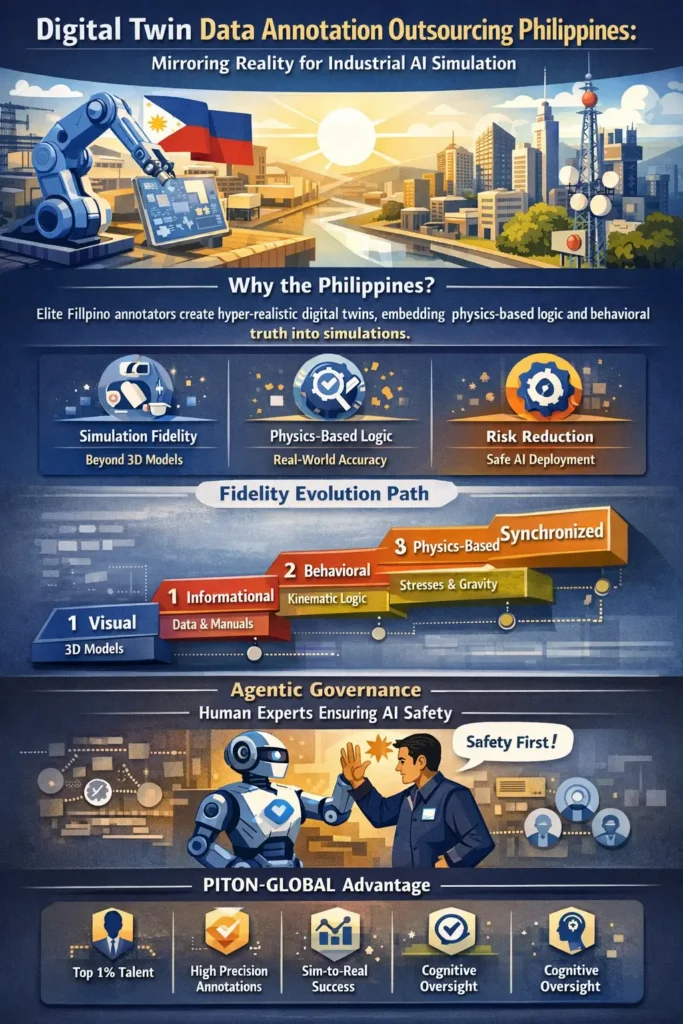
- Simulation Fidelity: True digital twins require more than 3D models; they need “behavioral truth” provided by human experts.
- Physics-Based Logic: Filipino specialists validate complex interactions like friction, stress, and sensor accuracy within the twin.
- Risk Reduction: High-fidelity annotation bridges the “sim-to-real” gap, preventing costly accidents in physical deployments.
- Agentic Governance: Expert human governors act as a firewall, teaching autonomous AI to prioritize safety over raw efficiency.
- Mission-Critical Access: PITON-Global connects industrial innovators with rigorously vetted Filipino simulation curators.
From Static Models to Dynamic Realities: The New Annotation Imperative
The first era of digital twin technology was largely aesthetic, focused on creating visually accurate but functionally hollow 3D models. Annotation at that stage was simple: identifying parts within a CAD file or a LiDAR scan. While these “digital photographs” were helpful for asset management, they lacked the depth required to train sophisticated AI. Modern industrial AI demands “digital cinema”—a multi-layered, living simulation that reacts to the laws of physics and real-time inputs.
Constructing these living realities requires a fundamentally more advanced form of data enrichment. Annotators no longer simply label a robotic arm; they define its kinematic chains, material properties, and causal relationships with its environment. This evolution moves the needle from the basic object recognition of pixel-level image annotation for computer vision to dynamic scenario validation. For an AI to learn how to operate a power grid or an automated warehouse, it must inhabit a digital space that mirrors the physical world’s unpredictability. This level of nuance is only achievable through the high-level cognitive intervention provided by specialized Filipino teams.
Why Fidelity Drives Labeling Complexity
A digital twin’s strategic value is tied directly to its fidelity—the precision with which it mirrors its physical counterpart. As companies move from visual replicas to fully synchronized systems, the cognitive demand on the annotator scales exponentially. The same discipline applies at the opposite end of the hardware spectrum, where labeling data for lightweight on-device models rewards density over volume.
The Fidelity Evolution Path
| Fidelity Level | Description | Representative Task | Strategic Goal |
| Level 1: Visual | 3D geometry and surface appearance. | Bounding boxes, semantic segmentation. | Design review, inventory management. |
| Level 2: Informational | Visuals enriched with static manuals/logs. | Entity linking, technical data tagging. | Enhanced maintenance planning. |
| Level 3: Behavioral | Basic operational logic and kinematics. | Kinematic chain definition, state labeling. | Procedural training for humans. |
| Level 4: Physics-Based | Accurate simulation of stresses and gravity. | Physics parameter validation, event sequencing. | Predictive maintenance, AI training. |
| Level 5: Synchronized | Real-time updates from IoT sensors. | Anomaly annotation, RLHF for agent control. | Autonomous operations, “what-if” planning. |
Intelligence Arbitrage in Simulation
In the context of industrial simulation, Intelligence Arbitrage is the act of infusing a digital environment with the unwritten rules of the physical world. While an automated system can map a 3D space, it cannot intuitively understand that a specific mechanical vibration precedes a failure or that a certain lighting condition might blind a sensor.
The strategic advantage of the Philippines lies in a workforce capable of converting human experience into machine intelligence. These specialists identify “edge cases”—rare but critical scenarios—that would otherwise be invisible to an algorithm. By labeling these interactions as “unsafe” or “inefficient” within the twin, they provide the training data necessary for an AI to survive the transition from a clean virtual world to a messy physical one. This human-in-the-loop oversight is the single most important factor in closing the “sim-to-real” gap.
“Industrial AI is undergoing a paradigm shift where the fidelity of the simulation dictates the safety of the real-world deployment. Our clients are building dynamic, physics-based mirrors of their entire operations. Success here depends on expert annotators who can validate every sensor reading and failure mode. This cognitive arbitrage is the ultimate strategic edge offered by the Philippines.” — John Maczynski, CEO, PITON-Global
Maturity Model for Digital Twin Annotation
As enterprise needs mature, the partnership with an annotation provider must advance from basic digitization to the governance of autonomous agents. PITON-Global aligns Filipino talent with this four-stage maturity model.
| Maturity Stage | Primary Focus | Key Annotation Service | Business Outcome |
| Stage 1: Foundational | Asset Digitization | 3D cleanup, metadata tagging. | Comprehensive digital library. |
| Stage 2: Procedural | Workflow Simulation | Scenario and kinematic labeling. | Operational guides and training. |
| Stage 3: Predictive | Maintenance Logic | Anomaly detection, failure mode tagging. | Reduced downtime and costs. |
| Stage 4: Autonomous | Training AI Agents | RLHF, safety/ethics validation. | Safe, autonomous physical deployment. |
Agentic Governance: The Human Firewall for Industrial AI
When AI agents begin controlling physical machinery—like autonomous forklifts or chemical processors—within a digital twin, a new layer of oversight is required. This is Agentic Governance. Filipino annotation experts serve as the human firewall in this process, reviewing the actions proposed by an AI and providing corrective feedback.
If an AI proposes a high-speed route through a warehouse that risks a collision, the human governor flags the behavior and adjusts the reward model. This moves BPO beyond data labeling and into the realm of active AI stewardship. By ensuring that autonomous systems prioritize safety and ethics over raw speed, the elite cognitive workforce in the Philippines provides the final, essential seal of trust for industrial AI.
Expert FAQs
Q1: How does digital twin annotation differ from standard 3D labeling?
Standard 3D work identifies “what” an object is. Digital twin annotation defines “how” it works. This includes defining physical properties like mass and friction, as well as labeling the complex sequences and behavioral rules that govern how objects interact over time.
Q2: Why is the Filipino workforce ideal for industrial simulations?
Success in this field requires a blend of STEM-based technical knowledge and abstract reasoning. Filipino professionals are recognized for their ability to grasp complex systems and apply logical deductions to ambiguous scenarios—the same reasoning that drives extracting structured entities from unstructured text—making them well suited to curating high-fidelity simulations.
Q3: How is the ROI of simulation-based annotation calculated?
ROI is measured by the acceleration of safe deployment. A perfectly annotated twin allows for virtual testing that is faster and cheaper than physical prototyping. The results include a dramatic reduction in on-site accidents and faster AI development cycles.
Q4: What is the role of RLHF in digital twins?
Reinforcement Learning from Human Feedback (RLHF) allows humans to “reward” an AI for choosing the most stable or efficient path during a simulation. This expert feedback rapidly teaches the AI the intuitive strategies needed for optimal performance in the physical world.