

TL;DR: The Key Takeaway
Named Entity Recognition (NER) outsourcing in the Philippines has matured beyond simple data extraction, now offering sophisticated, human-powered services that provide the contextual understanding and accuracy necessary for advanced AI and machine learning applications. This evolution is turning unstructured data into a source of significant strategic value. NER typically runs alongside the broader annotation and training-data teams for AI companies that Filipino providers staff.
Named Entity Recognition (NER) outsourcing in the Philippines is the strategic process of employing expert human intelligence to identify, classify, and link entities (e.g., people, organizations, locations, and technical terms) within massive unstructured datasets. By 2026, the Philippines has secured its position as the global hub for “Intelligence Arbitrage,” providing the specialized “Human-in-the-Loop” (HITL) oversight necessary to turn chaotic text into structured, queryable knowledge graphs with near-perfect accuracy.
Executive Briefing
- From Tagging to Knowledge: Move beyond simple identification to “Relationship Extraction”—identifying not just the entities, but the web of connections between them.
- Contextual Disambiguation: Resolve complex linguistic ambiguities (e.g., distinguishing “Apple” the corporation from “apple” the fruit) that traditional automated systems consistently miss.
- High-Fidelity Extraction: Leverage a workforce that ranks #2 in Asia for English Proficiency to ensure data integrity for regulated industries like Fintech, Healthcare, and Legal.
- Strategic ROI: High-accuracy NER lifts revenue-per-employee by enabling faster product discovery and automated risk management.
- Security & Trust: Operate within the “Switzerland of Data”—a 2026 Philippine BPO ecosystem defined by quantum-safe authentication and strict GDPR/SEC compliance.
From Text to Intelligence: The NER Imperative
In the 2026 digital economy, unstructured data is a double-edged sword: it contains a wealth of intelligence but remains “locked” in a format machines cannot natively process. Named Entity Recognition (NER) is the vital key that unlocks this value, transforming raw emails, medical reports, and legal filings into structured data that powers AI models, and it is often the first layer of a wider human-in-the-loop NLP program.
While basic NER is automated, High-Fidelity NER requires a deep understanding of nuance. An automated system might see “The White House” and simply tag it as a “Location,” but a Filipino NER specialist understands the context—distinguishing whether the text refers to a physical building or the administrative branch of the U.S. government. This human-led precision is the foundation of modern enterprise intelligence, and the same contextual judgment separates careful image annotation for computer vision from labels applied by rote.
The Strategic Value of High-Fidelity NER
The demand for NER in the Philippines has shifted from volume-based processing to outcome-based knowledge creation. Organizations now partner with specialized Filipino teams to drive critical business results:
| Industry | NER Application | Business Impact |
| BFSI | Analyzing regulatory filings & news. | Real-time AML & KYC fraud detection. |
| Healthcare | Extracting data from clinical notes. | Accelerated drug discovery & RCM accuracy. |
| Retail/E-comm | Identifying entities in customer feedback. | 34% increase in conversion via “Sentiment-AI.” |
| Legal | Contract review & discovery processing. | 70% reduction in TCO for litigation support. |
Intelligence Arbitrage in NER: Beyond the Tag
By March 2026, the traditional model of “Labor Arbitrage” (finding the cheapest person to type) has been replaced by Intelligence Arbitrage. This new paradigm focuses on “Intelligence Velocity”—the speed at which human experts refine AI outputs to ensure accuracy in regulated environments.
“Clients are no longer asking for data entry; they are asking for knowledge creation. They need teams that can not only identify the entities in a document but also understand the web of relationships that connects them. This is the new frontier of outsourcing, and it’s a space where the analytical and critical thinking skills of the Filipino workforce provide a decisive competitive advantage.” — John Maczynski, CEO, PITON-Global
Under this model, a single Filipino “Judgment Architect” manages a fleet of 5–10 Agentic AI instances, intervening only when the system flags a high-stakes ambiguity or complex logic requirement.
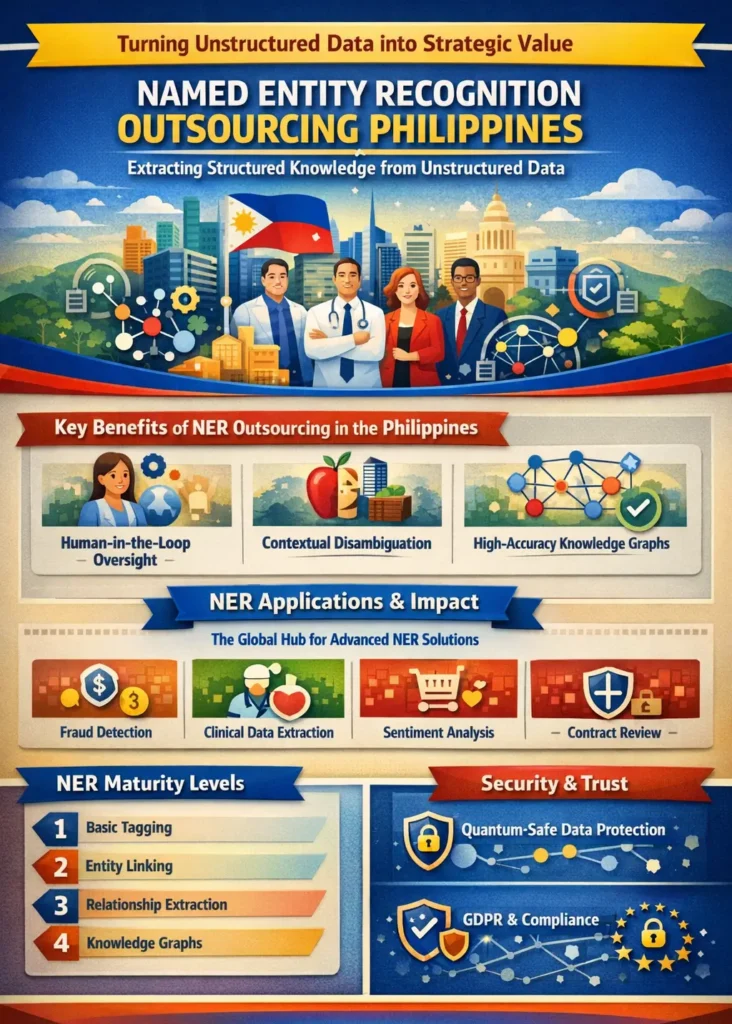
NER Maturity Level: From Data to Discovery
As enterprises advance, their NER needs evolve from foundational tagging to transformational knowledge modeling, usually on top of well-governed text annotation workflows.
| Level | Description | Key Activity | Business Impact |
| 1: Foundational | Basic Entity Extraction | Tagging people, places, dates. | Improved data searchability. |
| 2: Advanced | Entity Linking | Disambiguating entities to a KB. | Data consistency across silos. |
| 3: Strategic | Relationship Extraction | Mapping complex interactions. | Predictive analytics & insights. |
| 4: Transformational | Knowledge Graphing | Building comprehensive models. | Proactive automated decisioning. |
Agentic Governance: Security as the New Currency
As of 2026, the Philippines has positioned itself as a global leader in Agentic Governance. With the “CREATE MORE” Act offering a 20% Corporate Income Tax and incentives for high-tech infrastructure, BPO providers have invested heavily in security. NER projects in Manila or Davao now operate under Zero-Possession Data Architecture and quantum-resistant encryption, ensuring that offshore teams handle sensitive PII (Personally Identifiable Information) with the same rigor as an in-house team in New York or London.
Expert FAQs
Why is human-in-the-loop (HITL) still necessary for NER in 2026?
Even the most advanced AI models suffer from “hallucinations” and struggle with evolving slang or domain-specific jargon. Filipino experts provide the “Ground Truth” necessary to keep models from drifting, ensuring that the extracted data remains reliable enough for high-stakes decisions.
How does the Philippines compare to India for NER services?
The Philippines stands out in Front-Office AI Oversight. The Filipino workforce’s superior cultural alignment with Western markets makes them more effective at “reading between the lines” for entities that require cultural or emotional context.
What is the “CREATE MORE” Act’s impact on NER outsourcing?
This law, signed in November 2024, rewards firms that move toward high-value cognitive services. It provides 100% deductions for power and training, allowing BPOs to reskill workers into “AI Pilots” while keeping costs well below onshore alternatives.
Can NER help with compliance for the EU AI Act or US SEC frameworks?
Yes. Filipino NER specialists are now being trained as “Risk Pilots,” using NER to scan and flag data privacy violations (PII/PHI) in real-time, helping global firms maintain compliance with increasingly strict international data mandates.